
Following God When You Are Young… And When You Are Old

Explore the impact of youth on faith and calling through Jeremiah’s journey and personal reflections on devotion and God’s purpose.

Jer 1-2

Ps 122

Luke 5

-Devotion by Cayce Fletcher

Growing up in the COGGC, one rite of passage, and the highlight of everyone’s year, was the annual national youth camp, FUEL. We all loved to load up in the big charter bus at 2 am and drive the 14+ hours to a campus nestled between cornfields in northern Indiana. 

We would worship, learn, and play—and at the end of the week, everyone would be faced with a choice: How was this week going to impact the rest of their life? What would they do when they returned home? 

For some, this was the moment when they made the decision to be baptized. Others recommitted themselves to a life lived for Christ. Still others made the big leap to attend Bible college, some even dedicating their lives to a life of ministry. 

It’s been over a decade since those high school days, and a lot of life has happened. You never realize how much can change from the bright-eyed days of your youth until you live through it. Friends have grown up, married, had kids, and gotten divorced. Friends have gone to college, moved, started businesses and careers, and changed those again and again. And friends have grown closer to God and away from Him. 

Jeremiah is one of the longest books of the Bible and is nestled between the books of the prophets. It’s easy to read these books and gloss over them, thinking, ‘I’ll just understand this when I’m older.’ (Hey, I still think that sometimes!) 

But Jeremiah actually begins with him feeling the inadequacy of youth. He was probably 15–25 years old, the son of a priest (aka a Levite) from one of the towns in the land of Benjamin. 

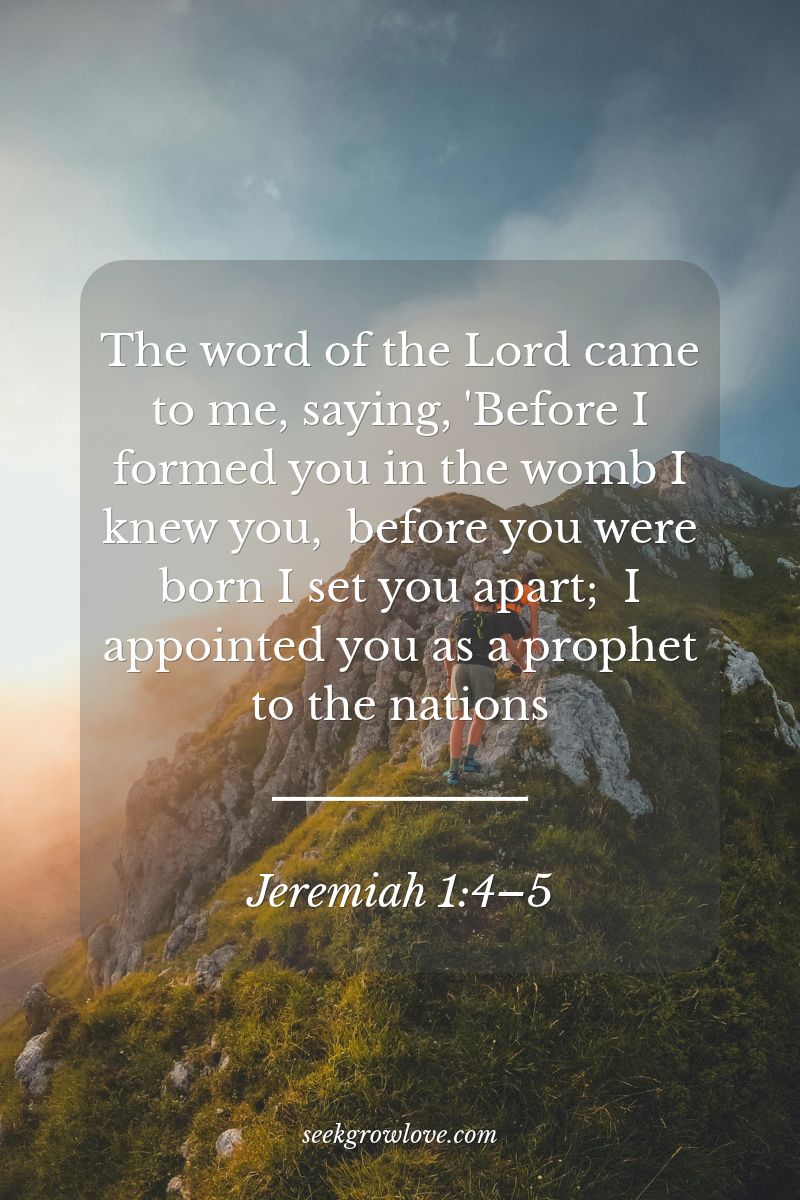
God called him: “The word of the Lord came to me, saying, ‘Before I formed you in the womb I knew you,  before you were born I set you apart;  I appointed you as a prophet to the nations’” (Jer. 1:4–5). 

God had a plan for Jeremiah. He wanted to use him in great ways. 

But Jeremiah responded in v. 6, “‘Alas, Sovereign Lord, I do not know how to speak; I am too young.’”

It’s interesting to me that one of the first messages that Jeremiah was told to give to Jerusalem was about how Israel was so devoted in “the days of her youth” (Jer. 2:2). It reminds me of those days at camp when my friends and I all sat around and dreamed of the big things we would do for God. 

But as I’ve seen, Israel also went on a wayward path. Just like in marriage, the wedding is not the hardest part. It’s the daily choosing to be devoted to one another despite the trials of life. 

This passage in Jeremiah tells us two important principles: 

  1. God can use anyone, no matter what their age, to do his work. If he calls you, he’ll equip you. 
  2. There is a reason God says that we must become like a little child to enter into the Kingdom of God. Yes, folly is bound up in the heart of the youth—but so is unreserved passion and devotion. It’s easy to let the worries, pleasures, and cares of this life suck out our fruitfulness. We have to choose daily to seek the Kingdom of God. 

Maybe you came to faith later in life. Maybe you got baptized when you were still in the single digits. Your testimony can be full of twists and turns… or it can be rather boring. 

Regardless, you need to choose to follow God daily, when you are young and when you are old. 

Like Jeremiah, you were also knit together in your mother’s womb by God (Ps. 134). He knew you. He called you. And he loves you. 

Will you live for Him? 

Cayce Fletcher is a wife and mom of three. In addition to homeschooling and other ministry projects, she writes and podcasts at amorebeautifullifecollective.com about faith, motherhood, and theology. 

Reflection Questions

  1. How would you describe your testimony? When did you feel “called” by God? 
  2. Do you believe that you can do “big things” for God now? How is God equipping you for ministry? 
  3. Where might our love for God have “grown cold”? 

Prayer

Dear Lord, may we always keep you at the forefront of our minds. May our eyes not turn to the right or the left, desiring something that is not you. Please equip us for the good work that you want to do with our lives. In Jesus’ name, Amen 

SGL.2026.CalendarDownload

Words Matter

Jeremiah 1-2; Psalm 90-91

This past Saturday women (and some men) gathered in front of the US Capital in Washington, DC and in state capitals across the United States to protest for women’s rights to choose to abort their unwanted babies.  One of the signs held up said “Rage, Rage Against the Denial of Your Rights”.

That’s a dangerous way to begin today’s devotions.  Some of you are likely offended or possibly even angry at me for what I wrote.  I referred to them as unwanted “babies” and not “fetuses” or “products of conception.”  Words matter.  If a person says “illegal aliens” referring to those who cross the border without proper documentation and not “undocumented aliens” we know that they have an opinion about the status of those who have entered the country.  “Illegal” sounds like a bad thing, like someone has broken a law and might be punished, whereas “Undocumented” sounds like some innocent mistake or a government slip up.  I forgot my hall pass on my way to the bathroom and so I’m undocumented.  That’s different than bringing a gun to school or taking drugs at school.  Those activities are illegal and should be punished somehow, but crossing over the border without proper authorization, that shouldn’t be illegal, right? (If your sarcasm detector is now going off then it’s working properly)

Words matter, whether you say “illegal” or “undocumented” or whether you say “unborn or pre-born baby” or “product of conception.”  If I refer to a “product of conception” that a woman has a right to dispose of, that’s no big deal.  But if I say that it’s a human baby that is alive and waiting to exit her mother’s womb, and that we are killing that baby, that sounds pretty awful.  No one wants to think about killing babies.  No one should have the right to kill babies, but every woman should have a right to dispose of an inconvenient or unwanted ‘product of conception”.

Words matter.  Jeremiah 1 wasn’t written specifically to address the issue of human life, and yet Jeremiah’s inspired words, given to him by God, are worthy of reflection and application to our context today. 

“The word of the Lord came to me, saying,

“Before I formed you in the womb I knew you,

    before you were born I set you apart;

    I appointed you as a prophet to the nations.”- Jeremiah 1:4-5

Here, God is calling Jeremiah to be his prophetic voice to the people of Israel.  Jeremiah is an integral part of God’s plan to prophecy against His people Israel for their worship of other gods.  Before Jeremiah was even born, God had a plan for his life.  While Jeremiah was still in his mother’s womb, God set Jeremiah apart to be a prophet.  This is such a rich passage and we could reflect on it a hundred different ways.  It speaks about God and his omniscience (that’s a technical term that means God knows everything).  God is able to peer into the future and see that this tiny little cluster of cells which carries in it the DNA for a male human person who  probably has brown eyes, brown hair and olive skin, will grow up to be able to speak for God 20 or 30 years in the future and be a key part of God’s plan.

This little tiny cluster of cells in that young Jewish woman’s womb would  one day be born, grow up  and go in the name of God to confront an entire nation with its rebellion against God.  

“My people have committed two sins:

They have forsaken me,

    the spring of living water,

and have dug their own cisterns,

    broken cisterns that cannot hold water.”- Jeremiah 2:13

It was this tiny pre-born human, who God would use to condemn his people because: “On your clothes is found  the lifeblood of the innocent poor.”- Jeremiah 2:34

God condemns Israel because her clothes are stained with the blood of the innocent and the helpless.  Again, in the context Jeremiah is not referring specifically to pre-born babies who have been unjustly murdered (aborted).  However, in our present context, those words have a clear application.  Who are the most innocent and helpless human beings in the world today?  It is the pre-born humans whose Mother’s don’t want to allow  them to live.  As thousands gather around the country to rage at the prospect of some states seeking to bring greater justice and defend the defenseless we must ask ourselves “How in the world did we get here?”

When God called Jeremiah it was to take a courageous stand against a wicked and corrupt nation.  Is God calling His people today to take a courageous stand?  I think so.

“Get yourself ready! Stand up and say to them whatever I command you. Do not be terrified by them, or I will terrify you before them. Today I have made you a fortified city, an iron pillar and a bronze wall to stand against the whole land—against the kings of Judah, its officials, its priests and the people of the land. They will fight against you but will not overcome you, for I am with you and will rescue you,” declares the Lord.” -Jeremiahs 1:17-19

If you, like Jeremiah, accept the call to speak faithfully for God against the current culture of death, and in doing so invite the rage of those who don’t want their right to murder unwanted pre-born human babies, then put Psalm 91 in your back pocket and carry it with you wherever you go: 

“Whoever dwells in the shelter of the Most High

    will rest in the shadow of the Almighty.

I will say of the Lord, “He is my refuge and my fortress,

    my God, in whom I trust.”-Psalm 91:1-2

The Lord be with you.

Jeff Fletcher

Today’s Bible reading passages can be read or listened to at BibleGateway.com here – Jeremiah 1-2 and Psalm 90-91