
2 Kings 24-25 and 2 Chronicles 36
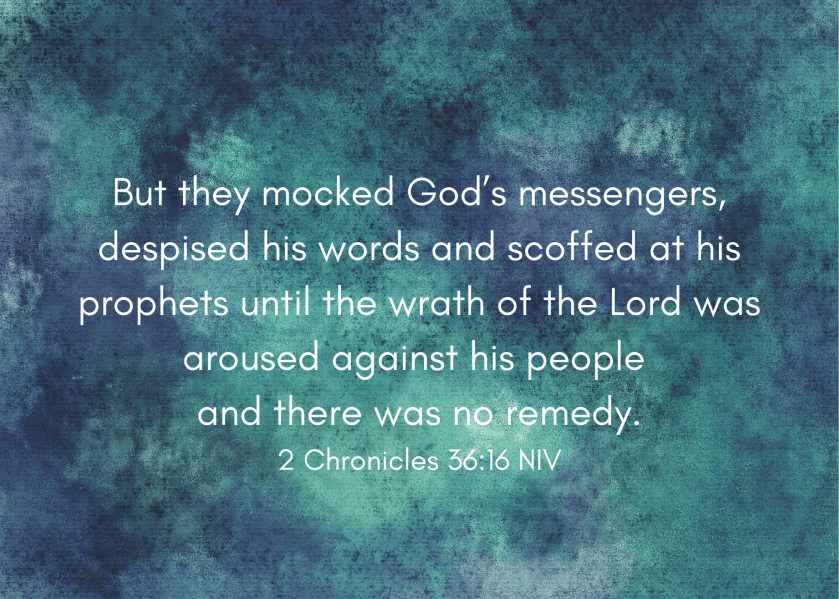
Well, if yesterday’s reading was one of the most depressing passages, I guess it applies doubly today, since we read two more accounts of the Babylonian conquest of God’s holy city Jerusalem and the nation of Judah. Bad kings, poor decisions, temple treasures plundered, men and women forced into exile, rebellion, siege ramps around Jerusalem, starvation, fleeing king captured and tortured, temple and city set on fire, officers executed, more and more exiles, governor assassinated, fleeing for safety. God’s anger.
It’s not a pretty story. But it is a story well worth our time to know and remember and understand. It is such an important part of God’s story and His character. This is the same God of today and the same God who centuries before this had saved His people out of Egypt and revealed himself to Moses as, “The Lord, the Lord, the compassionate and gracious God, slow to anger, abounding in love and faithfulness, maintaining love to thousands, and forgiving wickedness, rebellion and sin. Yet he does not leave the guilty unpunished…” (Exodus 34:6,7). God had been patient with His people hundreds of years, but there comes a time when their unfaithfulness can no longer be overlooked or excused or explained away. He had sent many, many prophets to warn the people and if His people would had listened and repented and turned from their wicked ways, they would have been saved from this time of judgment. But they made their (poor) choices and there was a consequence to pay for it.
Today, many like to focus solely on the God of compassion. It is a beautiful picture. And, it is true – but it is not the whole picture – or the whole truth. It can be a fatal error to not consider the whole picture when viewing, knowing and loving God. He is a God of compassion who is slow to anger and abounding in love and faithfulness. Praise God! We have benefitted from His love and compassion in many ways and at many times! He does not always treat us as our sins deserve. But He is just when He does punish – way back then, and today.
Did you notice that the two accounts we read today don’t end the same? At the conclusion of the book of 2 Kings we read of the grace extended to Jehoiachin, a king from Judah who was deported to Babylon and held as a prisoner for 37 years. The new Babylonian king not only releases him, but welcomes him to a place of honor, he eats at the king’s table and his daily needs are provided. It is indeed a sweet ending for Jehoiachin.
The book of 2nd Chronicles was written at a later time – to remind the surviving Israelites of their history. This author knows that Jehoiachin is not the only one to experience great grace and restoration. The years of time-out in exile in Babylon would last 70 years, as predicted by Jeremiah – and then the time would come for God to extend grace and restoration to His people, or to the remnant of believers. The final verses of 2 Chronicles are:
” In the first year of Cyrus king of Persia, in order to fulfill the word of the Lord spoken by Jeremiah, the Lord moved the heart of Cyrus king of Persia to make a proclamation throughout his realm and also to put it in writing:
23 “This is what Cyrus king of Persia says:
“‘The Lord, the God of heaven, has given me all the kingdoms of the earth and he has appointed me to build a temple for him at Jerusalem in Judah. Any of his people among you may go up, and may the Lord their God be with them.’” (2 Chronicles 36:22,23 NIV).
God works in amazing ways towards restoration for the faithful remnant who walk with Him. The story of God’s people does not end in exile.
Take heart. Remember God’s character and His story. He is a God of love and compassion – who in His perfect love, will not leave the guilty unpunished. Be wise and pay attention to God’s Word – listen to the prophets who speak for Him. Seek God with your whole heart and don’t follow after false gods. God’s plan is still in progress. It includes love and punishment. And ultimately He is planning a time of restoration where He will dwell with the faithful remnant in His Kingdom on earth. How will you prepare for that today?
Marcia Railton
Today’s Bible reading can be read or listened to here – 2 Kings 24-25 and 2 Chronicles 36
Tomorrow’s reading will be the three short chapters that make up the book of Habakkuk as we continue on our 2020 Chronological Bible Reading Plan

 Seek Grow Love