The Man of God

*2 Kings 23-25

Psalm 69

2 Corinthians 13

-Devotion by Jeremy Martin (TN)

            There is so much going on in our 2 Kings reading today that it’s unlikely that we’ll have the chance to adequately cover it all.  Of particular note, there are some hidden gems, or “easter eggs” as the kids say, strewn about that you have to be looking for carefully or you’ll miss (*An Easter egg is a message, image, or feature hidden in various forms of media).  These were some of my favorite bible books to read as a child just because there was so much excitement and adventure going on, but looking closely you’ll find that there are quite a few nuggets of wisdom, but you have to dig for them sometimes.  Some are laying right on the surface, though.

            The first part of 2Ki 23:1-25 is detailing some of the things Josiah did as king.  Keeping in mind that he was only 8 years old when he took office (2Ki 22:1), I was wondering how old he was when he realized that his father Manasseh had led the nation astray and started working to correct it.  The closest I could come in the book of 2 Kings to finding that answer is in 2Ki 23:23 where it says “But in the eighteenth year of King Josiah, this Passover was celebrated to Yahweh in Jerusalem” (LSB), for the first time since the time of the judges (back in v22).  So, is that in the 18th year of his life, or the 18th year of his reign?  I found the answer over in 2 Chronicles 34&35, which states that in the 8th year of his reign he started to seek the Lord, and that in the 18th year of his reign (after significant reforms had already been made) they celebrated the Passover for the first time since the time of the judges.  So, for you bible nerds out there, he became king at 8, was about 16 years old when he started seeking God, and was about 26 when he reinstated the Passover feast.

            Oh, and in case you were wondering if grandpa Manasseh was really such a bad guy, the biblical writers remind us again and again whose fault it is in 2Ki 23:26 and also 24:3, squarely blaming all of the misfortunes about to befall them during this time on him.  You know, in case you forgot, because apparently they did not: EVER.  Keep in mind, this is an epic time in history; the Assyrian kingdom was in decline, Egypt was still a force to be reckoned with,  and the Babylonian kingdom is on the ascension.  Up until the time of the Babylonian exile, the ancient Jews had a real problem with idolatry (you’ll recall that’s #1 in the list of ‘thou shalt not’s).  After the time of the Babylonian exile, you never hear about  idolatry again in the land of Israel (at least on a national level).   Think about that: just like when you got a spanking from your father as a child, God generally performs punitive actions to correct behavior.  This time it absolutely worked, check it out if you don’t believe me: the Israelites never again returned to idolatry once they returned from Babylon (at least on a national level).

            Here’s one “Easter egg” I found when doing a deep dive into this reading: I’d always assumed that the “idolatrous priests” (2Ki23:5) referred to, you know: priests who worshipped false idols or pagan deities.  Reading closely in v5,6,8, and 9 however we can see that some of these were kohanim, Aaronite priests of God, particularly in v9 where it states “…but they ate unleavened bread among their brothers.” (LSB).  We can infer from these passages that even if you’re the right guy, serving the right God, if you’re doing it in the wrong way or in the wrong place: you might be idolatrous.  I’ve got a note in my bible that reads: “priests of God, but serving in the wrong place?”.  Just a little food for thought, something to consider.

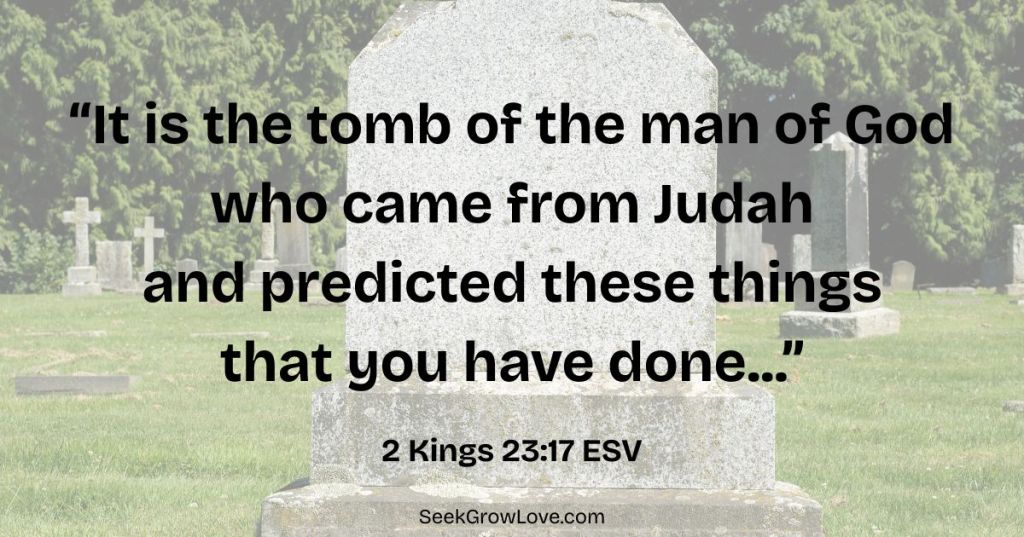
            Do you like finding “Easter eggs” as much as I do?  Well, lucky day, here’s another one: read carefully 2Ki 23:15-18, about the grave of the “man of God”.  This is a great story, but to get the full scope of it, after you read the above verses, you’ll need to flip backwards over to 1 Ki 13.  We sadly never get to know the name of the man of God, we do however get to learn a valuable life lesson: listen to God if He’s talking, and absolutely ignore men if they are saying something different. 

            A  quick summary of the story is as follows: God sends a man, a prophet, to deliver a message to the king, which he does.  This prophet is commanded to “eat no bread, nor drink water, nor return by the way which you came”.  Then another prophet chases after him and says “uh, so God told me you’re supposed to come eat with me”, and he does.  Then the prophet who invited the first one to eat then says “why have you rebelled against God?” and tells the guy he’s going to die, which he does shortly after he leaves (by a lion).

            Then, to add insult to injury, when the second prophet realizes that the “man of God” has been killed (and while accepting absolutely no personal responsibility in this series of events as possibly overstepping by telling the first prophet that God had told him he should eat), he has him buried and mourns him saying “alas, my brother!”.  Then, as if that wasn’t enough, this second prophet then tells his kids “When I die, bury me with that guy, because he was a prophet.” (paraphrased and summarised, but accurate, go and read it: 1 Ki 13)!?  As a result, when all the other graves are defiled later on, the second prophet who misled and (indirectly?) caused the “man of God” to be killed was also left undisturbed when Josiah left the grave alone in 2 Ki 23:18.  Ironic, isn’t it?  The moral of that story is: ignore men, listen to God.

            Now remember as we continue on, Manasseh was a really bad guy.  So bad that even when Josiah did what was right in God’s eyes, God’s promise to Josiah was not that he would relent from His (righteous) wrath on the nation, but that Josiah would die before it happened so that he “would not see all the evil which I will bring on this place” (LSB, 2 Ki 22:20).  This happens in 2Ki 23:29, when Pharaoh Neco (AKA Necho II, @610-595 BC) puts him to death at Megiddo.  Does the name of that place sound familiar?  It should, in Rev 16:16 the “final battle” prophesied is to take place in what is translated as “Armegeddon”, which is literally “Har Megiddo”,  or the “hill” of Megiddo (an ancient city).  Same place (insert dramatic sound effect here). 

            In 2 Ki 24, we see the beginning of the rise of Nebuchadnezzar and the ascension of the kingdom of Babylon.  Later on in this chapter (v10) Judah goes into exile, and then in chapter 25 we see the fall of the last stronghold in Judah, Jerusalem.  It is notably at this point that the temple is burned, Solomon’s temple, one of the grandest architectural structures of the time.  The people had begun to think of themselves as untouchable, since they had the temple in their midst, even though idolatry was running rampant (See Jer 7:4 for the popular view of “the temple” at this time).  This effectively ended the “First Temple” period, considered to be the “golden age” of Jewish prosperity and centralized worship.

REFLECTION QUESTIONS

  1. Can you think of a time in your life when it felt like God was punishing you?  Upon reflection and with the passing of time, were you able to see the lesson that was being taught? (I sure did.)
  2. Has there ever been a time in your life when even if you were trying to do the right thing, you realized you were in the wrong place?  Reflect on this quietly for a few moments, I can think of at least 3 personally (and I wasn’t even always trying to do the right thing).  How could you have had a better outcome?
  3. Why are we inclined to listen to men over God, sometimes?

PRAYER

Father God, please place me in the right spot.  Purify my heart, and give me strength so that when I am there, I can do your will.  Please let my ears hear Your whispering over the shouting of men, and guide my feet onto the path that leads directly to Your kingdom.  Thank you most of all for sending Jesus to teach us and to be a role model.  In his name we pray, Amen.
A Nation of Halfheartedness

*1 Kings 15–16

Psalm 62

1 Corinthians 14

-Devotion by Brian Froehlich (IL)

As these chapters unfold, the kings begin to blur together.

One ruler rises.
Another falls.
One dynasty begins.
Another ends violently.

1 Kings chapters 15–16 read almost like a tragic cycle repeating itself over and over again. Many of the kings are summarized with painfully similar words:

“He did evil in the eyes of the LORD…”

Again and again, leaders repeated the same sins, especially the idolatry introduced by Jeroboam. The nation became spiritually unstable because its leaders continually drifted away from wholehearted devotion to God.

Yet in the middle of this decline, a few bright moments appear.

King Asa of Judah was not perfect, but he genuinely sought reform. He removed idols, confronted corruption, and tried to turn the nation back toward God. Scripture says:

“Asa’s heart was fully committed to the LORD all his life.”

That phrase stands out.

Not because Asa was flawless.
But because his heart belonged to God.

There is a profound difference between perfection and faithfulness.

Some people become so discouraged by their failures that they stop pursuing God altogether. Others excuse their sin by claiming nobody is perfect anyway. But Scripture repeatedly points us toward something deeper: a sincere heart that keeps turning back toward God even after stumbling.

Unfortunately, most of Israel’s kings did not do that.

Instead, spiritual compromise became normalized. Idolatry became politically convenient. Corruption became routine. Violence became common. Kings assassinated one another, families were wiped out, and power struggles consumed the nation.

One of the saddest realities in Scripture is how quickly people can become accustomed to spiritual darkness.

What once shocked the conscience slowly starts feeling normal.

That danger still exists today.

A culture can slowly lose its moral compass.
A family can drift spiritually one compromise at a time.
A believer can become numb to things that once troubled the heart deeply.

And usually, it happens gradually.

That is why these chapters feel so repetitive. The repetition itself is part of the warning.

Sin unaddressed tends to multiply.

By the end of chapter 16, Ahab rises to power — and Scripture describes him as worse than the kings before him. He married Jezebel, aggressively promoted Baal worship, and led the nation even further into rebellion.

The spiritual condition of Israel was collapsing.

Yet even then, God had not abandoned His larger plan.

Prophets would still speak.
Truth would still be proclaimed.
And God’s promise of a coming righteous King still remained alive.

Human governments repeatedly fail because human hearts are broken. But the Bible points forward to a future Kingdom ruled by a King who will not tolerate corruption, injustice, or idolatry.

That future hope matters in a world where compromise often feels normal.

Three Things to Remember
  1. Faithfulness matters more than perfection.

Asa was flawed, but his heart remained committed to God.

  1. Sin becomes dangerous when it feels normal.

Spiritual compromise often grows gradually over time.

  1. God’s plan continues even in dark times.

Corrupt leaders could not stop God from moving history toward His coming Kingdom.

The repeated failures of Israel’s kings remind us of something important:

Humanity does not merely need better politicians, better systems, or better laws.

We need transformed hearts.

And ultimately, we need the righteous King that God has promised.

Reflection Questions

  1. Who do you know whose heart could be described as Asa’s – “fully committed to the LORD all his life”?
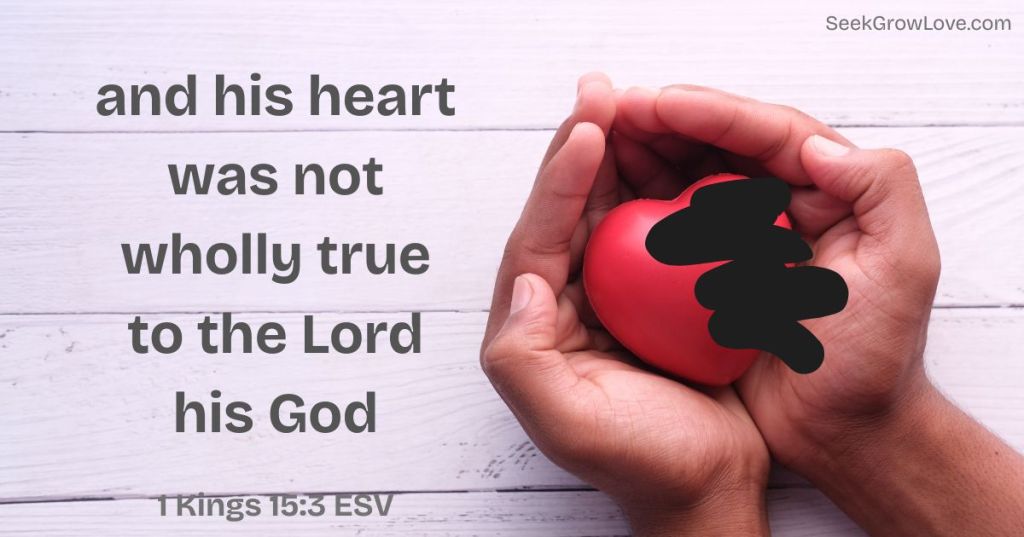
  2. What about your heart? What percentage of your heart would you, or those closest to you, say is committed to the LORD? Is there one certain part of your heart that has difficulty becoming or remaining fully committed to the Lord?
  3. What can be done to increase your faithful commitment to the Lord? What could be helpful in creating this change?
  4. What assurance do you have when going through dark times?

Prayer

Dear Great & Mighty God, You are worthy of my whole heart. Forgive me for the days I come to You with halfheartedness. Help me hold nothing back but be fully committed to You, Your Son and Your wonderful plan.

Zealous for Truth, Refined by Fire

Num 25-26

Ps 21

Mark 5

~ Devotion by Cayce Fletcher (SC)

Cayce Fletcher is a wife and homeschool mom of three. She writes and podcasts at amorebeautifullifecollective.com where she helps women cultivate a life of depth, discipline, and delight. Read the latest post on finding beauty in the everyday here

When we read through the Bible, we are confronted with episodes that may make us feel uncomfortable. Some stories feature violence and death, and to our modern sensibilities, they may seem extreme and a little off-putting. But we must always remind ourselves that the guide for what is good is God, and we learn about him through his word. 

So, today, when we read about a plague and the violent means to end the plague, we have to remember that we cannot come to the text with preconceived notions about what is good and place them on it (“Love is love,” etc.) We have to look at what the text says about goodness and truth. 

The Israelites were almost at the end of the 40th year of wandering. They were living in a place just north of the Dead Sea. They began to pursue the ways of the people who lived around them (and I’m putting that euphemistically). This ultimately resulted in idol worship. Numbers 25:3 says, “So Israel yoked himself to Baal of Peor.”

The people had entered into a covenant relationship with God, and one of the key commandments of that relationship was to have no other gods before him. But they rejected that law and sought their own path. 

Throughout the wanderings, they had committed several sins that showed their lack of trust, but as of yet, they had not sinned in this way: worshipping the gods of another nation. This phrasing – being yoked to Baal – is interesting. Throughout the rest of the Old Testament, we see Israel struggle with this habitual sin of Baal worship. 

Also interestingly, it seems that Baal was introduced to the Israelites through the counsel of Balaam in Numbers. 31:16, see also Rev. 2:14. The Enduring Word commentary says, “Essentially, after his failure to curse Israel, Balaam said something like this to Balak: “I cannot curse these people. But you can get them to curse themselves by luring them to rebel against their God. Send your most provocative girls among them and tell them to tempt the men of Israel to immorality and idolatry.” And it worked.”

And thus starts the long battle against idolatry that plagues the Israelites through the judges, kings, and on into Exile. When framed in this way, it is easier to see why God was so angry at this breaking of the covenant. This was not a one-off situation. This was the beginning of the story of unfaithfulness. 

In response, God’s anger “burned against Israel.” Fire is often a picture of wrath, judgment, and refinement. Ultimately, we will all be refined by fire, and we want what remains to be pure and complete not lacking anything. 1 Peter 1:7 says it like this, “So that the proven character of your faith—more valuable than gold which, though perishable, is refined by fire—may result in praise, glory, and honor at the revelation of Jesus Christ.”

We must take a hard look at the sin in our lives and repent of it. We have to reject idolatry and the lies of this age. We have to flee from evil.

We want to be refined and proven true on that glorious day of Christ. 

Reflection Questions

  1. Some of today’s passage was hard to read. Why do you think God included difficult passages in his word? Why do we need to wrestle with these passages? 
  2. Balaam was able to hurt the Israelites much more by enticing them to idolatry than by his curses. How does the enemy work in the same way today? 
  3. How did Phinehas deal with idolatry and sin? How must we deal with it in our lives? 

Prayer

Dear Heavenly Father, 

You are a great God – the only God worth worshiping. Thank you for your word that helps us to know you better. Please keep us from idolatry. Help us to be zealous for you and you alone. 

In Jesus’ name,

Amen.

SGL.2026.CalendarDownload

Two Sides of the Mountain

Exodus 31-32

Psalm 5

Matthew 19

Devotion by Jennifer Hall (IN)

Exodus 31 and 32 are full of some pretty exciting stuff. There seems to be good reason why Moses is a recurring character in children’s lessons and why illustrations of these stories made the cut for one of the rare colored pictures inserted into the old Children’s Bibles of my day! 

In this story, while the Israelites were busy stripping off their valuable gold to fashion it into a false god, Moses was busy encountering the LORD.  Unfortunately, not only were the Israelites just doing the handicraft work of sculpting calves with gold, we also see in Exodus 32:8, 

“. . .they have bowed down to it and sacrificed to it and have said, ‘These are your gods, Israel, who brought you up out of Egypt”

Umm, excuse me, who brought them out of Egypt??  The only God. The one true God. The LORD who was busy inscribing tablets for His people at this same time. God was writing. At a time where writing wasn’t something you did with a stylus on magic screens, when you didn’t highlight or color code or copy and paste. . .writing itself was more rare and precious. And while they were spouting lies and whining, God was inscribing His words in stone for them anyway.

As an occupational therapist, one thing I get to do quite a bit is assess how people write, how I might be able to make it easier, less painful, help children develop writing skills, etc. So, while I read this chapter, I couldn’t help but get intrigued wondering how He was doing it and how it looked. Is God right handed or left? Was He pointing with an index finger? Does He have an index finger? Were there any pink sparkles involved? Basically, I got distracted thinking about things through my filter and what I know. While these chapters don’t share this detail, Deuteronomy and later in Exodus tell us that these tablets were written by “the finger of God”.  That is some handwriting action I would LOVE to observe! But most importantly, given the God who parted the Red Sea for this crew to miraculously flee Egypt, was writing with His finger on stone for His people, one would assume these words were treasures. But. . .

How heartbreaking to see two vastly different things going on at Mount Sinai at the same time. A God who loves His people and knows them best writing a message for them. A people who claims to be His in one breath, yet lifting a golden cow as their god in another, all the while clueless to what the true God is busy doing for them.  Surely we can relate before we throw stones. We live in a world of gold, cows, false gods, lies, distractions, and people telling us other things are gods constantly. We also live in a world created by the one true God with a beautiful plan for renewal in the coming kingdom.  Maybe one day we can see God write, but until then, we have His living word, His spirit, and His love available to us. Let us purge our golden idols and seek to focus our attention on Him even if it means being patient, obedient in tough things, and focused on the promised land.

Reflection Questions:

  1. What can you learn and apply from the characters on the top and bottom of Mount Sinai in today’s story?
  2. What can you do today to treasure God’s word?

Prayer:

Dear God, You are the one true God worthy of all our praise. Thank You for loving us through all our faults. Help us remember to seek You first and cast aside any idols we have. Amen.

Set Apart

Exodus 25-26

Psalm 4

Matthew 18

Devotion by Jeremy Martin (TN)

Ps 4: 3a “But know that Yahweh has set apart the holy one for Himself;…” (LSB)

In Hebrew, the word for “holy” is “qodesh”.  Like many of the words that we translate over into English, the original word in Hebrew has a number of meanings and we try to summarize it nicely to the word that most closely matches in our language, but in doing so we also sometimes lose a lot of the “flavor” that the original word encompasses.  We translate “qodesh” as “holy”, but it  also means “seperated”, “set aside”, and “set apart”.  When we read the above verse with that in mind, you can also read it as “Yahweh has set apart the set apart one for Himself” entirely accurately.  It’s a clever word play.

But what does that mean?  It’s simple, look around you at our society.  We live in a world that is rife with sin, carnal images, narcissistic encouragements, pride, immorality, etc.  It’s everywhere.  We are a people that has largely forgotten about our God, it’s painfully apparent in almost every aspect of our society.  God wants us to set ourselves apart from all of this, to remember and honor Him, and to obey His will.  In return, He promises that He will set apart for Himself those who set themselves apart.  But how are we to do that?

Ps 4:4-5 “Tremble, and do not sin.  Ponder in your heart upon your bed, and be still.  Offer the sacrifices of righteousness, And trust in Yahweh.” (LSB)

The fear of Yahweh is the beginning of wisdom (Pr 9:10).  Fear, and do not sin.  Think about God as you’re laying in your bed, and be still.  Another translation of “be still” is “quit kicking”, which I’m personally a fan of.  This is all about attitude and understanding your place.  Acknowledge God as not only your creator, but the creator and master of ALL THINGS, He’s in charge and you’re not.  A roommate of mine in college had a fantastic poster that read “2 Foundation Facts for Human Englightment: 1 There is a God, 2 You are not Him.”.  

Are you living a righteous life? That is the sacrifice that God requires, not the cattle on a thousand hills, not a specific percentage of your income, not writing the big checks you see on TV that take 2 people to even hold up, but righteousness.  It’s a sacrifice, you put aside some of the things you think you’d like to do to set yourself apart and obey God.  

Do you trust God?  Our society has taught us to trust in ourselves, to trust in the system, to trust authorities, and to trust in our abilities but has largely obscured this critical aspect of trusting in our creator.  There are a thousand and one things to distract us, to divert us, to capture our attention and take it away from this critical foundational concept of trusting the God that made us.  I will put forth for your consideration that anything you trust in more than God has become an idol to you.  Anything that you delight in more than God can become an idol to you, and cause you to focus on things aside from our heavenly Father.

God specifically and repeatedly tells us not to have idols, not to focus on things that are worthless, and remember Him.  We look back in history at some of the false gods that the Israelites worshipped and just shake our heads.  Then we go back to watching TV, getting on social media, watching movies, trying to get ahead at work, playing video games, reading books, getting a better car/house/mate…anything that diverts and distracts us from what our real job should be; setting ourselves apart and offering up to God the sacrifice of our righteousness and trust.  If any of those things is taking more of your focus than you are giving to God, it has become an idol to you.  I will tell you a painful reality: if you swim for too long in the sewer, you’re going to smell like poop.   Everything that takes your attention away from God is the sewer.

I do trust God, because do you remember the story of the prodigal son?  That was me.  My Father came running down the road to greet me when I started coming back to Him.  I am ashamed that I ever turned aside, and humbled that despite my vast unworthiness, my God came running to me the moment I started back towards Him.  I promise, if you have veered off the path, return to God.  He will come running to meet you. 

In our Matt 18 reading today, in 18:12-14 is the parable of that lost sheep.  That was me, too.  God came looking for me when I was lost, and found me.  Notably, He found me when I pointed my head back in His direction because I heard Him calling; if I would have kept wandering away, who knows what would have happened?  In Luke 15:7 it says that when that lost sheep is found, there is rejoicing in heaven.  I get a little choked up just thinking about it, God cares so much about me, about you, about all of us, that He is actively seeking us to find ways to bring us home.  There is rejoicing in heaven when we start heading back towards God.  This should melt your heart, when you realize the depth of love and compassion that our creator has towards us.

So what about you?  Are you trusting in the God that loves you and offering up the sacrifice of righteousness to Him?  Have the idols of this present evil age distracted you?  Are you playing on the field, and not spectating from the seats in the game of life?  Here are a few practical daily tips to help you focus on and trust God.

  1. Pray.  Not just at meals, but when you wake up, when you shower, before you go to bed, while you’re driving.  Let your heart be melted by the love God has shown to you, and reciprocate it back towards God.
  2. READ SCRIPTURE!  Daily.
  3. Fast occasionally.  It doesn’t even have to be food, take a break from some of the things that distract you from God and spend that time seeking God instead.  Man does not live by bread alone, but he also doesn’t live by TV, social media, or anything else that isn’t something that comes out of God’s mouth.
  4. Love others.  God doesn’t just want us to love Him, He says that one of the ways that we can show Him that love is to love the rest of His creation.  This includes jerks, hostile enemies, addicts, ugly people, people with different cultures and colors, that person who uses weird pronouns, that guy who took your parking spot, the lady who was gossiping about you at work…every other living being is a creation of God, and by loving them (whether we agree with them or not), we honor God.  
  5. Do you want to find Jesus?  He’s probably in the parking lot at Walmart, and he’s probably hungry.  Go buy him a sandwich. (Matt 25:40).  Or maybe he’s lonely, in a nursing home, and wants a visit. Or maybe he’s doing time in prison and needs to talk.  Or maybe, he’s a lonely widow who can’t mow their own lawn because they’re feeble.  Maybe he just needs a ride.  Go find him.

REFLECTION QUESTIONS:

  1. What are your idols?
  2. How can you do better at “setting yourself apart”?
  3. What is your biggest obstacle to living a righteous life?  How can you change that?
  4. Do you trust God more than yourself?  Why, or why not?

PRAYER:

Father God, you have been faithful and kind to me throughout my entire life.  Thank you.  Please help me to focus on you, to remove the things that distract my focus, and to live a life that pleases you.  Help me to be a servant who pleases his master.  Lord, look deep in my heart and show me my flaws, and help me to remove them so that I can love you fully.  Thank you for sending us your son.  Please forgive me of my flaws, and lead me to You, in Jesus name, amen.

When Blessings Lead to Spiritual Adultery

Hosea 10-14

Chapter 10 of the book of Hosea, implements an analogy of Israel as a thriving vine. The more fruit it bore, the more Israel used its prosperity to betray Yahweh, turning blessings into the means of idolatry. God gave them the Promised Land, and they used the blessing that he gave them to make other gods. Instead of gratitude, they responded with spiritual adultery.

The Israelites’ hearts were divided, pulled in different directions by possessions and self-interest. “You will seek me and find me when you search for me with all your heart.” (Jeremiah 29:13, REV). Israel never gave God their whole heart. And so they couldn’t find Him. God was ruled out of the life of Israel and now the same thing is happening here in our own nation. We see our country’s leaders supporting and encouraging sinful actions.

“How can I give you up, Ephraim? How can I hand you over, Israel? How can I make you like Admah? How can I make you like Zeboiim? My heart is turned within me; my compassion is aroused.” (Hosea 11:8, REV). Yahweh doesn’t want to destroy His people. He didn’t want to then, and he doesn’t now. But again and again, Israel turns elsewhere. In chapter 12, they make a covenant with Assyria looking for safety in the arms of another nation, not in God. Maybe that is the way we should treat some of the things in our lives. We tend to distance ourselves from the thought that we are creating an alliance with things daily like our phones instead of God. 

“I knew you in the wilderness, in the land of great drought.” (Hosea 13:5, REV). The idea from Hosea 13:5 is that when we have an abundance of conveniences it’s hard to see the things we need. In the States most of our problems are “first world problems” which is a polite way of saying they’re not problems at all, just inconveniences. Our abundance and ease of living is one of the many reasons that America is struggling morally in our present time. With too many conveniences, too many options, or too much time -it’s easy to forget what you need.

“According to their pasture, so were they filled. They were filled, and their heart was exalted, so they forgot me.” (Hosea 13:6, REV). Let us not forget our God and turn foolishly toward the things of this world. 

Application Questions:

Do you prioritize things like work, school, social media, TV, over your family, time reading God’s word, or time helping other people?

What are some distractions that are pulling you away from God?

Who are a couple people in your life who can keep you accountable in spending less time on the things of this world and more time on things of God?

-Bridger Grable

Thanksgiving and Giving Thanks

OLD TESTAMENT: Daniel 5

Poetry: Psalm 136

NEW TESTAMENT: John 8:48-59

Can I tell you a secret? I *loathe* the nickname “Turkey Day” for Thanksgiving. 

Sure, the big bird is special to the day and to the success of the first colonist. Sure, Ben Franklin thought the bird was “a Bird of Courage.” But there is much more to Thanksgiving than the protein. 

In a world of many gods, like Babylon, feasting and reveling for the glory of a deity was common. Sometimes, in the ancient world, the Kings would claim to be gods, or children of the gods, and would show their superiority over “other” gods and people by belittling the symbols of those gods. Belshazzar, the final king of Babylon, showed his contempt for Almighty God and God’s people by allowing his guests at his drunken feasts to eat and drink out of the Temple treasures that were in Babylon. In Daniel 5:4, we read “They drank wine and praised the gods of gold and silver, bronze, iron, wood, and stone.” 

However, God does not take kindly when the glory due him is given to another. Therefore, because they are using God’s Temple’s treasures while worshipping other gods, God decides to give Belshazzar and his kingdom and his treasures to others, the Medes and the Persians. Daniel tells Belshazzar, “the Most High God rules over the kingdom of mankind, and sets over it whom he will.” 

Thanksgiving was instituted by George Washington on October 3rd, 1789. Read this declaration to see why he instituted it : “Now therefore I do recommend and assign Thursday the 26th day of November next to be devoted by the People of these States to the service of that great and glorious Being [i.e., Almighty God], who is the beneficent Author of all the good that was, that is, or that will be—That we may then all unite in rendering unto him our sincere and humble thanks—for his kind care and protection of the People of this Country previous to their becoming a Nation—for the signal and manifold mercies, and the favorable interpositions of his Providence which we experienced in the course and conclusion of the late war—for the great degree of tranquillity, union, and plenty, which we have since enjoyed—for the peaceable and rational manner, in which we have been enabled to establish constitutions of government for our safety and happiness, and particularly the national One now lately instituted—for the civil and religious liberty with which we are blessed; and the means we have of acquiring and diffusing useful knowledge; and in general for all the great and various favors which he hath been pleased to confer upon us. 

and also that we may then unite in most humbly offering our prayers and supplications to the great Lord and Ruler of Nations and beseech him to pardon our national and other transgressions—to enable us all, whether in public or private stations, to perform our several and relative duties properly and punctually—to render our national government a blessing to all the people, by constantly being a Government of wise, just, and constitutional laws, discreetly and faithfully executed and obeyed—to protect and guide all Sovereigns and Nations (especially such as have shewn kindness unto us) and to bless them with good government, peace, and concord—To promote the knowledge and practice of true religion and virtue, and the encrease of science among them and us—and generally to grant unto all Mankind such a degree of temporal prosperity as he alone knows to be best.”

President Washington desired for his Nation to thank the true God, not the gods of this world, but the “glorious Being,” the subject of “true religion and virtue”. Thanksgiving was instituted, not just to feel grateful but to give thanks to the only God, the God who is there, the God who is present in the affairs of this world and in the life of this nation and in the prosperity and peace of humankind. Today is and should be a day of feasting and merriment for all our many blessings. In the midst of all the joy of this holiday, be sure to give thanks, sincerely and humbly, to the Almighty, the Most High God. 

Happy *Thanksgiving*!

Growing deeper:

Are you thankful for your blessings? If we aren’t conscious, we could miss them. Today, don’t answer questions but make a list and try to think of every blessing in your life. Number them and see how high you can make your list. Don’t forget the blessings that might be too small to consider (aren’t eyelashes amazing?) and the blessings that might be too big to see (you are able to read this, so you have life, a computer or phone, and access to the internet, plus electricity…). The list grows quickly.

-Jake Ballard

The Wise Raising of a Family

OLD TESTAMENT: Ezekiel 29-30

POETRY: Psalm 127

NEW TESTAMENT: John 3:1-21

Most of the Psalms were written by David, but there are a few that were written by others.  For example, Psalm 90 was written by Moses and Psalm 127 was written by David’s son, Solomon.

Today’s reading, Psalm 127 is what we will reflect upon.  It offers wisdom about the wise raising of a family.  I find some parts of Solomon’s teaching a bit paradoxical.  Solomon’s father, King David, had 19 sons by his wives.  The year before his father David died Solomon’s first wife Naamah gave birth to his one and only son, Rehoboam.  She also gave birth to two daughters Taphath and Basemath.  As far as we know from the Bible these are the only three children Solomon fathered.  This is odd considering Solomon had 700 wives and 300 concubines.  Solomon valued children and saw them as a reward from God.  

A Song of Ascents. Of Solomon.

Psalm 127 

Unless the Lord builds the house,
    those who build it labor in vain.
Unless the Lord watches over the city,
    the watchman stays awake in vain.

It is in vain that you rise up early
    and go late to rest,
eating the bread of anxious toil;
    for he gives to his beloved sleep.

Behold, children are a heritage from the Lord,
    the fruit of the womb a reward.

Like arrows in the hand of a warrior
    are the children of one’s youth.

Blessed is the man
    who fills his quiver with them!
He shall not be put to shame
    when he speaks with his enemies in the gate.  

If Solomon valued children so much why didn’t he have more?  The most likely answer is that Solomon’s next wife was the daughter of the Pharoah of Egypt.  She worshipped idols and brought them into the royal palace.  Many Biblical scholars believe that Solomon had no more children as punishment for allowing idolatry to enter his family.

Psalm 127 begins “Unless the Lord builds the house, those who build it labor in vain.”  The house referred to here is not a physical house or palace but a family or a household.

That strikes me as a very wise teaching. And yet Solomon’s actions weren’t very wise when he had 700 wives and 300 concubines.    Another paradox is that in 1 Kings 3 Solomon asked God for the gift of wisdom.  Because Solomon’s request of wisdom was very unselfish (he didn’t ask for riches or a long life, God agreed to give him what he asked for, wisdom and what he didn’t ask for: wealth, honor, and long life as long  Solomon followed God’s commands.

This begs the question… how did God give him wisdom?  Did he open up Solomon’s head and pour in wisdom, or was wisdom acquired over time?  Perhaps Solomon grew in wisdom over time, when he realized that he missed out on the blessings of a large and fruitful family because he allowed idolatry to enter his home?

Solomon doesn’t quantify a number of children that qualify one as blessed.  David had 19 sons.  Solomon’s 1 son Rehoboam had 28 sons and 60 daughters (wow, that’s a lot of weddings to pay for).

My wife Karen and I have been blessed with 7 sons and 4 daughters (JJ, Jon, Joshua, Karee Anne (Gregory), Joel, Kailyn, Katie Beth (Mattison), Kass, Jordan, Josiah, and James).  We also have been blessed with 16 grandchildren (soon to be 17). We are greatly blessed.  My children (and their spouses) and grandchildren are precious gifts from God and I’ve always appreciated this Psalm. Of course, having a large family is not the only sign of blessing from God.   However God chooses to bless you, receive it with gratitude and joy.  

Peace, Grow, Love             

-Jeff Fletcher

Reflection Questions

  1. How would you put in your own words and explain Psalm 127 verse 1? Compare what a house/family built by the Lord looks like versus one built in vain. Consider the home you were raised in – which was it more like? Which do you want for a home/family you will/are or have raised?
  2. What are some of the current views towards children that you have witnessed? Which ones would God agree with, which ones would he not?

What are you looking towards?

OLD TESTAMENT: Isaiah 16-18

POETRY: Psalm 106

NEW TESTAMENT: Hebrews 6

One of the most memorable sermon illustrations that I’ve heard is about someone who is driving a car. If their eyes are on the road, they can direct the car wherever they choose (as long as the road and traffic patterns allow). But, how often have we been driving and our eyes drift from the road to something else? Maybe it’s something on the side of the road or a passenger in the back asking a question. Maybe we need to grab something from our purse or check our phone (even though that’s illegal in most states). 

In a split second, we can go from being on the right path to being in a ditch on the side of the road. This is why the push against texting and driving is so strong. We may choose to ignore the facts, but in 2022 alone, over 3,000 people died just from texting while driving. This is because “Sending or reading a text takes your eyes off the road for 5 seconds. At 55 mph, that’s like driving the length of an entire football field with your eyes closed.”

When you take your eyes off the road, you begin to veer off course. This can lead to destruction and harm. 

This is true literally when we are driving a car, but it is also spiritually true when we are thinking about our walk with God. The Bible often speaks of where our eyes are fixed to describe the spiritual health of our hearts. If our eyes are turned to God, we will be walking towards him. But, all too often, our eyes get focused on other things – jobs, pleasures, stresses, idols – and when this happens, we begin to veer off course. 

Isaiah 17:7-8 says, “In that day people will look to their Maker and turn their eyes to the Holy One of Israel. They will not look to the altars, the work of their hands, and they will have no regard for the Asherah poles and the incense altars their fingers have made.”

At the time, Israel had their gaze fixed off-course. They had turned towards idols, with their Asherah poles and incense altars. That focus led their hearts away from God and ultimately ended in destruction. They were headed towards a spiritual crash. 

God spoke off a day in the future when the Israelites course would be righted. Instead of turning to their false gods, they would look to their creator God. They would be headed on the right and good path. 

When this happens, the ultimate destination is one that is filled with hope for the good things of God. Isaiah 16:4-5 describes, “The oppressor will come to an end, and destruction will cease; the aggressor will vanish from the land. In love a throne will be established; in faithfulness, a man will sit on it— one from the house of David – one who in judging seeks justice and speeds the cause of righteousness.”

We know that this is our hope too. We have a glorious hope in the kingdom, when Jesus is seated on the throne. There will be justice, righteousness, love, and faithfulness. We wait for that day. We long for it. 

So where are your eyes fixed? Are they fixed on idols, pleasures, or cares of this world? Or are they turned towards your Maker? 

-Cayce Fletcher

Cayce Fletcher is a teacher-turned-SAHM mom of two. She blogs and podcasts at A More Beautiful Life Collective where she focuses on how you can create a life you love and cultivate your heart for God. Currently, she is working through a systematic theology series on her podcast. You can find her latest post on Bibliology here

REFLECTION QUESTIONS

  1. What are some of the things that lead to ‘distracted driving’ in your spiritual walk? How do your eyes get taken off of God? 
  2. Where are you currently looking now? Are you looking to God? Or somewhere else? 
  3. How does Jesus fulfill the prophecy in Isaiah 16:4-5? How does this fill you with hope for the future?

In Times of Spiritual Decline

Old Testament: 2 Kings 21

Poetry: Psalm 86 (last of 4 days)

New Testament: Luke 23


Scripture:
“He did evil in the eyes of Yahweh according to the detestable things of the nations whom Yahweh drove out before the Israelites.” — 2 Kings 21:2 (LEB)
“Listen, Yahweh, to my prayer, and attend to the voice of my supplications.” — Psalm 86:6 (LEB)
“And Jesus said, ‘Father, forgive them, for they do not know what they are doing.’ And they cast lots to divide his clothes.” — Luke 23:34 (LEB)


2 Kings 21 describes the reign of Manasseh, who led Judah into idolatry and wickedness, turning away from the faithfulness of his father, Hezekiah. Manasseh’s actions had devastating consequences for Judah, but even in the midst of such darkness, we can find lessons of hope and redemption when we look at the prayers of Psalm 86 and the forgiveness offered by Jesus in Luke 23.


Manasseh’s reign was marked by the restoration of idolatrous practices that his father had abolished. He erected altars to Baal, worshipped the stars, and desecrated the temple by placing an idol within it. His actions not only provoked God’s anger but also led the people of Judah into deep sin and rebellion against God.


Manasseh’s actions demonstrate the destructive power of idolatry and disobedience. When we turn away from God and pursue false gods, it leads to moral and spiritual decay. Psalm 86 is a heartfelt plea for God’s attention and mercy. In times of spiritual decline, prayer becomes a vital connection to God, seeking His guidance and forgiveness. Despite the evil of Manasseh’s reign, the story of Jesus on the cross in Luke 23 reminds us of the power of forgiveness. Jesus’ prayer for those who crucified Him highlights God’s boundless grace and the possibility of redemption even for those who have strayed far from Him.

-Jeff Ransom


Reflection Questions:


Are there any “high places” or idols in your life that you need to remove to fully commit yourself to God?

How can the prayers of Psalm 86 inspire you to seek God more earnestly and sincerely in your daily life?

How does Jesus’ example of forgiveness on the cross in Luke 23 challenge you to extend grace and forgiveness to others?


This week, reflect on the life and reign of Manasseh, and consider how you can remain faithful to God. Seek to remove any idols and influence others toward righteousness. Let the prayers of Psalm 86 inspire your own prayers, and remember the forgiveness and redemption offered through Jesus Christ.