
Generosity and Thanksgiving

Theme Week – Thanks: 2 Corinthians 9

Old Testament: Ezekiel 43 & 44

Poetry: Psalm 110

When Abraham (still Abram at the time) was called by God to set off for unknown lands, to seek adventure in going to the place that God would show him, we see that God not only tells him what he is doing, but WHY he is doing it. Genesis 12:1-3 reads this way :

“Now the Lord said to Abram, “Go from your country and your kindred and your father’s house to the land that I will show you. And I will make of you a great nation, and I will bless you and make your name great, so that you will be a blessing. I will bless those who bless you, and him who dishonors you I will curse, and in you all the families of the earth shall be blessed.””

So that you will be a blessing. 

In you all the families of the earth shall be blessed. 

Interesting, isn’t it? Abraham is blessed to be a blessing. When we use that terminology, blessed to be a blessing, we begin to understand that is what happened with every person God used. 

God blessed Abraham with a family so that there will be those who follow God.

He blessed Moses with the Law so that that Israel might walk in his ways. 

And he blessed the prophets with his Word so that the people could be drawn back to God. 

Again he blessed the Kings with success so that there might be peace. 

Ultimately, he blessed Jesus with his Spirit so that the world might be saved. 

But don’t hear Abraham, Moses, Prophets, Kings, and Jesus and think these blessing are out of your reach!

In the time of Paul, Jerusalem was undergoing a severe famine and the church in Jerusalem were rather poor. In contrast, Corinth would have been an extravagantly wealthy region ; a port city with a major trading lane would cause riches to flow in. Paul, in his missionary journeys, encourages the Gentile churches to share in the needs of the poor in Jerusalem. Paul encourages the Corinthians to give generously and cheerfully. He lets them know that they “will be enriched in every way to be generous in every way.” Blessed to be a blessing. 

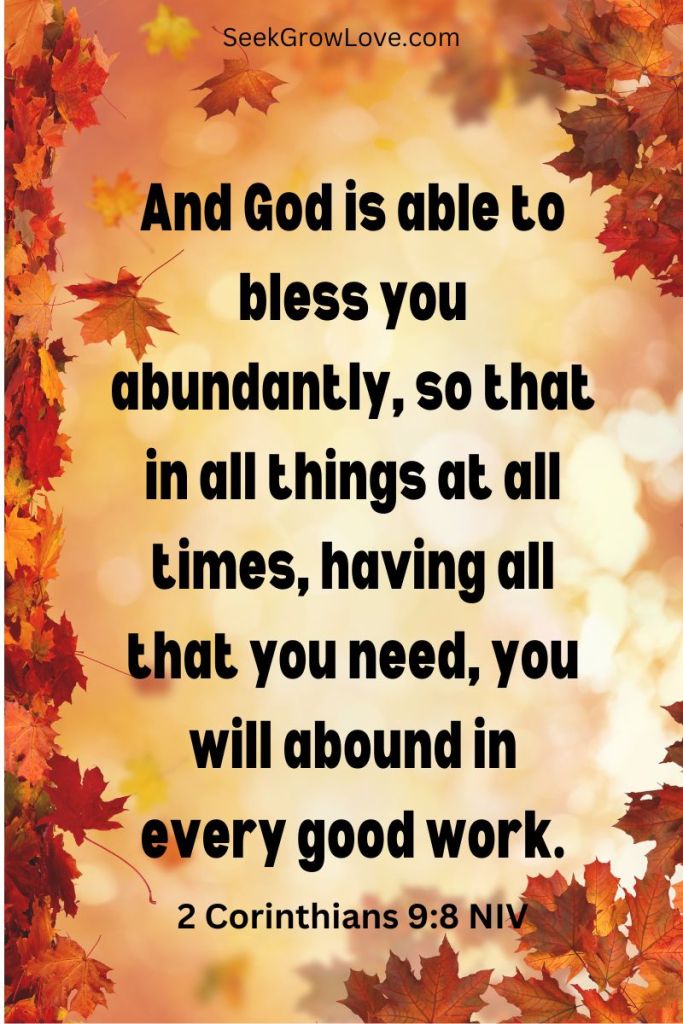
Often, human look at life as a zero-sum game: if I give what I have to someone else, then I lose and they win. But Paul reminds the Corinthians that this world is not a battle of wealth between the haves and the have-nots. “God is able to make all grace abound to you, so that having all sufficiency in all things at all times, you may abound in every good work.” (2 Corinthians 9:8) If God owns the cattle on a thousand hills (Psalm 50:10), do you think he is unable to meet your needs, even when you give “until it pinches a little.” C. S. Lewis speaks about the amount one “ought” to give and he writes “I am afraid the only safe rule is to give more than we can spare.” We might be afraid to give generously, but only in giving generously will we receive generously, just like the farmer can only reap bountifully when he sows bountifully. 

I want to be very clear : when Jesus prayed for his care from the Father, he asked for bread (“daily bread”) and water, rather than steak and Starbucks. This is not a lack of the provision of God, but the reality that giving extravagantly and full of joy does not mean that we will receive a sudden windfall, or be able to buy the nice car. God is not concerned with your riches or wealth in this life but with your obedience. God promises to care for your needs, not necessarily your wants. Obedience does produce something infinitely valuable though : the ability to do more good. ”So that you may abound in every good work.” “You will be enriched in every way to be generous in every way.” Your generosity will “produce thanksgiving to God… overflowing in many thanksgivings to God.” And we have seen how important thanksgiving is. In fact, that is what Paul ends this encouragement to give with, thanksgiving!

 We see that God wants us to give cheerfully and generously, and he will continue to bless us to be a blessing. Our giving is done because we know that every blessing given is already a gift, and everything we own belongs to the God who owns everything. As we give, we can remember that God has already given the greatest gift of all, and our generosity can and will result in thanksgiving to God for his inexpressible gift!

-Jake Ballard

Questions and Application

  1. “Blessed to be a blessing.” :  Have you thought about how this description defined so much of the interaction of God’s people with the world? What are some of the blessings you have been thanking God for this week? How can you use those blessings to bless the world around you?
  2. “Trusting God with Generosity” : Lewis’ call to give more than we can spare requires that we trust that God will meet our needs even when budgets seem to say we can’t. Not everyone is called to sell everything they have and give to the poor, but some were (and maybe are). How much is the right amount to give for you? Who around you needs to be blessed?
  3. “Supplying the needs of the saints” : I have tried to be very clear that Paul was talking about giving money. We should give money to make sure we meet the needs of those around us who lack funds. There are three important points to remember. First, if we are young and don’t have a job, it is very hard to give money. A way to help is to give what you can ; your time or your talents, for example. Second, however, if you give of your time and talents, that doesn’t excuse you from giving money if you can. You should be willing to give everything to God, time, talent and treasure (money). Third, and the opposite of the last points, if you give money to a ministry, that is not a substitute for volunteering your time and abilities. All three, the time you are given, the talents (abilities) you have and the treasure (money) you own, are blessings from God, and are given so you can bless others. 
Is it OK to be Rich?

More than a third of the world’s population lives on less than two dollars a day according to research done by the United Nations.  You might not consider yourself rich if you compare yourself to others in the United States (and many other countries), but most or all of you are probably quite rich when looking at the whole world.  Is it ok to be rich?

Let’s first consider Solomon, the richest king that ever was.  God gave him wealth, possessions, and honor such as no king before or after him (2 Chronicles 1:12).  God made Solomon rich, so the good news is that we have an example of someone who was very rich and it was ok in God’s eyes.

Being rich may be ok, but the rich young man in Matthew 19:16-24 received advice from Jesus that made him sad.  Jesus told him if he wanted to be perfect, he should sell his possessions and give to the poor.  He then told his disciples that it is hard for someone who is rich to enter the kingdom.  Jesus had more to say about the matter in Luke 6:20-26.  He said, “Blessed are you who are poor, for yours is the kingdom of God.”  He went on to say, “But woe to you who are rich, for you have already received your comfort.”  Jesus was warning us that being rich could interfere with your salvation.

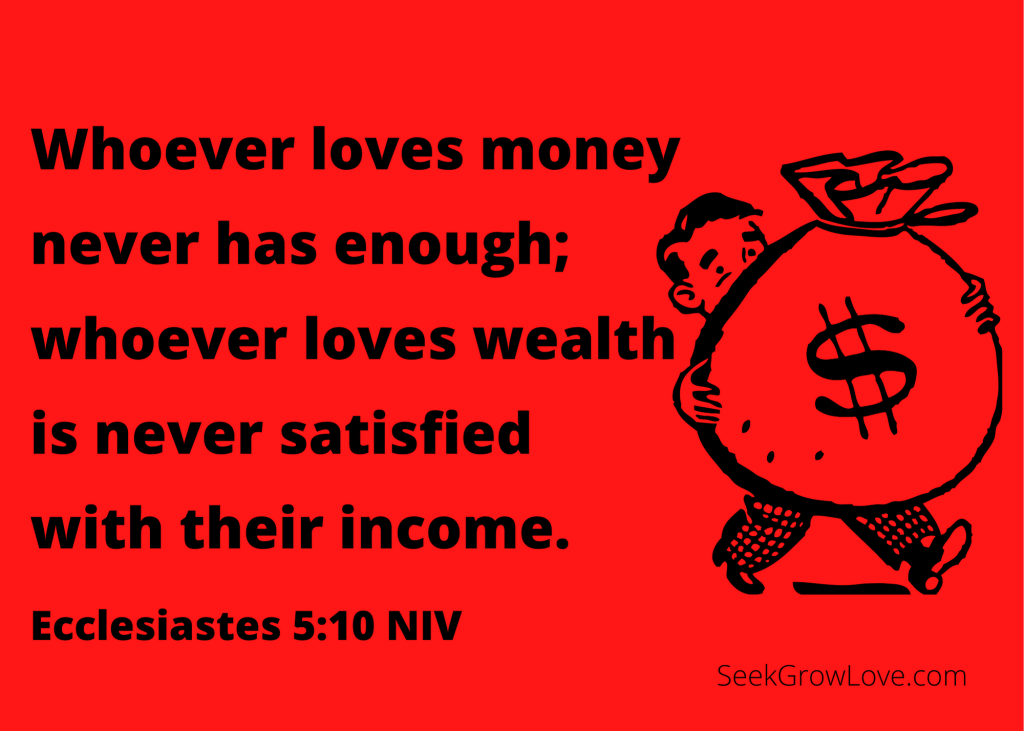
Ecclesiastes 5:8-20 says that whoever loves money never has enough, and whoever loves wealth is never satisfied with their income, and this is meaningless.  It also says that the abundance of the rich permits them no sleep.  However, it also says that it is appropriate for a person to eat, drink, and find satisfaction in their labor during the few days God has given them.  It explains that it is a gift from God when He gives someone wealth, possessions, and the ability to enjoy them.

This may be a bit confusing to hear that wealth can be good or bad.  I think it all boils down to your attitude and how you spend your money.  If money is your master, you are always wanting and trying to get more, and you spend it all on yourself; that is bad.  If you realize that your money comes from God, is actually owned by God, and is not the focus of your life, it is fine to enjoy that gift from God from time to time.

I now want to change gears a bit here and talk about yesterday’s devotion on tithing a bit more.  I said it was not mentioned in the New Testament that we should tithe.  However, there are two verses in the New Testament (Matthew 23:23 and Luke 11:42) that talk about the Pharisees giving a tenth of their spices and Jesus scolding them for neglecting justice, mercy, faithfulness, and the love of God, and saying they should have practiced the latter without neglecting the former.  I do not consider these two verses a mandate for us today to tithe ten percent of our earnings, although I can see how it can be interpreted that way.  These individuals were giving a tenth of their spices and Jesus said they should continue to do that.  If they had said they were fasting, I think Jesus might have told them to continue to do that, but I don’t think that necessarily means we all must fast today.

I could be wrong about this, but I don’t think the ten percent tithe is a specific rule we must follow today like the many rules they were required to follow in the Old Testament.  However, I definitely believe we should be giving money to the church, and I think it would be fine to look at what they were instructed to do and model that by giving ten percent of your earnings to the church.  I also believe it is possible that God wants some people to give more than ten percent.

Paul never discussed tithing ten percent, but he did talk about giving.  In 2 Corinthians 8:3, he said the Macedonians gave as much as they were able, and even beyond their ability.  In 2 Corinthians 9:6-7 he says, “Remember this:  Whoever sows sparingly will also reap sparingly, and whoever sows generously will also reap generously.  Each of you should give what you have decided in your heart to give, not reluctantly or under compulsion, for God loves a cheerful giver.”  In Paul’s first letter to the church in Corinth, he told them that they should set aside a sum of money in keeping with their income on the first day of every week (1 Corinthians 16:2).  I think if it was still a rule to tithe ten percent, Paul would have mentioned it, but instead he talked about giving with the proper attitude and according to your income.

-Rick McClain

Today’s 2021 Bible reading plan passages can be read or listened to at BibleGateway.com here – Isaiah 55-56 and 2 Timothy 3

My Money

Many people work hard for their money, some have inherited their money, and others make money in many ways.  Most of us feel good about the money we have, even if it isn’t that much, but is the money really ours?  Today we are going to talk about the heart of the matter when it comes to a Christian perspective about money.  The most important thing you need to understand about your money is that it is NOT your money.

Psalms 24:1 states that the earth and everything in it is the Lord’s.  God says that the silver and gold are His in Haggai 2:8.  1 Corinthians 6:19-20 tells us that we don’t even own our own bodies; they were bought at a price.  God owns everything, including your money.  That makes you the manager.  He is the owner, and you are the manager that works for Him.

If this is a new idea to you, it can be a game-changer.  Have you ever been upset when your car broke down and you wondered how you were going to pay for the repairs?  Let me explain this situation with our new lens.  Let’s pretend you work for UPS (unless you actually do work for UPS; then you don’t need to pretend).  Let’s pretend that the UPS truck you drive breaks down and needs major repairs that will cost a lot of money.  Are you going to be upset about that, or are you just going to let someone know that your truck broke down and ask for a different one to drive?  You aren’t going to be too upset because you don’t own the truck, UPS does.  You know they have plenty of money to fix it and you won’t lose any sleep worrying about the cost of the repair.  When your car, I mean God’s car, breaks down, you shouldn’t be worried about the cost of the repair.  I’d be quite sure God is not up in heaven wondering how He is going to get through this problem.

Let’s try another one.  Someone steals $100 out of your wallet.  That tends to make us upset.  Let’s pretend this time that we work for Wal Mart as a cashier and someone steals $100 out of your cash register at gunpoint.  Granted, being held up at gunpoint would be very stressful, but how concerned would you be that Wal Mart just lost $100?  You wouldn’t be concerned at all.  And God is not concerned about how He is going to help you get by with $100 less in your wallet.  He is pretty capable of finding solutions to help you get by so you should not be concerned when someone steals money from your wallet.

Having said that, it does not give us a license to be reckless with our money.  We are the manager of the money and we still need to act responsibly.  We shouldn’t be driving crazy and we shouldn’t leave our wallets sitting on our front porch.  But if bad things happen when you are acting responsibly, don’t sweat it; God is going to take care of you.

We have one last myth to bust with this new mindset.  Some Christians believe that if they give 10% of their money to God, the rest is theirs to do with it whatever they want.  Again, we don’t own 90% because God owns 100% of our money.  That doesn’t mean you can’t spend any money on yourself.  You are the manager, and you need to decide what an appropriate amount of spending on food, housing, clothes, vacations, etc. would be.

If you are a good manager, Luke 16:10-12 explains that someone who can be trusted with little can also be trusted with much.  It is likely that if you make good decisions with the money you are managing, God will trust you with more.

If you find yourself stressing out about finances, think about who really owns the money.  That should put your mind at ease because we both know that God is not stressing about your finances.

-Rick McClain


Today’s Bible reading plan passages can be read or listened to at BibleGateway.com here – Isaiah 51-52 and 2 Timothy 1

Loyal to God

1 Chronicles 26-29, Psalm 127

1 Chronicles 29 18 NIV sgl

Today we finish off the book of 1st Chronicles as King David is finishing his 40 year reign and is passing over the kingship of the nation of Israel and the plans for building God’s temple to his son Solomon.

I love the example we see of accepting God’s will and passing on the torch.  Even though David had wanted to build the temple himself, he accepted that this was not God’s plan for him, and he fully immersed himself in doing all he could (with God’s spirit to guide him) to see the project succeed for the next generation.  How well do we accept changes from what we had planned and desired “in our heart” (1 Chronicles 28:2)?  Do we devote ourselves to God’s will even when it wasn’t our personal “first-choice”?  Do we do all we can to see others succeed with what we wanted for ourselves?

I also love the picture we have of giving and sacrifice. In a Spirit-led manner, David gave of himself, his time, his talents and his possessions to prepare the work for the tabernacle.  He passed along to Solomon very detailed plans, “of all that the Spirit had put in his mind for the courts of the temple of the LORD” (1 Chronicles 28:12) including specifics such as the division of labor for the priests and the weights of each of the lamp stands and bowls and other items to be used in the temple.

David knew the plans were no good; unless, there was also the means to follow those plans.  It was going to take material goods to do the work of the Lord.  He opened Israel’s storehouses to provide the gold, silver, marble, bronze, fine stones and other materials that would be used to build this “palatial structure,” “not for man but for the LORD God” (1 Chronicles 29:1).  And then he dug deep and gave from his own treasuries and bank account.  And then he asked the people, “Now who is willing to consecrate himself today to the Lord?”  How do you really set yourself apart and show your devotion to God – you give, just as David gave.  And Israel responded just as their king had set the example for them – and they gave willingly.

And they gave with humble, thankful hearts – knowing that everything they had belonged to God.  I really love that part!

David rejoiced and praised God when he saw the people respond with generous, giving hearts.  He prayed to God, “keep this desire in the hearts of your people forever, and keep their hearts loyal to you.  And give my son Solomon the wholehearted devotion to keep your commands, requirements and decrees and to do everything to build the palatial structure for which I have provided.” (1 Chronicles 29:18).

This, too, can be our prayer for our own generation and the ones to follow.  We are now God’s temple (1 Corinthians 3:16 & 6:19) and we have been given so much.  May we not wish for what isn’t in God’s perfect plan for us, but work wholeheartedly where he wants us to be.  May we be leaders who inspire others to give back to God.  May we and our children and their children be consecrated to Him and show that in our generous giving with humble hearts.  God, please keep our hearts loyal to you.

Marcia Railton


Today’s Bible reading can be read or listened to at https://www.biblegateway.com/passage/?search=1+Chronicles+26-29%2C+Psalm+127&version=NIV

Tomorrow’s reading will be Psalm 111-118 as we continue the 2020 Chronological Bible Reading Plan