Coming Home

john 14_3

One of the most bittersweet moments after a long, fulfilling journey is coming home.   Over the course of the past several years, I have been to a handful of different countries and have had some of the most wonderful, unforgettable experiences.  I usually spend my flight home scrolling through pictures, journaling, retelling that trip’s running joke, and planning a return journey to the destination I’m leaving behind.  Nevertheless, no matter how far I stray away, I find a soothing pleasure in seeing that final turn that will steer me into my driveway, opening the door to take a breath of the familiar smell, and laying down on my bed with my head perfectly placed on my pillow.  As I close my eyes, I do not think how much I wish to be where I was, I only think that I am so happy to be home.

I know many of you reading this have the exact same experience with the place you call home; however, I know for others, your current home is far from a place you wish to return.  Returning home to you means refacing an unpleasant past, examining poor relationships, having greater opportunity to sin, dealing with loneliness, hiding from abuse, or a customized mixture of some/all of these things.  The contrast between where you were and where you are going back to is so remarkably different that you see no hope in returning. There is always hope in returning home.

“Do not let your hearts be troubled. You believe in God; believe also in me. My Father’s house has many rooms; if that were not so, would I have told you that I am going there to prepare a place for you. And if I go and prepare a place for you, I will come back and take you to be with me that you also may be where I am. You know the way to the place where I am going.”  John 14:1-4

The reality is that all of us who believe are on a journey home, but it is possible none of us will make it there in this lifetime.  God is preparing a place for all of his children, those who believe in the Father and the Lord Jesus Christ and know and live by saving grace that comes through faith.  Jesus Christ is preparing a place for us to lay our heads for eternity, and he will one day come back for us, fulfilling his promise. We do not look for a physical direction, or a spiritual ascent in the heavens, but look for the way, the truth, and the life Jesus speaks of as the restoration to the Father. Our desire is to be here on this earth, but it is not in its present state (1 John 2:15-17), but the fulfillment of the Kingdom of God.

No matter where we lay our heads or what situations befalls us, we have been given a way to where Jesus is calling.  One place is not more powerful than another. One experience is not higher than the other. By placing Jesus Christ as our heart, our hope stays with us, and is never in a location or circumstance.  Still, even our spiritual highs pale in comparison to what is promised for us in the place that is being prepared for us. In the Kingdom we will be in the presence of our Savior and our God. Where we arrived at the place prepared for and rest in the assurance of eternal life, none of us will desire to be where we were; we will only think we are happy to be home.

-Aaron Winner
Church

matt 18 20

We hear all the time that church attendance is down. It is. We could share the statistics, but we don’t need to. If you haven’t heard that, look around you. Church buildings, once central to communities, now stand empty or are used for other purposes. Restaurants, stores, and even more annoyingly, community and kids’ events are now regularly open/held on Sunday mornings without thought. But, why shouldn’t they be if attendance or business doesn’t decrease? And if you aren’t sure from observation alone, there are plenty of statistics out there to satisfy the most analytical of researcher. Home churches have increased in recent years, but even this increase doesn’t begin to make up for the decrease in overall church attendance. This certainly brings several questions such as “Why don’t people attend church?” or “Why have people left the church?”. . .but also. . . “What is the church?”

In our English language and contemporary society, the word “church” generally conjures up ideas of a building. Maybe a white building with a steeple and an organ. Maybe a cathedral, centuries-old with beautiful stained glass. Maybe a megachurch with full band, coffee shop, and million-dollar electronic equipment. Whatever the picture in our minds. . .it is generally far different from the meaning of the Biblical “church” and its references to the church family.

 “Remember those who led you, who spoke the word of God to you; and considering the result of their conduct, imitate their faith.” (Hebrews 13:7)

Be on guard for yourselves and for all the flock, among which the Holy Spirit has made you overseers, to shepherd the church of God which He purchased with His own blood.” (Acts 20:28)

Let the word of Christ richly dwell within you, with all wisdom teaching and admonishing one another with psalms and hymns and spiritual songs, singing with thankfulness in your hearts to God. (Colossians 3:16)

“For where two or three have gathered together in My name, I am there in their midst.” Matthew 18:20)

“. . .let us consider how to stimulate one another to love and good deeds, 25 not forsaking our own assembling together, as is the habit of some, but encouraging one another; and all the more as you see the day drawing near.” (Hebrews 10:24-25)

“These all with one mind were continually devoting themselves to prayer. . .” (Acts 1:14)

“They devoted themselves to the apostles’ teaching and to fellowship. . .All the believers were together and had everything in common. They sold property and possessions to give to anyone who had need. Every day they continued to meet together in the temple courts. They broke bread in their homes and ate together with glad and sincere hearts, praising God and enjoying the favor of all the people. And the Lord added to their number daily those who were being saved.” (Acts 2:42-47)

In scripture, the Greek word “ecclesia” refers to the group of believers. . .and clearly the content of scripture indicates that it doesn’t matter where that group meets, but who that group is. We are God’s children united in one church, one body.  We may “attend” a wedding or funeral, but we ARE the church. If we separate from the church, the body is injured. And if we think that church is something we “do” or somewhere we “go”, then we injure the body and minimize its potential. Our church family is our most important family and within it is the way we are called to seek the kingdom and spread the gospel.  If we wonder why people don’t attend church, or don’t do more than show up for a “service” and leave, perhaps we need to look at ourselves and encourage one another to amp it up a bit with a few of these things. Actions can speak louder than words sometimes, and it doesn’t help anyone to simply bemoan the state of society and the lack of church attendance and tell someone they should “come to church”. Instead, let us share it by remembering those who led us and imitate, be on guard, be thankful, teach, admonish, forgive, share, stimulate, encourage, persevere, and prioritize. We love our church, and we love even more the hope of one day being in the kingdom in a perfect, Christ-led body together. That day is ever-approaching. Let us not give it up now.

–Brian and Jennifer Hall

Children of God

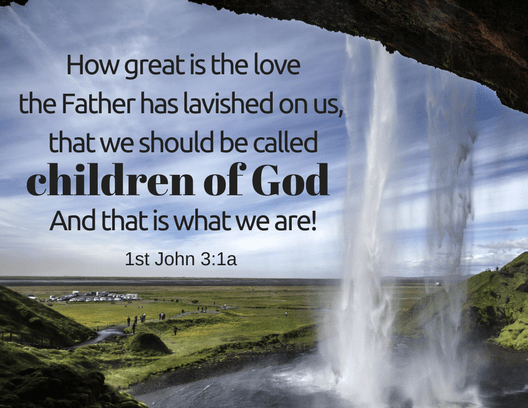
1 John 3

1 John 3_1

I have been told I am a lot like my dad. We have the same sense of humor; we both have blue eyes; we have the same voice inflections. We have a deep compassion; we both are extremely persistent; we both don’t get embarrassed.

Sometimes when people are talking to me they will give me a weird look and say, “You sound just like your father.” I take that as one of the highest compliments, because my dad is my hero.

Some of you can fully relate to what I just said; some of you, not so much. Some of you have a difficult and complicated relationship with your dad – or even a nonexistent relationship. One that is not your fault. One that is full of hurt and heartache. If that is you, I am so so sorry.

The thing is, we all have an even greater Dad than the one we have on this earth. For some, it’s seems hard to believe anyone could come close to being that awesome. For others, it might seem impossible to have a dad who actually cares.

Take a look at verse 2:

“Dear friends, we are God’s children now, and what we will be like has not yet been revealed. We know that when He appears, we will be like Him because we will see Him as He is.” (HCSB)

If you’re like me the first time you read that, you think to yourself, “Aww, how cute. We believers are just one big, happy family. What great warm fuzzies on the inside.”

But then it hit me. We are going to be like God.

Let that sink in.

We are God’s children. We will be like Him.

Woah.

God loves us so much that He wants us to be a part of His family despite our sin, our brokenness, our bad days, our deepest and darkest secrets. He wants us to be a part of His family even when we don’t want that for ourselves, even when we run away, even when we don’t trust, even when we don’t deserve it. God loves us so much that He wants us to be made perfect and be like Him.

It doesn’t matter if you are fourteen years old or forty. It doesn’t matter if you are rich or poor. It doesn’t matter what you look like. It doesn’t matter what your past looks like, but only your future.

Because God loves you. So live like it. Live so then people notice that there is something different about you. Live like you’re a child of God.

– Madison Cisler

Caring for the Poor

Proverbs 23  (Tuesday)

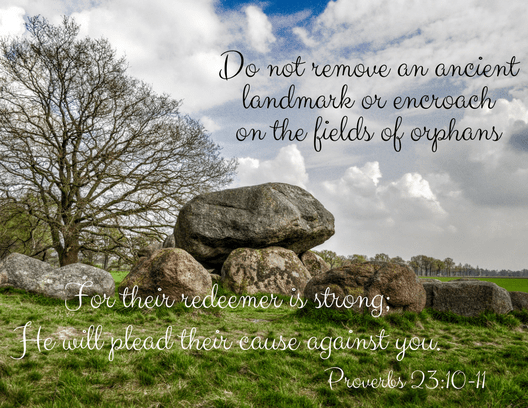
Prov 23-10-11


There are two strong images that emerge in this proverb.  The first is that of moving a landmark so that it encroaches on “the field of orphans” (Proverbs 23:10).  This is most likely a reference to the Israelite practice of leaving the corners of a field for the poor to glean from (Lev. 19:9-10; Deut. 24:19-21).  This institutionalized care for those in need meant that farmers would always leave part of their field unpicked.


Just like surveyors today, the properties of each person would have been laid out by various markings: large rocks, stakes, or a cairn (pile of rocks).  While there wasn’t a board or city commission the farmers could check against, a greedy farmer could slowly move a marker year after year to make their own plot larger while taking from their neighbor – or in this case, shrinking the portion of their field that is left for the poor.  Human greed to take from those who already have so little is nothing new today.  So, this proverb is a warning that if we try to steal from the orphaned and poor, we have their redeemer to answer to — God.


The second image comes in verse 11 and is connected to the story of Ruth.  It is the role of the “redeemer.”  In the Hebrew, this is the word Gaal or Gaw’al (spellings vary).  We might more accurately translate it as a “kinsman redeemer” like Boaz is in Ruth.  This is the person whose responsibility it is to care for family members who don’t have a means to protect themselves.  And God will not only protect them, but plead their case against us if are the ones threatening the little that they have.


Our God is one who jealously guards His children, even more so those who have no protector themselves.  As the people of God, this Proverb reminds us that God is one who stands as the kinsman redeemer of the poor and that it is our responsibility as part of his family to take up their cause as well.

–Graysen Pack