
Test Your Memory

DEUTERONOMY 3-4

“Deuteronomy” is derived from the Greek word deuteronomion, meaning “a second law.” This whole book is meant to be a second edition of God’s laws, compiled of commandments received at Mount Sinai as well as a few additional ones. The first four chapters of Deuteronomy set the stage for these laws by providing reminders of why the Israelites serve the God of Abraham, and the importance of keeping His statutes. 

Moses begins this book emphasizing to his people the importance of remembering. He reminds them of the many instances in which God delivered them from their enemies and gave them new lands. As we read yesterday and continue to read today, chapters 1-3 serve as a brief overview of Israel’s recent happenings. In chapter 4, Moses switches gears and opens the book with a call to remembrance, and a command to obey. (Deut 4:1-5, 4:9-10, 4:14, 4:23, 4:30) 

Only be careful for yourself and watch over your soul diligently, so that you do not forget the things which your eyes have seen and they do not depart from your heart all the days of your life; but make them known to your sons and your grandsons. – Deut 4:9

Moses is reiterating that the laws provided previously in Exodus weren’t just a temporary set of guidelines or a mere suggestion; they were meant to be kept. These laws are the foundation upon which God’s chosen people will be set apart, unique from the rest of the world. (Deuteronomy 4:5-8, 4:32-40)

So keep and do them, for that is your wisdom and your understanding in the sight of the peoples who will hear all these statutes and say, ‘Surely this great nation is a wise and understanding people.’ For what great nation is there that has a god so near to it as is the Lord our God whenever we call on Him? Or what great nation is there that has statutes and judgments as righteous as this whole Law which I am setting before you today? – Deut 4:6-8

Israel’s obedience and devotion to the statutes of the LORD serve a larger purpose. Not only will these laws keep Israel on the right track in terms of their own safety and wellbeing, but they will also distinguish God’s people from the rest of humanity as a righteous and wise nation. Ultimately, despite many roadblocks and failures, these laws will sustain Israel for 400 years, allowing them to become the nation from which the Messiah is born (as prophesied later in Deuteronomy 18:15-19).

Moses makes it abundantly clear to his people that God will not forget His covenant with them, therefore it is crucial that they do not forget either. He warns them that they will stray, but that they serve a merciful God, a loving Father who patiently waits for His children to return to Him. (Deut 4:25-31)

For the Lord your God is a compassionate God; He will not abandon you nor destroy you, nor forget the covenant with your fathers which He swore to them. – Deut 4:31

Though Christ has since set a new system in place, consisting of new laws under the new covenant, the main ideas that Moses expressed in these scriptures remain true for us today. First, we must remember God’s promise to one day restore the earth (Gen 3:19), as well as the commands His Son gave generations later under the new covenant. Second, God’s commands are not meant to needlessly restrict us, but to guide us into a life of blessing and purpose. When we obey, we reflect His wisdom and goodness to the world around us. And lastly, that God knows we live in a broken world; He sees our darkest desires and our biggest downfalls. But even when we stray from His ways, He waits for us to return to Him, arms open and heart yearning to pull us into His loving embrace. 

-Isabella Osborn

Reflection Questions:

  1. How can you actively remind yourself (and others) of God’s goodness, His commands, and His promises?
  2. Moses emphasized that God’s laws were meant to set Israel apart—how does living according to God’s principles set you apart in today’s world?
  3. How does knowing that God patiently waits for us to return to Him impact the way you approach repentance and restoration in your relationship with Him? How can this truth shape the way you view both your own failures and those of others?
Don’t Give Up Now

Jeremiah 35-37

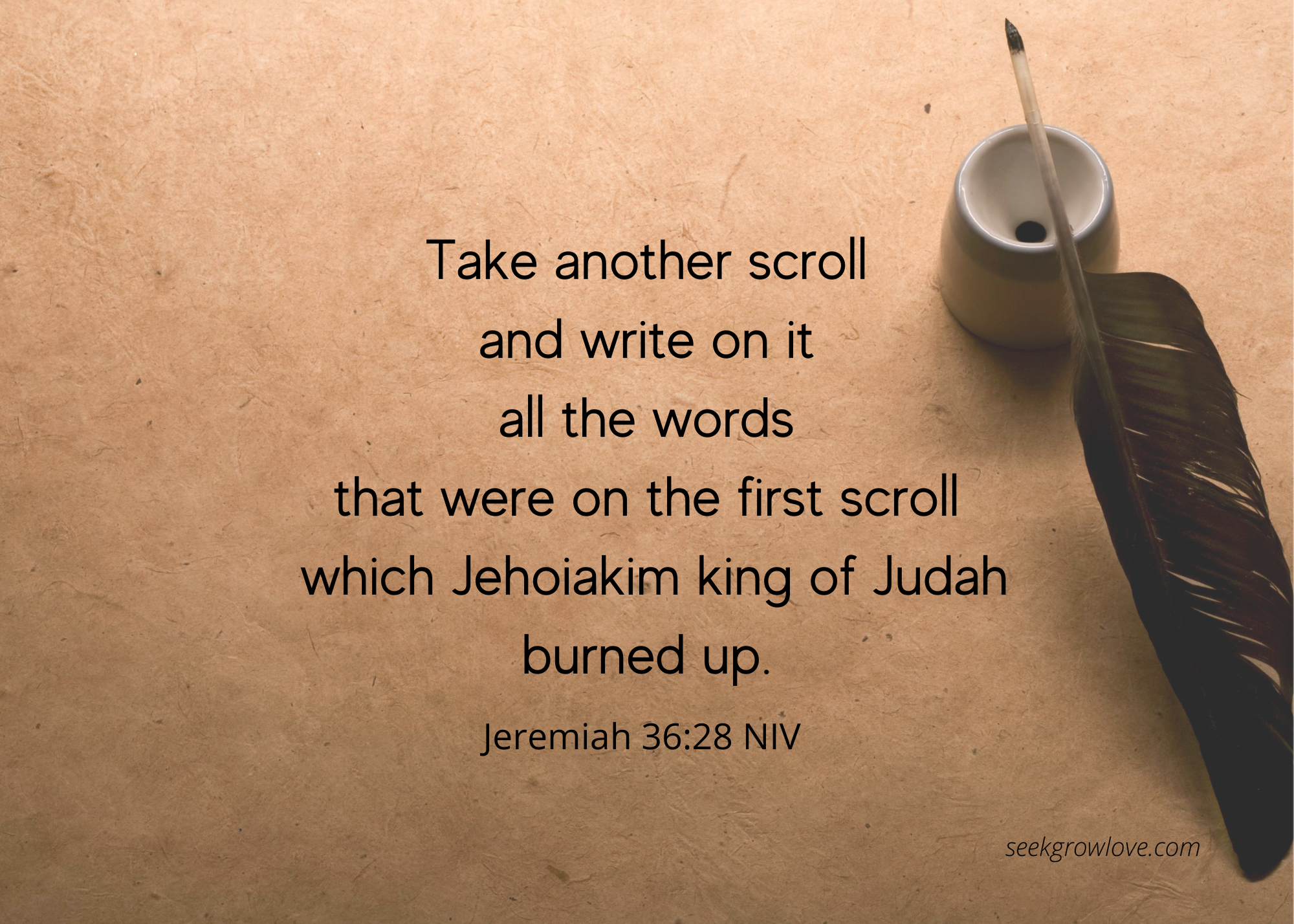
Jeremiah 36 28 NIV sgl

We sure could use a few more Jeremiahs today!  He was quick to follow God’s instructions, and he boldly spoke God’s truth even when it was quite unpopular.  And, he didn’t quit!

At the time of the events of Jeremiah chapter 36 the prophet had already been preaching to his Jewish brothers for over 20 years – warning them of God’s displeasure and the coming wrath if they don’t repent and turn from their wicked ways.  Over and over again he has urged the people, the kings, the priests to stop sinning and return to God.  But as a nation, they don’t get it.  They revel in their freedom, follow after the gods of their neighbors and fall further and further from what God designed them to be – His chosen people who love Him and follow Him and are blessed by Him.

The 20 plus years of preaching hasn’t turned the hearts of Judah back to their Creator.  Maybe if it was ALL written down – would the people listen then?  God tells Jeremiah to write down all the sermons he has ever preached – every word that God has given him from the very start of his ministry.  God said, “Perhaps when the people of Judah hear about every disaster I plan to inflict on them, each of them will turn from his wicked way; then I will forgive their wickedness and their sin.” (Jeremiah 36:3 NIV).  Even though God hates the sins of His people He still loves them and wants to give them another chance to come back to Him.  And so a great project begins.  Jeremiah dictates as his scribe Baruch writes it all down.  Perhaps the people will listen.  They spend over a year writing – God has said a lot.  How will the people respond to this book that lays it all out?

Since Jeremiah’s unpopular (but very Godly) message has already had him personally banned from the temple, Baruch is sent to read God’s words through Jeremiah to the people.  One who hears it, Micaiah, realizes the importance of what has been written and he arranges a reading of it with some of the royal officials.  “When they heard all these words, they looked at each other in fear” (Jeremiah 36:16) and they arrange for the king himself to hear the words on the scroll from Baruch, Jeremiah, and ultimately God.

Here’s the king’s chance.  He can hear God’s word and repent and lead the nation into a time of Godly reformation, thus saving them from God’s wrath at the hands of the Babylonians – just as his father Josiah had done years ago.  But King Jehoiakim thinks he knows better.  His arrogance and hardened heart don’t crack.  Instead, as the scroll is read to him in his chambers, he cuts it apart and burns God’s word, piece by piece.

Can you imagine the anger and defeat and perhaps fear Jeremiah and Baruch may have felt when they heard the fate of their scroll – God’s words?  To know the utter disrespect they (and their God) had received – and how their work was violated and destroyed.  And they didn’t even have a copy saved on their hard drive.  Totally lost.  Over a year’s work, gone.  But, God’s Word stands forever (Isaiah 40:8).  So, when God tells Jeremiah to write it all down again – with an extra word for Jehoiakim – Jeremiah and Baruch get to work – and the second work is completed, more impressive than the first.

God’s Words are priceless.  Some will hear and respond and pass it on – to work to save themselves and their hearers  (1 Timothy 4:16).  Some will scoff, show no fear and even seek to destroy it.  It does not change the supreme importance and value of the words – or the God who spoke them.  Nations, kings, priests, people; past, present and future will be judged by how they respond to God and His Word.  The king who brazenly cut apart and burned the scroll paid with his life – and his children and country suffered mightily for it as well.  Jeremiah and Baruch had far from an easy life – but they didn’t give up.  They kept at it – living, writing, sharing, reading, speaking God’s Word.  Striving to help save those in danger of experiencing God’s wrath.  Will you stand with them today and be a Jeremiah?

Marcia Railton

Today’s Bible reading passage, Jeremiah 35-37, can be read or listened to at https://www.biblegateway.com/passage/?search=Jeremiah+35-37&version=NIV

Tomorrow’s Bible reading will be Jeremiah 38-40 and Psalm 74 &79 as we continue the 2020 Chronological Bible Reading Plan

Judah Kicked Out of the House

Jeremiah 10-13

Jeremiah 12 7 NIV sgl

We all understand what it is to make a promise.  When you were a little kid did you ever do a “pinky swear” with your friend?  When I was in high school we used to “go steady” with that special guy or girl.  If it was really serious you let her wear your class ring or your letter jacket (my HS girlfriend wore both my class ring and my letter jacket).  To go steady was to make a promise, “I won’t date any other girl but you.”  (note, in the 70’s dating in 7th grade might mean walking her from her locker to class, possibly holding hands publicly, and dancing exclusively with her at the sock hop… I know, times have changed.)  When things got rough, you would “break up”.  There would be tears and drama.  After you broke up, it was understood that you no longer were going steady and were free to walk other girls from their locker or dance at the next sock hop.

Marriage is a more serious commitment.  You make a public promise to God and each other before witnesses to love and be faithful to each other until one of you dies.  That kind of promise is known as a covenant.

The nation of Israel was God’s chosen people.  God entered into a covenant with Abraham and his descendants Isaac and Jacob (who later became Israel).  God promised to be their God, to protect them, to provide them with all that they needed:  productive land to live in, abundant children and animals, and protection from their enemies.  In return, God asked Israel to be faithful only to Him.  To worship only God and to follow God’s teaching, God’s instruction, God’s rules for living in community.  They were not to be unfaithful to God by worshipping false gods or man-made gods known as idols.  God warned Israel that if they were not faithful to their covenant with God, they would suffer serious consequences.  God might withhold rain, send plagues, or even allow their larger and more powerful neighboring countries to attack them and God would not defend them.  It was a covenant, a kind of marriage between God and Israel.  In fact, God referred to Israel as His bride.

The bottom line was clear- if you are faithful to God and to the covenant with God, you will be blessed, if you are unfaithful to God and to the covenant, you will be cursed (punished, not experience the blessings).  Throughout their history, Israel frequently went through periods when they were unfaithful to God and violated the covenant.  God would often punish them in some way, they would repent, which means they would turn away from whatever wrong they were doing and return to God, and then God would once again bless them.  However, as time wore on, Israel’s unfaithfulness grew worse and worse, God’s punishments grew harsher and harsher and Israel grew more calloused and disobedient.  Think of a toddler who absolutely refuses to obey his parents.  Usually, a swift punishment will result in repentance.  But after a long time, they had become rebellious teenagers who no longer repented, or as a better example, an unfaithful wife who continually cheats on her husband and doesn’t even bother to hide it from everyone.  Something had to change.

Several hundred years passed since the days of Abraham and later Moses and even King David.  Israel’s unfaithfulness to their covenant with God had grown more brazen as they worshipped Baal and other idols.  Finally, God had had enough.  God was sending his faithless bride into exile.

The prophet Jeremiah was one of several people God sent to Judah, God’s people who lived in the southern Kingdom, where God’s temple in Jerusalem was and from where God’s anointed King ruled.  God told Jeremiah to warn his people that the time had come for them to face the full measure of punishment for breaking faith with God.

Jeremiah 11:6-12

The Lord said to me, “Proclaim all these words in the towns of Judah and in the streets of Jerusalem: ‘Listen to the terms of this covenant and follow them. From the time I brought your ancestors up from Egypt until today, I warned them again and again, saying, “Obey me.” But they did not listen or pay attention; instead, they followed the stubbornness of their evil hearts. So I brought on them all the curses of the covenant I had commanded them to follow but that they did not keep.’”

Then the Lord said to me, “There is a conspiracy among the people of Judah and those who live in Jerusalem. 10 They have returned to the sins of their ancestors, who refused to listen to my words. They have followed other gods to serve them. Both Israel and Judah have broken the covenant I made with their ancestors. 11 Therefore this is what the Lord says: ‘I will bring on them a disaster they cannot escape. Although they cry out to me, I will not listen to them. 12 The towns of Judah and the people of Jerusalem will go and cry out to the gods to whom they burn incense, but they will not help them at all when disaster strikes.

This isn’t just, “I’m taking away your cell phone” or “I’m taking away your car keys for a week until you straighten up.”  This is “I’m kicking you out of the house because you refuse to follow the rules.”  It’s harsh punishment.  It’s called “tough love.”   Even loving parents are sometimes forced to have an “intervention” or in the South we say “come to Jesus meeting”.

To illustrate the point, in chapter 13 God tells Jeremiah to get a linen belt, go bury it near a river, then later go back and retrieve the belt, that by then was ruined, and then show it to the people as a visible illustration of what Israel did.  God joined himself to His people symbolized by the linen belt, it was pure and spotless, and yet his people ruined that covenant by their unfaithfulness.  Now, they must face the consequences.

If you are a Christian, you entered into a covenant with God as well.  It was a new covenant, not based on your birth as a descendant of Abraham, but through faith in God’s son, Jesus Christ.  Water baptism is a visible symbol of that covenant.  When you entered that covenant you promised to worship God alone and follow Jesus Christ and keep his instructions.  Have you stayed faithful to your covenant promise to God through faith in Jesus Christ?  Or have you treated your promises to God like that linen belt that’s ruined and worthless.  The good news is, if you’ve been unfaithful to your promises to God there is still time to repent.  What are you waiting for?  Will you do it today?  Pinky swear?

Pastor Jeff Fletcher


Today’s Bible passage, Jeremiah 10-13, can be read or listened to at https://www.biblegateway.com/passage/?search=Jeremiah+10-13&version=NIV

Tomorrow’s reading will be Jeremiah 14-17 as we continue our journey through the 2020 Chronological Bible Reading Plan