A Proverb a Day Keeps the Folly at Bay #2

Old Testament: Jeremiah 27 & 28

Poetry: Proverbs 17

New Testament: 1st, 2nd & 3rd John Intro – found below


Today is the second of a three-day exploration of single-proverb contemplation. This time we will be considering Proverbs 17:9, which reads in the ESV, “[w]hoever covers an offense seeks love, but he who repeats a matter separates close friends.”  

There are basically two responses to the wrongdoing of your friend. You can, as they say in Brooklyn, “forget about it” or you can act in the same way one’s credit report does—that is, holding every delinquent payment against them. Friendships are meant to last but cannot if they are a score-keeping struggle. There will always be disparities, but the goal is not to get even. The goal is to give your best. If you are worried that the other person isn’t putting in the same amount of effort as you, sure, you could bring it up, but it is not necessarily what’s best for your relationship. So, what is? 

Paul explains in his first letter to the Christians in Corinth that true love doesn’t keep a record of wrongs (1 Corinthians 13:5). For the Christian, it cannot be that we hold the mistakes of our brothers and sisters over their heads. Does this mean that we shouldn’t hold people accountable for their actions? Certainly not. This verse speaks to a healthy Christian relationship. In a healthy relationship, the two parties will not be engaged in constant offenses against one another. When this happens, the relationship cannot be defined as healthy and will not likely be a relationship for much longer if the problems are not acknowledged and addressed. To keep a healthy relationship healthy, each person must make a habit of not bringing up the mistakes the other has made.  

If someone is constantly causing offense against you, perhaps the best thing to do is withdraw. Especially in cases where there is violence (physical or verbal), the victim should not pretend like nothing wrong is happening. I pray you never find yourself in a violent relationship. This advice is not for such cases. When the other person is causing you great fear, seek help.  

If you find yourself continually bringing up a friend’s (or, spouse’s) wrongdoing, ask yourself why you keep doing it. Do you think that relationships are supposed to be (or, that it’s even possible for them to be) even, 50/50? Are your own insecurities leading you to point out flaws in others to make you feel better about yourself? Could you be worried that the hurt from your past will repeat itself in the future? Whatever may be the reason you keep bringing up your friend’s past mistakes, it cannot continue if you want the relationship to. There may be some difficult conversations that need to take place, but a little difficulty now is worth the chance of saving a relationship, making it stronger, or even changing the type of relationship it is (if it’s for the best). Relationships cannot flourish if one or both parties are holding on to the hurts of the past. Forgiveness is essential for relationships with others. When we bring up hurt, we are showing that we’re still holding on to offense and maybe haven’t forgiven the other person.  

If you are the one in the relationship whose action keeps getting brought up – be sure that those actions that are mentioned aren’t something you keep doing. If you keep doing something harmful maybe you shouldn’t be surprised if a human being with feelings keeps bringing it up. If it is something for which the other person has supposedly forgiven you, but they won’t let you forget it, let them know that their continuing to mention it is hurting you and making you feel like they haven’t really forgiven you. This may be a tough conversation. Perhaps the other person doesn’t realize that it hurts you (hopefully, they don’t realize it). But make sure it doesn’t become a score-keeping battle. It is entirely possible that you don’t realize you’re doing the same thing to them. Make sure you are aware of how you are speaking to them and how it is affecting them. And always remember that love covers a multitude of sin (1 Peter 4:8).  

-Joel Fletcher

Reflection Questions

  1. Think of a time when someone could have brought up one of your past mistakes but didn’t, how did it make you feel?
  2. Do you sometimes think of some of your relationships as a score-keeping battle? Why is this harmful? What is a better view? And how can you remind yourself of this when you slip back into score-keeping mode?

1 – 3 John Introduction

First, Second, and Third John were written by “the elder”, who is believed to be John, the son of Zebedee, the disciple Jesus loved.  This is the same John who wrote the gospel of John and the book of Revelation.

John started out his message explaining that he saw, heard, and touched Jesus, and wanted to bring the next generation of believers into fellowship with “us” (apostles? believers?), and into fellowship with God and with his Son, Jesus Christ.

The two overriding themes of the three books are:  Love, and beware of false teachings.

John explained that God is light, and that people need to walk in the light by obeying Jesus’ commands.  He echoed Jesus’ command that believers should love God and should love one another.  And warned believers not to love the world, because the world and its desires pass away, but whoever does the will of God lives forever.

John also warned the church to beware of false teachers who deny that Jesus is the Christ (messiah), trying to lead people away from the truth.  He warned that false prophets did not acknowledge that Jesus had come in the flesh – this is the spirit of antichrist.  John urged believers to “test the spirits to see whether they are from God, because many false prophets have gone out into the  world.”

He pointed out the great love the Father has lavished on us, that we should be called the children of God.  He wrote, “this is how we know what love is:  Jesus Christ laid down his life for us.  And we ought to lay down our lives for our brothers and sisters.”

Continuing on the theme of love, John wrote, “Dear friends, let us love one another, for love comes from God. Everyone who loves has been born of God and knows God. Whoever does not love does not know God, because God is love.”

In his conclusion to the book of First John, John wrote, “I write these things to you who believe in the name of the Son of God so that you may know that you have eternal life.”

-Steve Mattison
A Hot Head

Old Testament: 1 Samuel 21 & 22

* Poetry: Proverbs 12

New Testament: Acts 6

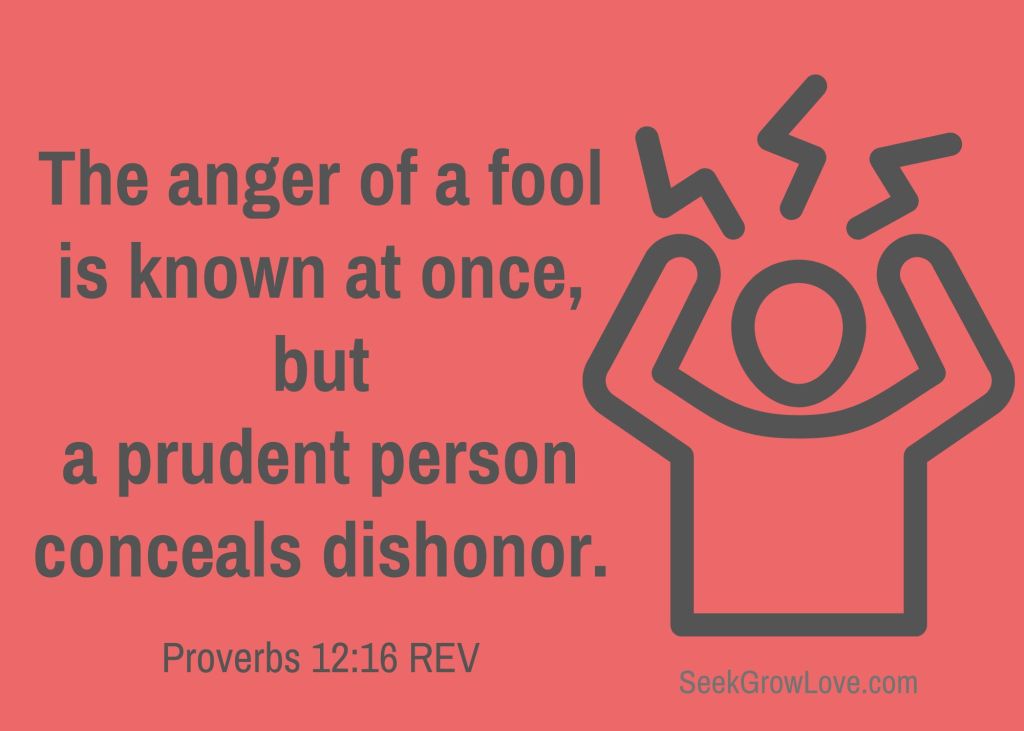
Proverbs chapter 12 has some very interesting proverbs that can walk us deeper into understanding the wisdom and knowledge that begins with the fear of Yahweh (cf. 1:7; 9:10). One of those proverbs is 12:16, which says, “The anger of a fool is known at once, but a prudent person conceals dishonor.”

Picking up on the conjunction “but” that connects the two lines together, this suggests that the parallelism in this proverb is likely antithetic, meaning the two lines are expressing opposing ideas. In the first line, the main idea is that the “anger of a fool” is readily apparent (i.e., “known at once”). The question we always need to ask ourselves when reading wisdom literature, especially Proverbs, is, “How is this proverb true?” In other words, “What circumstance could this proverb be accurately describing?”

Have you ever known someone who had a short temper? And what was the characteristic behavior of this individual that earned them this reputation? Probably they got angry easily, right? The first line is identifying that a fool is someone who has no control over their temper and quickly erupts at the smallest provocation. They are a “hot head” just waiting to blow. Given the wrong remark or facial expression from others, their attitude can turn sour in an instant and their anger flares up like a barrel fire.

On the contrary to this foolish behavior, the “prudent person,” who exercises self-control and discipline and has a “cool head” about them, “conceals dishonor.” Thus, unlike the fool that vents their anger immediately, unable to rule their emotions but makes an open show of their contempt, the “prudent person” covers over, overlooks, or does not give attention to the dishonorable actions of others. They do not respond in a like manner with unrestrained, emotionally charged reactions.

Thus, the point of the proverb is that a wise person recognizes the best way to handle criticisms or insults and does not react impulsively or irrationally by stooping to meet the fool at their level.

Have you ever just wanted to let someone have a “piece of your mind”? I sure have, and I bet you have too. But the self-restraint required to not vent one’s frustration or anger is part of living with wisdom. Did you know that learning how to rule over your emotions was exercising godly wisdom? It may not “feel” as good in the moment as it would if you yelled at the other person, but wisdom is not about what “feels” good—it is about what is good and right to do that glorifies Yahweh and aligns with his intention for how life is best lived. Therefore, the wise person must deny the temptation to give in to destructive emotions, like uncontrolled anger, that would inflict harm on others. Wisdom teaches how to build strong, healthy relationships and ways of interacting that promote peace and godliness. And that entails being able to keep one’s emotions in check.

-Jerry Wierwille

Reflection Questions:

  1. Give some examples of how temper can interfere with living a life that glorifies Yahweh. Any come to mind when you were the one with the hot head? How could it have played out differently with more self-control?
  2. How can you work on more self-control and discipline? Ask Yahweh, too.
  3. What does Yahweh value?

A Bad Relationship

Judges 16

March 2

If you have been in the dating world for any amount of time, there is a high chance that you have had a bad relationship at some point. We’ve all probably had a date go wrong, had someone cheat on us, or had a relationship just not go where we thought it would. This is so common that it shouldn’t surprise us to find an example (among many) within the Bible itself, and that’s what we see with Samson. Blessed with incredible strength by God, Samson sacrificed that gift because he thought he loved someone and paid for it with his life. However, as we look at the story, we see that this was avoidable, and it is a powerful lesson for all of us that bad relationships in general are usually avoidable too.

Looking at Samson’s life, we see that, although he was blessed by God from an early age, he was driven by passion and lust (v. 1). He was so driven by his lustful passions that he fell in love with a woman from the Philistines, who did not worship the same God as him. Not only that, but we learn nothing about how they related to each other’s families, or how quickly they got involved together (although, it can be assumed by his track record that they jumped into things quicker than most). Samson wasn’t aware that Delilah planned on betraying him and didn’t really love him back. Perhaps he would have known if he spent more time thinking it over before getting involved? 

How often do you hear stories about people who “loved” someone else, only to find out later that they weren’t the person they thought? How many of you, or people that you know, have stories about rushing into relationships too quickly, only to have it hurt you in the end? Have you ever been involved with someone else who didn’t share the same beliefs as you, causing you to sacrifice your morals and convictions to please them? This happens all the time, but God doesn’t want this for us. He has given us clear instructions to have healthy relationships in the Scriptures, because as our Father, He wants what is best for us. Patiently consider what God says about dating and marriage before you get too deep with someone else.

-Talon Paul

Questions to Consider

  1. If you are considering dating someone right now, have you taken your family’s and your church’s opinions to heart? Dating is intended to bring you towards marriage, and your family’s view of the person could be life-altering in the future.
  1. The apostle Paul encourages us to not be “unequally yoked” to unbelievers (2 Corinthians 6:14). Their morals and views of the world do not always match up with your own. How important is your potential date’s faith to you, and is it a deciding factor in your relationship? Should it be?
  1. What guard-rails or boundaries have you set up in your relationship to maintain your faithfulness to God? Breaking these barriers can have life-defining consequences in the future.

Boundaries

Deuteronomy 6

February 19

Love is one of the most powerful things in the world. You love your friends and your church, but most importantly you love your family. God is our father and he gives unconditional love to us. As we should give him this love he also shows us many times in the Bible, that love comes with boundaries and rules. The commands in Deuteronomy 6 show this. In any relationship there has to be boundaries and rules in order for it to be a healthy and loving relationship. These rules, like not putting your lord your God to the test, must be followed. Love comes with these boundaries and rules to have a steady balance. Look at the relationships you have. The love you have with certain people comes with certain boundaries and rules.

-Genesis Dylewski

Questions for Reflection and Discussion

  1. How do you show your love for God? With your heart? With your soul? With your strength? Are there any areas of your life where you feel you should love God more? How so?
  2. What was to be taught to the children? How? Why? How well are you passing along the knowledge of who God is, and how to love and obey Him to the younger generation? What can you do this week and throughout the year to increase your involvement and effectiveness with teaching and encouraging the children and youth in their Christian faith and upbringing? What will happen if we don’t?