
*Deuteronomy 23-24
Psalm 29
*Mark 14
-Devotion by Jeremy Martin (TN)
Today’s reading has a number of gems in it, that not only teach us about God’s character but also the character of His son. In our Deuteronomy readings today we see a number of statutes; take a moment to read them all carefully and consider them as a group (note that we could spend a lot of time here, but there is a huge, critical, overwhelmingly important theological revelation in Mark 14 that we will spend a lot of our time on ). God is holy (Deut 23: 9-14,17-18,21-24), and will be treated as such when in His presence. God will judge each of us individually (Deut 24:16), we won’t be held responsible for the sins of another. God wants us to treat each other with mercy and love (Deut 23:15-16, 25, and chapter 24 in it’s entirety). The equity (or, ultimate fairness) of God is something that always amazes me. God’s will for His people is that they honor and revere God, and treat each other with love and respect.
We humans have a will too, but since we are human beings and not God, we have limited perceptions and because of this we tend to make poor decisions at times. Think of it this way: as human beings walking along the road of time we can see moderately clearly where we are standing, looking backwards we can see a narrow view of where we have been (but even so it grows fainter in the distance), and looking ahead we are essentially just guessing how the path will go based on the path we’ve walked so far. This doesn’t really highlight how limited our perceptions are, so now let’s imagine that this road is almost completely dark, and as we walk we are holding a candle that faintly illumines a tiny area around us as we walk; but there are vast worlds and other paths aside from the one that we walk that we can’t see which others are walking. That’s what it’s like to be human.
My whole point is this: our perceptions are very, very limited. Our tiny human brains can only perceive so much, the limitation of the human eyeball only accepts a very specific very tiny range of light frequencies, the human ear only hears a very specific very small range of sound frequencies, and all of our senses have limitations built into them. God, on the other hand, our Creator, is not limited in this fashion. He sees the thousands upon thousands of potential paths that we all walk on, fully illumined, and from the beginning of the trail of our birth to the end of the trail at our demise. The God who made us does not suffer from our inherent limitations, and as such, has a much clearer macroscopic picture. It is only logical that His will is superior to ours, since He has a much clearer perception of not only us, but our neighbor, and the world (all of which He created). The God who made your heart knows it better than you do yourself.
This is why the wise person submits himself to the will of God, because God has better information and therefore can make better decisions with better outcomes (Hillary Scott has a great song out called “Thy will” which I recommend). We tend to be very limited and narrow in our vision, and tend to make poor decisions with poor outcomes when we rely on our own will because of our inherent limitations. The more you rely upon your own will, the poorer the decisions and the worse the outcomes (and trust me, I’m speaking from painful experience on this one).
When we come to our reading in Mark 14 today, our savior Yeshua (Jesus), our future king, is having a crisis of faith. You see, having been born a man; a nice Jewish boy from the line of David (Matt 1,), even though God both knit (Luke 1:35) and sent Jesus (according to Jesus, 32 times in the book of John), even though he was the prophesied and anointed Messiah (the son of David, the son of God, the king who will rule forever: 2 Sam 7), Jesus still self-identified as a son of man (a human, about 72 times in the gospels). So even though God had knit and sent this man to be the savior of Israel (and the world), and even though Jesus was given a portion of the holy spirit that allowed him to perform signs and wonders in the name of the Most High God, he was in fact (by his own words, John 8:40) still a man.
Every human, when they are faced with their own mortality, has some serious thinking to do, even if you have been given a large portion of the holy spirit. We know that God had revealed to Jesus that he was about to die because we can see from the passage here in Mark 14:32-42 that he is agonizing over his upcoming gruelling death. I believe that one of the main reasons that our God revealed this to Jesus is that our God is, overwhelmingly, fair and equitable. He wanted to allow a choice to His chosen Messiah; a final act of complete trust and obedience (reminiscent of the one he offered Abraham when he was asked to sacrifice his only son from Sarah to determine his faith).
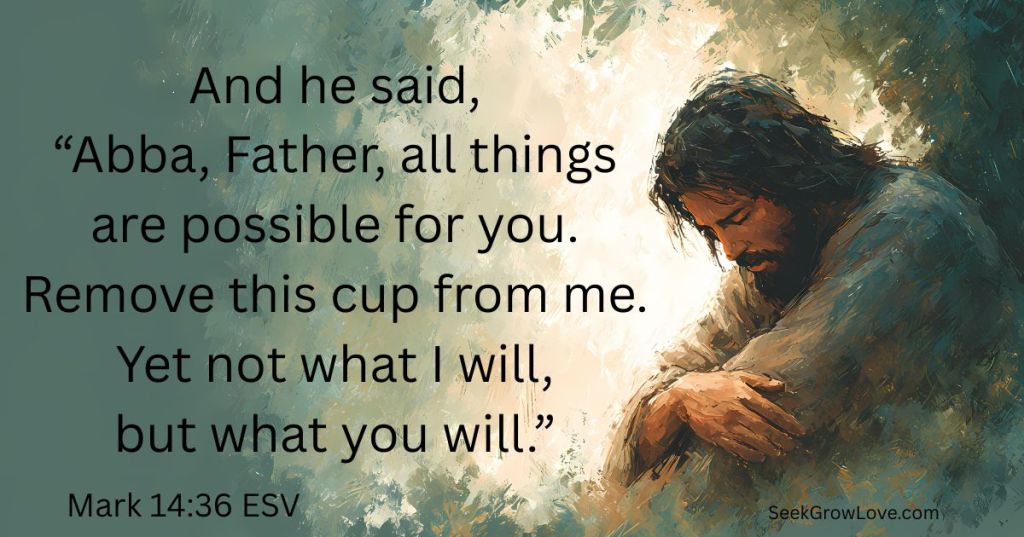
“…Abba! Father! All things are possible for you; remove this cup from me; yet not what I will, but what You will.” ( Mark 14:36 LSB). Jesus knows that God can do all things, and hopes there is another way and asks God to provide it, but he also completes that request with an obedient submission to the will of the Most High God, YHVH. If you have accepted some of the later traditions of men in understanding of the nature of God, this will create some serious questions for you; because we see clearly that Jesus is subordinate to the Father and one of the primary tenets of many groups is to insist on their equality, but that’s just not what the scriptures say.
Jesus has his own will and it’s to not die, just as Abraham’s will was not to sacrifice his son, but he obediently complies and submits to the will of God, just like his ancestor Abraham. This is not the act of an equal, but a loyal subordinate. If you acknowledge this clear scriptural understanding then you are going against a lot of “traditional” requirements in many churches and you might just get kicked out of band camp if you bring it up, because that conflicts with some of the other later ‘developed’ traditions of men that have come to be traditional requirements. Please remember though: you are the one that will stand before God to account for yourself, not your church group or pastor, but you. Trust God.
So what do you do if scripture doesn’t agree with your doctrinal theology? Change your doctrinal theology, of course; we are under the scriptures and not above them. Scripture is our guideline, the word of God transmitted in written form, and if we are going to be obedient children of God, like our Messiah, King Jesus, then we must submit to God’s authority. When God speaks, we listen, period. Is a servant greater than his master? “Verily, verily, I say unto you, The servant is not greater than his lord; neither he that is sent greater than he that sent him.” (John 13:16 KJV). In the book of John alone, Jesus explicitly states that the Father has sent him over 30 times, and also states “As the Father has sent me, I am sending you” (John 20:21 LSB). The Christ is under the authority of God, the Father, and we are under the authority of the Christ. It’s a pretty straightforward corporate organizational chart, if you believe scripture and hold to it as authoritative.
REFLECTION QUESTIONS
- Why do we often follow our own will and not God’s?
- Have you ever changed something you believed because scripture indicated something different?
- God sent Jesus, Jesus sent us: are you being a good representative and can you improve?
PRAYER
Abba! Father! Not my will, but Yours be done. Show me Your will, Father, and grant me the perseverence and humility to submit to it. Help me to be a servant who pleases you, Father. All things belong to You, and all of the blessings that I’ve received have come from You, even my life. Lead me and teach me, please. Thank you, in Jesus name, Amen.
 Seek Grow Love