Love Your Kids – Obey God

Genesis 24-26

Abraham was a man of incredible faith.  God made astounding promises to Abraham, and Abraham believed God – and this was credited to him as righteousness.  Abraham lived a long and faithful life of service to God, then, as recorded in Genesis 25, Abraham died.

We’re picking up the story in Genesis 26 – after Abraham was dead and gone.  Genesis 26 starts by telling about a famine in the land that was so bad that Isaac (Abraham’s heir) had to move to have enough food to eat.

Then we find this amazing encounter in Genesis 26:2-6, “The Lord appeared to Isaac and said, ‘Do not go down to Egypt; live in the land where I tell you to live. Stay in this land for a while, and I will be with you and will bless you. For to you and your descendants I will give all these lands and will confirm the oath I swore to your father Abraham. I will make your descendants as numerous as the stars in the sky and will give them all these lands, and through your offspring all nations on earth will be blessed, because Abraham obeyed me and did everything I required of him, keeping my commands, my decrees and my instructions.’ So Isaac stayed in Gerar.”

God promised:

  • To give Isaac and his descendants all these lands
  • To confirm the oath God has sworn to Abraham
  • To make Isaac’s descendants as numerous as the stars of the sky
  • To bless all nations on earth through Isaac’s offspring (Jesus)

And did you notice why God extended all of these promises to Isaac?  “Why” is recorded in verse 5: “because Abraham obeyed me and did everything (emphasis added) I required of him, keeping my commands, my decrees and my instructions.”

Did you catch that?  Isaac was promised that he would receive incredible blessings because his dad had obeyed God and had done everything God required.  

A couple of years later, in Genesis 26:24, we read, “That night the Lord appeared to him and said, “I am the God of your father Abraham. Do not be afraid, for I am with you; I will bless you and will increase the number of your descendants for the sake of my servant Abraham.”

Again, God extended blessings to Isaac because of Abraham’s faithfulness.

And oh yeah, most of that obedience to God was before Isaac was even born.

We’ve heard about the blessings for ourselves if we follow God – especially eternal life in the Kingdom of God.  We don’t often think of the blessings for our descendants because of our faithfulness to God. 

When I was young, my dad would have us memorize scripture.  One of those verses he had us memorize was Psalm 37:25 which says, “I was young and now I am old, yet I have never seen the righteous forsaken or their children begging bread.”

I think the point my dad was trying to make was that we needed to be righteous, and God would never forsake us.  But I remember thinking something like this at the time: “I’m glad my dad is righteous, because in spite of my not necessarily being righteous, I will be blessed because of my dad’s righteousness.”

Now that I’m old, I recognize that the decisions I made, and the example I demonstrated had an impact (for good or for bad) on my kids.  As a result, they have picked up both some of my good traits and some of my bad traits.  I wish now that I had demonstrated more good examples and fewer bad examples – not only for my own benefit, but also for the benefit of my children.

Now let’s talk about you.  It doesn’t matter if you’re a teen, a parent, a grandparent, young, or old.  The most important thing you can do with your life is to obey God, and do everything He requires.  This will guarantee you eternal life in God’s coming kingdom, and may also give you many blessings in this life (not necessarily including health and wealth).  But in addition to your blessings, you may also pass along an inheritance of faithfulness to God to your kids – even those unborn.  And then they too can have incredible blessings.  

So, if you love your kids, obey God.

-Steve Mattison

Reflection Questions

  1. What are all the benefits/blessings you see to obeying God? Which have you already enjoyed? Which are you still looking forward to?
  2. How are you doing in the faithfulness department? Will God be able to tell your descendants that you obeyed Him, did everything He required, and followed His laws?
  3. What did God reveal about Himself to you today?

(originally posted for SeekGrowLove January 16, 2023)

God Provides in Times of Testing

Old Testament: Genesis 21 & 22

Poetry: Psalm 8

New Testament: Matthew 8

God had promised Abraham, in Genesis 17:19, “Your wife Sarah will bear you a son, and you will call him Isaac.  I will establish my covenant with him as an everlasting covenant for his descendants after him.”

At this point, Abraham was over 100 years old, and had faithfully followed God.  In Genesis 12, Abraham obeyed when God told him to leave his country and family.  Abraham allowed Lot to take the lush land around Sodom in Genesis 13, and trusted God to provide for his own flocks and herds on barren mountains.  In Genesis 15, Abraham trusted God’s promise that he would have a son in his old age, and God counted that faith as righteousness.

In Genesis 22:2, we find God commanding Abraham, “Take your son, your only son, Isaac, whom you love and go to the region of Moriah.  Sacrifice him there as a burnt offering on one of the mountains I will tell you about.”

This doesn’t make sense.  God had explicitly promised that God’s promises to Abraham would be passed down through Isaac’s descendants, and now God was commanding Abraham to sacrifice him – apparently destroying the promise He had made to Abraham.

By this point, Abraham had developed a very close relationship with God.  In fact, we’re told 3 times in the Bible that Abraham was God’s friend (2 Chron 20:7, Isaiah 41:8, James 2:23) – and as far as I know, Abraham is the only person in the Bible of whom this is said.

We’re told in Hebrews 11:19 that Abraham reasoned that God was able to raise the dead, and that He was going to keep His promise.

So early the next morning, Abraham took Isaac and 2 servants and left for the place God told him to go.  When they got close, Abraham told the servants, “Stay here with the donkey while I and the boy go over there.  We will worship and we (emphasis added) will come back to you.”

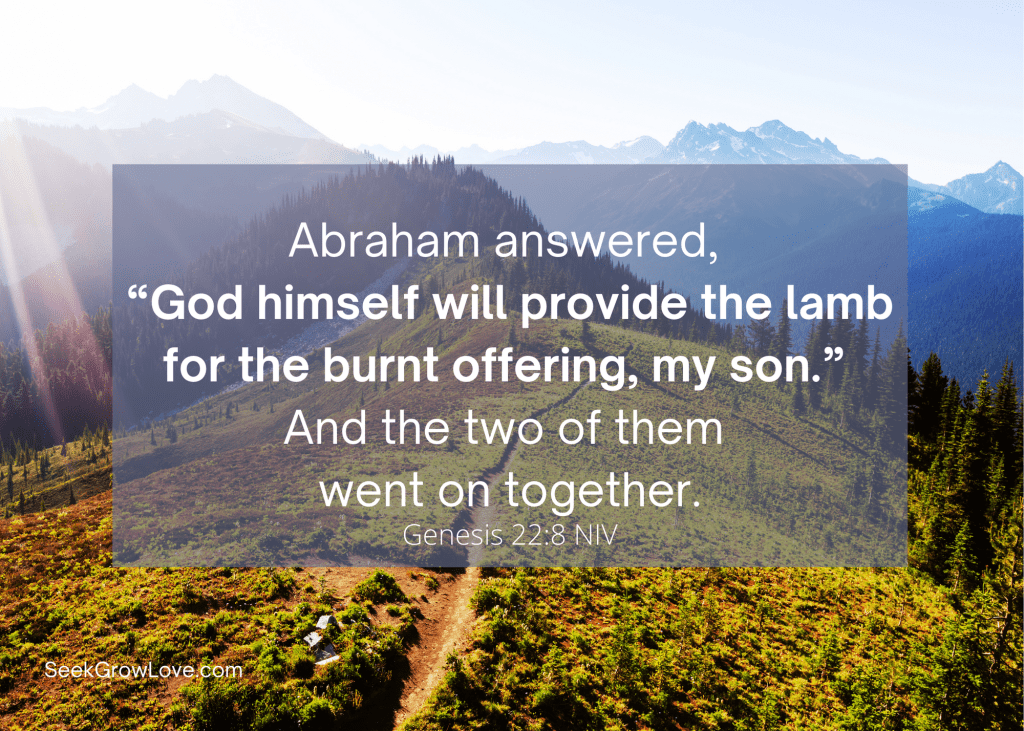
As they got even closer, Isaac asked his dad, “The fire and wood are here, but where is the lamb for the burnt offering?”

Can you imagine how this must have broken Abraham’s heart, looking down into his son’s questioning face, knowing that in a few minutes he would be killing his beloved son, who would be the offering?  Abraham answered, “God himself will provide the lamb.”  (Actually, God had provided Isaac – as a miracle baby in his parent’s old age.)  When they reached the place God had told him about, Abraham built an altar, arranged the wood, tied up Isaac, and laid him on the altar.  

As he was getting ready to kill Isaac, the angel of the Lord called to him from heaven and stopped him.  Abraham then saw a ram caught in the brush by its horns, and sacrificed it instead.  God then promised Abraham, as recorded in Genesis 22:16-18, “I swear by myself, declared the Lord, that because you have done this and have not withheld your son, your only son, I will surely bless you and make your descendants as numerous as the stars in the sky and as the sand on the seashore… and through your offspring, all nations on earth will be blessed, because you have obeyed me.”

I could point out all the similarities of Abraham’s being willing to sacrifice his son Isaac, and God being willing to sacrifice His Son, Jesus.  I could point out the significance of another quote from this chapter, “Jehovah Jireh – on the mountain of the Lord it will be provided.”  (This was the mountain where Soloman’s temple was built hundreds of years later.)  I could point out the importance of obeying God, and the benefits that result.

Instead, I want to comment on who, when, where, how, and why of God’s provision.  

Who:  God tested Abraham with a very difficult test even after a life of serving God.  We see that God provided the ram in this case only after Abraham trusted and obeyed God – even though it didn’t make sense.  Assertion:  God provides for those who trust Him and obey Him.  

When:  God provided for Abraham at the very last minute, not before.  We’re told in Hebrews 4:16 that we will “receive mercy and find grace to help us in our time of need.”  Assertion:  God provides precisely when we need something, not when we think we need it.  (i.e.  according to God’s timing.)

Where:  God provided for Abraham only after Abraham went where God told him to go, and after he obeyed everything God told him to do.  Assertion:  God will provide if we are where He wants us to be.  We should have no expectation of receiving God’s provision if we aren’t where He wants us to be. 

How:  God didn’t send an angel from heaven with an offering for Abraham to sacrifice, God provided a normal ram, caught in a normal thicket, by it’s normal horns.  And God didn’t send a whole flock of sheep, just one ram, because that was all that was needed.   Assertion:  God will usually provide in ways that are very natural – don’t look for miracles.

Why:  In times of testing, it’s easy to only think about our problems, and focus on, “why is this happening to me?”  I think there may be two general reasons why trials come.  First, we are told in Romans 8:28, “And we know that in all things God works for the good of those who love Him, who have been called according to His purpose.”  Note that this only applies if we are living according to His purpose.  Also note that trials are by definition difficult, and won’t seem to be beneficial at the time.  Second, ultimately, everything is for God’s glory.  Isaiah 43:7 says, “everyone who is called by my name, whom I created for my glory…”  We see an example of this with God destroying Pharaoh and his army for God’s glory in Ex 14:4, 17.  Assertion:  God allows trials and gives provision for our good and for His glory.

The bottom line is, if we are faithfully following God, times of testing will come.  If we remain true to God, if we are where He wants us to be, and if we are obedient to Him, he will provide what we need (not necessarily what we want), at the very last minute, usually through normal means – and this is for our good.  If we aren’t following God, the times of testing may just be to bring Glory to Him.  I’d rather be in that first group.  How about you?

–Steve Mattison

(originally posted January 11, 2021 for SeekGrowLove)

I am sorry this was not posted this morning – I thought it was – and then was surprised to see it still sitting here this evening. We are enjoying a weekend of reFuel North, a youth retreat in northern Indiana and haven’t been on the computer today. 

Reflection Questions

  1. In what times of testing have you seen God provide for you? How?
  2. Are you where God wants you to be now so that He can provide for you?
  3. What do you learn from Abraham in Genesis 21 & 22?

The LORD Will Provide

Genesis 22

February 3

There are many different times that different people in the Bible confess their true faith. At the beginning of Genesis 22, God tells Abraham to sacrifice his only son. We see Abrahams’s true faith when he doesn’t protest or complain. He just does what God told him to do. I for one am very jealous of his faith. 

As Abraham was stretching out his arm to slay his son, an angel of the Lord called to him from heaven telling him to stop. Then, they heard a rustle from behind them and it was a ram. This shows us that God is with us and He will always provide a way. We just have to have faith like Abraham. I hope that we can all grow our faith in the near future and fully trust in Him.

-Nik Ransom (youth who attended reFUEL: North last month, and son of one of our writers two weeks ago)

Questions for Reflection and Discussion

  1. Take a moment and think about what you love most in life. Would you be willing to give whatever it is if God told you to? Would you give it up with or without hesitation?
  2. Abraham is known as a man of great faith. Why? What does James have to say about Abraham in the New Testament? (James 2:14-26) Is it possible to have great faith without action/deeds/obedience? How can we practice growing our faith?
  3. Re-read the account of Abraham willing to sacrifice his son Isaac while knowing what you know of God’s sacrifice of His son Jesus. What similarities do you find? What differences? What does this say of God’s sacrifice and love for you?

Tomorrow we will be reading Genesis 27.

Abraham is tested

Today’s Bible Reading – Genesis 21-22 and Matthew 11

God had promised Abraham, in Genesis 17:19, “Your wife Sarah will bear you a son, and you will call him Isaac.  I will establish my covenant with him as an everlasting covenant for his descendants after him.”

At this point, Abraham was over 100 years old, and had faithfully followed God.  In Genesis 12, Abraham obeyed when God told him to leave his country and family.  Abraham allowed Lot to take the lush land around Sodom in Genesis 13, and trusted God to provide for his own flocks and herds on barren mountains.  In Genesis 15, Abraham trusted God’s promise that he would have a son in his old age, and God counted that faith as righteousness.

In Genesis 22:2, we find God commanding Abraham, “Take your son, your only son, Isaac, whom you love and go to the region of Moriah.  Sacrifice him there as a burnt offering on one of the mountains I will tell you about.”

This doesn’t make sense.  God had explicitly promised that God’s promises to Abraham would be passed down through Isaac’s descendants, and now God was commanding Abraham to sacrifice him – apparently destroying the promise He had made to Abraham.

By this point, Abraham had developed a very close relationship with God.  In fact, we’re told 3 times in the Bible that Abraham was God’s friend (2 Chron 20:7, Isaiah 41:8, James 2:23) – and as far as I know, Abraham is the only person in the Bible of whom this is said.

We’re told in Hebrews 11:19 that Abraham reasoned that God was able to raise the dead, and that He was going to keep His promise.

So early the next morning, Abraham took Isaac and 2 servants and left for the place God told him to go.  When they got close, Abraham told the servants, “Stay here with the donkey while I and the boy go over there.  We will worship and we (emphasis added) will come back to you.”

As they got even closer, Isaac asked his dad, “The fire and wood are here, but where is the lamb for the burnt offering?”

Can you imagine how this must have broken Abraham’s heart, looking down into his son’s questioning face, knowing that in a few minutes he would be killing his beloved son, who would be the offering?  Abraham answered, “God himself will provide the lamb.”  (Actually, God had provided Isaac – as a miracle baby in his parent’s old age.)  When they reached the place God had told him about, Abraham built an altar, arranged the wood, tied up Isaac, and laid him on the altar.  

As he was getting ready to kill Isaac, the angel of the Lord called to him from heaven and stopped him.  Abraham then saw a ram caught in the brush by its horns, and sacrificed it instead.  God then promised Abraham, as recorded in Genesis 22:16-18, “I swear by myself, declared the Lord, that because you have done this and have not withheld your son, your only son, I will surely bless you and make your descendants as numerous as the stars in the sky and as the sand on the seashore… and through your offspring, all nations on earth will be blessed, because you have obeyed me.”

I could point out all the similarities of Abraham’s being willing to sacrifice his son Isaac, and God being willing to sacrifice His Son, Jesus.  I could point out the significance of another quote from this chapter, “Jehovah Jireh – on the mountain of the Lord it will be provided.”  (This was the mountain where Soloman’s temple was built hundreds of years later.)  I could point out the importance of obeying God, and the benefits that result.

Instead, I want to comment on who, when, where, how, and why of God’s provision.  

Who:  God tested Abraham with a very difficult test even after a life of serving God.  We see that God provided the ram in this case only after Abraham trusted and obeyed God – even though it didn’t make sense.  Assertion:  God provides for those who trust Him and obey Him.  

When:  God provided for Abraham at the very last minute, not before.  We’re told in Hebrews 4:16 that we will “receive mercy and find grace to help us in our time of need.”  Assertion:  God provides precisely when we need something, not when we think we need it.  (i.e.  according to God’s timing.)

Where:  God provided for Abraham only after Abraham went where God told him to go, and after he obeyed everything God told him to do.  Assertion:  God will provide if we are where He wants us to be.  We should have no expectation of receiving God’s provision if we aren’t where He wants us to be. 

How:  God didn’t send an angel from heaven with an offering for Abraham to sacrifice, God provided a normal ram, caught in a normal thicket, by it’s normal horns.  And God didn’t send a whole flock of sheep, just one ram, because that was all that was needed.   Assertion:  God will usually provide in ways that are very natural – don’t look for miracles.

Why:  In times of testing, it’s easy to only think about our problems, and focus on, “why is this happening to me?”  I think there may be two general reasons why trials come.  First, we are told in Romans 8:28, “And we know that in all things God works for the good of those who love Him, who have been called according to His purpose.”  Note that this only applies if we are living according to His purpose.  Also note that trials are by definition difficult, and won’t seem to be beneficial at the time.  Second, ultimately, everything is for God’s glory.  Isaiah 43:7 says, “everyone who is called by my name, whom I created for my glory…”  We see an example of this with God destroying Pharaoh and his army for God’s glory in Ex 14:4, 17.  Assertion:  God allows trials and gives provision for our good and for His glory.

The bottom line is, if we are faithfully following God, times of testing will come.  If we remain true to God, if we are where He wants us to be, and if we are obedient to Him, he will provide what we need (not necessarily what we want), at the very last minute, usually through normal means – and this is for our good.  If we aren’t following God, the times of testing may just be to bring Glory to Him.  I’d rather be in that first group.  How about you?

–Steve Mattison

Holding Nothing Back

Genesis 22-24

Genesis 22 12b NIV

One of the sayings that I sort of cling to in my life is, “You get out of life what you put into it.” I find this can be helpful in those moments where Netflix or a nap can be much more appealing than doing homework, reading a book, folding laundry or any of the other responsibilities we have in this life. Even though some of those things listed like folding laundry or reading a book I can really enjoy and get a sense of accomplishment from doing those things. In a way doing things like taking naps or watching Netflix are just easier and don’t require any brain activity from me. For instance there can be a temptation to just read devotions and not actually read the Bible on your own. This is because reading a devotion, which is an already processed thought is easier than having to read and process the Bible on your own.

Now, is reading devotions great?  Absolutely.  Devotions are great because you can see what God worked on in another person’s heart and that is pretty cool to be a part of. I love writing these devotions and hope they add to your spiritual growth and help you understand God better.

You may be wondering why I wrote two paragraphs about putting an effort into life and what I really think is the principle at work here is sacrifice, and that is what Genesis 22 is really about.

In Genesis 22.1-14 is a story about sacrifice and commitment to God and I don’t think it is necessarily in the way that we think. Right now, you should go read Genesis 22.1-14. My next paragraph will wait for as long as they maintain the rights to the domain name. Haha

I’m glad you are back. What Abraham was about to do here is crazy. He was willing to offer his son, that he had waited 25 years for and had at 99 years, because God told him to. Abraham could have so easily rationalized disobedience away by saying “There is no way that I am going to harm a child.” But Abraham decided to obey God despite all reservations that he had. One of my favorite verses as a teenager and even now is Matthew 6.21 “For where your treasure is, there your heart will be also.” Abraham didn’t treasure his child more than he treasured God and IT SHOWED in a big way. He held nothing back from God.

You may be getting a mixed message at this point. I’m not telling you to give all your stuff away or to sacrifice your brother or sister as a burnt offering. That would not bless God. What I am telling you is that if you live your life holding nothing back from God, you will reap the reward from that. The same principle applies to how much work and effort you put into your spiritual growth.

If you want God to really change your life cut Netflix out of your life for a month and instead spend that time with your head in a Bible and see what God does in your heart and how he changes you.

If you really want to serve others and see God do something through you then commit yourself to that and go do it. Make it your center point! Go help others in whatever way you can. Look for ways to serve others and give your life away to them.

The reason that Abraham is the father of our faith is because he held nothing back. After this story Abraham received a promise from God that his offspring would be as the stars in heaven and sands on the seashore and that all the nations of the earth would be blessed through him. Abraham got out of life what he put in. Abraham was used by God through this promise because Abraham was completely devoted to God.

I know there is a better life. When our lives are completely focused on God, something changes. I want to say this to you and hope you take it to heart. I know what being sold out to God is like and it is uncomfortable and can be really hard but the reward is life altering, it’s God glorifying and it’s kingdom strengthening. Our sacrifices don’t go unnoticed by God and they will come to fruition and it isn’t always how we expect it.

Do not take this as me telling you that you can make God do things but rather God honors the sacrifices that we make in our lives for him. He in turn wants to bless us and help us. Do not do any of things that I mentioned unless you really want to do them. God doesn’t want just sacrifices. He wants our hearts behind the sacrifices that we make and, honestly, that is the key to love. When your heart and actions combine into one that is true love.

Daniel Wall


Today’s Bible passage can be read or listened to at https://www.biblegateway.com/passage/?search=Genesis+22-24&version=NIV

Tomorrow’s passage will be Genesis 25 & 26 on the 2020 Chronological Bible Reading Plan