Embrace Life

Old Testament: 1 Chronicles 17 & 18

Poetry: Ecclesiastes 9

New Testament: Colossians 1:1-14

One of life’s great paradoxes is that it is predictably unpredictable. Life never seems to go the way we think. Solomon reflects on the inevitability of mortality where death is the great equalizer, the advantage of being alive, and encourages the reader to relish and enjoy life on the way to death, because that is what awaits everyone in the end.

There is a common “fate” that awaits every person: death. And regardless of a person’s righteousness or wickedness, the same end is waiting for them. Solomon says, “people do not know whether it is love or hatred; everything is ahead of them.” “Love or hatred” refers to divine favor or judgment. No one knows what their work will produce because it lies in the future. According to Solomon’s method of investigation, no one can say whether they will receive “love” or “hatred” in the future.

Solomon describes the common denominator of life—death—as an “evil” that is done under the sun. No one can predict when it will happen, and no one can escape it. There is “one event” that happens to all. After death, a person has no further reward or enjoyment of things done under the sun.

But for those who have not joined the ranks of the dead, Solomon says “there is still hope!” There is “hope” that while being alive a person can acknowledge the reality of death and thereby embrace the joys in life that they can, because no possibility exists for the dead as their life has ended and there is no going back.

In Solomon’s perspective, life is better than death. Period! Even a measly, no good dog (the ancient world did not have a high view of dogs) is better than a dead lion (viewed as one of the strongest and greatest of all animals in the ancient world). He brings the “hope” of the living into plain view by bluntly stating the obvious, “the living know they will die, but the dead do not know anything.”

Solomon’s point is for the reader to embrace life and all its blessings and joys. We only have a certain amount of time to do this, and then it is over, and we can’t have more.  When a person dies “their hatred, and their envy” all perish with them. And so, while we are living, Solomon advises that we pursue life to the fullest and to engage in every activity with all that we are. Soon enough, we won’t be able to. So live it up, Solomon says, “Let your garments be always white, and do not let oil be lacking from your head. Enjoy life with the wife whom you have loved.” He is using very festive language here about wearing white garments and applying oil on one’s head.

But it is important to note that as part of the life that Solomon suggests one should live, he includes dedicating the time to work hard. That is part of the fullness of life, and the food and drink from one’s labor is part of the essential joys one can partake of in life.

Solomon turns to address the uncertainty of life as something perplexing and which he finds unsatisfying. Everything he lists seems to be disordered. The race should be won by the fastest racer, the battle should be won by the strongest soldier, wise people should have food to eat, foolish people shouldn’t have money, people who are skilled should be preferred (i.e., have favor), etc. But Solomon identifies that “time and chance happen to them all.” The point is misfortune and disaster are not selective about who they happen to fall on any given day. Everyone is susceptible to the chance of bad things happening to them. To prove his point, Solomon draws upon two negative images—fish in a net and birds in a snare—to illustrate the horror of the human condition where people find themselves encountering adversity when they least expect it.

In the final section of the chapter, Solomon tells a parable of a small city that is saved by the wisdom of a poor man, but in time, the poor man was forgotten about. So, Solomon affirms traditional wisdom that says, “Wisdom is better than strength.” But people did not recognize the poor man’s wisdom as such and soon forgot about it and him.

While traditional wisdom says that “wisdom is better than strength,” Solomon’s observations seem to complicate that conclusion because things are not always that way in reality. According to the narrative in his parable, it only takes one sinner to destroy (i.e., neglect) what wisdom says. And so, Solomon is asserting that as powerful and valuable as wisdom is, it has its limits. It is certainly preferrable to foolishness, but it is not immune to the destructive effects of a little foolishness. A small bit of foolishness can spoil the greatness of wisdom. This then begs the question, “What real value is wisdom if it can be overthrown so easily by a single fool?”

-Jerry Wierwille

Reflection Questions

  1. How has the unpredictability of life ever caught you by surprise?
  2. What do you enjoy about life? How do you embrace it? Does this include your labor?
  3. Can you give an example of when or how, “A small bit of foolishness can spoil the greatness of wisdom”?

What you See vs. What you Know

Old Testament: 1 Chronicles 15 & 16

Poetry: Ecclesiastes 8

New Testament: Philippians 4:10-23

Solomon begins by asking “Who is like the wise man?” in a rhetorical fashion to get the reader to consider if they are like the wise man in the verses that follow where Solomon will set forth several scenarios involving a king (who represents any authority figure) and how certain responses are appropriate or not. The phrase “makes his face shine…hardness of his face is changed” refers to how using wisdom can change the way someone is presenting themselves to their superiors. One’s demeanor and conduct, if done with wisdom, can sway the other person’s opinion of them and earn them their favor.

Verse 3 is probably better as expressing the wisdom in leaving the king’s presence and carrying out his command rather than the instruction to remain since the following phrase instructs the reader to not “persist in an evil thing” by objecting to the king’s command and remaining in his presence to argue and oppose him.

An “evil thing” is likely a reference to a “bad idea” or a proposal that is not favorably received by the king. On the basis of the king’s authority as absolute, anything that interferes with or opposes his will automatically becomes “evil.” However, this is not moral evil, it is just Solomon’s way of describing something that causes trouble (the Hebrew word for “evil” also can mean “trouble”).

Wisdom would say for a person to respect those in authority and not push their agenda or object rudely to their directions. Why is that? Well, Solomon says that “the king’s word is authoritative.” Now, Solomon has in mind a monarchical government where the ruler (i.e., the king) is a totalitarian. This was the common form of government in the ancient world. But in our world, we could think of someone who has a superior rank (e.g., our teachers, boss, or civil leader).

“Whoever keeps the commandment” refers to the person who listens and obeys the king. This person will be safe, and no harm will come to them. Punishment does not fall on the one who does what they are told. Rather, the consequences are reserved for the one who rebels and disobeys.

But if there is a disagreement with the king, Solomon notes that there is “a proper time and procedure,” meaning that there is an appropriate way to provide feedback and one’s opinion for the king’s consideration. The wording here is extremely close to the wording we saw in 3:1—“For everything there is a season, and a time for every matter under heaven.”

Verse 10 begins a new section in Solomon’s discourse in the chapter. The issue that Solomon raises is about justice and retribution. He sets forth a scenario where he sees wicked people live and then die, and he watches them get buried. He even describes them as previously participating in the temple worship of Yahweh, and they received the praise of people in the city where they carried out their wicked schemes.

Here in this section, the pointlessness that Solomon is interested in expressing is about the delay judgment of these wicked people. He asserts that they were never judged while they were alive, and so it seems as though they never were punished, and the victims never received justice for their crimes.

vv. 12-13—this is the first assertion that Solomon makes that departs from his methodology of observation. It is outside the scope of inquiry to know that it will be “better” for the person who fears Yahweh and is reverent before him, since all of his observations point toward an experiential indifference between the righteous and the wicked. In fact, he even notes an inversion that he sees in the world where the wicked live long and the righteous die young.

Solomon is expressing a distinction between what he “knows” and what he “observes.” What he “sees” happening is vastly different from what he internally “knows.” And so, we begin to see the dilemma that Solomon is facing in his quest. But he doesn’t resolve the tension here. He merely presents it.

Solomon expressed a similar idea in 3:16-17, where he said, “16And moreover I saw this under the sun: in the place of justice, that wickedness was there, and in the place of righteousness, that wickedness was there. 17I said in my heart, “God will judge the righteous person and the wicked person, for there is a time of judgment for every purpose and for every deed.”

The judgment of God was not something that Solomon observed. In fact, what he saw was a complete absence of justice “under the sun.” And thus, the issue of delayed justice is brought back up again in verse 14: the righteous are punished and the wicked go free.

Since the judgment of the wicked is not happening in the present world, but Solomon “knows” that it will occur, his advice is to not focus on it, but to enjoy life despite the brokenness and the injustice happening all around. The “joy” that Solomon says is to accompany one’s work and the eating and drinking the fruit of that work has been a theme already mentioned twice before in 2:24 and 5:18.

In certain circumstances in life, we often make a deductive choice on what would be at least a good way to respond. For Solomon, his deduction is at least, “enjoy life,” by eating, drinking, and being merry. This is at least a good response for humankind with the work that God has given them to do.

The exhaustive effort that Solomon has applied to his search has caused him to lose sleep. The lack of any satisfying answer has left him disturbed and unable to find rest. All day and all night, his mind is busy, preoccupied with the question that he feels he must answer. But because he cannot solve it and discover the ultimate meaning of life, he resorted to a simplified suggestion as a baseline of what he knows—it is good to enjoy life as one labors all the days that God has given to them.

Solomon offers verse 17 as a summary of his effort and makes a grand claim that he has observed it all—all the work of God—and his conclusion is that no one can find it out. No matter how thorough Solomon has been or could be in his investigation, his methods fail; he cannot discover the answer to the ultimate meaning of life. And if a wise person thinks that he can figure it out, he’s wrong, Solomon says—He can’t, because no one can.

-Jerry Wierwille

Reflection Questions

  1. Can you give some examples of when what you “see” is different than what you “know”?
  2. What is your approach to people in authority? Is there anything you can learn from Solomon in this chapter regarding your interactions with people in authority?
  3. What are the benefits to being a wise person? What are the limitations to human wisdom?

Satisfaction in Life

Old Testament: 1 Chronicles 11 & 12

Poetry: Ecclesiastes 6

New Testament: Philippians 4:8

In chapter six, Solomon reiterates some of his former sentiments but in a reverse fashion. In 5:18-19, Solomon said, “18Here is what I have seen to be good: it is appropriate for one to eat and to drink and to see good in all his labor in which he labors under the sun, all the days of his life that God has given him for this is his portion. 19Every man also to whom God has given wealth and riches, and has given him power to enjoy them and to accept his portion and to take pleasure in his labor—this is the gift of God.”

Solomon’s frustration has reached nearly a fever pitch by what he sees happening around him with people not being able to enjoy the wealth and honor that God has given them. He offers an anecdote to explain the “evil” that he sees happening “under the sun” and the heavy weight that is upon all humankind: God gives to a person “wealth, riches, and honor” to the degree that they have no lack of anything, and they have all that ever desired. But that is all that they get! God does not give them the accompanying ability to enjoy the bounty and pleasant life that having everything you want is supposed to offer.

Solomon cannot understand why this is the case for some people. His logic is that if someone works hard and God gives them “wealth, riches, and honor,” but then they don’t get to enjoy those things, but rather someone else does, this is wrong and unexplainable in his eyes. To “eat” something was often a metaphor for fully experiencing and enjoying it. It is as if Solomon is thinking, “Why shouldn’t someone get to enjoy the fruit of another person’s labor?” And so, he is repulsed by this observation and finds it entirely enigmatic and confusing.

We are not told why God would withhold giving a person the ability to enjoy the benefits of their hard work and the revenue and recognition that it has produced. But the answer to “why’ really isn’t the focus of his story. Instead, Solomon is bewildered that it even happens at all, and that in his view, such a reality is mysterious and frustrating. He even goes so far as to say that this is an “evil” and a “severe affliction.”

In vv. 3-6, Solomon considers that as enjoyable as having a large family with many children would be, it can’t be the answer to his question about the meaning of life because Solomon says that even if a person had a hundred children, if their “soul is not satisfied with good things,” then it is all pointless. So apparently, children are not the answer for true satisfaction in life.

It is the absence of enjoying the “good things” that brings discontentment. But what are those “good things” if not one’s family? The “good” that Solomon has mentioned already in the book of Ecclesiastes is eating, drinking, and rejoicing in one’s work (5:18). Essentially, Solomon is saying that no matter how good the circumstances are or what you possess or what you can do, if you don’t simply enjoy life, then everything else is pointless.

Furthermore, in his vexation over this issue, Solomon turns to offer a dark comparison by suggesting that a stillborn child is better off than a person who remains unsatisfied in life. This is a grisly move that is emotionally charged, for Solomon thinks that the baby who never had the chance to draw breath is better off than a person who lives an unsatisfied life. Now, Solomon is not defying the Creator and saying that life is worthless and not even worth living. Remember, what Solomon says he says with a certain perspective in mind. Here, he sees the stillborn baby as not having to suffer and endure the frustration and pointlessness of all that goes on under the sun. They don’t have to be subject to a life deprived of enjoyment and filled with futile desires that can never be met.

Solomon appears to move on from this thought (vv. 1-6) to address yet another issue: wisdom and foolishness.

In broad terms in verse 7, Solomon attributes the reason for all human work as being aimed at satisfying his sensual desires, but those desires are never fulfilled. A person is never completely content and satiated—the desires just keep returning. And so, the search for satisfaction is never ending; it is a vicious cycle that keeps spinning. Thus, the inability to find satisfaction is a deep frustration to Solomon.

Solomon perceives that perhaps there is an answer in the teaching of wisdom as wisdom was viewed in the biblical culture as the normative way to acquire material wealth. If a person was wise, then they would be blessed and would prosper and accrue riches. But the wise are not immune to the desire for wealth and material goods which ultimately does not lead to satisfaction.

Furthermore, Solomon does not find wisdom to provide an advantage for the poor person. His point is not that wisdom is unable to help the poor person in their material needs, but that wisdom doesn’t give the poor person an advantage in finding satisfaction in life. Even if the poor person were to gain wealth through employing wisdom in their dealings, they are no closer to satisfying their true desires than the person who was wise to begin with. Wisdom can help a person obtain money, but not meaning in life.

Verse 9 provides the proverbial statement, “Better is the sight of the eyes than the wandering of the desire.” The general idea of the proverb is that what is present in one’s hand that they can use and enjoy is much better than what one desires but does not yet have (and may never have).

Beyond these issues, many questions can plague a person about their life, but which of them can provide the answer to the meaning of life. Solomon exasperates himself to no end trying to understand this answer. Ultimately, he seems to think that no one can know what is “good” for a person in life since life is so brief, and no one can know what will happen in the future after they are gone. Endless questions about if what we do now will have any lasting effect for those who come after us. But we are all left not knowing if there is a “profit” in what we do because we are limited to only knowing the here and now. “For who can tell a person what will be after him under the sun?” (v. 12b).

-Jerry Wierwille

Reflection Questions

  1. Where do you agree with Solomon? Anything you disagree with in Ecclesiastes 6? (Remember, he has not yet come to his final conclusions.)
  2. Can you give some examples of where you have found truth from the proverb in Ecclesiastes 6:9?
  3. How content are you right now with your life? Why or why not? What might Solomon say to you? What might God say to you?

Four Evils Under the Sun

Old Testament: 1 Chronicles 7 & 8

Poetry: Ecclesiastes 4

New Testament: Philippians 4:6

In chapter 4 of Ecclesiastes, Solomon continues his observational reporting about the wickedness and evil that he sees “under the sun.” Some of his assessments about these events accurately describe them as truly “wicked” or “evil,” but at other times he uses that terminology simply to describe something that is frustrating and/or enigmatic (i.e., too complicated to comprehend).

The first problem that the Sage identifies is oppression, which is an extension of his critique on social injustice in the previous section (3:16-17). Oppression is a general term that can refer to a range of activities from: exploitation, robbery, fraud, abuse of power, disenfranchisement, assault and physical violence, confiscation of property, social prejudice, unfair dealings, etc. In its basic sense, oppression is the abuse of power that is perpetrated on those who are vulnerable and less powerful, particularly the poor, widows, orphans, and foreigners (e.g., Ezek 22:7, 29; Amos 4:1; Mic 2:1-2). It is a denial of personal rights and justice, often accompanied by violence and bloodshed (e.g., Jer 22:17; Ezek 22:6-7, 12, 29).

All oppression is a product of selfishness. It is seeking the benefit of yourself (or your interests) without regard to the needs, wellbeing, or rights of other people who are harmed in the process. Power, in whatever form it takes, whether economic, political, religious, or otherwise, is not to be used for selfish gain and advancement, because it ends up turning other people into objects whom you can treat as you please and squeeze until they give you what you want. In this oppressive regime, people are treated as less than human, and denied their intrinsic value and equality as being created by the same God who has created all humankind.

In verse 4, we can notice that Solomon is exaggerating here again. It is hard to imagine that what he is saying is that “rivalry” is truly the sole motivation behind every person on the planet who works hard. Nevertheless, we probably can say that it is a large motivating factor.

This section is linked to the previous in the sense that people often oppress others because they want to get ahead. They push others down so that they can climb higher. And in their pursuit of climbing the ladder of success, they don’t mind kicking the heads of those who are below them if it means progress and advancement toward their ambitions.

So, in Solomon’s view, if rivalry is what motivates all of this work that he sees, and it is a pointless endeavor, then perhaps it is better to not work, but rather just rest. This logical proposition leads Solomon to consider two proverbs (which he quotes in vv. 5-6) that offer perspective on this matter and reinforce his general conclusion.

The next problem Solomon identifies is that of isolation. In verse 7, he sets forth a rhetorical question from the exasperated view of the loner, “For whom then, do I labor, and deprive my soul of pleasure?” Clearly the answer is that the loner labors for himself and no other. But if all he does is work hard to amass wealth for himself as the end objective, then he is depriving himself of enjoying the pleasure that results from his labor. Essentially, Solomon has in mind the workaholic, the person whose ambition in life is to be successful at their career, to go as far as they can, and climb the ladder as high as possible. But such an outlook on life will never be satisfying, he concludes. His eyes will never be “satisfied with wealth.”

The final two problems are laid out in vv. 13-16: power and popularity. Solomon introduces these final two problems using a “better-than” comparison. The problem Solomon sees is twofold: 1) in vv. 13-14 the issue is being in charge but becoming closed off and obstinate, unwilling to listen to any instruction, and 2) in vv. 15-16 the issue is being in charge but being unpopular, where no one praises and rejoices in your leadership.

The sense of this section is that the old foolish king who would not listen to anyone was eventually replaced by the wise youth, who came from humble beginnings. Then another youth eventually replaced the wise youth who became king, and many people followed him and liked him. But his popularity was only temporary as he would lose favor in the eyes of the people, and they would no longer rejoice in his leadership.

So, what do all four of these problems have in common and what are they telling us about Solomon’s pursuit of the meaning of life? First, the problems that are mentioned help us identify what is truly meaningful in life. These problems identify the need for justice, cooperation, companionship, and humility. The problems also tell us what we should not put our time and effort in seeking to attain or being worried about changing. The world is the way it is, and it has always been that way. Nothing new is happening now that has not already happened and will happen again. These problems are endemic in a broken world, and that is why they cannot provide true meaning in life. True meaning is found in the age to come when the world will be restored, and these problems will be no more.

-Jerry Wierwille


Reflection Questions

  1. What modern examples can you find of what Solomon saw in his day for each of these issues: oppression (selfishness), loneliness (and workaholism), power and popularity? In your own life where have you seen yourself struggle or tend toward one of these?
  2. While realizing we live in a broken world with evil which won’t be changing until the age to come, of what value is justice, cooperation, companionship and humility in your own life? Which of these is most lacking in your life? How can you work toward each of these?
  3. How can you be a comforter to those experiencing the harsh realities/evils of this broken world today?
  4. What beauty and hope lies in the age to come?

God’s BIG Picture

Old Testament: 1 Chronicles 5 & 6

Poetry: Ecclesiastes 3

New Testament: Philippians 4:5

Chapter 3 of Ecclesiastes begins with a long poetic structure on the nature of time. Verse 1 gives the overall premise and theme of the poem, “For everything there is a season, and a time for every matter under heaven.”

There are SEVEN double pairs in the poem (FOURTEEN pairs total), which likely is meant to represent completeness for all the possible human activities and experiences in life. All the pairings are all polar-merisms, where the two extremes of an activity are mentioned to represent all the various combinations and degrees that can exist between them.

The appropriateness of timing is a major theme in wisdom literature. Timing is everything in life. Wisdom promotes knowing how fitting the timing is for a particular activity. The idea that there is a proper time for everything stems from the premise in wisdom literature that God has created the cosmos in such a way that everything follows an orderly path and timing. So, if creation exhibits orderliness and appropriate timing of events, then wisdom would see that intention as being applied to human decisions and life experience as well.

While God has ordered the cosmos in such a way that it follows distinct patterns and activities, Solomon is not saying that such a mechanistic view of the world is meant to be replicated exactly in human life. The various circumstances described in the poem are not pre-determined to happen in the course of life like a formula or preset timeline.

Interestingly, outside of being born and dying, every other circumstance that is described in the poem is one which a person can respond to when they find themselves encountering that occasion. Throughout the poem, it is difficult to pin down exactly what some of the references actually mean. They are mostly generic and therefore can be applied to a wide range of human situations. Furthermore, it cannot be determined if they are meant to be understood concretely (i.e., literally) or figuratively.

Verse 11 says that God makes “everything appropriate in its time”—what does it mean to be “made appropriate in its time”? This is perhaps one of the most difficult verses in the entire book of Ecclesiastes. It seems that the best way to understand this phrase is to begin with Solomon’s framework of the world in mind where he sees God as the one ultimately in charge in ordering the world. And so, in Solomon’s view, God has structured the world so that everything has its proper time in which everything happens, but the how and when of the appropriateness of the timing is elusive to the human mind. Only God can comprehend how he has made everything to have its own appropriate time.

Along with this complex statement, Solomon says next that God has also “set eternity” in people’s hearts, but not in such a way that they “can find out the work that God has done from the beginning to the end.” What does it mean to “set eternity” in the human heart? The phrase can be taken a couple of different ways, but it seems that the best way to take the phrase is referring to how God has placed a sense of time in the human heart where they are aware of past, present, and future and the duration of events. In a world that is ordered by time, humans can understand “that” there is a time and place in which all events happen, but to grasp the larger picture, to be able to see the whole, escapes the comprehension of humankind.

However, another way to understand this phrase could be that God has placed “a deep-seated desire, a compulsive drive…to know the character, composition, and meaning of the world…and to discern its purpose and destiny.”[1] In essence, God has placed an endless curiosity for understanding and acquiring answers in the human heart. Humans want to know, we crave to know, the answers to the questions we ask. Human beings desire to understand the “beginning” all the way to the “end” in order to control and manipulate it, thereby being able to obtain some profit or gain from their efforts.

But none can be collected. We are not able to discern the plan or pattern that God has set in motion in the world. The intricacies of God’s “work” (why he does what he does) are outside the realm of human investigation (i.e., we can’t find out no matter how hard we search), and therefore, it is beyond human comprehension, and by extension then, human control. And so, while we have “eternity” in our hearts, we are left in a state of bewilderment regarding the mystery of time by which all events happen in life.

What I think we can learn from this is that life is filled with a diversity of experiences and is not something that can be micromanaged. While we can choose how we respond to various circumstances in life, our lives are filled with events that are outside our control. God has ordered the world and life in general in such a way, and we experience life according to that ordering but not in a way that we can understand why everything happens the way it does, when it does. We must trust our lives to God who has infinite wisdom and sees all things. Only he has the “big picture” and knows the end from the beginning. To him be all the glory and praise. Amen.


[1] Walter Kaiser, Ecclesiastes, 66.

-Jerry Wierwille

Reflection Questions

  1. Where in your own life have you experienced “a time for everything”?
  2. How do you think God has put eternity in your heart?
  3. In what ways and understandings is God much much bigger than you?

Nothing New

Old Testament: 1 Chronicles 1 & 2

Poetry: Ecclesiastes 1

New Testament: Philippians 3

1.   Ecclesiastes is wisdom literature

Ecclesiastes is unlike any other book in the OT canon. It is part of the wisdom literature genre, but it is presented in a unique fashion with a different approach than the other wisdom books. Each of the wisdom books in the OT are unique in their style and approach (Job, Psalms, Proverbs, Ecclesiastes, Song of Songs). Nevertheless, there are definitely some aspects of Ecclesiastes that are akin to what is found in the Book of Proverbs.

2.  The approach of Ecclesiastes

Ecclesiastes can be likened to a journal that contains the reflections of one man’s journey through life.

  • It conveys the author’s observations on life.
  • It records his attitudes and feelings as he searches for meaning in life.
  • It sets forth his conclusions after a lifetime of searching.

We could also think of Ecclesiastes as like a travel log or guidebook that was left after a traveler had completed his trip, and he wanted the next traveler to see what lies ahead of them if they follow his path. Thus, it contains all the uncensored observations and learnings of a man along the journey of life that was fully lived with no avenue or pursuit left unexplored. He’s done it all, and he simply tells it like he sees it because he has lived it and knows it.

3. Why is the book called “Ecclesiastes”?

The title “Ecclesiastes” is actually the Greek title given to the book in the LXX (Greek translation of the Hebrew OT done around the 3rd cent. BC). Actually, most of the book names in the OT that we have in our English Bibles today come from the LXX rendering of the Hebrew.

Before we talk about the word “Ecclesiastes,” let’s take one more step back in time to the Hebrew Bible. The title “Ecclesiastes” is translated from the Hebrew word Qohelet, which roughly means “one who calls the assembly” or “one who addresses the assembly.”

And thus, an “ecclesiastes” was a person who sat in or spoke to an ekklēsia (“assembly”). Ekklēsia is the NT word for “church” and the OT word used in the LXX for the “assembly” (i.e., “the congregation”) of Israel.

4. Who is the author?

There is no specific identified author of Ecclesiastes, but it has traditionally been ascribed to King Solomon, the 3rd king of Israel. All we know is that the author identifies himself as the Qohelet (“the Ecclesiastes”) in v. 1. But there are other clues in the book that lead us to conclude that the author is likely King Solomon.

  1. He was a king in Jerusalem (1:1)
  2. He was a/the son of David (1:1)
  3. He considered himself to be the wisest man (1:16)
  4. He was a great builder (2:4-6)
  5. He was extremely wealthy (2:8)
  6. He had a large harem (2:8)

But some scholars have noted that there are a couple of factors that militate against concluding that Solomon was the author, or at least that Solomon wasn’t the one to compose the book.

There are shifts from 1st person to 3rd person, suggesting the possibility of a narrator as the composer of the book, much like the way Gospel writers composed their re-telling of the life and ministry of Jesus by recording his teachings and activity, but Jesus was not technically the author.

But whether Solomon was the direct author, or a later editor compiled his writings into their final form, it seems best to still identify the “Sage” as being Solomon.

5. The Main Theme

Ecclesiastes 1:2-3

“Utterly pointless!” says the Sage;

 “Utterly pointless! Everything is pointless.” 

 3What does a person gain from all his toil

 at which he toils under the sun?

Solomon’s basic premise → “When all is said and done in life, there is nothing that can give a true sense of accomplishment and gratification.” True, it is a very pessimistic outlook on life. Solomon is basically saying that nothing can actually satisfy and provide what we want. Life on a purely human level, no matter how great it is lived, will be pointless. Why is that? Because activity, in and of itself, doesn’t produce anything of lasting and ultimate value.

Have you ever worked really hard and then thought to yourself, “Am I even getting anywhere?” We can work really hard, and yet not feel like what we do is really going to matter. In one sense, this is correct. We can work ourselves to the bone, but all that effort is really not going to produce something that truly lasts or has an enduring value.

One of Solomon’s other points in this opening section is: Nothing is every truly “new.”

Solomon has observed that there really is nothing ever truly new in life. Either people have forgotten what has gone by in the past, and then later rediscovered it, or people were never aware of it in the first place and then think their eventual perception of it is somehow a profound and novel occurrence.

All that life consists of, all the complexities and frustrations it brings, and all the incredible advancements in human knowledge don’t change the fact that life as we know it is basically the same. We may use different tools, be involved in different activities, or use various other means by which we accomplish the tasks of life, but everyone is still occupied with the same basic needs and desires as they always have been. Nothing in the centuries and millennia of human existence has ever really deviated from the original pattern.

-Jerry Wierwille

Reflection Questions

  1. Who do you know who has passed along wisdom after they have “travelled the road”? What did you learn from them?
  2. Are you generally a pessimistic or optimistic person? What do you think of Ecclesiastes 1? What wisdom do you find in this chapter?
  3. Why do you think God wanted Ecclesiastes 1 included in the Scriptures?

What do you Love More?

Old Testament: Hosea 8 & 9

Poetry: Psalm 124

New Testament: Matthew 10

Matthew 10:37-39

Whoever loves father or mother more than me is not worthy of me, and whoever loves son or daughter more than me is not worthy of me. 38And whoever does not take his cross and follow me is not worthy of me. 39Whoever finds his life will lose it, and whoever loses his life for my sake will find it.

After commissioning the twelve apostles, Jesus proceeds to teach them about what this commissioning entails. First, they will be persecuted (vv. 16-25), but they don’t need to be afraid because God will be with them and cares for them (vv. 26-31). Then comes a section that deals with the seriousness of the need to acknowledge Jesus as the Messiah, which can be a controversial subject (vv. 32-39). Jesus says that he did not come to bring peace but a sword (v. 34). This proclamation is not Jesus’ war cry as though his intention is to bring violence, but rather, it reveals that Jesus recognizes and discloses that he will be a point of contention and disagreement for many people. In other words, the truth that Jesus came to bring (and which he represents) will inevitably cause disunity and conflict.

It is on the heels of this declaration by Jesus that we read of the even more severe nature of this conflict—it may happen even within one’s own family. Jesus assumes the natural love of one’s family as a premise and then moves to identify that as a lesser priority in life than love for him. When he says that a person who loves him less than their family is “not worthy” of me (v. 37), he is making a value claim upon himself as more important than them. To be “worthy of me” means to “be fit to be a disciple.” It is important to clarify that Jesus is not advocating that his disciples not love their families. Instead, he is simply stipulating that the value attachment of a person to their family must not exceed their value attachment to him. To be Jesus’ disciple is to prize him above even one’s own flesh and blood.

The implications of this statement are far reaching. Who would say that loving a brother, sister, child, or parent should be subservient to the love of another? But this is precisely the demand that Jesus is making of his disciples. It is a declaration of discipleship that calls for absolute devotion. This extreme requirement is extended as Jesus also says that those who would follow him must “take [up] their cross” (v. 38). This is an expression referring to being willing to self-identify and endure the shame and suffering of one who is crucified.

Jesus elaborates by uttering one of the most interesting paradoxes: Whoever finds his life will lose it, and whoever loses his life for my sake will find it (v. 39). In essence, Jesus is saying that the life that matters is the life that is lived for the sake of Christ. To take the road of self-denial and live for something other than one’s self is to “find life.”

From these three criteria of discipleship, where do we find ourselves? Are we willing to follow Jesus no matter what? Does our love for him exceed our love for anything else? Are we willing to take up our cross? Are we will to die to self in order to find that which may truly be called “life”? Such a price is the price of being a disciple. Are we willing to pay that price? What might be stopping us from wholehearted devotion and service to the Master?

-Jerry Wierwille

(Originally posted March 12, 2018 for SeekGrowLove)

Reflection Questions

  1. Consider the great questions at the end of Jerry’s devotion.
  2. What happens when we love/value our family (or our job or our pleasure) more than Jesus?
  3. What does it look like when we love Jesus more than we love other people and things?
  4. It has been said that to love and care for our children well we need to first love and care for our spouse well. Do you think this concept can be applied a step up – to love and care for our family well, we need to first love Jesus well?

Just Say the Word

Old Testament: Hosea 4 & 5

Poetry: Psalm 122

New Testament: Matthew 8

In Matthew 8, Jesus is recorded as miraculously healing several distinct individuals that represent three classification of people who were viewed with lesser status in Jewish eyes. The first is a leper, who is considered unclean for a Jewish man to touch (vv. 1-4). Next is a servant of a Roman centurion, who was a Gentile foreigner and likely part of the oppressive Roman Empire, which Jews considered to be their enemy (vv. 5-13). Lastly, Jesus heals Peter’s mother-in-law (vv. 14-15), which is unique as women were not looked upon with much recognition or significance in Jewish society. In addition, the passage also reveals that Jesus healed numerous other people who were demon-possessed around Capernaum as well (vv. 16-17).

In verses 5-10 when Jesus is approached by the centurion, he concedes to the centurion’s request to come and heal his servant. Jesus’ agreement to come to the centurion’s home is quite a startlingly turn of events in this passage as a Jewish person would be deemed ceremonially unclean if they entered the house of a Gentile (cf. Jn 18:28; Acts 10:28). But nevertheless, Jesus humbly agrees to go and heal the man (vv. 5-7).

But the centurion replies quickly to Jesus expressing his “unworthiness” for Jesus to make the effort to come to his house. Rather, the centurion reveals a keen understanding of Jesus’ authority to speak with the power of God. The centurion explains that he knows what authority means because he speaks, and someone obeys, and the task is accomplished. In the same way, he claims that Jesus only needs to speak the “word,” and according to the authority of his “word,” the centurion’s servant will be healed (v. 8).

This proclamation amazes Jesus because the centurion understood the power and authority of God that Jesus represented. And in response to the centurion’s understanding of this reality, Jesus declares, “Truly, I tell you, with no one in Israel have I found such faith” (v. 10). What an unsuspecting pronouncement—that Jesus would confess such a great faith from this Gentile that superseded any he had seen in all of Israel. The emphasis here is that even a Gentile, who was not considered a member of God’s people, will see the power of God at work when they trust in Jesus, God’s Anointed.

What the passage can teach us is that God’s power flows in response to the exercising of faith (trust) in God as the source of all power and in Jesus as God’s Messiah. If we want to see God’s power at work in our lives, it begins by recognizing that God moves when we believe and trust in him, knowing that he is able to do even what may seem impossible in our eyes. Our trust in God doesn’t make God move; rather, God responds when we trust in him. And we must also trust in his character—that he responds as the good and loving God that we know he is.

-Jerry Wierwille

(originally posted on March 11, 2018 for SeekGrowLove)

Reflection Questions

  1. What do you learn about Jesus in Matthew 8? What makes him worthy of celebrating and following?
  2. What has Jesus done that his followers ought to do too? How can you do that this week? What did Jesus do that only he could do?

Who You Walk With

Old Testament: 1 Samuel 23 & 24

*Poetry: Proverbs 13

New Testament: Acts 7

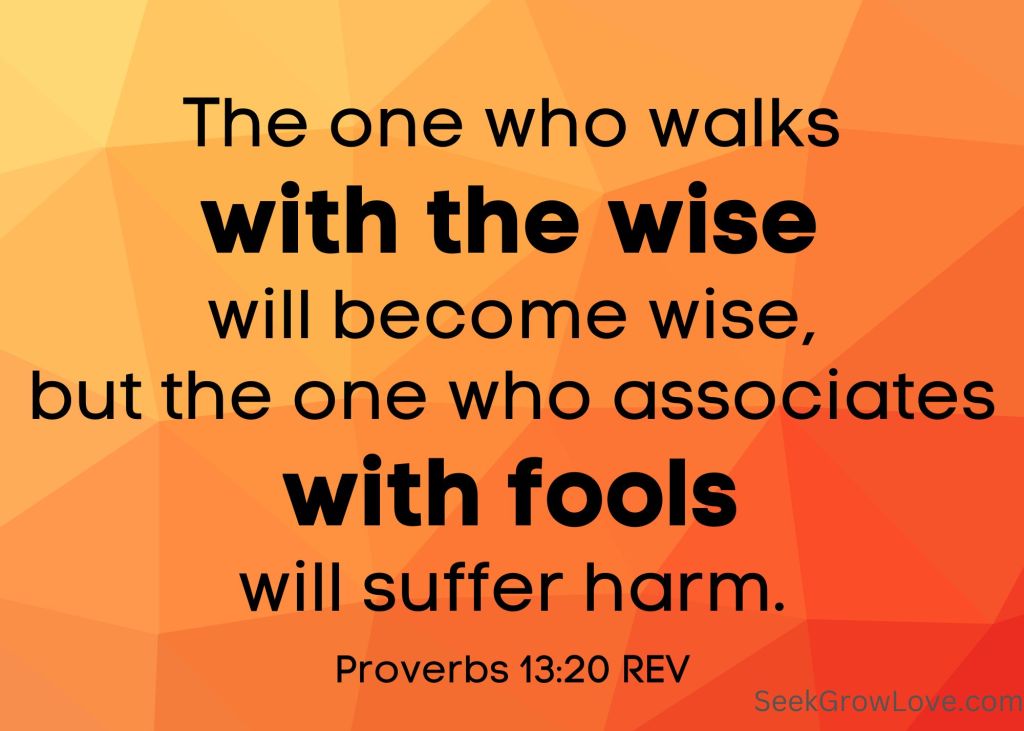
Proverbs 13:20 says, “The one who walks with the wise will become wise, but the one who associates with fools will suffer harm.”

Out of all the proverbs in this chapter, let’s ruminate on this one for a few minutes. The meaning of the proverb is simple enough on the surface: you become wise if you hang out with people who are “wise,” but you will suffer harm or get in trouble if you hang out with “fools.” Nevertheless, the depth of the meaning comes in understanding why the proverb is true, and also the difficulty it poses for actually applying it in our lives. What do I mean? I am saying that the proverb is simple in what it is stating, but the concept behind why what it says is true is very deep and rich.

This proverb touches on a reality of our lives that is so often overlooked or minimized, and that is, how other people can influence and change our behavior. One of the most powerful forces in the formation of human psychology and sociology is peers. The people our age that we spend the most time with are some of the most influential people in our lives. We tend to subconsciously adjust our ways of speaking, acting, and even preferences to align with what others around us are doing and think is “cool.”

The phrase “the one who walks with the wise” is an idiom that describes spending significant time with and to be in close association with a wise person. “Walking” together is a way of saying doing life together. And friends are definitely people that you “do” life with. But it is not just friends that the proverb has in mind, it is specifically a person who is “wise.” Wisdom comes with age, and so if you are relatively young, then a “wise” person is probably much older than you. And while older people might not rank high on the “cool” factor in the eyes of young people, they possess a vast amount of wisdom to young people in comparison.

If your friends exhibit godly speech and conduct in their lives, then that is part of wisdom, and they are exerting a positive influence on you, whether you consciously realize it or not. But if your friends talk behind peoples backs, rebel against authority, use vicious words to tear others down, steal, lie, or any other number of wicked patterns of behavior, then they are a “fool,” and they will likely either rub off on you or pressure you to be more like them (because they will ridicule you if you don’t or just stop hanging out with you because they think you are “lame”).

The apostle Paul mentions this principle in 1 Corinthians 15:33 when he writes, “Do not be deceived: ‘Bad company corrupts good morals.’” His warning expresses the same wisdom as the second line of the proverb. If you associate yourself with “fools” you are bound to get corrupted and become like them. It only takes one bad apple to spoil the whole bunch.

Take a moment to think about if you are spending time with a “bad apple,” and if so, whether you notice how that relationship is negatively affecting you. Because one way or another, it is. If you find yourself thinking that you need more positive influences in your life, then maybe it is time to start walking with someone who is “wise” so that you too can become “wise.”

-Jerry Wierwille

Reflection Questions

  1. How would you honestly describe the people you spend the most time with? Take a moment to think about if you are spending time with someone who is negatively affecting you. What are your options? Which is the best one?
  2. Who do you know who is wiser than yourself? What can you do this week/month to spend more time with that person? Set it up.
  3. How can you be a wise friend to others rather than being a bad influence that leads them (and yourself) to harm?

A Hot Head

Old Testament: 1 Samuel 21 & 22

* Poetry: Proverbs 12

New Testament: Acts 6

Proverbs chapter 12 has some very interesting proverbs that can walk us deeper into understanding the wisdom and knowledge that begins with the fear of Yahweh (cf. 1:7; 9:10). One of those proverbs is 12:16, which says, “The anger of a fool is known at once, but a prudent person conceals dishonor.”

Picking up on the conjunction “but” that connects the two lines together, this suggests that the parallelism in this proverb is likely antithetic, meaning the two lines are expressing opposing ideas. In the first line, the main idea is that the “anger of a fool” is readily apparent (i.e., “known at once”). The question we always need to ask ourselves when reading wisdom literature, especially Proverbs, is, “How is this proverb true?” In other words, “What circumstance could this proverb be accurately describing?”

Have you ever known someone who had a short temper? And what was the characteristic behavior of this individual that earned them this reputation? Probably they got angry easily, right? The first line is identifying that a fool is someone who has no control over their temper and quickly erupts at the smallest provocation. They are a “hot head” just waiting to blow. Given the wrong remark or facial expression from others, their attitude can turn sour in an instant and their anger flares up like a barrel fire.

On the contrary to this foolish behavior, the “prudent person,” who exercises self-control and discipline and has a “cool head” about them, “conceals dishonor.” Thus, unlike the fool that vents their anger immediately, unable to rule their emotions but makes an open show of their contempt, the “prudent person” covers over, overlooks, or does not give attention to the dishonorable actions of others. They do not respond in a like manner with unrestrained, emotionally charged reactions.

Thus, the point of the proverb is that a wise person recognizes the best way to handle criticisms or insults and does not react impulsively or irrationally by stooping to meet the fool at their level.

Have you ever just wanted to let someone have a “piece of your mind”? I sure have, and I bet you have too. But the self-restraint required to not vent one’s frustration or anger is part of living with wisdom. Did you know that learning how to rule over your emotions was exercising godly wisdom? It may not “feel” as good in the moment as it would if you yelled at the other person, but wisdom is not about what “feels” good—it is about what is good and right to do that glorifies Yahweh and aligns with his intention for how life is best lived. Therefore, the wise person must deny the temptation to give in to destructive emotions, like uncontrolled anger, that would inflict harm on others. Wisdom teaches how to build strong, healthy relationships and ways of interacting that promote peace and godliness. And that entails being able to keep one’s emotions in check.

-Jerry Wierwille

Reflection Questions:

  1. Give some examples of how temper can interfere with living a life that glorifies Yahweh. Any come to mind when you were the one with the hot head? How could it have played out differently with more self-control?
  2. How can you work on more self-control and discipline? Ask Yahweh, too.
  3. What does Yahweh value?