Parables of the Future

Matthew 25

January 25

In today’s chapter, there are three parables: the Parable of the the Ten Virgins, the Parable of the Talents, and the Parable of the Sheep and the Goats. 

It is important to note that parables are earthly stories that teach spiritual truths. Jesus creates images that his hearers would understand, and applies them to spiritual realities. The Parable of the Talents section will go into more detail about interpreting parables.  

The Parable of the Ten Virgins

In the first parable, we see ten women who are waiting to guide a groom to his bride. Five of these virgins were wise and prepared for the coming of the groom by have enough oil to last all through the night. Five were foolish, unprepared, who have to run off and fill up their supply of oil while the groom is on the way. They weren’t ready for the bridegroom and his coming, and they were not allowed in because they were late. 

Obviously, we can see the parallel with our faith. The point made by this story is simple and spelled out for us in verse 13: “Be on alert then, for you do not know the day nor the hour.” We must be prepared for the coming of Christ, ready for his return. 

But what does it mean to be ready for his return?

Parable of the Talents

In the second parable, a master goes on a long journey, and gives talents to his slaves. When we read “talent,” remember that the word HERE means “an amount of money”. A talent is a VERY LARGE amount of money, about 6,000 denarii. A denarius is one days wage. 1 Talent would take a working person 16 years to save. (see note) Five talents, two talents, and one talent are all VAST sums of wealth, and the King gives them to his slaves and entrusts that money into their care according to their abilities. When the master returns, he rewards those who use his wealth to make more, but punishes the one who hides the money away and does not use it. 

Again, we should start to see some connections to our own life. It is important to remember that this is a parable. Jesus is using images from the world around him to teach a spiritual point. The talents given by Jesus, the King, to us, his slaves, are decidedly not always money. There may be people who follow Christ who are dirt poor. Moreover, it should not be considered specific abilities or spiritual gifts. Because this story is a parable, one-to-one relations don’t always work. For example, what is the oil and who are the oil sellers in the parable of the ten virgins? Don’t think too hard on it, because those are silly questions. The parable is about being ready for the return of Christ. I’m making a similar point for this parable: don’t try to define what the talents are (spiritual gifts, or natural abilities, or other) but think of them as the blessings of God in our life generally. And that makes the point clear: We can either use the blessings God has given us to produce more blessings for ourselves and others while risking and sharing, or we can bury our blessings and avoid the risk of interacting with others. 

If you use the talents with which you are gifted, you will receive the reward the master gives. He says to both the one with five talents as well as the one with two : “Well done, good and faithful slave. You were faithful with a few things, I will put you in charge of many things; enter into the joy of your master.” (21, 23). Note the words aren’t different, though the blessings are. We are to use our blessings that we have been given. We are not to worry about not having as much as the next person or whether we can see the fruit of them using their blessings. It is for the master to judge them, not another slave.

Finally, Jesus, our master, EXPECTS us, his slaves, to gain on the blessings given. For the slave given one talent, even if the talent was just “put in the bank”, then it would have been better. Instead, the slave played it safe, and is punished for his unfaithfulness. The one who is was unfaithful has their blessings revoked and the blessings were given to the faithful. (Another reason we don’t think of talents as specific spiritual gifts or natural abilities. It seems doubtful that God would take the spiritual gift or natural talent from one and give it to another.)

We need to be ready at all times for the return, and that is by using our blessings to bless others. Jesus puts a fine point on this teaching by saying the final parable of the chapter. 

The Parable of the Sheep and the Goats

In the final parable, all humanity is imagined as a herd of animals, sheep and goats. The final judgement, that comes at Christ’s return, has him separating sheep and goats. Jesus tells the sheep that they fed, watered, invited, clothed, and visited the great king by doing it for the “least of the brothers of mine.” When we care for other Christians, we are caring for Jesus, the great king Himself. Moreover, many Christians have understood a greater implication. Because Jesus is human, he views all of humanity as brothers and sisters. This is why Paul says in Galatians 6:10 “Therefore, as we have opportunity, let us do good to all people, especially to those who belong to the family of believers.” Not ONLY believers, but especially believers. It starts in the family and radiates outward. However, the goats did not feed, water, invite, clothe, or visit the great king. When they did not care for their brothers and sisters in Christ and for their human family, they were not caring for the king. 

And what happens to each group is shocking. One is given eternal life, life in the age to come, life that lasts forever because it is in the presence of the One who is Life. And the other is punished, and the punishment, death, will be eternal and final. 

These three stories teach us what it means to be ready for the return of Christ which is promised in chapter 24. To be serving the least of these, both in and out of the family of believers, with any and all blessings that God has given us, actively waiting and expectantly watching for the coming of Christ. It is not staring at the sky while twiddling our thumbs nor is it quietly serving with no Kingdom messages. It is serving the least, blessing them, and sharing with them the Gospel of the Kingdom. That’s the message of the parables.

-Jake Ballard

Questions for Reflection and Discussion

  1. Are we the wise or the foolish virgins? Will we be found prepared, without knowing the day or the hour? Will we be running around when he comes, hoping to be found ready?
  2. Are we faithful with the blessings of God we have been given? Are you using the gifts God has given in an effective way?
  3. The sheep seem to be surprised that they were serving the King, and the goats are surprised they weren’t serving him. Are you taking care of the least, the last, the little and the lost? When have you fed or given water to the poorest in your community? When have you given clothes to those who have none or invited them into your homes? It is tempting to say “I give to charities that do that” but Jesus won’t be asking the charity if THEY cared for the least of these, he will be asking you and me. Will we be in surprise that we served or in surprise that we did not?

Note: https://www.bibleodyssey.org/HarperCollinsBibleDictionary/t/talent
Growing Faith

Mark 4 14.png

Mark 4

    In this chapter Mark tells of some of Jesus’ arguably most famous and well known parables.

The first is the parable of the sower and soils. “3 “Listen to this! Behold, the sower went out to sow; 4 as he was sowing, some seed fell beside the road, and the birds came and ate it up. 5 Other seed fell on the rocky ground where it did not have much soil; and immediately it sprang up because it had no depth of soil. 6 And after the sun had risen, it was scorched; and because it had no root, it withered away. 7 Other seed fell among the thorns, and the thorns came up and choked it, and it yielded no crop. 8 Other seeds fell into the good soil, and as they grew up and increased, they yielded a crop and produced thirty, sixty, and a hundredfold.” 9 And He was saying, “He who has ears to hear, let him hear.”” (NASB).

After Jesus preached this to the crowd from a boat, his disciples were confused as to what its meaning was. Jesus then explains what it meant in the next verses.

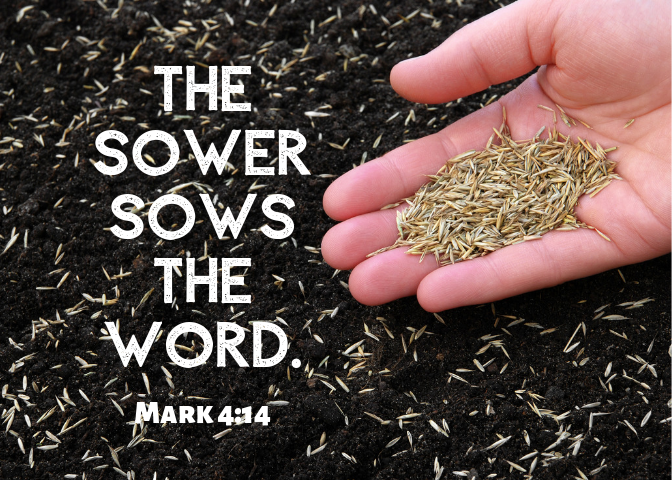
“13 And He *said to them, “Do you not understand this parable? How will you understand all the parables? 14 The sower sows the word. 15 These are the ones who are beside the road where the word is sown; and when they hear, immediately Satan comes and takes away the word which has been sown in them. 16 In a similar way these are the ones on whom seed was sown on the rocky places, who, when they hear the word, immediately receive it with joy; 17 and they have no firm root in themselves, but are only temporary; then, when affliction or persecution arises because of the word, immediately they fall away. 18 And others are the ones on whom seed was sown among the thorns; these are the ones who have heard the word, 19 but the worries of the world, and the deceitfulness of riches, and the desires for other things enter in and choke the word, and it becomes unfruitful.20 And those are the ones on whom seed was sown on the good soil; and they hear the word and accept it and bear fruit, thirty, sixty, and a hundredfold.””


After this Jesus tells them to shine their light and not hide it. He also says to be careful as to what they listen to.


The next Parable is the parable of the seed. It compares the kingdom of God to a man putting his seed on the soil. It grows, but he doesn’t know how. The soil grows the seed one section at a time. This too is how our faith grows. When the crop is ready, it will be harvested.


The final parable is probably one of the most well known parables in the Bible. It is the parable of the mustard seed. A mustard seed is the smallest seed grown in soil. But, almost miraculously, it grows into a very large plant. In this, Jesus shows that, no matter how small your faith is when you start your walk in the faith, you can grow it so much. This gives me so much hope. To know that, even if my faith is very small at times, I can grow it like a mustard seed and become strong in my faith when I grow it in the right conditions.


Later that day, Jesus took his disciples on the boat. While he was sleeping, a huge storm overtook it. His disciples became very scared (wouldn’t you?) and woke up Jesus asking him why he didn’t care that they were going to die. So, Jesus got up and said, “Hush. Be still” to the waters. And it immediately became calm. He then scolded his disciples asking them if they had no faith.This further scared the disciples. (But wouldn’t you also be scared if your friend could calm the sea?) They started to wonder who Jesus really was and what power he had if he could do all of these things.


Mark 4 is a great chapter for many reasons. Not only does Jesus show us that we need the right conditions to grow our faith and also that there is hope for even people with the smallest of faith, but the actions of his disciples also teach us something.

They are confused as to what his parables mean and also seem to continually lack faith. Our first thought may be to judge them. They literally had JESUS, the one who saved us from our sins, right in front of them! How could they not see it? But, if you think about it, how many times has God put things right in front of your face that you didn’t see until afterwards?

Furthermore, the disciples reveal Jesus’ compassion and patience. Jesus kept leading them even when they didn’t understand or were reluctant and scared to follow.

Jesus will do the same for you. Even though your faith may seem as small as a mustard seed, all you need is to trust in him and follow the word. Always remember that Jesus died for you. He loves you that much. Even when you have little faith.

-Samantha Stokes

The Kingdom Treasure

Matt 13_44

Matthew 13:44-46

“The kingdom of heaven is like treasure hidden in a field, which a man found and covered up. Then in his joy he goes and sells all that he has and buys that field. 45“Again, the kingdom of heaven is like a merchant in search of fine pearls, 46who, on finding one pearl of great value, went and sold all that he had and bought it.

In this section of the Gospel (13:44-49), Jesus presents three parables that deal with the kingdom. All of them begin with “the kingdom of heaven is like….” But the first two deal with the value of the kingdom (vv. 44-46), while the last one deals with the judgment that will happen at the end of the age (vv. 47-49). Let’s focus on the first two that describe the value of the kingdom.

First, the kingdom of heaven is like “treasure hidden in a field” (v. 44). In the biblical times, there were no such things as safety deposit boxes. People would hide their wealth in the ground by digging a hole and burying it. In the parable of the talents, this is what the individual who received one talent did (cf. 25:25).

Jesus describes the kingdom as “treasure” that has been buried in a field, but which was discovered by someone and then “covered [back] up.” The person who discovered the treasure, reburied the treasure. That seems odd. Why didn’t he or she just keep the treasure they discovered? To make a long explanation shorter, the owner of a property owned everything both on top of and within the ground of the property. So in order to legally claim the treasure, the person had to buy the land. But Jesus’ point is not this technicality. His emphasis is upon the value the person estimated the “treasure” to be worth. The person sold “all that he has” in order to buy the field (v. 44). The man was filled with “joy” and because of the recognition of the treasure’s value, the person deemed it worth more than all their other wealth combined.

In the next parable, Jesus uses the imagery of commerce with a merchant who found a “fine pearl” (v. 45). In the biblical culture, “pearls” were among the most prized jewelry since they were very rare (no scuba equipment yet to dive deep enough to easily capture oysters…lol). And like the person in the previous parable who found buried treasure, the merchant also esteemed the pearl to be more valuable than all his or her other possessions. Therefore, the merchant sold everything he owned in order to buy the one pearl (v. 46).

Ok. So we get that Jesus is driving home the point about how valuable the kingdom is. But I think what is most important about these parables is the attitude depicted by the two individuals who were willing to get rid of everything else they had in order to obtain this one precious item. I sometimes wonder if I have that attitude. Intellectually, I can rationalize why it is completely true. But practically speaking, I think about whether my life truly reflects that disposition in my heart. Do I see the kingdom as the “hidden treasure” or the “fine pearl”? Am I willing to forsake all else in order to seek the kingdom?

Obviously, the parables are a hyperbole for emphasis as Jesus is not literally instructing his disciples to dispose of all their physical wealth and belongings. Rather, Jesus is touching on the attitude of one’s heart. Where do we prize the value of the kingdom in our life? Have we put anything else in front of it and added the kingdom on to the side of our pursuits in life.

Let’s not forget Jesus words: “But seek first the kingdom of God and his righteousness, and all these things will be added to you” (6:33).

-Jerry Wierwille