The Weight of Sorrow

Matthew 11

Matthew 11 28.png


There is a destiny that makes us brothers:

None goes his way alone;

All that we send into the lives of others

Comes back into our own. —Markham


Today’s chapter is a solemn one for me. Jesus just finished the send-off of the 12 disciples out into the proving grounds and I imagine was watchful about the results. As word of the disciples broaden, John the Baptist hears about the Messiah’s latest turn of events and sends a question to Jesus in (verse 3): “Are you the one who is to come, or should we expect someone else?”


This question intrigues me because of what it doesn’t ask. “Why won’t you help me? Do you not care that I sit suffering in this prison cell?” John the Baptist was the cousin, a dear friend, and a mentor of sorts who baptized Christ himself. He knew Jesus and Jesus knew John. They most likely grew up together. Jesus simply replied, (verse 4-6)  “Go back and report to John what you hear and see: The blind receive sight, the lame walk, those who have leprosy are cleansed, the deaf hear, the dead are raised, and the good news is proclaimed to the poor. Blessed is anyone who does not stumble on account of me.


While this is a message of good report for the current gospel cause, what strikes me is what isn’t said to his friend. John would surely have known by this response that Jesus was referring to Old Testament prophecies like Isaiah 29:18-19, 35:5-6, or 61. These were the credentials of sorts that the coming Messiah would fulfill. Isaiah 61 is one of the most famous passages using phrases of comfort  like “ bind up the brokenhearted,” “proclaim freedom for captives,” and “release prisoners from darkness.” Yet, Jesus doesn’t convey any of THOSE phrases in the reply to John because he knew they couldn’t be upheld. Silence often speaks louder than words.


Have you ever had a friend or family member truly in sorrow and are unable to comfort them due in part to the schedule you must maintain? Maybe they were grieving a death, consequence, job loss, betrayal, or abandonment. You want nothing more than to stop everything and sit with them in their sorrow and to share the load. I have to believe this is what Christ wanted more than anything with John the Baptist, but his circumstances made this impossible and he ultimately knew that freeing John from prison was not the will of the Father. John was soon to die. Jesus sent a loving message of “omittance,” perhaps suggesting that he had not forgotten John, nor his sufferings. The tribute upon which Jesus bestows upon John in the next 14 verses following this makes me believe he was hurting for his brother. He wanted nothing more than to comfort, but his schedule and AGENDA would not allow.    


Jesus models a very important lesson here and later in Matthew 14 upon reaction to the terrible death of John the Baptist. SOMEtimes the best way to ease heartache is by getting back to work. Use your grief to empower your ministry. Rather than turning in on yourself and thinking “woe is me,” turn outward to serve and to love the crowds. It is ok to cry. It is ok to mourn for lost people or situations, but we must not let our emotions turn inward for long, lest it becomes pity. In our brokenness God is able to use us mightily. In desperation our dependence on Him will serve as a powerful testimony to a lost and dying world.


Is your heart broken today? Does life seem empty? Do you feel like giving up? Take hope in the example of Jesus. Take up whatever duties lie before you and dedicate them to God. Refuse the luxury of self-pity. Do something to lift the burdens of others and Jesus will strengthen you.

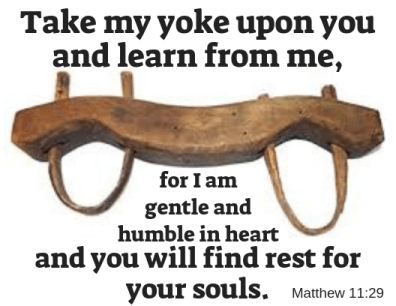
The final verses (28 – 30) of Matthew 11 confirm this truth. “Come to me, all you who are weary and burdened, and I will give you rest. Take my yoke upon you and learn from me, for I am gentle and humble in heart, and you will find rest for your souls. For my yoke is easy and my burden is light.”


When you serve others you will find yourself.


-Julie Driskill
 

matthew 11 29

A Prideful Warning

matthew 3 1

Pride goes before the fall.  It is warning given to us by our elders, many times in our youth when we think we have it all figured out, and is based in one of Solomon’s proverbs (Proverbs 16:18-19).  Just when we think we are on top of the world with our wealth, education, social status, or even our religion, we are undoubtedly a gut-wrenching moment away from being put back in our place.  And unfortunately for us, the bigger the man, the harder the fall.

In Matthew Chapter 3, John the Baptist is sent out to prepare the way for Jesus.  He is the “voice of the one crying in the wilderness”, and man dressed in camel hair (although I don’t think it was cashmere turtlenecks), and a diet based on what he could find around him in nature.  No doubt, this man sent to prepare the way was a bit of a spectacle, but not deliberately. John gathered many followers, baptizing them for the forgiveness of their sins. John was taken aback when he saw who was in the line – Pharisees and Sadducees.   Both the Pharisees and Sadducees were caught up in outward observance of religious law. They might pray in the streets (Matt 6:5), openly announce their giving (Matt 23), ask many religious, pious questions (Act 23), becoming spectacles themselves, yet still they only abided by the laws that conveniently roll off the tongue and fit their interest.  These men were highly regarded for their piety. They were key members of the religious community. Their roots were in the church. Yet, time and time again, John, then, Jesus see these men for who they are: prideful hypocrites.

It is no wonder they come to John to be baptized for the forgiveness of their sins, something common with Jewish culture even before Christ, because this was an outward observance of faith, and really the one enduring public expression that remains today.  For them, it was another way to add another tassel, place another feather, earn another merit badge to showcase their devotion (to their pride) on their whitewashed tomb (Matt 23:27-28). John calls out this action for what it is and begins to cut these men down to size, pleading with them to work on the inside: true repentance and bearing fruit (Matt 3:8).  Then he warns them that God himself will cut these men down to size if he must, not simply pruning (John 15), but cut at the very root, and throwing their fruitless mess into the fire once and for all (Matt 3:10).

As we are reading today, let this be a warning to us, especially those of us who are “church folk”. We may study the Bible, hold a position of leadership, or make eloquent confessions of faith, but to whose purpose do we do these things?  Are we lining up so we can receive our reward in full today (Matt 6:4)? Earn our badge, sticker, or tassel? I know I constantly battle my pride as I check more boxes of serving God.  As I articulate and expound on deep theological questions, cast judgement in situations of others, or feel like I have shared a great message, I can’t help but think, “Wow. Good thing God has me on His side.” How arrogant. How prideful.  How ashamed am I. The things I share, that I might selfishly revel in, that are so wonderful, so grand, are not my own, but God’s! Doing things “for Him”, like we ever could, does not assure our place in His kingdom (Matt 7:22; Eph 2:9-10). Only repentance and bearing fruit. Everyday we must fight for altruism in our lives, to die daily, to fall a little, and be consumed by God’s kingdom message.  I’d rather be eating locust and wearing camel skin, than have God bring justice to me later – but today, it is a warning – Church, check your pride.

-Aaron Winner

Being the Light

Matt 5 14


Yesterday I talked about the entrance of Jesus to the earth. I talked about him being the Light and how the darkness will never be able to overcome the light that Jesus brought to the world.

Now it our responsibility as believers to walk in the light and to be the light.


I was reading awhile back about John the Baptist, and I came upon John 5:35 where Jesus talked about John the Baptist. In this verse Jesus said, “He was a burning lamp and you were willing to rejoice for a while in his light”.  I believe that that is now to be our goal—we are to be a lamp to show people to the true Light, Jesus.


Jesus even calls us the light of the world. 14 “You are the light of the world. A city set on a hill cannot be hidden. 15 Nor do people light a lamp and put it under a basket, but on a stand, and it gives light to all in the house. 16 In the same way, let your light shine before others, so that they may see your good works and give glory to your Father who is in heaven”         Matthew 5:14-16.


These verses are clearly stating that in order to show your light you must have works, and those works are showing others that you are walking in the Light. We are supposed to be that light to the people and the world around us. Just as John was a burning lamp that showed the people to the true Light Jesus, we are to do the same, and be a lamp that guides the way until the true Light comes back to this earth. We do this not for our own glory, but to show people to their Savior Jesus, and for the glory of God.


As John the Baptist wisely said “He must increase, but I must decrease” –John 3:30.


-Luke Elwell

Time in the Desert

josh1 9

There are several instances of people in the Bible spending time in the desert.

Moses was raised in Pharaoh’s house but he was an Israelite. When he was a young man he killed an Egyptian who was beating one of the Jewish people. Fearing for his life, he fled to Midian, married and became a shepherd. We don’t hear from him again until God appears to him in a burning bush in Exodus 3. Moses went on to become one of the most famous leaders of the Jewish people and led them out of Egypt and to the brink of the Promised Land.

The children of Israel were at the threshold of the Promised Land but they let fear hold them back, and so God made them wander for 40 years in the desert. In Deuteronomy 8:2 “You shall remember all the way which the Lord your God has led you in the wilderness these forty years, that He might humble you, testing you, to know what was in your heart, whether you would keep His commandments or not.”

Israel became a mighty nation that proclaimed the name of God to all nations on the earth. The prophet Elijah after his encounter where he defeated the prophets of Baal, feared for his life, and ran away, he was fed by an angel, then traveled 40 days and 40 nights, and ended up in a cave in Horeb. The Lord came to him in the cave and asked in 1Kings 19:9b “What are you doing here, Elijah?” This was right before the Lord showed himself to Elijah in the small whisper of wind. Elijah went on to continue being a bold prophet of God to the Israelites.

John the Baptist was in the desert until his appointed time to proclaim the good news of Jesus Christ. He preached the gospel of the coming of Jesus to thousands.

Jesus spent his time in the desert when he was going through his temptation. After this, he went on to establish a ministry that would change the world. He became the sacrifice that would save us all from our sins.

In all of these instances, God was with them and so they had no reason to fear. Fear is a natural emotion for humans but when we give in to fear instead of trusting in God, it is a bad thing. My daughter painted this picture for me a few years ago, because she knew that Joshua 1:9 was one of my favorite verses “Be strong and courageous, do not be afraid, do not be discouraged, for the Lord, your God, will be with you wherever you go.”

When we feel like we are in the desert, due to circumstances in our lives, we need to relax and let God give us some rest and then get out of the desert and let God use our lives in an incredible way. In all of these instances, they came out of the desert a better person. All of these people allowed God to use them for what he had planned for their lives. I pray that we all let God use us to fulfill His plans for us. We can always rest in the knowledge of Jeremiah 29:11 “For I know the plans I have for you,” declares the LORD, “plans to prosper you and not to harm you, plans to give you hope and a future.”

Sherry Alcumbrack

The Wisdom of the Kingdom

matt 11 19b

Matthew 11:16-17

“But to what shall I compare this generation? It is like children sitting in the marketplaces and calling to their playmates, 17‘We played the flute for you, and you did not dance; we sang a dirge, and you did not mourn.’”

After his disciples depart from him, Jesus turns to the crowds and begins to address them and tell them about the ministry of John the Baptist (v. 7ff). He chastises them for their dismissal of John’s ministry and their false expectations for who John was as a prophet. Jesus praises the ministry of John and acknowledges his preeminent place as the greatest prophet, yet this is not the way the people viewed the ministry of John.

Transitioning into a caricature of the crowds to whom he was speaking, Jesus says, “to what shall I compare this generation?” (v. 16). This “generation” was Jesus and John’s contemporaries who heard them preach and who should pay attention to them. But Jesus describes them as “little children” who are in the “marketplace.” The similitude with which Jesus draws upon is how children play with each other in public and respond to each other by playacting. They engage with each other and are influenced by what each person is doing.

But the people Jesus is speaking to are not like that. Instead, they are like children when their friends call to them and play the flute, do not dance; or when their friend sings a sad song, they do not mourn (v. 17). What this analogy is pointing out is that the present generation surrounding Jesus does not care to respond to what John and he are doing. They are not interested in the kingdom or the message of repentance. Their reluctance to embrace the ministry of John demonstrated their unreasonableness and refusal to hear his words.

Our generation today is not much different than in the time of Jesus. Even though we have a message of grace and truth that exceeds that of John, people will still be disinterested in those words. We might play a flute or sing a dirge, but by and large, our generation still resists the wisdom contained in those words. Not our wisdom, but the wisdom coming from the one who the message is about—Jesus.

Jesus concludes this section by saying “Wisdom is justified by her deeds” (v. 19). The wisdom that Jesus taught and which we proclaim today is something not aimed at competing with what is so called “wisdom” but is proved right by the results it produces when it is lived. The wisdom of the kingdom is not to be found in the eloquence of the message but in the actions that accompany the one who follows it, for wisdom is shown to be right according to the deeds that she accomplishes. If our deeds demonstrate the wisdom of our Master, then even if no one dances or mourns, we can be confident that we are not failing to fulfill the mission given to us. We must remember that this generation too will resist the message that brings hope and delivers people from the darkness of this age. So don’t be dismayed at the world’s refusal or their ridicule of you but be encouraged knowing that you are bearing the light in a dark place, and there are few who are willing to carry that torch.

-Jerry Wierwille

John the Baptist

Matthew 3

Matt 3 3

Matthew 3 revolves around John the Baptist, the forerunner of Jesus.  He was sent to prepare people for Jesus.  Jesus’s ministry was really radical when compared to what had been taught previously.  We will see more of that in future chapters.  John started that radical teaching here.

First though, we are introduced to John the Baptist and then in verse 3 we read a prophecy from Isaiah.

“The voice of one crying in the wilderness,
‘Make ready the way of the Lord,
Make His paths straight!’”

Again, this would have probably been a prophecy taught about the coming Messiah, and so the Jewish people of the time would need to see how this is fulfilled to believe Jesus was their Messiah. Obviously, a lot of them still did not believe, but for the ones that did, they needed to see each of these prophecies fulfilled.

John was baptizing people as they confessed their sins.  There are some similarities between baptism and some of the ritual cleansing listed in the old testament.  However, even with that, this was a huge departure from what people had ever done before.   Never before had people come to an individual, and not even a priest, to confess sins and then be immersed in the water.

In verse 7 we see that even Pharisees and Sadducees were coming for baptism.  I have no idea why they would have wanted to be baptized, and in the little bit of searching I did, could not find an explanation.  No matter the reason, we see John call them a brood of vipers, and warn them of what Jesus is going to do.  This is the first confrontation we see with the Pharisees or Sadducees, and it sets up what we can expect between them and Jesus.

The end of the chapter, starting in verse 13 shows us the baptism of Jesus.  Jesus comes to John to be baptized.  John does not feel worthy to baptize Jesus, but I think does it out of obedience.  He recognized the authority of Jesus and that it is necessary to obey Jesus’s requests.

Verses 16 and 17 show a super natural acknowledgement of who Jesus is from God.

After being baptized, Jesus came up immediately from the water; and behold, the heavens were opened, and [i]he saw the Spirit of God descending as a dove and[j]lighting on Him, 17 and behold, a voice out of the heavens said, “This is [k]My beloved Son, in whom I am well-pleased.”

If anyone present had any doubts before that, this should have erased them.  However, it seems like the Pharisees and Sadducees were probably still there, and as a whole, they did not believe.

What does it take for us to believe?  We have the whole Bible and know the beginning, middle, and end of the story.  This should be an easy answer for us with everything we know.  So, if we believe, are we being like John the Baptist?  Are we a forerunner for Jesus to people who don’t know him?  Are we preparing the way for people to come to know Jesus?

-Andrew Hamilton

Because our God is a God of Second Chances

Luke 3

Luke 3 Pic Final

“Therefore produce fruit consistent with repentance. And don’t start saying to yourselves, ‘We have Abraham as our father,’ for I tell you that God is able to raise up children for Abraham from these stones!” Luke 3:7-9


Luke chapter 3 advances us forward to the ministry of John as well as the baptism of Jesus Christ and brings to light many important topics including baptism in water and repentance.


Starting in Luke 3:7, John speaks to the crowds telling them of the importance of repentance and to “produce good fruit”. This speaks wonders to the crowds who begin to ask, “What should we do?”


Stop and think of all of all the times you have failed. We’ve all been there. We are who we are. What is so amazing is that we serve a God who allows us to ask him how we can redeem ourselves. Simply put, our God believes wholeheartedly in second chances.


So, as you read today, be encouraged. Keep your head up. We serve a God who never lets us down. And, we serve a God who meets us where we are. He is strong in our weakness. So never give up, keep running. And if you get lost… breathe, seek, and ask, “Father, what should I do?”

-Leslie Jones

God Even Thinks of the Little Things

Luke 1


Fuel Blog post 1 final

Today we are reading through Luke Chapter 1, which begins with the prediction of John’s birth to Zechariah and Elizabeth, followed by the prediction of Jesus’s birth, and ends with the birth of John.


It is easy to look at this section of scripture and focus on the major events that occurred—which might I add—are incredible. Imagine being in Mary, Joseph, Elizabeth, or Zechariah’s shoes. In one moment, your life has completely been turned upside down. What a brave faith each of these individuals had.


But there is something important in this passage that I think could easily go unnoticed because of the power that the main story line holds. That is the fact that God thought of the smallest things.


To start from the beginning, we learn in Luke 1:7 that Elizabeth and Zechariah had been unable to conceive a child. In their time, it was a disgrace for a woman to not give birth. With both Elizabeth and Zechariah being older, I cannot imagine the shame that Elizabeth endured for years before conceiving John. She expresses this in Luke 1:25. Later, we find out that Elizabeth and Mary are related. Mary is also told that she, though a virgin, will conceive Jesus. Luke makes a point to draw the connection between Elizabeth and Mary in Luke 1:36.


Why am I bringing this up? Because God has the ability to do whatever he wants, whenever he wants, with whoever he wants. He could have chosen ANYONE to carry Jesus and John, so why Mary and Elizabeth?


By choosing Elizabeth to carry John, a faithful servant of God no longer had to be frowned upon for being infertile. He gave Elizabeth a beautiful gift and miracle that I am sure had been prayed for by both Elizabeth and Zechariah for years. God could have accomplished what he needed done without this, but he did it anyway.


Furthermore, God chose Mary to carry his Son. That in and of itself is miraculous, but what is so cool is that God gave Mary Elizabeth. He knew that Mary would struggle and need someone to comfort and be there for her. Not only was Elizabeth faithful to God, but she also had just conceived the miracle of John. Mary had someone that understood what she was going through, and Mary also had concrete belief that the prophecy was true because Elizabeth experienced something similar.


What is so crazy to me is that God did not have to do any of that! He could have chosen people hundreds of miles apart with no relation to one another to carry these two powerful men. He could have chosen someone to carry John who already had many children as well, but he didn’t!


Simply put, God thought (and still does) think of the little things.


This resonates because it proves that God will not call us on a mission without all of the correct supplies. We, as Christians, are called to big things whether we may realize it or not. A lot of these callings may be out of our comfort zone and force us to jump into territory that we might not understand completely.


But the beautiful thing is that God sees it all. So, the next time he calls, answer. Take the jump. Start running. Because, no matter what, God won’t let you jump out of a plane without a parachute.


-Leslie Jones