
Giving God the Best – Even our Rest

Old Testament: Leviticus 22 & 23

Poetry: Job 1

New Testament: Acts 15

Today we had several scriptures on our journey to read through the Bible in a year. The ones that resonated in my heart were from Leviticus 22 and 23. Chapter 22 talks a lot about sacrifices, being clean for them and what you are able to sacrifice. What comes to mind for me at first is that God wants our best. He lays out the things that need to be done in order to come before Him.

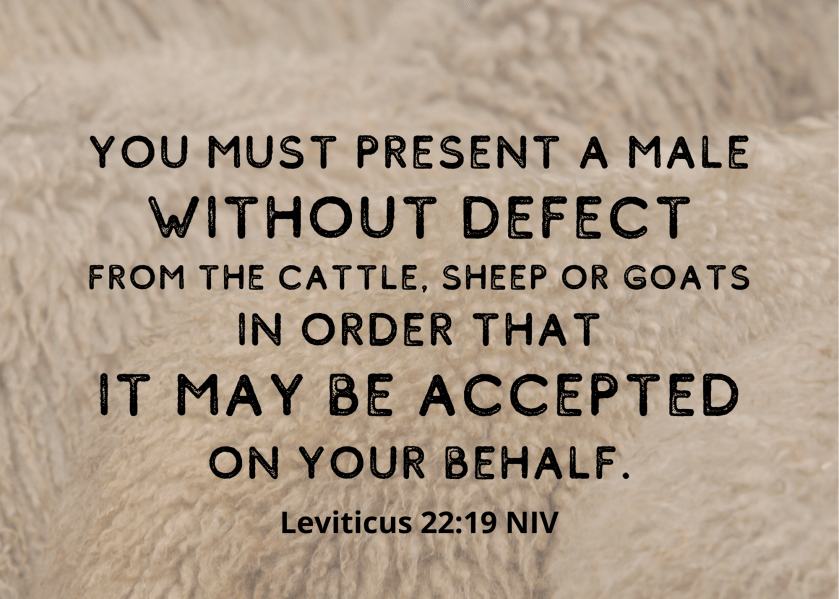
The scripture also tells us what can be sacrificed – and what can not be sacrificed. It says in 22:19 & 20 “you must present a male without defect from the cattle, sheep, or goats in order that it may be accepted on your behalf. Do not bring anything with a defect, because it will not be accepted on your behalf.” This makes me think of when I buy fruit or veggies at the grocery store, I stand in front of the strawberries looking for the best container I can get, no mold, nice and red, not soft and squishy, the best. God wants our best, unfortunately, sometimes it is hard to give him our best. We work or go to school all day, do homework, laundry, cook dinner…and the list goes on and on. The beauty of this is that Jesus died for us, we don’t have to be perfect to come to God. We just need to be children of God, have a relationship with Him, love Him and then love others. We should try to give Him our best, but we will fail (at least I do) and that is okay. We just need to keep trying.  

Leviticus 23 talks about Festivals. The thing that stuck out to me was verse 3 “There are six days when you may work, but the seventh day is a day of sabbath rest, a day of sacred assembly. You are not to do any work; wherever you live, it is a sabbath to the Lord.” During each of the festivals mentioned rest is a big part of it. Making sure you take the sabbath day to rest. The rest He is speaking about is not a nap. Although I love naps, and I think they are a great thing to do, He is speaking about resting in Him. Spend time with God. I will be honest with you; this is something that I need to work on. First,I need to slow down and rest, but most importantly, I need to rest in Him. Taking some time to stop your day to give your brain a break is great but are you giving Him your time?

-Jeani Ransom

Reflection Questions

What can you do to bring your best to God?

What does sabbath rest mean to you?

How do you rest in God?

Making A Different People: A Male Lamb, Without Defect

Leviticus 22-23

Leviticus 22 19 NIV
Today in our readings, we have many opportunities open to us to discuss. I would encourage you to go back and think through the significance of each of the festivals in Leviticus 23. Many we can see celebrated by Jesus in his life (Sukkot/Booths/Tabernacles in John 7) or were key to his death (Passover). It’s an interesting connection to see how the festivals of God played a role in the life of Christ.
But, I want to direct your attention to some words repeated again and again. The sacrifices that the Jews were to give were, from 22:17-25, a male without defect. This is interesting. Why specifically this requirement. There are a number of reasons.
First, this was a costly requirement. A sacrifice of a male without defect was costly because you wanted to keep those males. Strong male goats, sheep and cows produced good babies. If an animal doesn’t have a flaw but is a physically perfect specimen, you want to make sure those genes are passed along. You don’t have to know all about genetics to know this. In the ancient world, the better the bull, the better the calf. And God was demanding that these great bulls, billies and rams be given in sacrifice to show our allegiance to him, to prove that we are willing to both give our best and trust him to provide.
Second, the words in Hebrew are interesting. “Without defect” is from the Hebrew word “tamim” (tah-meem). The word for “defect” is from the Hebrew “mum” (moom). Both of these words are interesting because they DO mean, many times, physical perfection. The Law specifies no scabs, oozing sores, broken bones, engorged or crushed parts of the animal. Tamim notes completeness and wholeness of an animal in this way; mum denotes physical imperfection. HOWEVER, both of these words also were figuratively extended to speak about the way a person acted and lived. To live a tamim life was to live a life of integrity and innocence (in Psalm 18, the psalmist calls God’s ways blameless 5 times). However, when someone lives a mum life, they are not able to look to God for help because they are morally imperfect (Zophar believes Job has a MORAL defect in Job 11:15, NASB especially).
This leads to the third reason God would command male without defect : he was preparing the way for the lamb slain from the foundation of the world. God was preparing the world for the Messiah. God chose to give the world his Son, and to redeem us from our sins “with precious blood, as of a lamb unblemished and spotless, the blood of Christ.”(1 Peter 1:19). When God sacrificed Jesus as the “male lamb without defect”, he was purchasing us with the most costly gift, spilling out his own blood, the blood of his one and only Son, as Paul says in Acts 20:28.
The perfect Messiah, blameless, sinless, complete, and whole, was sacrificed and died to pay for our redemption. Praise God that we stand in him redeemed.
Jake Ballard
Today’s Bible reading can be read or listened to at https://www.biblegateway.com/passage/?search=Leviticus+22-23&version=NIV
Tomorrow’s reading will be Leviticus 24-25 on our 2020 Chronological Bible Reading Plan