
The Idle

Old Testament: 2 Chronicles 8 & 9

Poetry: Psalm 3

New Testament: 2 Thessalonians 3

     We don’t know how many variations of belief people in the early church fell into. We read indications of some in the Bible, like the legalism of the Galatians or the spirit-enthused group in Corinth. It may be that Thessalonica had a division, for a time, over how to understand the day of the Lord which might be seen in 2 Thessalonians 3.

     It is remarkable what people can convince themselves of, at least briefly. In the 1960s in America, a group said it was not necessary that they eat food to live. They considered that it was fine to eat food for the pleasure of it, if you chose to, but that eating had simply long been assumed to be important. They claimed all one really needed to do for continued life was breathe air. That group died out, but there have been many such extremes in history.

     We don’t know if false claims about the day of the Lord having already come affected the behavior of some in Thessalonica, but it could explain why some stopped working. We read of something like that attitude from part of the Corinthian church (1 Corinthians 4:8). Paul had made a point of telling the believers in Thessalonica that they should work with their hands and lead quiet lives (1 Thessalonians 4:11). We know that Paul himself wrote more than once about how, as an apostle ministering the gospel, he had the right to receive financial assistance but chose to work. In his work he set the people an example, but not all of them maintained it (2 Thessalonians 3:8‑9). In Thessalonica it seems that some believers who were capable of working took advantage of others’ assistance, they stopped working and behaved as busybodies (11). Whatever the reason for their behavior, it needed to change. It was bad for those who were being lax, and for the community’s reputation with outsiders. But if a claim about the kingdom was the reason for their actions it gives a nice twist to Paul’s response – if they thought the curse on the soil was past, and that work was no longer needed for food to be produced, they were wrong (Genesis 3:19). They were to return to work if they would continue to eat.

     Paul wrote that “undisciplined” people who did not obey the instructions of the letter were to be admonished and not associated with, so that they would be put to shame, but they were not to be treated as enemies (2 Thessalonians 3:11, 14, 15). They still could be brought around, and that is good. The extremes and oddities of Christianity would keep cropping up in the world, but all that Paul was asking from them was simple lives, lead with an appreciation of what Jesus had done for them. They were to live as examples of Christ’s behavior and speak his words. They were to do good, and not grow weary of it (13).

     Lord, thank you for the many and differing blessings we have in work. Work may have its origins in a curse on the soil, but you are often willing to take what began as a burden and use it to show your power and your grace. Thank you for allowing work to sometimes be a platform for our creativity, an opportunity to form friendships, a way to gain joy in our efforts. At times we may feel we are doing little more than proving we can hold out against boredom – but please help us to remember our goal of serving our Lord even as we engage in worldly employment. Thank you when you help us to locate work, thank you when you help us to do it well, and thank you for helping us to find courage and opportunity to leave it at the right time. Thank you, for so many of us who do not work in paid positions, that there are others able to provide us with financial support. Thank you, Lord. Amen.

-Daniel Smead

Reflection Questions

  1. It has been suggested that the sharing of goods in Jerusalem when the church first started had special causes, in part with so many people having come from other areas. Do you think it helped set bad influences for some churches later on?
  2. If any of the “undisciplined” chose not to work, but rather left the church over this situation, do you think that shows they were more than just “undisciplined”?
  3. What effect do you think going through this effort at correcting the “undisciplined” had on the Thessalonian church after it had been completed?

Joy Forevermore

Make Yourself Ready!

Over the last week we have focused on Philippians, and especially the theme of joy. Joy is a state of happiness and contentment in the midst of any and every circumstance because of our response to the gospel and our connection to God through Christ. When we live like Christ, we experience deep levels of joy. Joy is found also in overcoming those who try to turn us away from the gospel message, and those tendencies within ourselves. Finally, we are reminded, even commanded, to rejoice in the Lord always. Joy is available to us in every situation, not just good ones, but in suffering and pain, because of who we are and whose we are. (We are brothers of Christ, which makes God our Father!) We are able to have joy at all times; what great news!

In the Christian tradition there have been some documents that have really helped Christians explain their faith or aspects of their faith well. The Confessions of St. Augustine, The Institutes of the Christian Religion, The Chronicles of Narnia. Even if we don’t agree with everything in these works, they have made quite an impact on the Christian faith. (Especially the Chronicles of Narnia.) One other document is the Westminster Shorter Catechism, a document used to teach the Christian faith that has been around from the 1640s. The first question it asks and answers is :

What is the chief end of man?

Man’s chief end is to glorify God, and enjoy him forever. 

To explain, this is saying “the greatest goal of every person is to give God glory and praise, and to be in joyous relationship with him forever.” It’s not scripture exactly, but that sounds about right to me. The last state of the believer is joy with God.

In Revelation Chapter 19, there are three times that a great multitude exalts God and praises his name for casting down wickedness in the world. Revelation 19:6-8 say. “6 Then I heard what seemed to be the voice of a great multitude, like the roar of many waters and like the sound of mighty peals of thunder, crying out, “Hallelujah! For the Lord our God the Almighty reigns.7 Let us rejoice and exult and give him the glory, for the marriage of the Lamb has come, and his Bride has made herself ready; 8 it was granted her to clothe herself with fine linen, bright and pure…” In this picture of the great multitude, which are those who have been saved by the Messiah, they are saying that what they will do is to exalt and glorify God, but also to REJOICE in him. They are finding joy in God. 

That is the final state of those who have followed Jesus. When we think of the eternal life of the saved, it is not just living for a really long time, it is a fulfilled, joy, content life. It is life to the fullest. Yes, it will last forever but it will not be dull, boring and monochromatic, and it won’t be sorrow, struggle filled, and just like this life. 

We will feast with Jesus at his wedding to his bride, the Church. (Rev. 19:9) We will be exalted to live and reign with Christ, whatever that looks like. (Rev. 20:6) My favorite promise is that we will look into the face of God, and he will wipe away our tears. (Rev. 21:4) That is what it means to enjoy God forever. We will have EVERY REASON to find joy, because “God will dwell with us, and we will be God’s people, and God himself will be with us as our God.” (Rev. 21:3, in the first person) 

My brothers and sisters may Jesus be your savior and lord so you may feast and rejoice at his wedding supper.

May you be raised again so that death will have no power over you. 

May your tears be wiped away, and may you enjoy God forever. 

“Rejoice in the Lord, always” and forevermore!

-Jake Ballard

——————————

Jake Ballard is pastor at Timberland Bible Church. If you’d like to hear more from him, you can find Timberland on Facebook (https://www.facebook.com/TimberlandBibleChurch/ ) and on Instagram (https://instagram.com/timberlandbiblechurch?igshid=t52xoq9esc7e). The church streams the Worship Gathering every Sunday at 10:30. Besides studying and teaching God’s word, he is raising three beautiful children with the love of his life, plays Dungeons and Dragons and is really excited about going to a Renaissance Fair this Fall. If you’d like to reach out to talk Bible, talk faith, or talk about your favorite D&D monster, look Jacob Ballard up on Facebook (https://www.facebook.com/jacob.ballard.336 )or email him at jakea.ballard@yahoo.com
God bl
ess you all!

Read or listen to today’s Bible reading plan passages at BibleGateway.com here – Isaiah 17-18 and Colossians 2

Forgiveness

Genesis 32-34

Genesis 33 4 NIV

Today we are going to look at what happened when Jacob and Esau finally meet again. If you remember the last time the two brothers were together was back in Genesis 27. Whatever city they were in it definitely wasn’t Philadelphia, the city of brotherly love. Jacob’s mother actually has to tell Jacob to run away to another land because Esau, his brother, is trying to kill him. Probably Esau rightfully felt these things because Jacob stole his father’s blessing from him and also extorted his birthright. I could imagine having a little bit of hostility towards a brother who did these things to me as well. Luckily, Jacob’s mama gets involved and sends him away to her brother where he was able to get married and prosper.

I can’t imagine the hostility that lay between these two brothers. Some of us are slightly more dramatically than others of us but we have heard people use phrases like, “They ruined my life”. Now I’m not saying that they didn’t but they probably didn’t do it like Jacob did to Esau. Jacob literally took away Esau’s inheritance from him for a bowl of soup. That better have been like some lobster bisque. On top of that while Esau was out hunting for an animal to make his father a nice stew Jacob and his mother went the easy route and took one of the animals from the flock and made their father a stew and stole Esau’s birthright. I couldn’t imagine doing all the work of hunting an animal just to see that your brother took one from the herd and used it to steal your birthright. Talk about adding insult to injury.

Imagine having all that happen and how you would feel if you ever saw your brother again. I am not sure about you but I would be expecting the best apology in the world. I’m not really sure what all would be included in that apology but at the very least I’m thinking something like a sky writing plane writing, “I’m sorry. You are awesome.” Maybe then I could possibly forgive them if they included like season passes to my favorite ski mountain. Let’s take a look at how the incident actually plays out in the Bible. You should go read the entire chapter of Genesis 33 but since I cannot put the entire chapter in this devotion. I will settle for one verse.


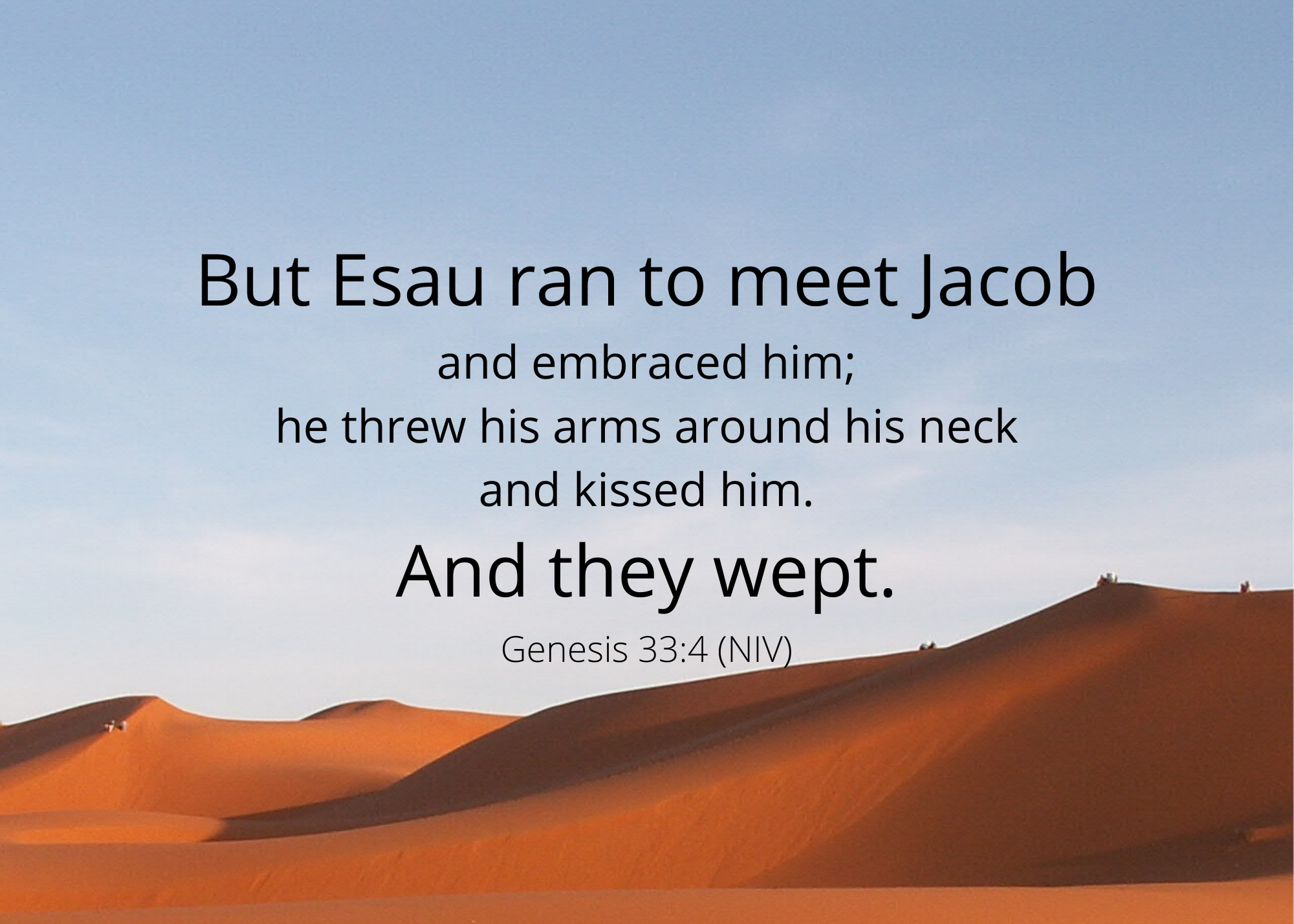
Genesis 33.4 “But Esau ran to meet him and embraced him and fell on his neck and kissed him, and they wept.”


Esau had twenty years to stew over how wrong Jacob had done him but instead of holding in all that hostility, anger and rage he chose to do something absolutely crazy. HE FORGAVE HIM. His reaction to seeing his brother is profound. He didn’t even just walk up and shake his hand. It says he ran to him, like children would when they see their father coming home from work. He embraced him, fell on him and kissed him. That’s love and forgiveness and all the stuff I want in my life.

I have things in my life that are as small as people have told lies about me and have said negative things about my character that I have a hard time letting go of and forgiving them for. But Esau, literally the leader of a non-Israelite nation, had way more forgiveness than I do.

Colossians 3.13 says, “bearing with one another and, if one has a complaint against another, forgiving each other; as the Lord has forgiven you, so you also must forgive.” This verse can seem kind of abstract and not practical. For me personally, when I see an example of how this is played out in real life like what happened with Jacob and Esau it raises the bar. It shows me my failure to fully attain to the level of Christianity that I want to be at; which is to live like Christ.

So how do you forgive somebody after something like what happened to Esau. I don’t think it is in our nature to. I think we need to bring it to God. I know that there are things that I wasn’t ready to forgive people for, my heart isn’t ready for and it still clings to the hurt. I think the only way to handle those types of situations is to bring it to God in prayer and ask something like, “God, please help me forgive this person and love them despite what they did to me.” Sometimes we just need to release that charge against them in our minds and tell ourselves, “I am not going to hold that against them.”

I hope that this helps any of you that are struggling in this way. I hope that we can all release that resentment we have and forgive each other fully.


Daniel Wall


To read or listen to today’s Bible reading you can check out Bible Gateway at https://www.biblegateway.com/passage/?search=Genesis+32-24&version=NIV

Tomorrow’s reading will be Genesis 35-37 in our 2020 Chronological Bible Reading Plan