The Words of the God You Love

Psalm 119

Wednesday, July 13, 2022 

            Back when I was a child, at Church camp when you stood in line for a meal they made you say a Bible verse.  Us young boys learned that John 11:35 was the “go to verse” for quick memorization: “Jesus wept.”   A two word verse, easy to memorize- boom “Jesus wept!” the legal requirements are met, now can I eat? 

            Bonus round—what is the shortest book in the Bible?  2 John or 3 John depending on how you measure it.  2 John has the fewest verses, 3 John has the fewest words.  For fun sake, Obadiah is the shortest book in the Hebrew Bible (The Old Testament).  We can argue about anything, can’t we?

            But there is no argument about the longest chapter in the Bible- Psalms 119 is the big winner.  Psalm 119 has 176 verses.  Compare that to the shortest chapter in the Bible – Psalm 117 which has only 2 verses. Not only is Psalm 119 unique because of its length, but its structure is quite unique as well.  Psalm 119 is written as an acrostic poem.  It is made up of 22 sections which are 8 verses each and each section begins with a different letter of the Hebrew alphabet, beginning with the first Hebrew letter “aleph” and ending with the final Hebrew letter, “taw”.  This was likely a device that helped the student to memorize the Psalm, which good little Jewish boys and girls did.

            Obviously with 176 verses we can’t look at the whole Psalm in one brief devotion and we won’t even try.  I’ll just point out something basic for you to consider and then focus on one section in some detail.

            Something basic for us to consider is that this Psalm is devoted to an appreciation of God’s Word.  Different Hebrew words are used in the Psalm including “Torah”, which can mean: “teaching, direction, guidance and law”; “Debar” which means “word” and “Misva” which means commandment or ordinance.  The entire Psalm is devoted to having a love for God’s word or commands or teaching.   This clear expression of love for God’s word is important.  In many places in the Bible, beginning in the Old Testament in places like Deuteronomy 6:5 , we are told to love the LORD/YHWH/God with all of our hearts.  Here in Psalm 119 we are told to also love God’s Word  or teaching.  Vs. 97 says “O how I love your ‘Torah’ (law/teaching) I meditate (think about/ponder deeply) on it all day long.”

            I don’t know about you but there are only a few things that I’ve ever thought about literally “all day long”. (One of them was my wife back when we first began dating, and another may or may not be Krispy Kreme hot donuts-they are beautiful and delicious and hot).  You usually only think about something constantly if it’s someone/thing that you really, really love a lot, or something that you are really, really worried about.  In the case of Psalm 119 it’s clear that the writer is thinking about God’s Word all day long because he/she loves that Word.

            Is there a difference between loving God and loving God’s Word?  In one way, yes.  There are people who diligently study the Bible simply as literature or history.  They tear it apart and analyze it like someone might dissect an animal or human cadaver or look at tiny things in a microscope.  But in this case, the person writing the Psalm loves God’s Word and thinks constantly about God’s Word because it’s God’s Word and this person loves God wholeheartedly so he also loves God’s teaching, instructions, commandments.  Jesus would later tell his disciples “If you love me you will keep my commandments.” (John 14:15).

            Let’s go back to that thing that I said I have literally thought about all day long (not the Krispy Kreme donut, but my wife, Karen, who is also beautiful, delicious, hot and begins with a K- sorry, but I needed to include that in order to embarrass any of my adult children who might be reading this devotion today, you’re welcome).   Because I love my wife I usually try to pay attention to the words she speaks to me. (I’ll admit, I’m not always perfect on this, but in my defense, sometimes she’s just talking to herself and I have to clarify who the intended listener is, me or herself, sometimes I miss the things that I’m supposed to hear).  Part of love is paying attention to the words spoken by the one we love.  So, for the Psalmist, he loved God so he also loved God’s word.  So for Jesus, if we love him we also need to keep his commandments/teaching/words.  So the overall theme of Psalm 119 is “I love God and so I also love God’s word.”

            The section of Psalm 119 I want you to think about is the second section- verses 9-16 which begins with the Hebrew letter “Beth” ב.  It begins with a question and answer:  “How can a young person stay on the path of purity?”  That’s a great question and reveals the important desire that forms the content of this person’s heart.  They love God so much that they want to know how to keep on the right path, the path of purity.  They want to know how to live a life that is pleasing in the sight of God.  The answer is by living according to God’s word.  If a person wants to walk a path that is pleasing to God then he or she needs to follow the word of God.  God has revealed to us, by His word, how to live a life that is pleasing to him.  We need to follow that path. 

            In order to stay on that path of purity we must be intentional.  We need to seek God with all of our heart.  Why do I want to pay attention to and follow God’s word?  Because I’m seeking God with my whole heart.  How do we avoid falling into sin? By putting God’s word deep into our hearts.  He speaks about the Law with strong emotional words: joy (rejoice), meditate and delight.  For him staying on a path that is pleasing to God brings him such joy that he is thinking deeply about God’s word all of the time and finds his delight in doing what God’s word says.

            You can love someone’s words without loving the person, but you really can not love a person if you don’t also care deeply about the words they use to convey what is important and meaningful to them.  The next time you look at your Bible, consider this: out of all the trillions of words that have ever been spoken or written in the history of the world, these words contained in this Bible are the words that were spoken by God to human beings in order that we might know, love and serve God.  So why would we not love the words that come from the God that we love, and why would we not obey the words that come from the God that we love?

            Do you want to keep your way each day pure (pleasing in God’s sight).  Then pay attention to those words each day, think deeply about them, immerse yourself in them, delight in them, find joy in reading and obeying them because you love those words because they are the words of the God you love.

-Jeff Fletcher

Reflection Questions:

  1.  Which words from today’s reading (Psalm 119) will you choose to think deeply about?
  2. Which words from today’s reading will you take special delight in thinking about?
  3. Which words from today’s reading will bring you the most joy?
  4. How will these words from God help you when you find yourself tempted to go in a direction that is not in keeping with loving God?
Spiritual Disciplines and Psalm 119

Psalm 119 Part 4 (verse 121-152

Before you click away, don’t be scared, turned off, or apprehensive of the words “spiritual discipline”! It’s a shorthand term for something like “the practices and habits that, when performed in love for God, move our hearts and minds to such a place that God can change us.” You can see why “spiritual disciplines” is easier. Psalm 119 has, implicitly and explicitly, four of these practices running through the text. If continually done, these practices and habits can put us in a place to live the best kind of life, the kind of life God wants us to live. 

Prayer

First, the psalm itself is a prayer. The psalmist is constantly calling on God. God is the “you” in the psalm. “You have ordained your precepts” and “By keeping it according to your word” are both ascribing worth and prestige to God. He is the God who gives precepts. He is the God who gives his word. The ground of every discipline is prayer, speaking to God and allowing space for him to speak back. In verse 147 this is the most clearly said. “I rise before dawn and cry for help; I wait for Your words.” The psalmist speaks and is ready to listen. The psalmist has cultivated a prayer life in God as he opens the pages of the Torah and begins to read. 

Bible Reading

Second, an extremely important spiritual discipline is Bible reading. While we should be open to hearing God’s voice in a miraculous vision from heaven, in speaking in tongues, and in prophecy (all which may have a place in the Christian life), the most common and most sure way to hear the words of God is to open a Bible and start reading. What an amazing gift it is that we can do this on computers, tablets, and in our homes. The psalmist would have to wait to go find a scroll in the temple to be able to read or hear the words of the Lord. The psalmist delights in the commandments of God. (See verse 47) Twice in two verses (47-48) he says that he LOVES the commandments of God. How can we love a book we never read? The psalmist knew that the only way to ground his life in truth was in God’s words. “Your Law is truth.”(142) He also knows that it’s not just a truth “out there” that we assent to and merely know, but truth that we can live by. “Your word is a lamp to my feet and a light to my path.”(105) Do you read the word of God to know truth and to know how to live truly?

The third and fourth discipline is also founded on this one. Simply reading God’s word is necessary to be able to spend more time with it. 

Biblical Meditation

And spending time with God’s word is the way to define “Biblical meditation.” Meditation has grown in popularity in the west in the past few years. In Hinduism, Buddhism, and Yoga, meditation is quieting the inner voice so that enlightenment and oneness may connect you to everything else. (At least, that is the claim of these philosophies and beliefs.) In these practices, one wants to detach and empty oneself from the world. In modern, western meditation, self-emptying is a part, but so that one can fill up with visions of the future they would like to make manifest, or they speak words of affirmation over themselves. You focus, but the focus is on you. 

In Biblical meditation, you engage your mental faculties on God. You pour over his words. You take words into your mind, but so that they can travel the 18 inches from you brain to your heart. “I will delight in Your commandments, which I love. And I shall lift up my hands to Your commandments, which I love; and I will meditate on Your statutes.” (47-48) The psalmist loves God’s word, so he wants to allow them to rumble and roll around in his head and heart. Meditation is allowing the words to tumble in your mind. To read with love is different than to read to understand. When I read a love letter from my wife, I don’t parse every word to make sure I have the proper tense of the verb. But I do mull over the words in different ways. Each turn of phrase leaves a sweet taste in my mouth as I sound them out. When we were apart before we got married, every “I miss you” text felt like a dagger. And the same is true for the words of the Torah. We mull them over and feel the pain when we are no longer with the Father who loves us and the God who made us. The psalmist in his delight of God meditates. “I will meditate on Your precepts and regard Your ways. I shall delight in Your statutes; I will not forget Your word.” (15-16) It seems the psalmist reads early in the day so that the words can be there all day long. “How I love Your Law! It is my meditation all the day.” (97) And meditating on God’s word, focusing on his words to the exclusion of everything else, is both facilitated by and facilitates the final discipline. 

Bible Memorization

How many verses of scripture do you know? 

Did you know that by 10-13, most Jewish boys were expected to memorize the Torah?

Someone said recently “Well, they memorized their whole Bible!” And I said “Yes, but it was shorter!” 

But, I don’t have the Bible memorized, not even an entire book. I do have sections down, many verses memorized. But I could always learn more. 

Meditation helps memorization and vice versa. When we read a verse in the morning and spend time thinking about it, and allow it to be the focus of our thoughts through the day, then we will have an easier time memorizing. If we memorize verses, then we will be able to have then stick in our heads. 

The psalmist clearly did this. “I have treasured Your word in my heart, so that I may not sin against You.”(11) The psalmist treasured up the words of God in his heart, meaning they were not just known but acted out. BUT, to be acted out, they must be known, memorized. In the midst of temptation the psalmist wasn’t fumbling around for a Bible, or a scroll. “The snares of the wicked have surrounded me, but I have not forgotten Your Law.” (61) The way of life was know to them. He understood that it was vital to memorize God’s law. It was life or death! “My life is continually in my hand, yet I do not forget Your Law.” (109) He knew that following the words of God was because God was the one who gave him life through his birth (73) and the one who gave him new life every day. (93)

Brothers and sisters, 

May you connect with God through prayer in a new and powerful way today,

May you hear his voice as you read his words, in this and every book of the Bible, 

May you hold his words in your mind, 

And as you have them memorized, may they transform your heart. 

And may God bless you this day and every day. 

-Jake Ballard

Read or listen to today’s Bible reading plan passages at BibleGateway here – Ezekiel 31-32 and Psalm 119:121-152

A Love Poem to the Torah

Psalm 119 (verses 81-120)

In both Monday’s and Tuesday’s devotion, I threw out a word that I did not explain that is really the centerpiece of the entire Psalm. The very first verse of Psalm 119 tells us how a person can be blessed. “Blessed are those who are blameless, who walk according to the law of the LORD.” Those last five words are the focus of Psalm 119. “The law of the Lord.” Transliterated from the Hebrew as “the Torah of YHWH.” (That last word is pronounced yah-way, and is the name of God anytime we see LORD in the Old Testament.)

What is torah? Torah comes from another Hebrew word, yarah. Biblical Hebrew has fewer words than Greek or English, so each word has a range of meanings that depend on the context, but one of the ways to translate yarah would be “to direct, teach, instruct.” When that word nominified is “Torah”. That means the word is something along the lines of “direction, teaching, instructions.” While the word law isn’t wrong, it may not be the best description of what Torah conveys. Instructions, the words of a loving God speaking to his beloved people, are instructions on how to live the best life.

“Blessed are those who are blameless, who walk according to the instructions of YHWH.”

But while that defines Torah, that really doesn’t tell us where to find it. The “Torah” understood as one thing, is the first five books of the Bible, Genesis -Deuteronomy. These books tell us how the Jews became God’s people, how they were rescued from Egypt, and how they were to live in response to that salvation from God. God gave these beginnings of these books to Moses in 1400 BC and had Moses and others edit and change bits and pieces all the way up to about the rule of King Josiah, in 600s BC. These inspired, authoritative, and true books tell us what God likes, dislikes, commands, demands, and desires from his people. 

In the Hebraic culture, the way one went about their day, from caring for their sheep, to planting or harvesting their crops, to going up to Jerusalem for a feast, one had to walk. In both the times of Jesus and the times of Moses, to “walk” in a way was to live that way out. You can begin to see the key ideas around verse one take shape. 

“Blessed are those who live according the the instructions that tell us the commands, demands, and desires of YHWH.”

Throughout Psalm 119, you aren’t always going to read “law”, but the words judgements, precepts, testimonies, and the rest are all words that are speaking about the same Torah. And the Psalmist recognizes their worth. Just today the psalmist’s “eyes fail with longing for your word” (82). The law is his delight (92). He loves both the law and the testimonies of God. (113, 119) These laws are not burdensome and followed begrudgingly. They are the source of life and salvation for the Psalmist. “Sustain me according to your word!” (116) “I am yours, save me; for I have sought your precepts.” (94)

“Blessed are those who live according to the saving, life-giving instructions and commands that YHWH has blessed his people with so we may know him more.”

The Torah commands a lamb to be sacrificed. 

“Behold the Lamb of God who takes away the sin of the world!”

The Torah commands us to love God. 

“Love the Lord your God with all your heart, soul, mind, and strength…”

The Torah commands us to love our neighbor like ourselves. 

“and the second is like is love your neighbor like yourself. These sum up the law and the prophets.”

The Torah shows us the mind, heart, soul, and desire of God for his people. 

Christ shows us the perfected way of following God. 

While things change, and we are not commanded to keep the Torah in the way Christ kept it perfectly, can we speak with the same kind of love for the first five books the way the Psalmist loved them, the way JESUS loved them? Are we able to speak about the commands of scripture in the same way as the Psalmist, that every command comes to bring life and salvation? 

Jesus saves us through faith before we ever act, and no amount of work on our part could earn salvation. BUT, the commands of scripture are given to show us the best way to live, and the commands of the Old Testament show us the way the Jews were commanded to live and show us insight into the mind of our beloved Father. 

Let us love God’s word the way the Psalmist did 

and may we all be blessed today. 

“Blessed are those who are blameless, who walk according to the law of the LORD.”

-Jake Ballard

Today’s Bible reading plan passages can be read or listened to at BibleGateway.com here – Ezekiel 29-30 and Psalm 119:81-120

God is My Teacher

Jeremiah 15-16 and Psalm 105

Yesterday’s Psalm (104) gave a history lesson on creation. Today’s Psalm (105) gives an overview of God at work during the years of Abraham, Isaac, Jacob, Joseph and Moses. God makes a great history teacher – He was there when it all happened and He knows clearly the lessons that ought to be learned to celebrate the good parts of the past and to prevent the tragedy of history repeating the ugly parts. The inspired Psalmist wrote: “Remember the wonders he has done, his miracles, and the judgments he pronounced.” (Psalm 105:5). We would do well to remember and be in awe of the amazing miraculous ways God has worked in the past to help teach and provide for His children. And, we must not forget the times He has taught (and will teach) with punishment and judgment those who have turned their backs on Him.

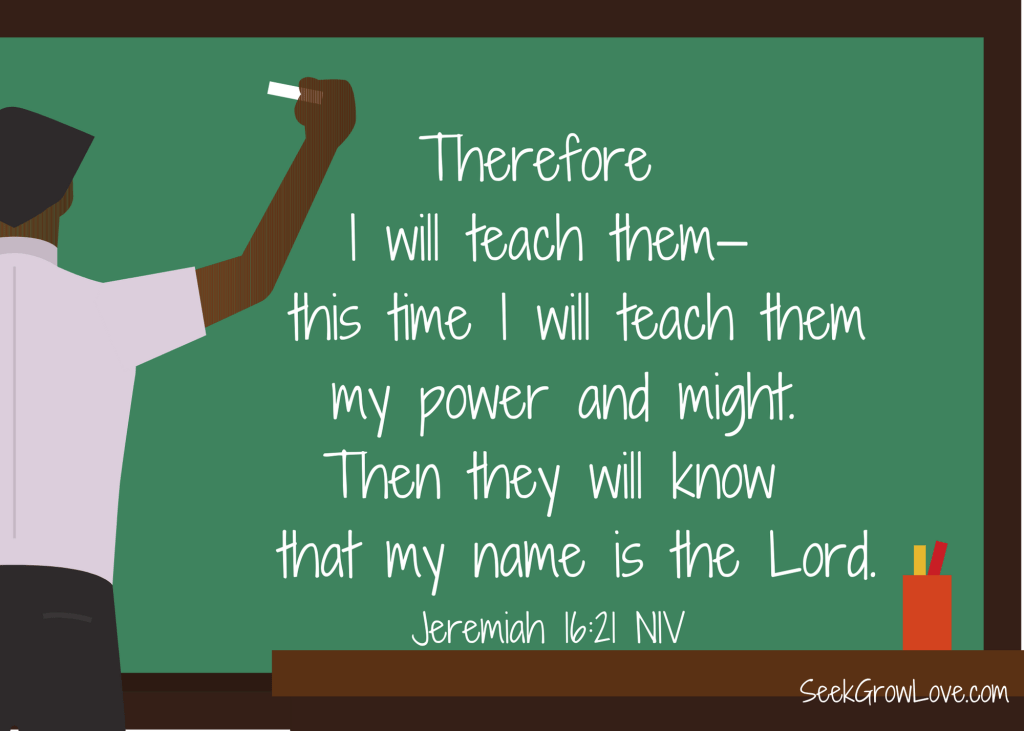
Our passage in Jeremiah today speaks of God as a teacher. Unfortunately, it is at a time when, “Each of you is following the stubbornness of his evil heart instead of obeying me.” (Jeremiah 16:12 – see the recurring stubborn heart problem we talked of earlier this week). Because of their disobedience and collection of false gods (one false god is too many) the lesson coming wasn’t going to be a pleasant one. God says, “Therefore, I will teach them – this time I will teach them my power and might. Then they will know that my name is the LORD.” (Jeremiah 16:21 NIV)

I love the idea of God being a teacher. We chose the name Moriah for our first born daughter, partly because of the reminder to always keep God first, even above our precious children (Moriah was the name of the mountain God sent Abraham to when He tested his faith and allegiance to Him). And, then when I found out Moriah means “God is my teacher” in Hebrew, it became an automatic favorite. This world tries to teach us many lies. I pray me and my family (and you and yours) will listen to and learn from God instead. And, if we learn the lesson well to put Him first and seek Him always, perhaps we will be saved the agony of the lessons He has reserved for those who have turned to false gods and neglect following His words. May we be busy listening to, and doing, what the Teacher says.

Jeremiah gives a good example of what kind of a student we ought to be. He says to God, “When your words came, I ate them; they were my joy and my heart’s delight, for I bear your name, O LORD God Almighty.” (Jeremiah 15:16) What teacher wouldn’t love having a student like this – one who listens, loves, devours, and receives great joy from the Teacher’s words and also takes pride in calling themselves the Teacher’s student. In fact, God told him if he repents (turns from evil) and speaks worthy not worthless words, he will use Jeremiah as his spokesman (Jeremiah 15:19 – perhaps a promotion to teacher’s aide?)

A good teacher knows the subject matter well – God does. He made the world and everything in it. He knows everything. He is the one and only omniscient being.

A great teacher must also know his students well – God does. What are the students’ strengths, their weaknesses, their needs, their fears? What motivates them, what distracts them, what do they already know, what do they still need to learn today, what do they need to be truly successful? How many hairs are on their head? God knows! In Jeremiah 16:17 God says, “My eyes are on all their ways; they are not hidden from me, nor is their sin concealed from my eyes.” The all-knowing, all-seeing teacher doesn’t miss a thing.

And, of course, the very best teacher not only knows each student backward and forward, inside and out, but that teacher loves each and every child to pieces, and is willing to sacrifice for that child’s benefit – God does! He loved you so much that He gave His one and only Son so that you, His student, could have life. His love doesn’t mean punishments won’t be given when earned. After all, punishment is a powerful way to teach a needed lesson. But through it all, never doubt, He knows, He loves and He teaches.

If God is the teacher, what kind of student are you? Are you the child who is easily distracted and zones out during the lesson, missing what the Teacher wants you to know? Are you the one who is making jokes during class to gain the attention and praise of your classmates? Do you deserve several time-outs a day due to your lack of self-control – throwing pencils across the room and getting caught up in sin? Are you a student with a stubborn heart problem and way too many gods in your life? (Hint: the most important math lesson is – the correct number of Gods is ONE and He is the Almighty Creator and Teacher who gives the final grades.). Or, are you a student who is feasting on the Teacher’s words, seeking Him, repenting, and searching for worthy words in an effort to help other students hear His words, too?

Report cards are coming – for you, your family, your church, and all nations. What will the Teacher say about you?

“Look to the LORD and his strength; seek his face always.” Psalm 105:4

-Marcia Railton

Today’s Bible reading passages can be read or listened to at BibleGateway.com here – Jeremiah 15-16 and Psalm 105