
Will You Stand Firm or Topple?

Old Testament: 2 Chronicles 13-14

Poetry: Psalm 95

New Testament: 2 Thessalonians 2

            Psalm 95 encourages praise and worship to the LORD with joy and thanksgiving. When I was in upper elementary school, I was challenged to make note of three things I was thankful for every day. I gave the same challenge to those who attended Family Camp at the end of my sermon Sunday night. I challenge you today to find at least three things you are thankful for and lift them up to the LORD in praise. 

            In 2 Chronicles 13 and 14, you read about the reign of Abijah and Asa, kings of Judah. Unlike King Rehoboam who did evil in the eyes of the LORD, these two both pointed the people back to God, but in different ways. Abijah focused on the fact that the Levites were still faithfully serving and teaching in the temple. He recognized the faults of the king of Israel for having false priests who were not faithful to the LORD most high. King Abijah recognized who God was and the implications that had on the people of Judah. King Asa went farther than King Abijah by removing anything that was meant for idol worship. He also commanded the people to seek God and follow His law. Under both these kings, the nation of Judah was prosperous and had great success when defending their land. They recognized and encouraged truth among the nation. 

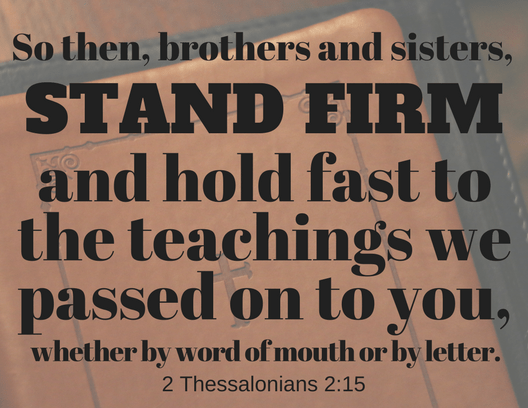
            2 Thessalonians 2 warns against a man of lawlessness who will say he is higher than God as well as encourage lawlessness and wickedness. This man is not like the kings you read about in 2 Chronicles. He will lead people away from God instead of towards God. Paul writes in verse 15 “So then, brethren, stand firm and hold to the traditions which you were taught, whether by word of mouth or by letter from us.” The way to combat this lawlessness is to stand firm in what you have been taught. Abijah stood firm in what he had been taught about God being with the people of Judah. Asa stood firm in what he had been taught by pointing people back to following God’s commands. Both successfully and literally fought off those who were against God. 

            This is going to look different within your own life. Instead of fighting a nation, you are fighting on an individual level. 1 Peter 5:8-9 says “Be alert and of sober mind. Your enemy the devil prowls around like a roaring lion looking for someone to devour. Resist him, standing firm in the faith, because you know that the family of believers throughout the world is undergoing the same kind of sufferings” (NIV). Temptation will come your way. Lawlessness approaches. Luckily, the Bible warns against that happening so you can be prepared to stand firm in your faith just like Abijah and Asa. One way you can be prepared to stand firm is doing what I challenged you to do at the beginning of this devotional. Finding the good in life that you can praise God for doing. Recognizing His presence and work within your life helps combat against the negativity of the world.

            Judy Hopps, from the movie Zootopia, is a good example of how your mentality can help you stand firm or be swayed. Judy is a small bunny whose childhood dream was to become a cop. She worked her hardest to pass from the police academy. She continued to work towards her strong desire to do good even when everyone around her didn’t think she could do it. When she ended up as a meter maid, she still tried to keep a positive attitude about her situation to stand firm in her convictions of doing good as a police officer. If you’ve seen in the movie she doesn’t always have that attitude and when she doesn’t, it doesn’t go well for her. Her joy and determination were completely gone so she ended up giving up. Judy lost her strong stance and fell. 

            The same can be true within our own lives. Not only should we know and understand the scripture in order to be firmly rooted in truth, we must also be firmly rooted in thanksgiving and praise. Recognizing God’s work in your life will help you stand firm. Having both knowledge and an attitude of thanksgiving, your foundation will be deeply rooted and ready for whatever comes. Like Paul warned against, a lawless one will come. He will spread lies and try to topple believers. You must stand firm in your faith like the good kings of 2 Chronicles. Knowing what is within the Word will help you stand firm, but having a heart of praise will keep you close to God and your attitude in a positive place. 

-Makenna Landry

Reflection:

1 – What are three things you can praise God for today?

2 – How has thankfulness helped you stand firm when the world seems bleak?

3 – What stood out to you the most in the lives of King Abijah and King Asa? 

Don’t Let Anyone Deceive You

Old Testament: 2 Chronicles 6 & 7

Poetry: Psalm 2

New Testament: 2 Thessalonians 2

     2 Thessalonians 2 is one of those chapters of scripture that can make us wonder why it was written. Did the people receive a false “spirit or a message or a letter as if from [Paul], to the effect that the day of the Lord” had already come (2)? And if they received such a communication about the day of the Lord, what was its purpose? Was the idea just to plant doubts and create turmoil? Did it achieve anything more than getting the people to check in with Paul?

     Maybe someone tailored a piece of misdirection based off Paul’s words in 1 Thessalonians 5:2, that the day of the Lord would come like “a thief in the night,” to suggest that the day was able to arrive and pass without people becoming aware of it. Such an idea would not fit well with the overall uses of the “day of the Lord” in the Bible, as Paul pointed out in 2 Thessalonians 1:10 speaking of “that day”, but we don’t know how the Thessalonians thought of the phrase before Paul wrote this letter. In 2:1 Paul linked “the coming of our Lord Jesus Christ” with “our gathering together to Him” before he addressed the idea of false communication about the day of the Lord. Perhaps the point of whatever deceiving message the people received was an attempt to separate the day of the Lord from one or both of those ideas in their thoughts.

     Returning to the “thief” metaphor for a moment, any metaphor or parable generally has only one application to be made from it, and can easily be misunderstood by being overapplied. The “thief” metaphor came from Jesus’ words, and it emphasized diligence (Matthew 24:43, see through chapter 25). Jesus didn’t apply any risks of the metaphor to those who were faithful. We do not know when Jesus is coming, but as believers we will not be left floundering when the world changes because of his return – the believers will join with him in celebration.

     Paul has a much plainer case to make than the implications of a metaphor, however, he points out that he already told the church that those who are alive when Jesus is just about to return will have seen signs before his coming. As part of this Paul describes a man engaged in a campaign of evil on behalf of Satan. Paul may seem to write of this remarkably calmly, though admittedly it can be difficult to read tone into written words. And, of course, we don’t know what the Thessalonians had imagined their situation was based on the “spirit” or “message” or “letter” Paul wrote of – he needed to clear things up. We do know that the circumstances Paul is describing will be extreme, and he mentions that he spoke about these things with them in person (v. 5), so he may have previously offered comforting words about the potential of living during this situation. In any case Paul leaves no doubt of who is more powerful, the man of lawlessness, or Jesus. Jesus will slay him by his mere breath (maybe a spoken word?) – it is not a contest. The call to the believers is to stand firm, and having received eternal comfort, and good hope by grace, to desire also to be strengthened in their hearts in every good work and word.

     On the other hand, the situation will be extreme for those who have rejected the truth. They will receive a “deluding influence so that they will believe what is false, in order that they all may be judged who did not believe the truth, but took pleasure in wickedness” (11‑12). This is not the situation of those we are trying to reach with an understanding of God’s love, history will have moved beyond that. It will be like what we read about in Exodus, when God hardened Pharaoh’s heart so He could show His signs and wonders in Egypt at the time of the ten plagues (4:21; 7:3). Pharaoh abandoned good behavior well before Moses arrived, but if shown enough miracles he might have been swayed from his course, even if only temporarily. God wanted a clear-cut setting in which to show His power. God intended to punish Egypt. It seems that things will go similarly with the man of lawlessness and his followers at the end of this age. It would be hard for anyone to remain loyal to such an evil leader and not try to weasel their way into compromises, even if just into other forms of evil, after God’s judgment is made clear. But by that point in history God wants a clear-cut setting to show His judgment. (I admit to finding some of this a bit distressing, but Paul had seen more of the evils of the world than I have, so I can understand if he was able to have a more clear-eyed view about it than I as he wrote about it.)

Lord, thank you for your strength, and that I feel able to put my trust in you no matter what situation I arrive in, even if I were to be living during the reign of the man of lawlessness. You are far greater than he. Your son is far greater than he. I trust that your love and your mercy will be comfort to me whatever may come. To whoever of your servants do live in that time, please let them have great outpourings of your grace and confidence from your Spirit. Life is not painless, but life is worthwhile when lived for you. Thank you, Lord. Amen.

-Daniel Smead

Reflection Questions

  1. Do you think the origins of 2 Thessalonians 2 might be from a prank? Or perhaps did it result from a serious attempt to damage a church’s faith where it seemed to be vulnerable? It has been said that it is normally easier to tear down than to build up. What is the best way you have experienced that a church has been built up? How can you visualize being part of building a church up?
  2. How surprising is it to you that Paul needed to write two letters to the church in Thessalonica, perhaps in the same year, based on their confusion about issues of eschatology? What might have happened if these issues went uncorrected? How much have you studied and compared scriptures about the future to develop your grasp on these ideas if you wanted to discuss them? How deeply do you choose to investigate these matters for yourself, compared to where you stop, considering that if you wished to examine the issue further you would take a question to a “Paul”?
  3. Do you find it hard to imagine a time when there will be no room for shifting between those who are fully committed to evil and those who serve God with their whole hearts? If you thought such a time was coming soon, are there things you would be doing today to prepare?

More and More

2 thess 1 3

I love Paul’s prayers!  They are some of my favorite parts of his letters.  You don’t find him praying about the weather (you know, those ‘no rain so we have a nice picnic’ prayers) and not too often about health needs – but always about spiritual growth and Godly matters.   One example of Paul praying for the church is found in 2 Thessalonians 1:3-12.  He starts out thanking God that the Thessalonian’s faith is growing MORE AND MORE.  How could your pastor or a church member be able to gauge the growth of your faith – is yours growing or shrinking?  How can you tell?  How can others tell?  Next he thanks God that their love for one another is growing.  Can you say the same for your love for your brothers and sisters in Christ?  How can you tell?  How can others tell?

How many of you have heard people complain that God is not just – if he was He wouldn’t allow evil and trouble.  I love Paul’s answer.  “God IS just:  He will pay back…and give relief…This WILL HAPPEN when the Lord Jesus is revealed from heaven.”  (1:6,7) No need to question God’s justice.  His clock is better than ours anyways.  God IS Just.

In 1st Thessalonians Paul tells us to encourage one another with the message that Jesus is coming to earth again!  2nd Thessalonians reminds us to not be deceived, for the Man of Lawlessness – the Anti-God – will be coming too, and will deceive many who have refused to love the truth.  In order to stand firm for Jesus’s return – we must be loving the truth and prepared for evil and lawlessness and deception.  “So then, brothers, stand firm and hold to the teachings we passed on to you.” (2:15)  Learn those teachings well – and cling to them – and pass them on to others.

Thank you God for your words through your servants.  Help me to hear, learn, live and pass along your words and your way.
Marcia Railton

Do Not Be Deceived

2nd Thessalonians 2

2 thess 2 15

This chapter talks about the coming of the Lord Jesus. It tells us not to be alarmed by others saying that the day of the Lord has already come. We are not to be deceived. This chapter mentions several things that need to happen before Jesus returns.

  • Rebellion occurs
  • The man of lawlessness will be revealed; he will set himself up in God’s temple and proclaim he is God.

When the lawless one is revealed, the Lord Jesus will overthrow him with the breath of his mouth and destroy him. Satan will display counterfeit miracles, signs and wonders to try to deceive us all. We need to be ready.  We need to anchor ourselves in the word of God, watching for these things. Stand strong in your faith and do not be deceived. I am going to end this devotional with verses 16-17:

May our Lord Jesus Christ himself and God our Father, who loved us and by his grace gave us eternal encouragement and good hope, encourage your hearts and strengthen you in every good deed and word.


Tomorrow we will talk about 2nd Thessalonians 3.


Many Blessing,

~The Ransom’s