The Whole Duty of Man

Num 19-20

Ps 19

Mark 4

~ Devotion by Cayce Fletcher (SC)

Cayce Fletcher is a wife and homeschool mom of three. She writes and podcasts at amorebeautifullifecollective.com where she helps women cultivate a life of depth, discipline, and delight. Read the latest post on finding beauty in the everyday here

Numbers 19 finishes the communication of the law of God to his people through Moses. We then see a 38-year jump in time. Right after the Exodus from Egypt, the people traveled to Mount Sinai. There they encamped around the mountain for about a year. It is there they received the law and celebrated the first Passover. 

After the year spent around Sinai, the Israelites went directly to Canaan, where the infamous episode with the spies took place. The Israelites were forced to wander for 40 years. Numbers 20 begins during this 40th year. The old generation that included Miriam (126 years old when she died) and Aaron (123 years old) was passing away, and the new generation was preparing to enter the Promised Land. 

Still, even though so much time had passed, the people seemed to have learned nothing. They began grumbling and complaining again. Moses turned to God in his distress. He fell down on his knees in prayer. What a picture of how we should respond when we are at the end of our rope! 

God met him there and gave him the next steps to take. He was to go to the rock and tell the water to come out. 

And then the tragedy occurs – Moses, who always chose the humble path, responded in anger (with a little bravado) to the people. He goes up to the rock, “and he said to them, “Hear now, you rebels: shall we bring water for you out of this rock?”” Then, he strikes the rock twice. 

Because of his disobedience, he is barred from the promised land. God tells him that his response ‘did not uphold God as holy before the people.’

The right response to God is faithful obedience on our knees. It is there that we meet him face-to-face. But it is so easy to let our view of God get clouded by our messy emotions and our chaotic surroundings. 

Do we respond to God in faithful obedience? Or do we react rashly – foolishly – hoping God will bless the response even if it’s sinful? 

God requires whole-hearted obedience and an attitude that reflects a pure heart. Moses’ anger towards the people in that moment caused him to react violently – and Moses was judged for it. 

We rarely feel fear, awe, or reverence for authority today, but today’s passage reminds us that God is holy. We must remember the holiness of God and cultivate a healthy fear of God in our souls. The fear of God helps us to respond faithfully with humility to the commands of God. 

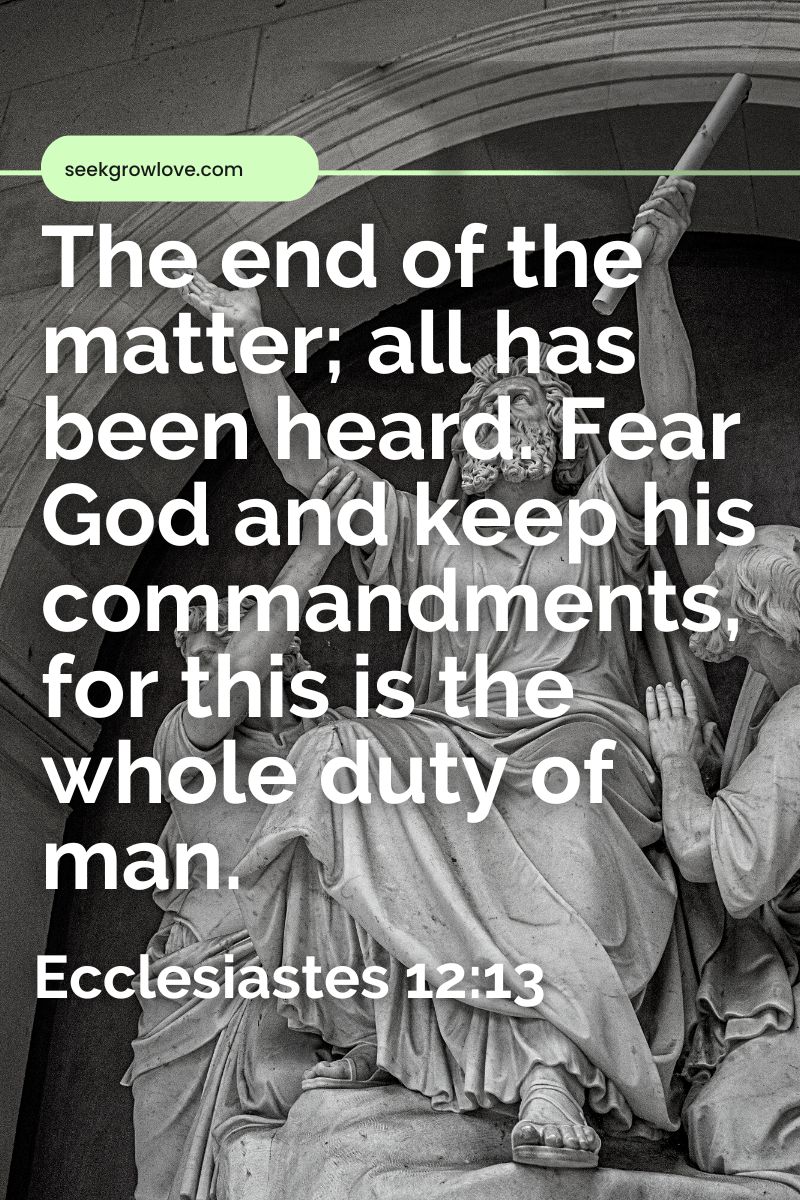
As we read of the end of Miriam and Aaron’s lives, let’s be reminded that the foundation of the legacy of our lives should be this fear of God. As Ecclesiastes 12:13 says, “The end of the matter; all has been heard. Fear God and keep his commandments, for this is the whole duty of man.”

Reflection Questions

  1. How does a life built on the foundation of the fear of the Lord differ from a life without it? 
  2. In what ways did Moses show a fear of God throughout his life? Why did this instance at Meribah not show a fear of God? 
  3. How do you grow in your fear of the Lord?

Prayer

Dear Heavenly Father, 

Please let us remember who the true Lord of our lives is. Let us remember how great you are. Let us remember that you are God and you are not. Thank you for the ways that you draw us back to this truth. 

In Jesus’ name,

Amen.
SGL.2026.CalendarDownload

Lead Us in the Ways of the Lord

Numbers 10-12

The first time I ever set up a tent without my husband was when I took my  just about to be 10 year old son to Cub Scout camp.  Unfortunately, both of us were a little too short to reach all the parts we needed to secure the tent. BUT! Luckily, another parent came over and helped us out. He also gave us some tips about tent camping.  However, he forgot one small detail, or maybe he thought it was common sense. He didn’t mention that we should sweep the ground before setting up the tent so there would be no rocks underneath.  The first night was very uncomfortable (the next few nights we were so exhausted that we didn’t care)!

I suspect that the people of Israel were getting pretty good at setting up tents by the end of Numbers 10.  This chapter lays out the order in which the tribes of Israel were to move when God would lift the cloud. It is interesting to note that Moses asks his brother-in-law for assistance since he was from around those parts.  My Bible footnote states that “Divine guidance does not exclude using human help.” I think that could apply to so many areas of our life! God often puts just the right person into our lives at just the right time to carry out His will! 

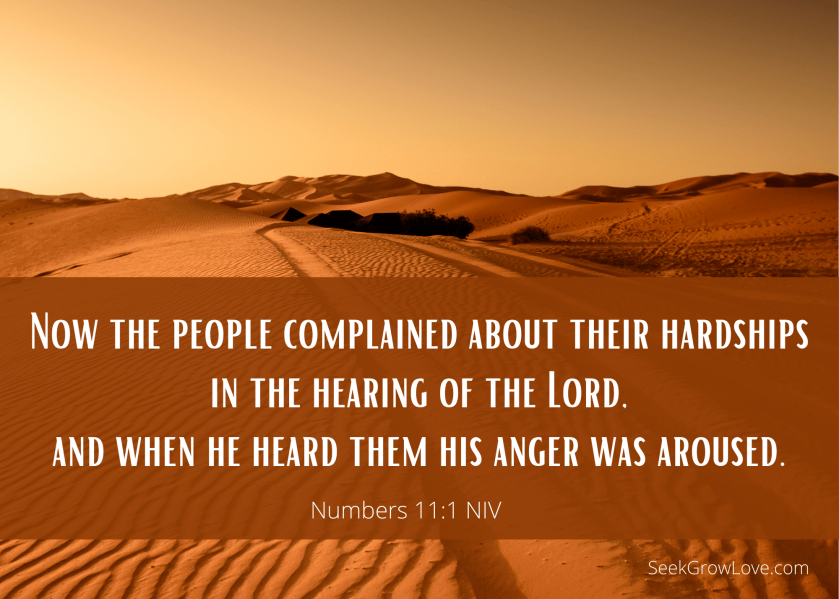
But sometimes the people in our lives can bring us down. In chapters 11 and 12, we find that the people are complaining, a lot, so much that some of them want to go back to Egypt! I don’t know for sure but I think it’s reasonable to guess that it probably started with a few people and soon others followed. Of course, this caused God to get a bit aggravated, sending fire and plagues against those who complained. Even Miriam, Moses’s sister, got a plague of her own, developing an acute case of leprosy. Fortunately for her, God forgave her and healed her. 

Today’s reading really reminds me that while God does send people into our lives to better us and for His glory, there are those who will pull us away from God. When deciding who is who, look at the overall life of the person. What does their life look like? What does their relationship with God look like? If they are a mess and far from God, I guess you could learn what NOT to do! However, we would be wise to listen to the ones who will lead us in the ways of the LORD (and will remind you to sweep before setting up a tent)! 

-Maria Knowlton

Reflection Questions

  1. Does your circle of influencers include more helpful people who will help lead you in the way of the Lord, or more complainers who will arouse the Lord’s anger? Who specifically do you know who could be beneficial to spend more time with?
  2. What would others say about you? Are you more known for your complaining or for leading in the way of the Lord?
  3. When you do complain, what are you more likely to be complaining about? and to whom? Would there be a better use of your time and words?

God’s Deliverance Begins – Again

Exodus 1-3

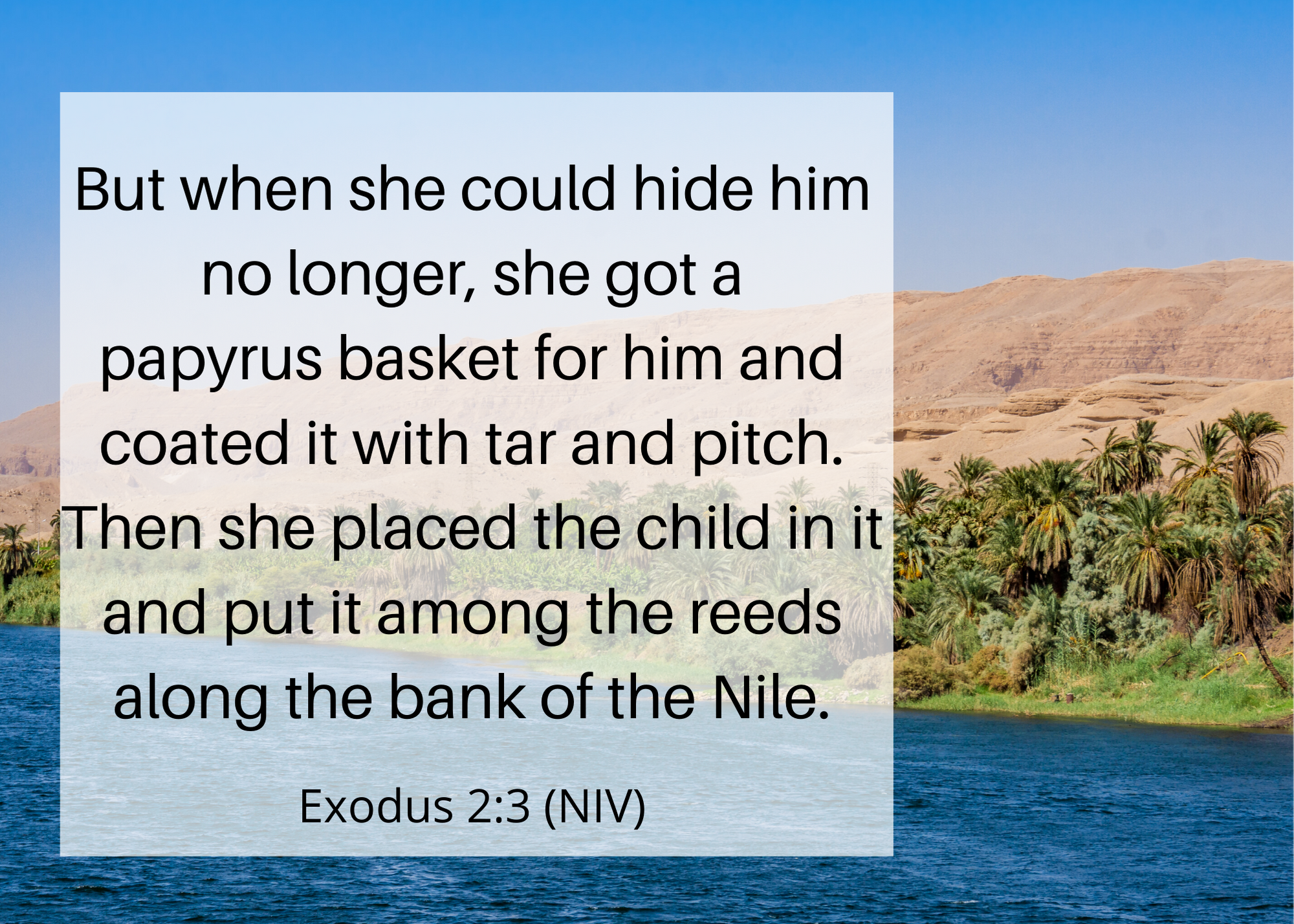
Exodus 2 3 NIV

I had fun with today’s reading; I laughed out loud numerous times. I’m going to try to recreate some of the internal dialogue that was playing out in my head as I read it. Enjoy.


“We need to be shrewd with these Israelites. What should we do? I have a brilliant idea! Let’s enslave them.” – The new Pharaoh, probably.

Shrewd: having or showing sharp powers of judgment; astute.

I’m not sure the new king really knows what shrewd means. I suppose he was astute in his observation that the Israelites are more powerful than he, yet he is not displaying great judgement in putting shackles on the people who got to their current position thanks to a very shrewd man named Joseph. As Egypt will soon find out, God is great at providing the Israelites with shrewd men who are capable of delivering them at just the right time.


“Murder all the baby boys. Do it for king and country, why else? What’s that? It’s immoral to kill babies? Why would you possibly think that?” – Also the new Pharaoh, probably.

The midwives are smart enough to lie to the king and tell him that they aren’t responsible for the lives of these children (as if a person could be considered “responsible” for someone else continuing to live). They claim that the women giving birth are just so skilled at it that they do not need the assistance of a midwife. That is quite a longshot. When is the last time you heard of someone giving birth to a child without the assistance of a professional? Yet the king is dull enough to buy it. He sincerely believes that these women have no concept of morality other than to obey the edicts of their government. The midwives feared God over their government and followed the commands of morality and God instead of the king.


The mother of Moses saves him because she thinks he is beautiful. When is the last time a mother did not think their baby was beautiful? Every mother in this time must have been like her, attempting to hide their baby boys after seeing how beautiful they were. After all, the king made it the family’s duty to kill their own children. Moses’ mother was shrewd. She put him in a basket and set him out in the Nile, intending for him to survive. This sounds insane knowing what lurks in the Nile. She created the basket so that he would be protected, it was waterproofed with pitch. She placed it among the reeds so that it wouldn’t wash away. Finally, she had Miriam, Moses’ sister watch over the basket from a distance. His mother was certainly crafty. I believe she knew exactly what would happen next, otherwise she would not have done it. When Moses is found, his own mother is hired to raise him. That is the work of divine providence and the craftiness of Moses’ mother.


As a side note, the midrash states that Miriam had a significant role in leading Israel alongside Moses and Aaron after the Exodus. https://jwa.org/encyclopedia/article/miriam-midrash-and-aggadah


The bloodlust of Levi comes out in Moses when he kills the Egyptian.


The burning bush seems unique at this point in the story. In the past, God had interacted with people by sending messengers. Abraham speaks with God before the destruction of Sodom and Gomorrah. Jacob wrestles with God. Now we have Moses talking to God in a bush. It is a little different but this begins to be the pattern from here on out. We soon get the pillar of fire and cloud (which appears over the tent whenever Moses speaks with God), and the mountain covered in cloud when Moses receives the law. Later God identifies himself in a new way. He gives himself a name “I AM WHO I AM” or “I AM THAT I AM” which is the translation of the Hebrew YHWH. Up until this point, He has always identified Himself as “The God of your fathers, Abraham, Isaac and Jacob.” This encounter seems to be a turning point in the human story. From now on, a large group of people is going to interact with God in a personal way, they will address Him by name and they will be in close contact with Him.


Nathaniel Johnson


Today’s Bible reading can be read or listened to at https://www.biblegateway.com/passage/?search=Exodus+1-3&version=NIV


Tomorrow’s reading will be Exodus 4-6 as we continue the 2020 Chronological Bible Reading Plan

Crossing the Red Sea (Exodus 14-16)

Although God had rescued his people out of Egypt through the ten plagues, he was not finished yet.  Once they were gone, God hardened Pharaoh’s heart one last time.

Exodus 14.4
And I will harden Pharaoh’s heart, and he will pursue them, and I will get glory over Pharaoh and all his host, and the Egyptians shall know that I am Yahweh.

Exouds 14.18
And the Egyptians shall know that I am Yahweh, when I have gotten glory over Pharaoh, his chariots, and his horsemen.

The Red Sea was part of God’s master plan.  He wants to demonstrate his power so that everyone will know that he is the great God over against the idols of the nations.  As Babe Ruth is known for hitting home runs, Steve Jobs for iPhones, and Mark Zuckerberg for facebook, Yahweh is known for rescuing his people from Egypt.  Years after this, Rahab told the Israelite spies what she had heard about their God:

Joshua 2.9-11
“I know that Yahweh has given you the land, and that the fear of you has fallen upon us, and that all the inhabitants of the land melt away before you.  For we have heard how Yahweh dried up the water of the Red Sea before you when you came out of Egypt, and what you did to the two kings of the Amorites who were beyond the Jordan, to Sihon and Og, whom you devoted to destruction.   And as soon as we heard it, our hearts melted, and there was no spirit left in any man because of you, for Yahweh your God, he is God in the heavens above and on the earth beneath.”

Rahab, living far away in Jericho, has heard the rumors about Yahweh.  Because of his mighty power, shown through partying the Red Sea, she knows he is “God in the heavens above and on the earth beneath.”  Splitting the Red Sea was not haphazard or happenstance, it was God’s plan so that people would hear, so that he would get glory over the Egyptians, so that five hundred years later they would write psalms about it, so that thousands of years later you would praise him for it.  The ten plagues and the Red Sea are all about Yahweh showing the world who he is.

Once the children of Israel got through the Red Sea and the chasing Egyptian chariots, horsemen, and footmen perished, God’s people took some time to praise him.  They wrote a song about how he saved them and how he decimated Pharaoh’s army.  Miriam took up the tambourine and led the other women in dancing.  This is the appropriate response when God delivers his people from something–worship.  Has God delivered you from anything?  If so, then testify to it.  Share it with others.  And most of all, worship him for his steadfast love to you.