
So They Will Know

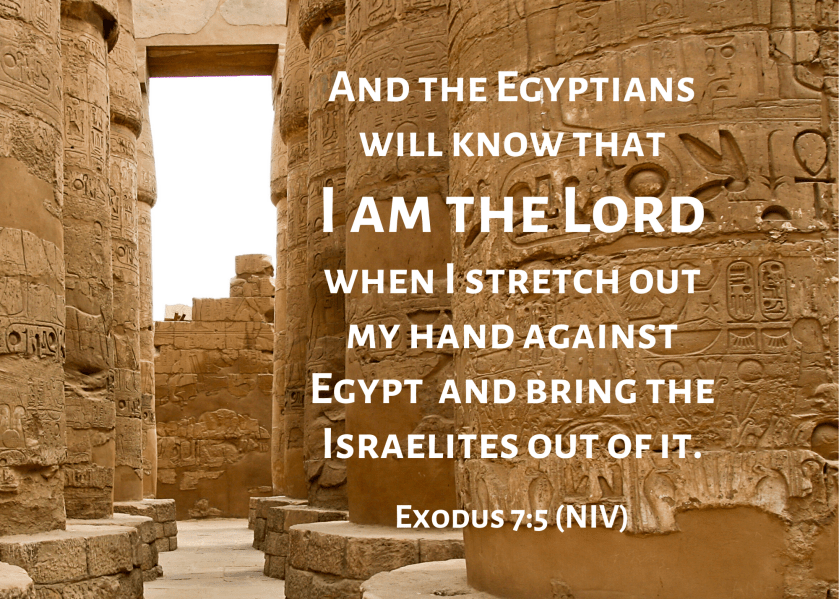
Exodus 7-9

Moses does not believe that he can speak adequately, so what does God say? He does not tell Moses, “I am sorry. I picked the wrong man.” No. Instead He says, “I picked you for a reason. If you can not speak, then delegate that duty to Aaron.” God still says that He is going to speak through Moses, not Aaron. Once Aaron has received the words from Moses, then Aaron can speak them to Pharaoh. In fact, this is the way that religion is going to work for the rest of human history. God will pick a prophet, whether that prophet thinks he is capable or not, and will speak to the rest of humanity through that single person. God is also able to set up leadership through this prophet and the prophet can lead others and coordinate with them in order to achieve more and reach more people. This is what is established in the Levitical priesthood.

I recently heard an interesting interpretation on the hardening of Pharaoh’s heart. I have usually not been able to define the phrase “hardened heart” when I read it. This interpretation however, defines the hardening of a heart as making a man brave. Under this interpretation, God did not force Pharaoh to refuse to listen. Pharaoh first chose to ignore the words of God. Then, when he became fearful because of the plagues, he was willing to let the Israelites go. It is at this point that God makes Pharaoh brave, allowing the Pharaoh to hold to his original decision not to let them go. I think this interpretation has some merit and is interesting at least.

Why did God choose the plagues that he chose? Why did he turn the Nile to blood? He could have turned it to mud or dried it up or anything. Why did he send a plague of frogs? Why not crocodiles or giant river snakes or something a little more intimidating? Why gnats? Gnats are just tiny little things, a nuisance at worst. Well God is the mastermind behind all of this, so He must have known what he was doing. Let’s try to think about all of these plagues in the context of Egypt. We know that Egypt is full of sorcerers who have a handful of tricks. We also know that the Egyptians were polytheistic and had many zoomorphic gods. Finally, we know that the Pharaoh had been oppressing the Egyptians with hard work and even worse, had slaughtered all of their baby boys.

God could have just dried up all of the water in the Nile and it would have had the same effect. All the fish would die and begin to rot and stink. There would be no water to drink. Yet God chose blood. This relates to what I said yesterday about turning people by degrees. God is starting with a plague that the Egyptians think is mere magic. The same thing occurs for the frogs, but the magicians can not create gnats. There is definitely some symbolism to blood in the Nile, possibly referring to the Pharaoh’s slaughter of the newborns. I also think it has to do with the significance of the river to Egypt. That river was a large part of the economy for them, they relied on it. So God took it away. Man should rely on God because he is the source of life. Even at this point in history, people knew that blood is an essential part of life and thought that a person’s life was in their blood. Thus, by turning the river to blood, God is saying, “I give life and I take away life.”

The plague of frogs is a weird one for me. The way it is described makes it sound like an inconvenience; they are just everywhere. One commentator I read said that this was poking fun at the Egyptians gods Hapi and Heqt. God was directly challenging the gods of Egypt.

The gnats are particularly nasty. Have you ever been out on a run in the summer when all of a sudden your mouth is full of gnats? Maybe that is just me. It is one of the most unpleasant experiences. Now have you ever been in a dry, dusty field running around and kicking up dirt? That is also quite unpleasant. It gets tough to breath. One time I was in a situation like this and I had to keep blowing my nose until it stopped coming out black. Now replace the dust in this field with gnats. That is a nightmare.

I am going to stop there and ask that you ask yourself these questions and see if you can come up with an answer. Why flies? Why livestock? Why boils? Why hail? God has every tool imaginable at his disposal, yet He deems these to be the best plagues for this situation. Why is that?

Thanks everyone for starting this plan and sticking to it! If you started from the beginning, great job making it this far and if you are just joining, I hope that you are able to find a routine of your own or hop in with this one. There is nothing better for the mind than to focus on God’s word daily.

Thanks for reading,

Nathaniel Johnson

(originally posted for SeekGrowLove on February 1, 2020)

Reflection Questions

  1. Why do you think God chose the plagues that he did? At which plaque would you have let the Israelites go?
  2. How might you describe a hard/hardened heart? Where have you seen one before? Have you ever experienced one? When is there a downside to being brave?
  3. What were some of the truly miraculous things about the plagues – including the timing, the location, the extent of each? What were the Egyptians learning? What were the Israelites learning? What are you learning? Who can you pass this knowledge on to?
Those Dangerous Excuses

OLD TESTAMENT: EXODUS 3-4

POETRY: PSALM 23

NEW TESTAMENT: MATTHEW 19

My son is fully in his threenager stage of life. Our days go something like this: 

“Jonah, go wash your hands. It’s time for dinner.” 

To which he responds, “Mama, I’ve already told you three [pronounced like tree] times. I’ve already washed my hands, and I’ll eat when I’m done playin’.” 

You can imagine my response to this. Let’s just say I have plenty of opportunities for correction and discipline throughout the day. 

Many times, I can recognize my own voice in what he says. What I say, he repeats in his cute toddler-growing-up way. In the conversation I mentioned before, his main goal was to keep playing, so he was just saying whatever he thought would lead to that outcome. He has a tendency to want to keep doing whatever he is currently doing. So if he’s playing, he wants to keep playing. If he’s at church, he wants to stay at church. If he’s at home, he wants to stay at home. This means starting the next activity involves a lot of excuses as to why he can’t quit what he’s doing and move on to the next thing, even if there are good things in store for him when he does. 

In today’s passages, we read about several excuses given as to why someone couldn’t follow through with what they were asked to do. In each case, the excuses were made because the person didn’t want to leave their comfort zone and change their life. 

In Exodus 3-4, Moses was leaving his flock to go find the lost sheep. On the way, he saw a burning bush. The LORD spoke to him there, calling him to go shepherd the Israelite people as they left Egypt and traveled to the Promised Land of Canaan. Moses gives a series of three excuses. He first asked what he should do if the Egyptians didn’t listen to him – probably thinking that it was a lost cause to go and try to ask the Egyptians to give up their unpaid labor. Then, he says that he is not a good speaker, calling himself “slow of speech and tongue.” Finally, he just comes right out and says, “Lord, please send someone else.” 

To each of these excuses, God responds with a resounding, “Go, I will be with you!” God doesn’t point to what Moses was capable of. Instead, he draws Moses’ attention to what he – God – can do through Moses. For the first excuse, God shows how Moses will be able to do wonders through God’s power. In the case of the second excuse, God points to how he is the creator. He will teach Moses what to say. In the last pleading excuse, God gives a helper to Moses in Aaron to be a mouthpiece for him. 

To each of Moses’ excuses, God gives a clear path forward, showing how he in his might and power will make what he has said come to pass. 

Our passage in Matthew 19 repeats this theme of excuses. The rich young ruler had attempted to live righteously, following the law. Jesus told him that he lacked one thing: He needed to sell his wealth and give to the poor. The rich young ruler went away sad, probably full of excuses. He didn’t want his life to change. 

We have been called ourselves. When we hear the gospel, we must change. When we hear God’s leading in our life, we must act. But, all too often, we are filled with excuses. We don’t want to leave our comfort zone, and we think of a million reasons why this is the case. 

Today, don’t focus on why you think you cannot accomplish something for God, or why you think you cannot move forward in faith. Instead, focus on what God has done and will do for you. Trust that he will lead you to “green pastures” and “quiet waters.”

~ Cayce Fletcher

Cayce writes about discipleship, productivity, and homemaking at her blog https://amorebeautifullifecollective. You can find her latest post on biblical ideas creating an ideal schedule here. You can also listen to A More Beautiful Life Collective Podcast on Apple Podcasts, Spotify, YouTube, or wherever you listen to podcasts. 

REFLECTION QUESTIONS

  1. Moses was asked to go down to Egypt, but he didn’t want to go because he felt inadequate. Have you ever felt inadequate when you have been asked to do something for God? How can you overcome those inadequacies and act in faith? 
  2. What excuses have you given when it comes to following Jesus in faith? 
  3. Psalm 23 focuses on how God, as a good shepherd, leads to good things. What are some good things to which God has led you in your life? 

SGLCalendar2024DOWNLOAD

Day of Trouble

New Testament Reading:  Mark 8

*Psalms Reading:  77

Old Testament Reading:  Isaiah 37-38

Have you ever felt so troubled that you couldn’t speak?    Your heart is so heavy, nothing you try brings comfort, you can’t sleep, you question God’s love and promises…..you are miserable.  Psalm 77 begins, “I cry aloud to God, aloud to God, and he will hear me.  In the day of my trouble I seek the Lord”. 

The Psalmist suggests that, in these times of trouble, we could remember the deeds of the Lord, ponder God’s work, and meditate on His mighty deeds.  Sometimes that is not enough.  Sometimes we don’t see God moving in our life.  Sometimes we don’t hear him guiding us.  Sometimes we don’t feel his presence.  Sometimes we need more than just remembering and meditating. 

Verses 16-19 describe when God parted the Red Sea for the Israelites as they fled Egypt.  Verses 19-20 say, “Your way was through the sea, your path through the great waters; yet your footprints were unseen.  You led your people like a flock by the hand of Moses and Aaron.”

God himself wasn’t seen.  BUT, He led the Israelites by the hand of Moses and Aaron.  I think He does that today.  He often uses people to help lead us. 

I have been there.  Troubled.  Unable to see or hear God.  Thankfully, I did have people in my life whom God used to lead me out of that darkness.  Some were friends and family.  Some were professional counselors.  Some were on the radio, singing or talking.  Some were authors.  Some were people in Scripture.  God sent help.  Let me say to you, “God WILL send help”.  Your job, in those troubled times, is to accept the help He sends. 

Your next job is to be that help for someone else.  2 Corinthians 1:3-5 tells us that God comforts us so that we may comfort others.

Amy Blanchard

Reflection Questions

  1. Have you ever experienced God sending someone to help in your troubles?  If so, share your experience with someone.  Maybe your story will give them encouragement, strength, and comfort. 
  2. If you are in a “day of trouble” right now and aren’t seeing or hearing God, don’t give up hope.  Look around you for people He is sending to help you.  Can you see anyone?
  3. Remembering God’s deeds is a good tool for strengthening our faith and our trust in Him.  Think about your life; which of God’s mighty deeds can you meditate on today?

Knowing to Trust

Exodus 32

February 14

When the people didn’t know what was going to happen with Moses, they turned to Aaron to create new gods. God was very angry.

We have struggled with plenty of fear just in the past few years. Not knowing is a great fear of mine. I struggle with not knowing which college I should go to or what I should do with my life.

The people were dancing and worshiping a golden calf. It says in Exodus 32 that the people are prone to evil. They asked for gods that will go before
them. Do we all struggle with evil or dirty desires? Most likely, but how we handle those desires is what matters the most.

Just because you can’t see what has gone over a mountain or you don’t know what’s going to happen in the future, this doesn’t mean we shouldn’t push for greatness. The kingdom is our goal. It is our motivation. We must trust in what we can’t see or can’t understand at the moment. We must understand that just because God sent Moses over a hill and we couldn’t see him and his plan – we must know there is one.

-Genesis Dylewski

Questions for Reflection and Discussion

  1. The people were quick to take (sinful) action when they felt like they had been abandoned by God and Moses. Have you ever felt (even for a moment or a day) like you were abandoned by God and/or those who have represented Him to you? What options did you have in how you reacted? What would have been the best course of action?
  2. How can you build your trust in God so that even when He is harder to see, you know He and his plan can be trusted?
  3. What false gods or unhealthy practices are you tempted to turn to when you battle fear? What consequences are there in these actions or attitudes?