It is Coming

Obadiah

Monday, November 7, 2022

Sometimes it can be hard to see what God has planned in our lives. When we choose to live a God-honoring lifestyle, it is easy to see all of the pain and suffering in the world and sit back and ask, “Why?” Why are some extremely wealthy and prosperous, yet, evil people allowed to do what they do untouched? The first thing we say is that it just isn’t fair. But really, to the people of God, good is coming and all we need to do is trust in God’s timing.

To be the smallest book in the Old Testament, the book of the prophet Obadiah is probably one of my favorites. Its message, once determined, is quite comforting and tells a message that is familiar to those of the Christian faith, albeit, from a different angle.

The whole book is composed of a powerful twenty-one verses that is to reveal the outcome of Edom, descendants of the family of Esau and long term enemy of the Israelites. And it doesn’t hold back. Condemning them for their pride, and for Esau’s violence against his brother Jacob, God says that though they build themselves up high like eagles, from that place He will bring them down.

“Then the house of Jacob will be a fire And the house of Joseph a flame; But the house of Esau will be as stubble.” (Obadiah 1:18)

The main lesson to be taken from this book is that God is a God that will vanquish our enemies. Yahweh is a living God that if we can trust, does hold the ultimate reward and in verse 21 “The deliverers will ascend Mount Zion To judge the mountain of Esau, And the kingdom will be the Lord’s.” The kingdom of those who can put their peace in the future day of the LORD.

-John Evans

Reflection Questions

  1. What are your feelings when you hear the Day of the Lord is coming?
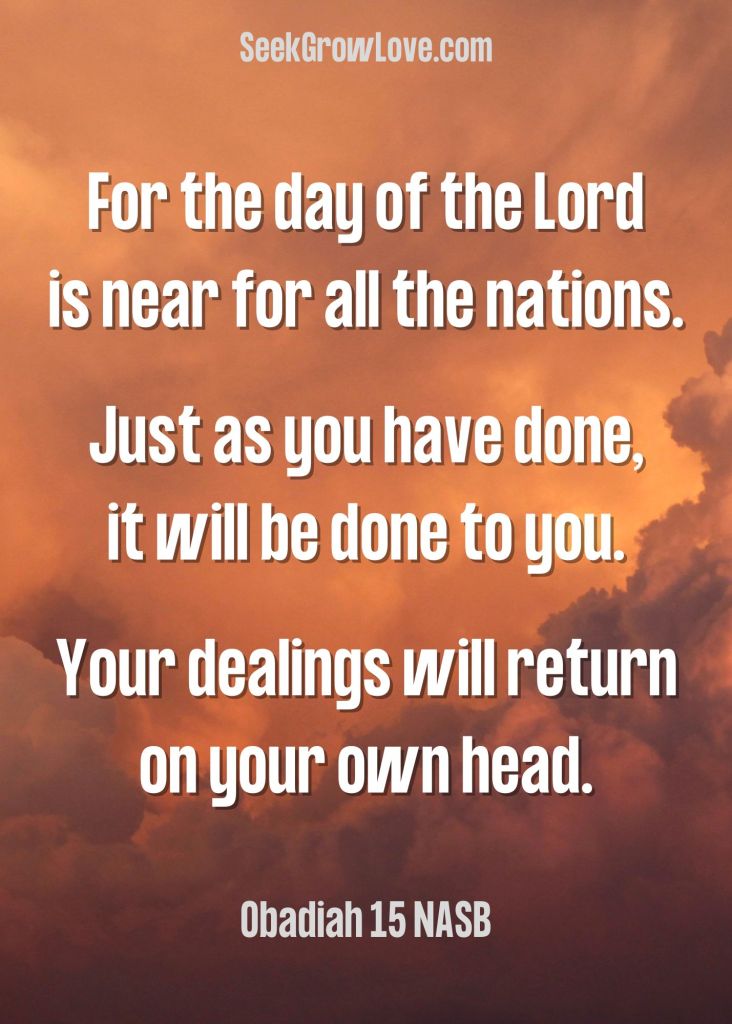
  2. What does it mean to you that, “Your dealings will return on your own head”? Are there any exceptions?
  3. Do you feel prepared for the Day of the Lord? Is there anything you need to take care of in your relationship to God and to others before that day comes?

The Opposite of God

Obadiah and Psalm 82 & 83

Obadiah 15 NIV sgl

In yesterday’s devotion, one of four bullet points focused on making God the judge. In today’s reading, there are calls from Obadiah and the Psalmist(s) for justice to come from on high.  To be clear, we are not appointing God to a position He doesn’t already command, and we aren’t necessarily persuading Him to intervene.  When we implore God to judge, we are inviting Him to rule in our favor by having a life-contrast or dichotomy that would allow Him to easily see we are for Him.  We are the wheat. We are the sheep. Whether he intervenes today or not, ultimately, “Come” will be the words of invitation we will hear from our King inviting us to dwell with God in love and in eternity.  Conversely, we are all declared guilty for the first death, but we can be condemned to a second and permanent death if we are not found covered by the innocent blood of Jesus Christ.  Those who remain are against Him. The chaff. The goats. “Depart” will be the words of condemnation to those who made themselves a stranger.  There is no invitation.  There is no love.  There is no eternity. God’s ruling is truly sovereign. There is no room for shades of gray.


Although the following isn’t a joy-filling thought to charge the beginning of your day, we need to be reminded there is a place opposite of God.  Sometimes those who dwell there actively and openly oppose Him (Obadiah 1:3). In fact, there are people in this world who would love nothing more than to imprison Christians, outlaw prayer, burn down churches, and try to expunge the name of Jesus Christ from existence.  Sadly, this happens quite a bit across the world today, and I dare say, at an ever-increasing pace in the United States. However, we must also remember, open defiance and apathetic faith are equally punishable in the eyes of God: women and men who prioritize their lives by accumulating wealth, try to make a name for themselves, acquire dizzying intellects, repeatedly give into vices, forget to take care of those who are hungry, thirsty, or imprisoned, or many other acts not listed here that do not center solely around God (Psalm 82:3,34, Matt 25:44,45). Apathy, complaisance, half-heartedness, and postponement can place us in imminent condemnation of God as plainly as open defiance.


To not share the name of Jesus Christ is to annul his message. To not lift up the church is to tear it down.  To not empower the weak is to place them in the hands of those who would do them harm.  Where is the contrast in your life?  Are you living for the finite or existing for the eternal? Are you with Him or against Him?  Yes, there is a place opposite of God, but let us pray that God uses these words we read today to convict us, bringing us closer to His calling as good and faithful servants.

Aaron Winner

Today’s Bible passage can be read or listened to at https://www.biblegateway.com/passage/?search=Obadiah+1%2C+Psalm+82%2C83&version=NIV

Tomorrow’s reading will be 2 Kings 1-4 as we continue our journey through the 2020 Chronological Bible Reading Plan

Don’t Be That Guy

Obadiah and Jonah

obadiah

Sunday, April 16

Don’t worry, God hasn’t forgotten.

Obadiah is the shortest book among the minor prophets, yet it’s message is anything but minor or insignificant. To grasp the content of Obadiah we have to go through a brief history lesson. History was my favorite academic subject in school, so other history nerds, you’ll enjoy this. Also, understanding the historical context of the books of the Bible is one tool used in hermeneutics (the study of how to interpret biblical texts). In other words, to be responsible interpreters of the Bible we should always attempt to reconstruct the historical context of the passage.

Though Jeremiah attempted to convince the people of Judah to surrender to the invasion of Babylon of 586/587 BCE, they refused. The context and content of Obadiah is situated in the aftermath of the destruction and exile brought on by Babylon. Verse 1 tells us that God gave Obadiah a vision concerning the nation of Edom. Edom is the cousin nation to the people of Israel. The patriarch of Edom is Esau and Jacob is one of the patriarchs of Israel. From the time of Jacob and Esau being in the womb to long after their deaths, they and their people have had rocky interactions, including the one described in Obadiah. Verses 2-9 describe judgement and wrath awaiting the nation of Edom, however we’re not told why until verse 10.

The first line of verse 10 says “Because of violence to your brother Jacob…”. Then from verse 11-14 the phrase “on the day/in the day” shows up nine times! When Babylon ransacked Judah, the Edomites, the cousin nation of Israel, just stood on the sidelines watching and did nothing. God is telling the Edomites they will be judged for what they didn’t do “on that day!” They didn’t come to the aid of the Israelites and instead enjoyed and gloated over their doom. Obadiah is writing to those who have been left behind to encourage them and remind them that God has not forgotten the wrong done to them.

There are two lessons we can take from Obadiah. First, just as God had not forgotten the wrong done to his covenant people Israel, likewise God doesn’t forget the wrong done to you. We serve a God who takes action in the present. And even if a wrong is not vindicated in this present evil age it will certainly be reversed at the return of King Jesus. Second, we see that God equates ignoring justice and not taking action as doing “violence”. Are you someone who shies from standing up for what is right? Do you stand by idly while injustice occurs? The New Testament places a great emphasis on taking care of other believers in the body and being there for them. Do you do this? Edom didn’t take care of their family and it displeased God greatly. Shoutout to God for having a significant message tucked away in a tiny unsuspecting book.


Don’t be that guy: The Story of Jonah

            The story of Jonah we have all heard in one capacity or another. Whether it be in Sunday School, a sermon, or just having a superficial awareness of Jonah and his short yet interesting story. The four chapter story can be summed up fairly easily: Jonah is called by God to bring Nineveh, a great terrible city, to repentance. Jonah then runs away but is swallowed up by a great fish-spewed back onto land and again given the charge to preach repentance to Nineveh. He preaches and Nineveh repents and as a result God does not smite the Ninevites. Meanwhile, Jonah stews about how they were saved not demolished.

Consensus about the purpose of Jonah among Old Testament scholars is that there is none. There are a bevy of interpretations concerning the purpose and point of the book. However, there is one thread that stuck out to me the most that connects the story of Jonah to our own contemporary world. We see Jonah as someone who knows the true God and thus is part of the people of God. God gives Jonah a mission to preach repentance to the Ninevites, so that they may turn from their life of pagan idolatry and a life without knowing the true God, to living lives in a manner that is reflective of the truth of the God of Israel, the one true God. But Jonah isn’t down with this plan and flees the opposite direction.

In a parallel manner, you and I have been called to evangelize to those who do not know the truth of Jesus and the kingdom of God. Be honest with yourself, as a disciple of Jesus, do you share the gospel with those who do not know it or have not accepted it? We can think of many reasons why we can’t or we shouldn’t, but is this being faithful to the call Jesus has given us? It’s uncomfortable, I get that. It can be awkward, you’re absolutely right. It’s scary, exactly. But let’s not be Jonah and run away from the message we have been given to proclaim.

Pray for boldness, confidence, and opportunity. Get the gospel message embedded in your heart and mind so that you know where to take someone when you dialogue with them. You got this, you can do it. Don’t be Jonah, be faithful.

-Jacob Rohrer

Bio: ABC (Atlanta Bible College) grad.  Ohio native. Kingdom citizen