Still Giving – and Standing Firm

Luke 21

Luke 21_28

Yesterday our devotion centered on the Christmas story – as presented in Luke chapter 20.  Today takes us into Luke 21 which begins with a few verses concerning giving gifts. How fitting.  But here it is a slightly different type of gift which Jesus is referring to.   “As Jesus looked up, he saw the rich putting their gifts into the temple treasury. He also saw a poor widow put in two very small copper coins. “Truly I tell you,” he said, “this poor widow has put in more than all the others. All these people gave their gifts out of their wealth; but she out of her poverty put in all she had to live on.” (Luke 21:1-4).   Giving to God’s work is indeed a great place to give your gifts – whether you are blessed with a lot to give or very little to give.  God sees the heart and is delighted in the heart that joyfully gives all to Him.

The rest of this chapter is devoted to the future – including some rather troubling events: earthquakes, wars, famine, and hatred, prison and persecution as a result of believing and  testifying about Jesus.  But hope is given.  Jesus says he is telling us these things so that we will know what must take place before the end will come.  A hard day of dirty work is always made easier by knowing it will not continue forever.  At the end there will be a time to enjoy the rewards of working hard.   So too, those who are faithful through the end times can look forward to reaping the reward when the Son of Man comes again.

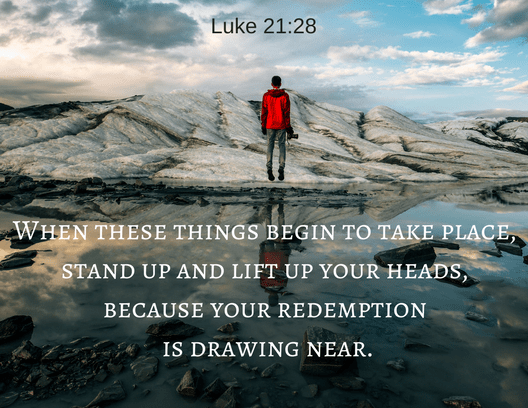
Jesus says do not be afraid; rather, “Stand firm, and you will win life.” (Luke 21:19).  Even while our neighbors are fainting from terror at the surrounding events, Jesus tells us to stand tall.  He says, “At that time they will see the Son of Man coming in a cloud with power and great glory. 28 When these things begin to take place, stand up and lift up your heads, because your redemption is drawing near.” (Luke 21:27,28). 

Keep Giving – and Stand Firm!

Marcia Railton

Living Simply

Luke 10

luke 10 2

In Luke 10 Jesus is appointing 72 of his followers to go out ahead of him and to spread the message and to see which towns will be open to his message.  Now I think that his instructions to this group of believers is unique to their purpose in aiding Jesus’ earthly ministry, but there are also some useful instructions for us today.  In verses 2 and 3 he tells them to pray that God will send his missionaries into the world, and then tells them that they are the ones that are being sent, but that it will be dangerous.  At that point in Jesus’ ministry I think that some of the disciples had been living in a bit of a bubble and hadn’t yet realized the kind of persecution that they would undergo in their lifetimes, and Jesus was preparing them for what was to come.  I think that similarly Christians in America, and especially those who have grown up in the church have been living in a bubble.  We have been a predominantly Christian nation for several generations, but our nation is quickly moving away from God and I personally believe that within my lifetime we will start to see a lot more persecution of the church.  So those of us that plan to be bold with our beliefs and plan on spreading them to those around us need to be ready and understand that there are dangers associated with being a Christian and being different from the world.


In verses 4-8 Jesus describes how they should move about and how they should act while they are staying in these towns they are visiting.  The summary of these instructions is that they need to move with haste and purpose and while they are staying as a guest in these towns they need to live simply and humbly.  They were to take whatever was given to them gladly and not complain about any food or accommodations.  I think that for us today we need to remember to live with a purpose and to not let ourselves be distracted by fancy living or money or other things of this world.  Our lives are relatively short and there is a great deal of work to be done for the Kingdom.  I’m not saying that we should go around without a wallet or purse or shoes like these disciples were instructed, but that we should lead simple lives so that we have more time for God.


At the end of Luke 10 in verses 38-42 we have the story of Mary and Martha, sisters who hosted Jesus while he was traveling and teaching.  Mary sat at Jesus’ feet and listened to all that he said while Martha ran about getting food and things ready for all of the visitors.  Finally Martha had enough and told Jesus to tell Mary to help her with the housework.  Jesus replied.


41 “Martha, Martha,” the Lord answered, “you are worried and upset about many things, 42 but few things are needed—or indeed only one.  Mary has chosen what is better, and it will not be taken away from her.”


Again a lesson to live simply and to put spiritual matters ahead of physical issues in our lives.

-Chris Mattison

Victorious God

Revelation 8-12

1023-REV011015ENGKJV08000480ISP02066256000

Wednesday July 19

Seven is the number of completion, of fulfillment.  The number seven appears repeatedly in Revelation:  seven Churches, seven seals…. and now seven trumpets.  A trumpet is blown to get people’s attention- something important is about to be announced.  The seven trumpets here announce the judgment of God upon the earth.  God is about to bring this evil age to a close to make way for the age to come, when the Kingdom of God replaces fully the kingdoms of this world.
Each of the seven trumpets are blown by an angel of God followed by some great disaster.  There is hail, fire, blood, large burning rocks falling from heaven (a meteor or asteroid).  Then stars fall from heaven, the sky becomes filled with darkness, more heavenly bodies fall to earth opening deep pits in the earth which release demonic creatures.  There are plagues and wars and all manner of destruction heaped upon the earth.  Here it’s important to remember that much of this is symbolic language.  The point is that there will be calamities which bring about destruction on the earth, some are ecological, some are interstellar, and some are man made.  This Summer there’s a t.v. show on called Salvation.  The premise of the show is that NEO object is heading toward earth and is likely to cause massive death or even total extinction.  In real life, under Yellowstone National Park in Wyoming there is a super volcano, which, if it erupts, would place nearly all of the continental US under a cloud of darkness that would result in massive famine.  Of course, we hear regularly dire predictions about global warming, rising sea levels, the melting of the Arctic permafrost etc…  And don’t forget the expanding nuclear arsenals of places like North Korea and Iran.  There are any number of ways that global destruction could occur.  This is a part of our human consciousness… and it was a part of human consciousness in the first century as well.  There has always been the understanding that there is much that is outside the limits of human control: drought and famine, earthquakes and fire from heaven.  These events were usually linked to belief that whatever gods that community worshipped were angry.  Destruction was linked to judgment, which was linked to human sin.  The normal response was to bring sacrifices to the gods and a promise to stop doing bad things.
In this section of Revelation, we see that the one true God is behind these disasters, but there is no willingness of the people to repent. In Rev. 9:20-21 the people refuse to repent of their idolatry, of their murder, of their sexual immorality.  The people will not link the calamities that befall them and the earth with their own bad actions that violate God’s word.
Revelation 12 gives another picture. It’s an overview of the history of the earth and it shows the cosmic dimension of the battle that’s taking place.  There is a spiritual warfare. Behind it all is this picture of evil described as the dragon, or the ancient serpent, or the devil or Satan.  Evil is making war on God’s people.  Yet, evil will be brought down and God’s people who refuse to submit to evil will be victorious.  Even though they may be killed by evil, yet will they ultimately be victorious.
Remember, when John received this vision, Christians were suffering at the hands of the powerful evil empire of Rome.  It seemed like a powerful or insurmountable monster that was able to impose his will on God’s people.  Imagine how hard it would have been to stay faithful to Jesus Christ during such a difficult time.  Yet here is a message of hope, a message of victory.  Evil and the human faces of evil will not win.  God has far more power available to him than evil does.  Those whose hearts are turned against God and refuse to repent will not be swayed by these displays of judgment and power, but those who are faithful to Jesus Christ and remain faithful, even to the point of death, will emerge victorious.
There are always events that happen in our lives that tempt us to doubt God or to turn away from Him.  These apocalyptic texts in Revelation serve as a vivid reminder that, no matter how bad things may get in the world, even for believers in God, God will be victorious.  Let us stay faithful and keep trusting God and our faith will not be disappointed.

-Jeff Fletcher

Unveiling the Past, Present and Future…And Then Repent!

Monday, July 17

revelation1-8

Revelation 1-3

The final book of the Bible is known as the Book of Revelation.  It is also known as the Apocalypse.  Apocalypse mean “unveiling”.  It has the idea of that which was hidden has now been unveiled or brought out into the open to be seen.  There are other passages in the Bible that contain apocalyptic material (parts of the book of Daniel and Ezekiel are two) but this is the only book of the Bible that is fully apocalyptic.
Revelation can be a little confusing (ok, a lot confusing).  A big part of this confusion comes from the challenge of pinning down the proper timeline.  It contains material that was past, present and future to the writer, John, who wrote toward the end of the first century.  The angel who gave this revelation to John said: “Write, therefore, what you have seen, what is now and what will take place later.”(Rev. 1:19).  There are different “schools of interpretation” that see Revelation as mostly focusing on John’s time period (end of first century in the Roman empire), others see it as being fulfilled progressively over the past 2000 years of the Church, and others see it as still to be fulfilled in the future.  This is compounded by the use of symbol and imagery that fill the visions of Revelation.  A lot of time can be spent trying to discuss and debate these issues, but for our purposes I’d like to focus on basic principles found in Revelation that can be of value to our lives as followers of Jesus today.
In chapters 1-3 a focus is on letters written to seven Churches throughout Asia.  John is writing to them as a pastor who at the time was living in isolation on an island in the Mediterranean sea.  He can’t be physically present with his churches, but he is with them in spirit and wants to encourage and instruct them, to help them stay strong during a time when many believers were suffering persecution by the Roman empire.  Imagine what it would be like to try to encourage Christians today living in places like Pakistan, or Egypt, or Sudan or Syria, where Christians were being killed because of their allegiance of Jesus Christ rather than to Mohammed.  What kinds of encouragement would Christians whose family members, friends and fellow believers were dying for their faith need to help them not lose faith?
In the Roman Empire during John’s time of writing it was required by law for citizens to declare allegiance to Caesar by publicly declaring Caesar to be Lord.  Jewish people were largely exempt from making such declarations (but not always).  Often Christians came under the umbrella of the Jewish exemption, but now always.  Thousands of Christians died as a result of religious persecution during the early Roman empire.  John writes to offer encouragement to keep faithful to their commitment to God and to Jesus Christ in the midst of such persecution.  The challenges we face today may not be the same type that first century Christians faced, yet we still have challenges, struggles and temptations.
Chapters 2 and 3 of Revelation contain words of exhortation and correction to the various Churches to which John is writing.  Each Church had many good things happening for which they were praised, but several also had not so good things going on for which they needed to be corrected.  One of the common themes of each letter to each Church was a call to repentance.  To repent means to turn around or change direction.  To the Church at Ephesus, John said that you have “lost your first love.”  They were just going through the motions of their faith, without the passion.  Perhaps you can relate to that.  Anyone who has been a Christian for a while has to be aware the danger of “just going through the motions” and losing their passion for God.  John is trying to get them fired up again.  John says: “repent” and do the things you did at first.  Most Christians, start out enthusiastic… they read the Bible a lot, they pray a lot, they tell their friends about God and their faith a lot, and they consciously seek to get closer to God and do things to please God.  But over time, they lose the passion, lose the drive… become complacent.  John says- get back to the love and passion you first had for Jesus.
Maybe this is you.  If it is… let it be a wake up call.  If this isn’t you, then keep reading through Revelation 2 and 3.  Look at what is said to each of the seven churches.  Is there anything that rings a bell?  Is there anything there that applies to you?  I’m guessing there is.  Read it… and then repent.
-Jeff Fletcher