
Shifting Our Perspective

Acts 1-3

Devotion by Kaitlyn Hamilton (Michigan – and Indiana)

One of my close friends in high school, while dealing with the loss of someone she knew, asked me the question, “Is it a bad thing that I’m concerned about his soul for eternity?”  This question, this concern, about a soul’s place in eternity is something that many people often consider when faced with the loss of someone they know.  This is great and all, but there’s one big problem with this – for many people, this is the only time they seriously consider what is going to happen to people in the grand scheme of eternity.  Do you spend significant time considering the number of people around you who you know aren’t part of the church?  But, it’s not enough just to consider it; once we realize the large quantity of people that we care about who are currently on the path of destruction for eternity, we should be ready to do something about it.

In reading Acts 2, we see that Peter recognized what was at stake.  The same person, who earlier, was too afraid to be associated with Jesus for fear of his life, takes a stand before a large crowd of people, including a group who were mocking them saying, “They are full of sweet wine.” (Acts 2:13)  Peter chose to shift his perspective away from the thoughts of the world, of what this crowd could do to him if they disliked his message, of what these same people did to Jesus only 53 days earlier.  Instead, he shifted his perspective towards that of God’s will, focused on the message these people needed to hear.  In Acts 2:22-24, instead of focusing on how to keep peace with all the men who Peter knew, instead of trying to remain on agreeable terms as friends, Peter was willing to stand up for his faith, was willing to tell the Jews gathered in Jerusalem the truth of what their actions did.  The Messiah that they had been watching for all their lives and the lives of all their parents and grandparents and all their ancestors before them, they had put to death, they had crucified.  Can you imagine having the courage to stand before just one person and telling them that their actions, their sins, were the reason that an innocent man was put to death?  But, Peter didn’t just tell one person, he told a huge crowd – a crowd that should they be angry enough could easily turn into a mob and kill him.  This choice to tell everyone the truth about Jesus, the Messiah, and what they had done to him, took courage that comes only from shifting your perspective away from the worries of this world to that of the hope and peace that come from God.

What would happen if we all shifted our perspective like Peter did?  If we all chose to focus on God’s will for our life instead of the fears that try to stop us from seeking him?

What would happen if we were willing to all stand up for our faith to everyone we know?

What would happen if we let everyone know that we were Christians and weren’t willing to budge on any of our morals?

What type of revival would we see if we did all this?  

Peter saw a revival that day of 3,000 people.  Imagine just how big of a revival we would see if we all chose to stand up together and proclaim our faith.  It’s not going to be easy.  It means going against your human nature.  It’s not going to be automatic.  It won’t be a switch being flipped overnight.  But, it will change you and the world.  So, I encourage you to start shifting your perspective today, to start recognizing what is at stake, and to start standing up for your faith today!

Reflection Questions

  1. What could it look like for you to stand up for your faith today, and the rest of this week, month, year, life?
  2. What fears do you think Peter might have had to overcome that day? What fears do you currently have about boldly proclaiming your faith? How might Peter respond to you if you could discuss with him about your fears? How do you think Jesus, or Jesus’ Father, would respond if you were to tell them about these fears? Go ahead, tell them and pray about it.
  3. What “Helper” was assisting Peter? (Hint: it wasn’t wine.) What benefits does this Helper provide? Do you use the same Helper?
Peter and Cornelius

THEME WEEK- Peter: Acts 10

Old Testament: Nehemiah Intro – found below

Poetry: Psalm 18

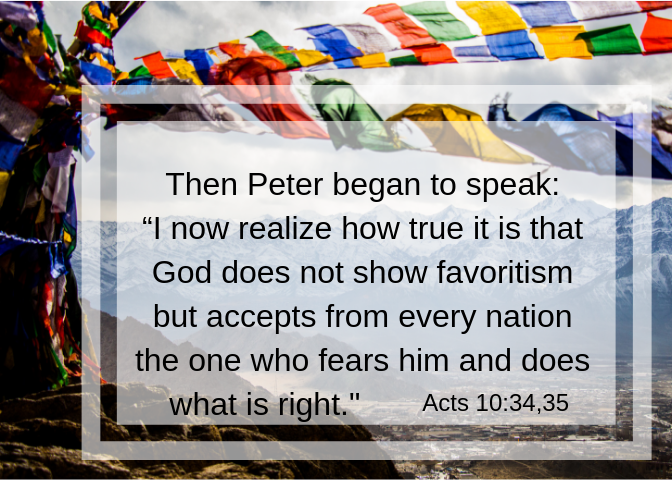
This devotion comes from Acts chapter ten. The Centurion of what was known as the Italian Cohort was a devout Christian man named Cornelius. Being known for the faith of all his house and his charitable actions toward the Jews, Cornelius is definitely the kind of guy you want around when change needs to be made. Now Cornelius has a vision, and in this vision he is instructed to seek out Simon Peter, afterwards he listens whole heartedly and dispatches a group to go find Peter and bring him to meet Cornelius. While the group is going to find Peter, Peter goes to a housetop to pray. On the housetop he becomes hungry and he is shown a vision. In this vision, a large sheet descends from the sky and in it are a multitude of unclean animals; birds, reptiles and all kinds of four footed animals. A voice instructs Peter to get up, kill and eat. But Peter is hesitant. He doesn’t want to, for he follows the tradition of the time and won’t eat anything considered unclean by tradition. The voice tells Peter “What GOD cleansed, no longer consider unholy” three times and the sheet is taken back up into the sky.

 At this time, while Peter is thinking over what he witnessed, the men sent by Cornelius arrive at the house of Peter. The Spirit tells Peter to receive the men without misgivings and after they greet one another Peter invites them in to stay.

So finally the stage is set. These men have come to take Peter to meet a Gentile, as Peter is starting to rethink what GOD considers holy and unholy. Breaking down traditions.

The group takes Peter and some others from Joppa to Caesarea to meet Cornelius and as he enters the house Cornelius bows to worship Peter. “Stand up” Peter says “for I too am just a man.” There with Cornelius were multiple other gentiles. Peter says “You yourselves know how unlawful it is for a man who is a Jew to associate with a foreigner or to visit him; and yet God has shown me that I should not call any man unholy or unclean. That is why I came without even raising any objection when I was sent for. So I ask for what reason you have sent for me.”

Cornelius gives the account of the vision he received and how he was instructed to reach out to Peter, and to hear the preaching of Peter. 

So Peter begins to preach. Starting with the beginning of Jesus’ ministry and his anointing. Then to the death and resurrection of Jesus, ending with the fact that Jesus appeared to those who ate and drank with him before his crucifixion. And while Peter was still preaching to those gathered the Holy Spirit descended upon all those that were in the room, Jew and Gentile alike. 

The believers that came with Peter were amazed that the gentiles also could understand the speaking of tongues. 

Acts 10:47-48 reads “Surely no one can refuse the water for these to be baptized who have received the Holy Spirit just as we did, can he?” And he ordered them to be baptized in the name of Jesus Christ. Then they asked him to stay on for a few days.”

So that’s the story of Acts chapter ten, but what do we learn? Our preconceived notions of what “GOD wants” may not always be true, just because our traditions teach us something doesn’t mean it’s right. Even though everyone is doing something doesn’t make it right.

But this passage is beautiful in its own way. Just because we may not belong to the house of Israel, doesn’t mean GOD’s love isn’t for us. While it seems like a surface level idea, this passage plainly shows our adoption into the family of GOD.

-John Evans

Reflection Questions

  1. Peter described to Cornelius who Jesus was. How would you describe Jesus?
  2. Are there any areas in which perhaps your ideas of what “God wants” is actually different than what God truly wants? Explain.
  3. What does it mean to you to be a part of the family of God?

Nehemiah Introduction

The book of Nehemiah was written by Nehemiah, the cupbearer to King Artaxerxes.  This is the exciting sequel to the book of Ezra.  Ezra oversaw the rebuilding of the temple.  Nehemiah oversaw the rebuilding of the wall of Jerusalem in an amazing 52 days.

The two important themes of the book are:
1. The amazing way God protected and provided as the returned exiles rebuild the wall around Jerusalem with amazing speed
2. The importance of being loyal to God.

I particularly appreciate chapters 8 and 9 where Ezra read the law of Moses to all the people; the people listened attentively and worshiped God.

May we be able to say, like Nehemiah in 13:31, “… Remember me with favor, O my God.”

-Steve Mattison