
Day and Night

Old Testament: Genesis 1

*Poetry: Psalm 1

New Testament: Matthew 1


I am proud to say that I rang in 2024 without a resolution. In fact, I have been resolution-less for the last three years. In a manner of speaking, I have completely given up on goals and I have no innate desire to make my dreams come true. It all sounds a bit melancholy, but follow me for a moment as I explain this change in mindset.  A few years ago, I stumbled across How to Fail at Almost Everything and Still Win Big by Scott Adams, the author of the Dilbert comic strip.  In this book, Adams makes the case priorities and their processes have a much greater impact on success versus goal-driven behaviors.  I am not anti-goal or resolution, but when we resolve to make a checklist of accomplishment, no matter how big or small, that is a momentary celebration followed by a lingering aftertaste of, “Now what?”  

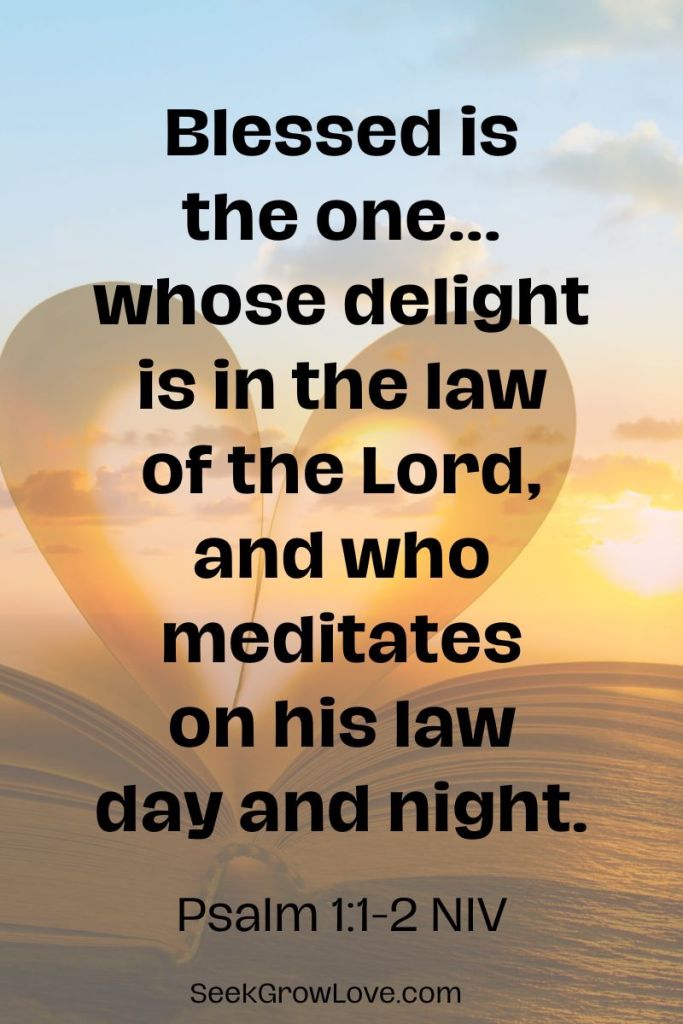
“Blessed is the one who does not walk in step with the wicked or stand in the way that sinners take  or sit in the company of mockers, but whose delight is in the law of the Lord, and who meditates on his law day and night. That person is like a tree planted by streams of water, which yields its fruit in season and whose leaf does not wither— whatever they do prospers.” – Psalm 1:1-3

Psalm 1 presents the idea that Delighting in God and meditating on His words are not quantifiable checklist items that earn badges or streaks.  These are the priorities that help develop processes, such as a daily visit to the Seek Grow Love blog, to help us live a more fulfilled life, whether it is star-studded or filled with very few accolades. Day and night, it becomes the rhythm to which we live our lives, alongside the very beating of our heart.  The only reprieve is a temporary status of death.  Any merit or notoriety we hope to achieve as Christians, such as sitting at the right hand of Jesus (Matt 20), is legalistic hoo-ha, and ironically, resolutions that may keep us away from the pursuit of the Kingdom of God.

So what do processes look like that prioritize God, let His word speak, and lead to Living Water throughout 2024 and beyond? One example we have is the contrast of Mary and Martha in Luke 10. We must choose Jesus over the mundane daily grind. This means that when Jesus is speaking the words of God at your house, you stop what you are doing to sit down and listen. There will always be a nagging chore, entertainment, and distractions, but more than Martha, we have an opportunity to invite Jesus every single day into our home.  Don’t be in the next room working, literally or metaphorically, missing this opportunity. 

Another example might be more related to the execution.  As a parent to a couple of toddlers, I have  wryly pondered the question posed by Peter,  “How many times should I forgive brothers (or in my case, children) when they sin against me?”  The answer supplied by Jesus is 490, a number we have well-passed for the same offenses in my house. I think we all understand that this is not a literal number but a commitment to prioritizing love for others over indulgences of self.  Some of us may be asked to forgive more than others, whether in accumulation of trespasses or a single terrible, unspeakable offense, planting ourselves by the banks of Living Water is the way we have access to the infinite, inexhaustible grace of God and still find delight in the hardest of pills to swallow.

Trust the process of prioritizing and meditating on God’s word.  Find less resolution and rid yourself of the rote. Worry less about what you need to accomplish and look for opportunities, day and night, to spend time delighting in the Lord, who is watching over our way. This year, begin to leave the accolades to Him.

“For the Lord watches over the way of the righteous, but the way of the wicked leads to destruction.” – Psalm 1:6

-Aaron Winner

Reflection Questions

  1. What benefits do you see in living more of a priorities and processes life than a goals and resolutions life? 
  2. What are your priorities? What processes do you already do to keep your top priorities top? What tweaks or refinements could be helpful in keeping first things first? 
  3. What does it look like to Delight in the Lord? How does one meditate on His law day and night? What does the life look like that does these things? What does the life look like that doesn’t do these things? Where are you? Where do you want to be? How can you get there?
Sit, Stand, Step

Psalm 1

Dr. Albert Mehrabian, a leading researcher in the field of body language, estimates that over half of our social communication is done through nonverbal cues.  Where we place our hands and feet, how or where we choose to stand or sit, the angle at which we hold our head, or even in the position of our eyebrows communicate our desires, our emotions, and our confidence (or lack thereof). Additionally, about one-third of how we send our message is with the tone and inflection in our voice, not the words themselves.  In fact, less than 10% of our social cueing has to do with our spoken word choices. The conclusion of the study is similar to the first verse of Psalm 1: where we choose to sit, where we choose to stand, and where we choose to step communicates our posture to our Heavenly Father and the world around us vastly more than words alone.

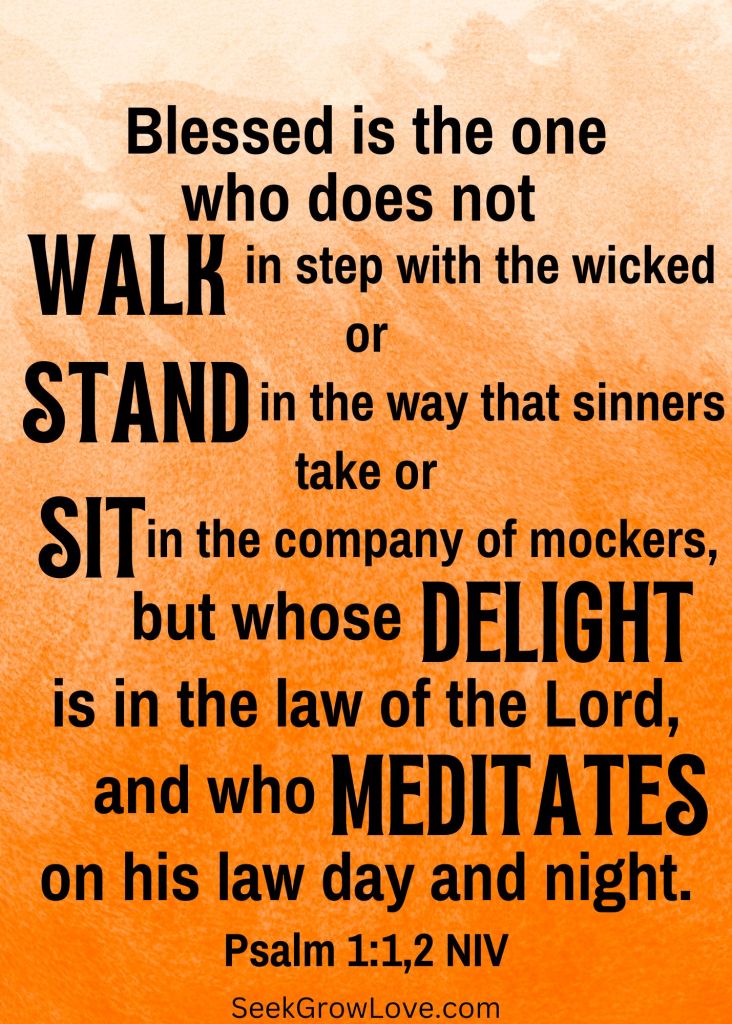
“Blessed is the one who does not walk in step with the wicked or stand in the way that sinners take or sit in the company of mockers. but whose delight is in the law of the Lord,and who meditates on his law day and night. That person is like a tree planted by streams of water, which yields its fruit in season and whose leaf does not wither— whatever they do prospers.” – Psalm 1:1-3

There is a good chance that today holds a contrast to where your feet landed yesterday.  Most likely, this Monday represents a return to work, school, or some other social role you will have to step into, stand up in, or sit through. As you enter the threshold, who or what are you walking towards or away from? Where and what are you standing beside or standing in the way of? How and who do you find yourself sitting beside, dwelling with, and meditating upon? Take note not only of the words you say aloud, but the thoughts and signals you send with your body because God doesn’t want a tithe of lip service; He desires the whole of your soul as a living sacrifice.

There is a blessing for living close to the commandments of our Creator.  Those who put their roots down with God are the direct recipients of the Living Water He provides. When we walk in His ways, when we stand on His promises, when we sit and meditate on His statutes, it completely changes our body language. We don’t wither, but we become confident in the hope we have. We are not empty vessels filled with cliche Christianism, but we bear the fruit of the Spirit for others to see.  We can simply sit and delight in the joy of the Lord because we serve a God of promises and follow-through.  Our posture, our actions, and our words stem from the refreshing source from which we draw life more abundantly. Wherever we step, stand, or sit, let the Living Water flow and the Kingdom of God flourish.

– Aaron Winner

Reflection Questions

  1. Compare and contrast the person in Psalm 1:1-3 to the person in verses 4-5? How would you describe each and what makes them different?
  2. Who or what are you walking, standing, sitting amongst? What do you find delight in? What are you meditating on? Are there any changes that ought to be made in order to be where you want to be at the end – of 2023, or of this life?
  3. What do we learn about the LORD God in Psalm 1? Mark it in your margins, journal it, pray to the God of Psalm 1.

AND -in preparation for tomorrow, when we will begin a chapter by chapter New Testament reading – here’s a little…

Introduction to the Book of Matthew

Before we introduce the book of Matthew, let’s quickly contrast it with the book of Genesis and the whole Old Testament.

The book of Genesis begins the Old Testament (and the Bible).  The theme of the Old Testament can be summed up in Genesis 5:1, which says, “This is the book of the generations of Adam…”.  The rest of Genesis 5 has another recurring theme, “… and then he died”.   The Old Testament was the story of Adam, his sin (and the consequences of that sin), and his descendants.  It illustrates the truth that “the wages of sin is death” (Romans 6:23a).  The Old Testament contains many of God’s promises – waiting for fulfillment.

The book of Matthew begins the New Testament.  Matthew starts with, “This is the genealogy of Jesus the Messiah the son of David, the son of Abraham.”  This begins the story of Jesus, and reveals “the gift of God is eternal life in Christ Jesus our Lord.” (Romans 6:23b)  The New Testament describes the fulfillment of God’s promises made in the Old Testament.

Matthew was one of Jesus’ 12 apostles, whom Jesus called from being a tax collector (read hated outcast) to being in the inner circle of the Savior of the world.  Many years after Jesus’ ascension, Matthew wrote the book of Matthew to convince a Jewish audience that Jesus was (and is) the Messiah – God’s chosen and anointed deliverer for His people – who fulfilled so many of the prophecies in the Old Testament.

Even though the Bible doesn’t contain anything that Matthew himself said, the book of Matthew which he wrote reveals Jesus as the Messiah promised and sent by God.  May the book of Matthew speak to you and reveal God’s great gift, Jesus the Messiah, to you in a whole new way as we seek to grow in Christ together this year.

-Steve Mattison

Download and print the 2023 Reading Plan below. You can choose to follow along in 1,2 or 3 readings a day. If you read all three you will read through the whole Bible in 2023.

Planted by the Water

Psalm 1

Tuesday, July 5, 2022

When I was young, we often sang this song during our Sunday School opening. 

“Jesus is my Savior I shall not be moved
In His love and favor I shall not be moved
Just like a tree that’s planted by the waters Lord
I shall not be moved.

I shall not be I shall not be moved
Just like a tree that’s planted by the waters Lord
I shall not be moved”   (John T. Benson, Mrs. James A. Pate, Words -1950 New Spring)

When I was researching the song, I found this verse which lines up better with the writer’s words in Psalm 1. 

“Glory hallelujah, I shall not be moved.

Anchored in Jehovah, I shall not be moved.

Just like a tree that’s planted by the waters Lord
I shall not be moved.”  (Alfred Henry Ackley, Lyndell Leatherman; Words, Public Domain)

What a wonderful visual and reminder to stand firm in God.

Psalm 1 is a contrast between a Godly man and a wicked man.  The Godly man isn’t walking, standing, or sitting with the wicked.  Instead, he is delighting and meditating in God’s law, God’s Word.  The presence of God’s Word in his life is like a tree firmly planted by streams of water. 

Have you ever seen such a tree?  It is usually bending toward the water, and often you can see the large, exposed roots.  It gets constant nourishment, constant life-giving water because of its proximity to the water.  The tree is fruitful, the leaves don’t wither.  This is the picture of a man rooted in the Lord and immersed continually in His Word.

The last three verses of the Psalm picture a completely different person, a wicked person.

Have you ever seen chaff blowing in the wind?  Chaff is the dry, scaly protective casing of seeds or other plant material.  In Hector, Minnesota where we lived for many years, there was (and still is) a celebration called Corn Chaff Days.  It was an appropriate name, because corn chaff often blew from the large grain elevators all over the streets and sidewalks of this little farming community.  It scattered everywhere, and eventually disappeared with the strong winds, lost forever.  Just like the wicked man. 

Two scenes in God’s creation

  • Strong, firmly rooted tree by the waters
  • Blowing, dusty chaff, cast off and receiving no nourishment

Two men presented

  • Godly man who does not STAND in the paths of sinners
  • Wicked man who does not STAND in the judgment

The choice is ours. 

“But if serving the Lord seems undesirable to you, then choose for yourselves this day whom you will serve.  As for me and my household, we will serve the Lord.”  Joshua 24:15a,d

-Paula Kirkpatrick

Reflection Questions

  1.  What contrasts in nature remind you of the Godly man and the wicked man?
  2. What can you do in your own life to root yourself deeper in God’s Word?