
Old Testament: Numbers 23 & 24
Poetry: Job 18
New Testament: Mark 4:1-25
It’s getting close to planting time in northern Indiana, so it seems a great time to look again at the Parable of the Sower – one of my favorite parables. And I love how I still find new thoughts and ideas in this teaching from Jesus. I remember how this parable ministered to me when I was a young youth worker experiencing heartache over a youth who had received the word but was going in a different direction. This parable encouraged me. Jesus didn’t expect that every seed we helped to sow would grow into a healthy, whole, fruit-bearing plant. But, he did, and does, expect us to keep sowing the seed. And, we never know which of the seeds we sow will indeed grow, bloom, and produce beautiful, life-giving fruit.
Today I want to zero in on the seed among the thorns, but first a quick review of the other three types of soil and Jesus’ explanation of each to provide contrast.
Seed 1 – fell along the path – birds came and ate it – as soon as they heard the word Satan (the birds) came and ate it
Seed 2 – fell on rocky places – not much soil – not much root – sprang up quickly – when sun comes up plant is scorched and withers – receive the word with joy – but lasts only a short time – trouble and persecution comes and the plant falls away
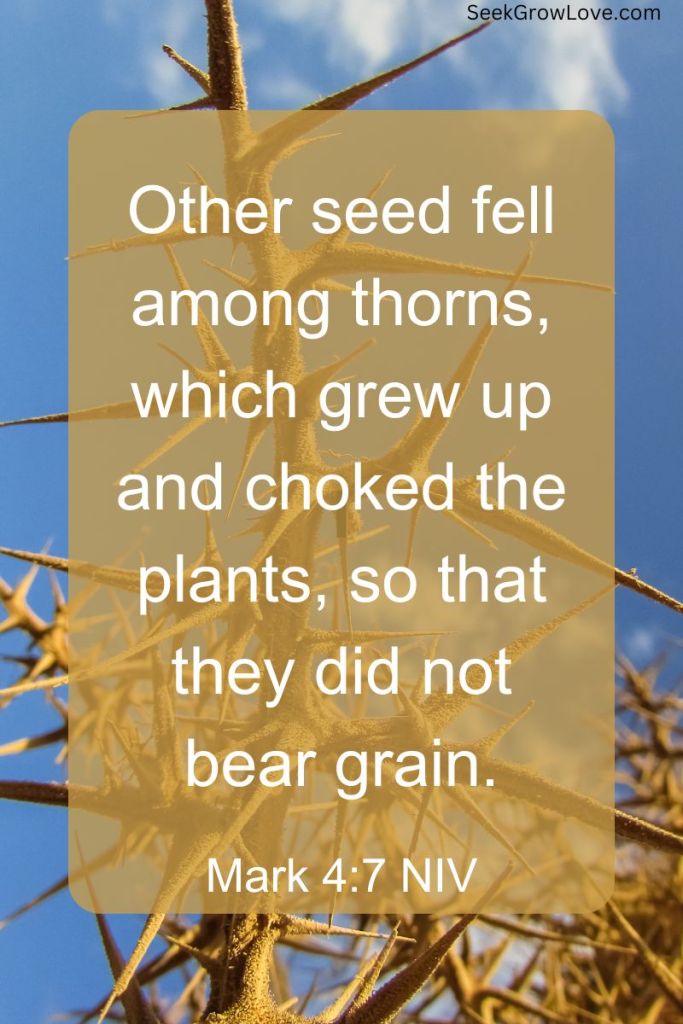
Seed 3 – fell among thorns – thorns grew up and choked the plant – plants did not bear grain – hear the word – but worries of this life, deceitfulness of wealth, and the desires for other things comes in – the plant is choked out, making it unfruitful
Seed 4 – fell on good soil – came up and grew and produced a crop, multiplying 30, 60, or even 100 times – hear the word, accept it and produce a crop
It is important to remember that in each of these scenarios the seed is all the same. There is nothing inferior to seed 1, 2 or 3. It is the same as seed 4. It is the perfect word of God being sown into the world. What creates the difference is where in the world it lands. Some people will accept it and do all that is necessary to make it grow in their lives and even produce fruit to give life to others. Some people will not. But, either way, the seed is still good and perfect.
The new thing I saw when I read the parable this time is that the plant from seed 3 that fell among the thorns did not necessarily die. Seed 1 never had a chance at life. Seed 2 enjoyed life for a short time but withered/fell away. I think in my mind I was giving a death sentence to seed 3 already as well. But, that’s not exactly what the Scriptures actually say. Both in the original parable and Jesus’ explanation it says the plant was choked by the thorns – it does not say killed by the thorns – at least not yet.
It is not down and out, yet. It is still alive – it might be sitting in your pew with you at church or it might be your neighbor across the street. It has a pulse. It might be a family member – it might be you. It is not dead, yet. It is alive – but it is not healthy. A healthy plant doesn’t have thorns wrapped around its neck. Jesus tells us the result of being choked by the thorns was that it did not bear grain – it was unfruitful. It is alive – but it is not experiencing the abundant life that Jesus spoke of. It is not producing and displaying the life-giving fruit of the Spirit. It is not reproducing and giving new life to others. It is alive but it isn’t passing along life. It is a sad place to be – whether you are a plant or a Christian.
Who needs a vegetable garden with no vegetables? Or an orchard with no apples? Or a wheat field with no wheat? Or a Christian with no fruit?
What can be done for such a plant? Is there any hope for the plant choked by thorns? I say yes! Cut off the thorns! Sometimes when I am gardening I am not sure what needs to be pruned and what needs to stay. What would kill the plant and what would help it grow healthy? I love that Jesus tells us exactly what the thorns are so we know what to cut out. He tells us the thorns are “the worries of this life, the deceitfulness of wealth, and the desires for other things” (vs. 19). And if you aren’t cutting them out, be sure that they are choking new life out of you. A worried Christian. A greedy Christian, or a Christian relying on his own bank account. A Christian with other priorities. It is not a healthy place to be. And it certainly doesn’t promote new life.
Examine your plant carefully. Being alive is good. But are you bearing fruit? What does your fruit look like? What does it smell and taste like? Where are you giving new life to others? If you aren’t sure if you are bearing fruit now – what do you want your fruit to look like? What do you need to get rid of first?
What thorns might be creeping up toward your neck? What are you worried about? Do you think your problems are too big for your God? What are you putting your trust in? God or yourself or your job or your paycheck? Do you hoard, are you always striving for the next big toy, is it hard to be generous? Have you bought any of the ‘deceitfulness of wealth’? Is pleasing God the most important thing in your life? Or are there other things you desire more? What have you made the number one priority in your life?
Cut out the thorns so you can have life – and bear fruit – which will in turn give life.
-Marcia Railton

 Seek Grow Love