Test Your Memory

DEUTERONOMY 3-4

“Deuteronomy” is derived from the Greek word deuteronomion, meaning “a second law.” This whole book is meant to be a second edition of God’s laws, compiled of commandments received at Mount Sinai as well as a few additional ones. The first four chapters of Deuteronomy set the stage for these laws by providing reminders of why the Israelites serve the God of Abraham, and the importance of keeping His statutes. 

Moses begins this book emphasizing to his people the importance of remembering. He reminds them of the many instances in which God delivered them from their enemies and gave them new lands. As we read yesterday and continue to read today, chapters 1-3 serve as a brief overview of Israel’s recent happenings. In chapter 4, Moses switches gears and opens the book with a call to remembrance, and a command to obey. (Deut 4:1-5, 4:9-10, 4:14, 4:23, 4:30) 

Only be careful for yourself and watch over your soul diligently, so that you do not forget the things which your eyes have seen and they do not depart from your heart all the days of your life; but make them known to your sons and your grandsons. – Deut 4:9

Moses is reiterating that the laws provided previously in Exodus weren’t just a temporary set of guidelines or a mere suggestion; they were meant to be kept. These laws are the foundation upon which God’s chosen people will be set apart, unique from the rest of the world. (Deuteronomy 4:5-8, 4:32-40)

So keep and do them, for that is your wisdom and your understanding in the sight of the peoples who will hear all these statutes and say, ‘Surely this great nation is a wise and understanding people.’ For what great nation is there that has a god so near to it as is the Lord our God whenever we call on Him? Or what great nation is there that has statutes and judgments as righteous as this whole Law which I am setting before you today? – Deut 4:6-8

Israel’s obedience and devotion to the statutes of the LORD serve a larger purpose. Not only will these laws keep Israel on the right track in terms of their own safety and wellbeing, but they will also distinguish God’s people from the rest of humanity as a righteous and wise nation. Ultimately, despite many roadblocks and failures, these laws will sustain Israel for 400 years, allowing them to become the nation from which the Messiah is born (as prophesied later in Deuteronomy 18:15-19).

Moses makes it abundantly clear to his people that God will not forget His covenant with them, therefore it is crucial that they do not forget either. He warns them that they will stray, but that they serve a merciful God, a loving Father who patiently waits for His children to return to Him. (Deut 4:25-31)

For the Lord your God is a compassionate God; He will not abandon you nor destroy you, nor forget the covenant with your fathers which He swore to them. – Deut 4:31

Though Christ has since set a new system in place, consisting of new laws under the new covenant, the main ideas that Moses expressed in these scriptures remain true for us today. First, we must remember God’s promise to one day restore the earth (Gen 3:19), as well as the commands His Son gave generations later under the new covenant. Second, God’s commands are not meant to needlessly restrict us, but to guide us into a life of blessing and purpose. When we obey, we reflect His wisdom and goodness to the world around us. And lastly, that God knows we live in a broken world; He sees our darkest desires and our biggest downfalls. But even when we stray from His ways, He waits for us to return to Him, arms open and heart yearning to pull us into His loving embrace. 

-Isabella Osborn

Reflection Questions:

  1. How can you actively remind yourself (and others) of God’s goodness, His commands, and His promises?
  2. Moses emphasized that God’s laws were meant to set Israel apart—how does living according to God’s principles set you apart in today’s world?
  3. How does knowing that God patiently waits for us to return to Him impact the way you approach repentance and restoration in your relationship with Him? How can this truth shape the way you view both your own failures and those of others?

Lessons from the Wilderness: Elijah

Wilderness Wandering Lesson #2: Remembering past circumstances can help to steady our heart in the midst of our current despair.

This slideshow requires JavaScript.

It was at that moment though that the sky got a little cloudy and the wind started to pick up. We wanted to hike a little, so we to hike the trail towards the top of the mountain, with cattle lazily grazing along the rocky path. Quickly, the picturesque scene turned gray. We made it to the summit, but the mountain had clouded over, so much so that it was difficult to see straight in front of you. We quickly walked back down and waited out the fog in a small cafe, trying to warm up our hands with a coffee, before making our way to the tram.

That hike was beautiful and totally worth our short brush with the fog. But, what I’ve found is that our lives sometimes mirror that hike, but the fog can be much more dangerous. Sometimes, our lives are steady, and we exist in the happy medium of contentment and love. At other times though, our lives can be a stormy cycle of highs and lows, mountains and valleys. In our case, we were on a mountain, a mountain where we were elated. We had traveled far to get there and wanted to rest in the view and the glory. But, it was on this mountain that what we had traveled far to see and done a lot of work to do (including a 1 hour train ride and a flustered conversation in German) that we experienced a storm that clouded our experiences and made us doubt if it was really worth it.

Elijah the prophet experienced his own brush with the wilderness right after he experienced the high of his life. He was no stranger to the wilderness after relying on God’s provision in 1 Kings 17. In 1 Kings 18, he is able to testify to God’s glory and work as he goes through a showdown with the prophets of Baal. He actually gets to see the fire of Yahweh fall from heaven and rid the people of the prophets of Baal!

If we saw these things, we might be tempted to say that we would never doubt God. After seeing this, we might be elated, speechless, high on our mountaintop moment. But, for Elijah, the fog rolled in. In chapter 19, Jezebel sends word to Elijah that she was planning on killing him as soon as she could get her hands on him. Elijah panics and runs for his life into the wilderness. There, he lays down and prays for God to take his life (v. 4). Sometimes, our wilderness moments can lead us to places like this. Our vision can get cloudy if it’s focused on our circumstances that may stormy and volatile. And, in those moments, dark despair can set in, and we may think it would be better to just give up.

But then I recall all you have done, O LORD; I remember your wonderful deeds of long ago.If you are in that moment, remember that God does not leave Elijah there, and he doesn’t want to leave you there either. Instead, he says, “Get up and eat (v. 5). After Elijah eats twice, he goes on a journey forty days and forty nights to the mountain of God. There, Elijah waits, first through a great wind, then through an earthquake, and lastly through a fire. In each of these places, he does not hear God’s voice. Finally, he hears it in the soft whisper, as God asks him “What are you doing here Elijah?” (v. 13) Elijah responds by saying, “I have been very zealous for the Lord God of Hosts, but the Israelites have abandoned your covenant, torn down your altars, and killed your prophets with the sword. I alone am left, and they’re looking for me to take my life” (v. 14). Elijah feels this despair because he had forgotten what God just showed him. In the desert when he was hungry, God was there with provision. He had forgotten that in the showdown, God was there with provision. When we turn our eyes from God to focus on our fractured circumstances, it can lead us to doubt. But, one remedy for that doubt is not only to remember the character of God but also to remember how God has exhibited that character in previous actions of faithfulness. We can trust in him not only because of what we know from the Bible but also because of what we know from our own lives. So, if you are in a wilderness period in your life, pause and remember God’s past faithfulness instead of dwelling on your despair. These reminders can help us to remember that even in our darkest times, God will carry us through.


~ Cayce Fletcher

When I Don’t Feel Courageous

Joshua 6 – Courage Recap

Be Strong & Courageous

Saturday, October 14

Franklin D. Roosevelt said, “Courage is not the absence of fear, but rather the assessment that something else is more important than fear.”

It is interesting that no “strong and courageous” pep talk is included in Joshua 6 as the Israelites were receiving and acting upon instructions for overtaking the walled fortress of Jericho.  Rather, the Lord said, “See, I have delivered Jericho into your hands…March!” (Joshua 6:2).  And the people did it – God’s way – and the walls came a tumbling down.

Were the people scared as day after day they approached the city to march around it’s walls?   Perhaps some were.  Perhaps some were remembering their fathers who had crumbled in fear and discouragement when faced with the prospect of fighting against the fortified cities of Canaan.  Yet, they had determined that something else was more important than fear – and they were following God.  Likewise, you have the opportunity to be a new generation.  You don’t have to follow a history of fear, failure, or inaction.

Perhaps they were making a conscience effort to instead focus on how they saw God and his faithfulness at work as well as how they had personally been prepared for this moment.  Remembering the crossing of the Jordan River.  Remembering Joshua’s meeting with the commander of the army of the Lord.  Remembering how they consecrated themselves in preparation to see amazing things the Lord would do.  Remembering the importance of relying on God’s Word rather than your feelings of fear (Joshua 1:6-9).  Remembering the Lord’s words that Joshua had passed on to them:  “Have I not commanded you?  Be strong and courageous.  Do not be terrified; do not be discouraged, for the Lord your God will be with you wherever you go.” (Joshua 1:9).

My daughter and I just read The Hiding Place by Corrie TenBoom.   We both highly recommend it!  In German occupied Holland Corrie and her family hide and care for many Jews during World War II – a job that certainly required a great deal of strength and courage.  Corrie’s life is a beautiful example of God providing for and preparing those who are seeking to follow God and His Word, regardless of the fears or consequences.  No doubt our memory verse this week was a great comfort as well as battle cry for Corrie: “Have I not commanded you? Be strong and courageous.  Do not be terrified; do not be discouraged, for the Lord your God will be with you wherever you go.” (Joshua 1:9).

What courageous works is God preparing you to do?  You may have no idea today.  But use the day to follow Him, remembering His faithfulness.  Actively seek and pray for direction on what courageous act God would have you do for Him today, next month and 5 years from now.   And then – DO it!

Be Strong and Courageous!

Marcia Railton

It’s So Shiny! (Judges 1-3)

Friday, September 30

nikki-fri-1

Nikki Green

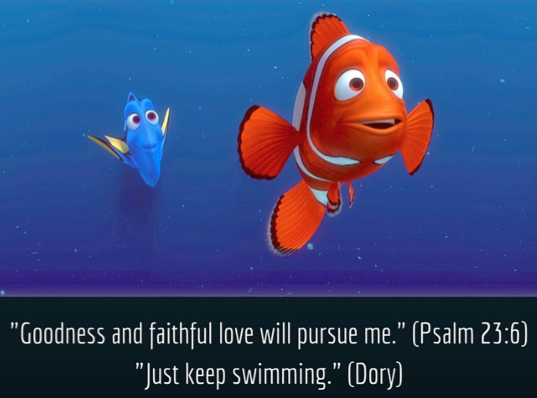
Joshua spends significant time during his life encouraging the Israelites to remember.  Remember… the commands of Moses, the allotted inheritance, all the LORD has done for you… However – we soon see, what appears to be, short term memory loss as we jump into the book of Judges.  I think many of us, as Christians, want to make great choices… then we see something attractive, fun, accessible, & maybe a little shiny.  We think we want it and we can handle it.  As you look at our friends from Finding Nemo staring at the shiny object, they feel happy and mesmerized by something they aren’t familiar with –but it’s close and it’s shiny and hard to turn away from.  The period of Judges spotlights some dark times and poor choices made by God’s chosen people.  The Israelites seem to trap themselves in a repetitive cycle throughout this book.  They persist in forgetting the LORD and follow a pattern of: sin, bondage, deliverance by a Judge, blessing, death of the Judge, and sin again.  It seems their shiny lure comes in the form of heathen people and their idols.

nikki-fri-2      nikki-fri-3


“The Israelites did evil in the eyes of the LORD” (Judges 3:7).  “The anger of the LORD burned against Israel so that he sold them … into the hands of …the king of Aram” (Judges 3:8).  Their shiny idols and lifestyle changes have now turned on them.  (Notice Dory’s shiny attraction turned on her too).  They were greatly oppressed for 8 years by these pagans.  God raised up Othniel (Caleb’s nephew) to deliver his people.  He went to war and overpowered the enemy, and the land had peace for 40 years.

It would be great if the Israelites brushed up on their history lessons and took a stroll down memory lane, but no!  They revert to their ever-so-popular repetitive cycle of sin.  The shiny idols and old pattern of infidelity reasserts itself.  They once again fall into the hands of their enemy.  This enemy is King Eglon of Moab and they are overpowered for 18 years.  We see a cry for help, and God is faithful to give them a deliverer.  Ehud is clever and uses his gifts of left-handedness and wit to his advantage.  He made an 18 inch double-edged sword and strapped it to his right thigh.  He secured this under his clothing when he joined other Israelites to present tribute to the king of Moab and his thugs.  Ehud and his men left the tribute and headed back to their people – but Ehud stopped and returned alone to the king.  As Ehud approached big ol’ King Eglon, I am sure the king and his guards were keeping their eyes on Ehud’s right hand – the expected offensive strong arm.  Ehud used a technique on the king that he couldn’t resist.  A little bait and hook!  Maybe this was King Eglon’s moment to want something special and shiny just for himself.  Ehud said, “I have a secret message for you, O King” (Judges 3:19).  Eglon was intrigued and selfish enough to want this all to himself!  He sent everyone out of the room.  He was ready for his special message.  Ehud approached him and told him he had “… a secret message from God for you” (3:20).  The King didn’t see it coming… Ehud used his dominant left hand to grab the sword from his right thigh and plunged it into the king’s belly.  Following this sneaky execution, Ehud led the Israelites in battle against the Moabites and won.  They had peace for 80 years.

Each time the Israelites relapsed to their infuriating cycle of sin, God was faithful to their cries to Him for help.  Judges 2:18 tells us, “Whenever the LORD raised up a judge for them, he was with the judge and saved them out of the hands of their enemies as long as the judge lived; for the LORD had compassion on them as they groaned under those who oppressed and afflicted them.”

We don’t know a lot about Shamgar, the third judge of Israel.  We do know he killed 600 Philistines with only an ox goad and he too saved Israel.  The Philistines were wise enough to realize if one man can defeat that many men with one farmer’s tool (long pole with a sharp metal point for herding oxen), maybe they should walk away.  If one man could do that – what could a dozen men, armed with ox goads, do?!  God’s power was written all over this story.  Why the Israelites couldn’t just hang out in the “deliverance by a Judge/ blessing” portion of their repetitive cycle… who knows?? Maybe too many shiny choices?  Let’s not allow distractions or shiny things to blind us.  We can attract others for the kingdom by reflecting God’s radiant light.  “In the same way, let your light shine before others, that they may see your good deeds and glorify your Father in heaven” (Matthew 5:16).

Let’s remember everything the LORD has done.  Let’s also turn away from sinful (shiny) desires… and, in the words of Dory, “just keep swimming!”

nikki-fri-4


REMEMBER (Numbers 15-17)

September 5

talon mon

By Talon Paul

In this section of reading, it can get very overwhelming to read with all of the laws that God gives to the Israelites that may not matter to us in 21st century America very much. However, one of the laws that God gives the Israelites should draw our attention and is very important to understand.

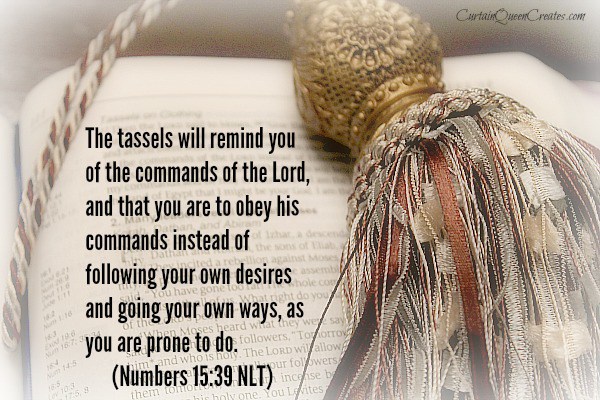
In Numbers 15:38-41, God commands the Israelites to wear ‘tassels’ on their outfits, but it isn’t just so that they look fashionable and “cool”. God has commanded this so that, as verse 39-40 state, the Israelites will remember all that God has done for them and to remember to do all that God commanded.

We as Christians have a very firm and more powerful reminder to do what God has commanded: the cross. A man, Jesus, was literally tortured and executed because of our sins. We can look back to this as a reminder of the fact that God has given us a way to be forgiven of our sins, but also as a reminder that, because of that sacrifice, we need to obey the commands of Jesus and God. When we do this, it keeps us from sinning against them and gives us a hope for the future.