
Genesis 48-50
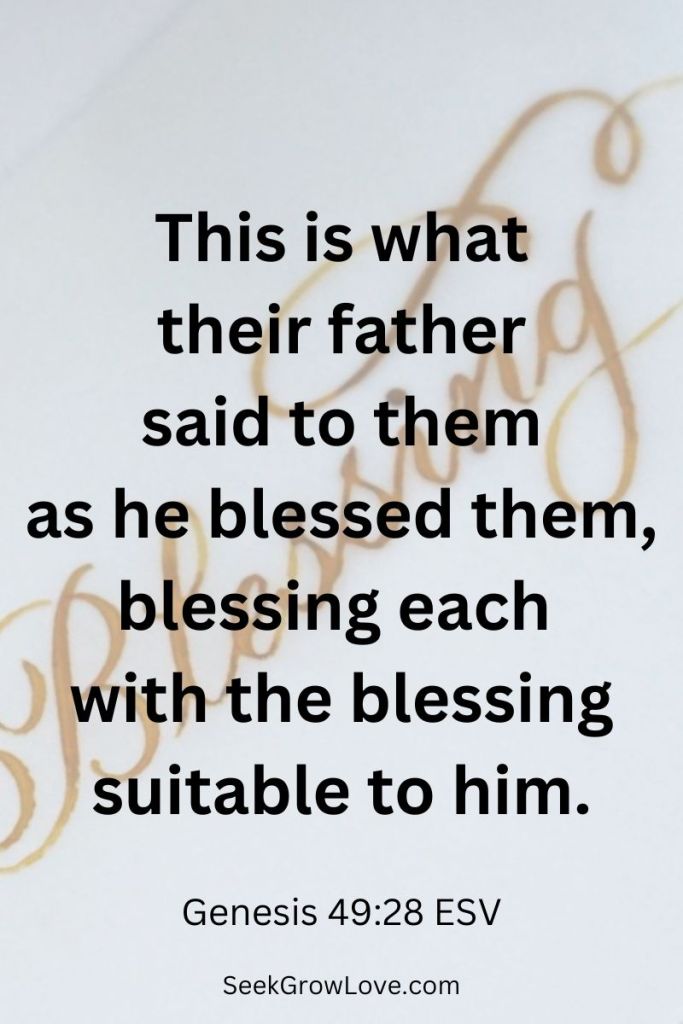
At the end of their lives the patriarchs bless their children. The ancients believed words matter. If you asked them, “What’s wrong with the world?” or “Why is the world broken?” they would answer, “The curse.” What’s wrong with the world is that God cursed it–using words. So, how should we expect the world to find healing and redemption? How does God plan to undo the consequences of our first parent’s rebellion? He blesses. First he calls Abraham and blesses him. Abraham calls Isaac and blesses him. Isaac calls Esau, but Jacob impersonates him to receive the blessing. Even so, now Jacob has come to die and he wants to pass on the blessing to his twelve sons who will become the twelve tribes of Israel. Somehow or other, God is going to use this dysfunctional Abrahamic family to initiate his master plan of redemption that will one day culminate with making everything wrong with the world right. Jacob is here playing his part in God’s agenda.
What’s interesting about how he blesses his children is that for several of them, the blessing sounds more like a curse. For example, to Levi and Simeon he says, “Cursed be their anger…I will divide them in Jacob and scatter them in Israel.” Through Jacob’s words, God is prophesying about the future. Indeed Levi was scattered throughout the tribes and Simeon was absorbed into Judah. What’s so fascinating about the blessing is that Israel passes over his first born, Reuben, as well as his second and third born, Simeon and Levi, and he jumps to boy number four–Judah. He compares Judah to a lion and then says, “The scepter shall not depart from Judah, nor the ruler’s staff from between his feet” (Genesis 49.10). This prophesy is rather staggering as we look forward to the rest of the bible. The great king David and his successors were from Judah. Ultimately, Jesus, himself, descended from Judah. So, how did Jacob know which of his children would hold the scepter? The odds of guessing it right are only one in twelve–about 8%. God was working with this man of faith to know what to say and whom to say it to. Jacob might be old, but he is still walking with God, right up until his last breath.
After Jacob dies, we learn about how Joseph forgives his brothers rather than taking vengeance into his own hands. Ultimately, Joseph himself arrives at death’s door. We read in the New Testament hall of faith the following about Joseph:
Hebrews 11.22
By faith Joseph, at the end of his life, made mention of the exodus of the Israelites and gave directions concerning his bones.
Out of everything that Joseph went through, his heroic perseverance and faith in God, this is what he is remembered for. When he came near to death, that same Abrahamic promise that had burned in Israel’s heart, blazed in Joseph’s as well, even while he came to the end of his life. He expressed his faith by this last request:
Genesis 50.24-25
24 And Joseph said to his brothers, “I am about to die, but God will visit you and bring you up out of this land to the land that he swore to Abraham, to Isaac, and to Jacob.” 25 Then Joseph made the sons of Israel swear, saying, “God will surely visit you, and you shall carry up my bones from here.”
Look at the faith of this man! He’s suffered so much in the course of his life and yet he never gave up on God. He had been elevated to the highest office in the land, next to Pharaoh, and he still retained his faith. In the end, God’s promises to Abraham, Isaac, and Jacob would not die. One day he would return to the land of his childhood. It would be centuries, but eventually, when the Israelites came out of Egypt, they carried Joseph’s sarcophagus with them through the desert and laid him to rest in the promised land. Whether you experience hardship or prosperity, be like Jacob and Joseph and keep faith your in God’s promises to bring the kingdom.
-Sean Finnegan
(originally posted for SeekGrowLove – back when it was Grow16BibleReading – on August 8, 2016 – our first full month of daily devotions!)
Reflection Questions
- What can we learn from Jacob and his blessings for his offspring? What part of Jacob would you like to display in your life?
- What can we learn from Joseph and his relationship with his family, with Egypt and with God? What was important to him? What part of Joseph would you like to display in your life?
- Why is “the land” important? What have we seen happen throughout the book of Genesis in regards to the land?
- What have you learned from the book of Genesis about God and how He works? What characteristics does He have? What is important to Him? What is God’s agenda? How has He interacted with His people? What has been a genesis/beginning in your relationship with God? What blessings are awaiting God’s children?
 Seek Grow Love