Hold ON!

Job 1-4

roller-coaster

Wednesday, December 14

The book of Job is an emotional rollercoaster. Rider/reader beware when you begin to venture this wild, scary, often windingly frustrating thrill ride. Pretty much everyone in the Book of Job dies except the main characters. But this story is about more than just mass destruction. Don’t get me wrong, the mourning rituals recorded after Job’s entire family dies are fascinating, but the physical destruction in the story leads to quite a collection of major philosophical ponderings that truly stick with the reader. Heavy, confusing stuff. You were warned.


The prologue places us in the land of Uz, not Oz, which is located far away from Israel. The unnamed author reveals no clear historical settings, and it seems as if all of the characters, except one, Elihu, are of any Hebrew origin whatsoever. The reoccurring themes throughout seemingly volley back and forth from the idea of suffering to justice. And by the way, don’t hold your breath, those questions will never get answered. Job will be pondering, reflecting, and VERBALIZING about how fragile and meaningless human life is in repeated fashion throughout.


The saga opens with the author declaring how awesome Job is, “He was the greatest man among all the people of the East.”(Job 1:3)  Wow. That is quite an endorsement. From this point we are ushered into the throne room of heaven in a very odd scene of sorts. The action resembles a court scene of sorts. God, the angels, and Satan are all present arguing the integrity and faith of Job. God gives Satan permission to test Job and the story gets very dark, real quick.


Pain is a central part of the human experience and there is no way around it. The book of Job covers all its pain bases: rashes, boils, and blisters, oh my! Not only does he experience physical pain but also emotional pain. Round that out with a heavy dose of spiritual pain and you can begin to see why Job finds himself at breaking points time and time again asking God why.


By chapter 3 & 4 we are introduced to Job’s “friends.” The reader will quickly discover that with friends like these you wouldn’t really have need of enemies.  The three bullies seemingly gang up on Job doing their best to convince him non-stop that he has sinned in some manner and God is simply punishing him for it. While Job is certainly down for the count, his consistent banter back and forth with the trio is mind boggling. Give it a rest Job? Just shut up and let them move on!


Remember how Job renounced God and became an atheist when his entire family died? No? Oh yeah, that’s because that’s not how it goes down. Nor will it ever be. Job makes it through Round 1 pretty successfully, but we find him getting more and more feisty when he finds himself with a rash and infuriating, obnoxious friends. And neither should we. Spoiler alert: God does not owe us explanations, and the sooner we come to terms with that timeless truth the happier we will all be. Tune in tomorrow as we observe the further unraveling of our besieged hero. I promise it will be worth the ride!

-Julie Driskill



Faith to the End (Genesis 46-47)

In these chapters Israel and his children and grandchildren migrate to Egypt, totaling seventy people.  They left the parched promised land behind and came to live under the care of Joseph.  I can understand why Israel was reticent to move down.  He remembered the stories of his grandfather, Abraham, about how God had promised to give him the land of their sojourning.  He was now 130 years old and had lived in Canaan most of his life.  Imagine living through over a century of nomadic shepherding, seeing bounty and famine, ups and downs, good times and bad ones.  Should he just ride this one out or should he uproot his entire extended family and move them to Egypt.  What would this mean about the covenant God made with Abraham, Isaac, and him?  If he leaves, does that mean he is giving up on God?  This is probably why God came to Israel in the night.  He spoke to him and told him not to be afraid to go down to Egypt and that he would go down with him.  After God assured him, Israel packed up the family and went to Egypt.  There, this group of nomads would incubate, growing from seventy to well over a million souls.

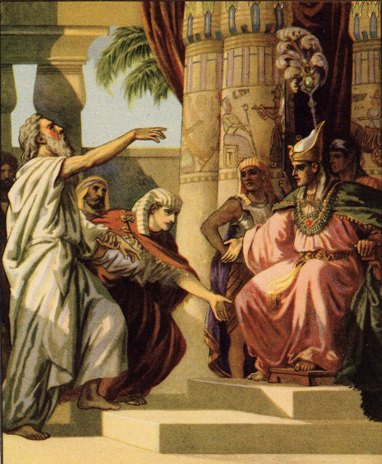
When Israel finally came face to face with Pharaoh he said, “The days of the years of my sojourning are 130 years.  Few and evil have been the days of the years of my life, and they have not attained to the days of the years of the life of my fathers in the days of their sojourning” (Genesis 47.9).  Israel had suffered greatly throughout the course of his life.  He duped his blind father under his mother’s advice to steal his brother’s blessing and then ran away to hide out in a foreign land.  While living with his uncle, he got duped himself repeatedly.  Laban constantly changed his wages and performed a switcheroo on his wedding night, substituting Leah for Rachel.  After twenty years of toiling under Laban’s greedy gaze, he finally broke free.  Terrified of meeting his angry brother Esau, Israel journeyed back home.  Fortunately his brother was no longer out for blood and the two established peace.  However, his overt favoritism of his one wife over the other three led to severe relational pain.  So jealous were his sons of the way Israel treated Joseph that they resolved to murder the lad and tell their father a beast tore him to pieces.  Although they sold Joseph into slavery, they still told their father his favorite son was dead.  Israel grieved for Joseph for days, months, years, and decades.  Indeed, his life was full of suffering: some self-inflicting and some just happenstance.

Yet, this is not the end of the story.  Israel may not have unlocked the secret to “Your Best Life Now,” but he did retain the faith of Abraham.  He may have poisoned his family relationships with favoritism, but he remembered the promise of God.  At the end of 147 years, he found himself on his deathbed in a foreign land, far from the land of God’s covenant.  As a result, his last request was simple.  He had Joseph swear to him, “Do not bury me in Egypt, but let me lie with my fathers.  Carry me out of Egypt and bury me in their burying place” (Genesis 47.29-30).  This seemingly insignificant and inconvenient request, is actually the indication of Israel’s tenacious faith.  He has seen a lot in his century and a half, but in the end he stayed true to the covenant.  He believed in his bones that God would give him and his descendants that land, and his last request was to receive a proper burial in the promised land.  Although he had suffered more than most in his life, he never gave up on God.  As a result, he will participate in the resurrection of the just and one day he will inherit that land as God promised.  I wonder, how deep is your faith?