A Kingdom of Priests

Exodus 19-21

Today’s reading is probably one of the most familiar passages in the whole Bible for it includes the Ten Commandments.  It is important to understand the context of these commandments.  God entered into a covenantal relationship with Abraham and Abraham’s descendants through Isaac and Jacob and Jacob’s sons who became the twelve tribes of Israel.  God promised to bless and provide for his people and in exchange His people promised to be faithful and obedient to God and worship God alone.

After 400 years of slavery, Israel has grown from 12 sons and their immediate family to millions of people.  These people, God’s covenant people, will be settling in a land where they will need to live in community.  They are no longer slaves.  They are now responsible to live in that community in peace and productivity.   They need help to know how to live together.  God provides His people with the structure of how to live together as God’s people.  The Ten Commandments and subsequently nearly 600 additional laws were all designed to help them be healthy and blessed representatives of God to the rest of the world.

God loves all people.  We must never falsely believe that God only loves certain people.  God considers all human beings His children and loves them all.  God wants to be in a right relationship with all of his children; however, many are disobedient and have no willingness to be in a relationship with God and many deny that God even exists.

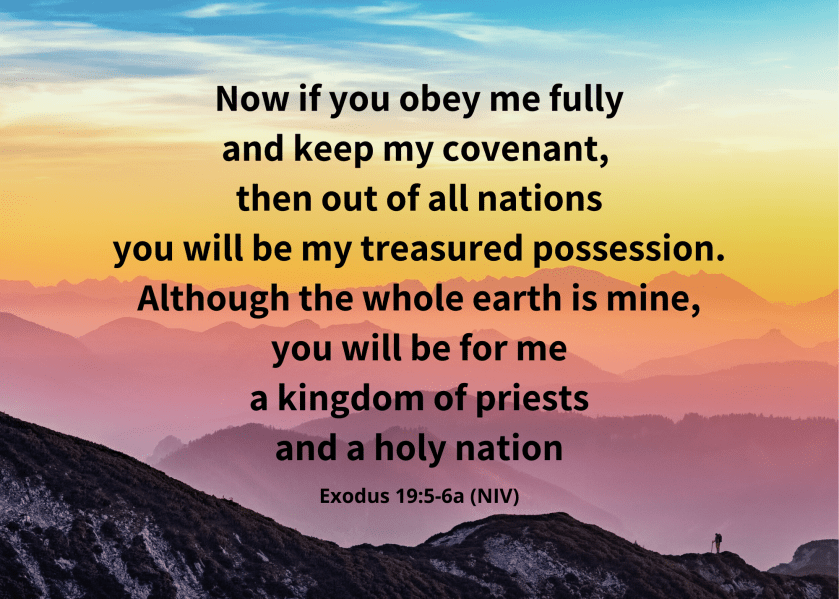
So God needed to start with one group of people and prepare them to be a special, chosen people who would bring the knowledge of God to others.  Exodus 19:5-6 says, “Now if you obey me fully and keep my covenant, then out of all nations you will be my treasured possession. Although the whole earth is mine, you will be for me a kingdom of priests and a holy nation.”

Israel was to be a kingdom of priests and a holy nation.  A priest is one who helps connect people and God.  God would go on to designate priests in Israel to help the people connect with God, but His expectation for Israel was that the whole nation serve as priests to help other nations connect with God.  Because the whole nation was being set apart by God to be priests for the world, they needed to live holy or set apart lives.  There were behavioral expectations that they were to follow.  They had to  be exclusively loyal to God, they could not murder, steal, lie, cheat, they were to be respectful and honoring of parents and not misuse God’s name.

Now we are completing what God began in Israel.  Through Christ we have entered into a covenant with God.  We are now the covenant people, we are called to be a kingdom of priests and a holy nation.  That is the Church’s role.  And God expects us to live lives of holiness as we are set apart to serve God.  As you read through the many laws in the Old Testament, recognize that some applied very narrowly to the Nation of Israel and do not necessarily apply to us.  Dietary laws and sanitary laws were important in Israel at the time they were given but are no longer applicable.  However, some of the laws which pertain to morality have been reaffirmed by Jesus Christ for the Church.  In other words, as Christians we are free to eat pork and worship on Sundays, but we are not free to practice polygamy or murder.

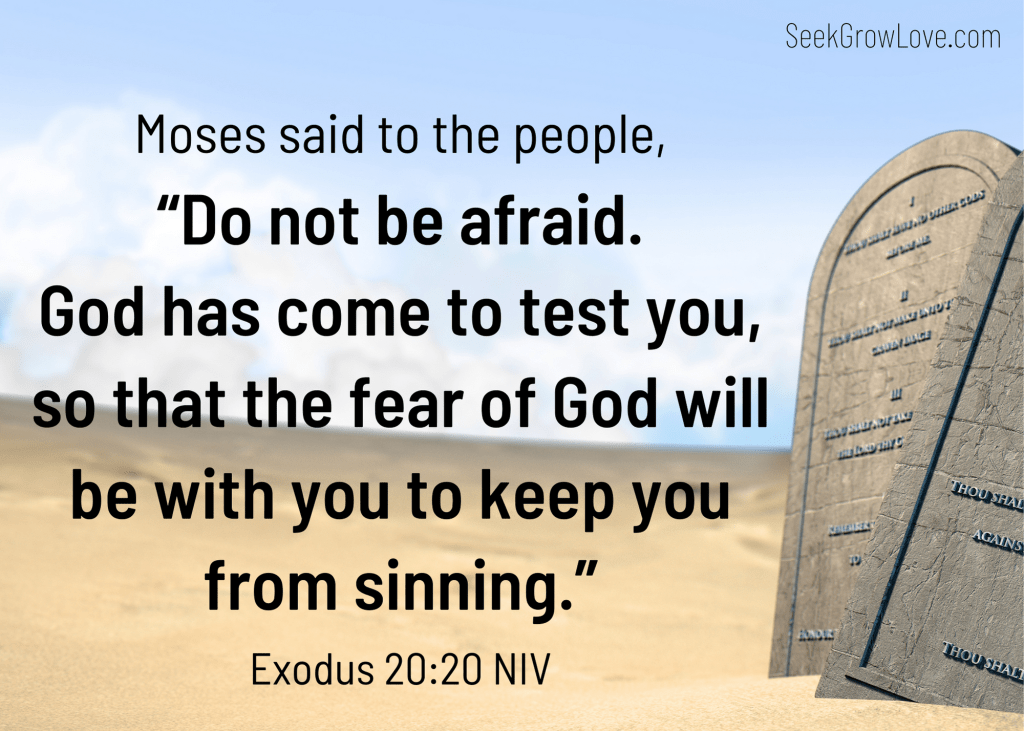
God is truly a God of grace and mercy, but God is also a God who hates sin and punishes sin.  In this way we are still to live in fear of the Lord: Exodus 20:20 “the fear of God will be with you to keep you from sinning.”

Jeff Fletcher

(originally posted for SeekGrowLove on February 5, 2020)

Reflection Questions

  1. What are the duties and responsibilities of a holy nation/kingdom of priests? How would you rate how well/poorly Christians in your nation are doing this job? How would you rate how well/poorly you are doing this job? What can you improve upon this week?
  2. How can we mirror God’s grace and mercy? How can we remind the world (and ourselves) of God’s rule book and judgment? What is the problem with doing just one but not the other?
  3. What does it look like to live in fear of the Lord? Is this only an Old Testament concept or do we find it in the New Testament, too?

And , here is the February Calendar!

The Big Ten

Old Testament: Exodus 19 & 20

Poetry: Psalm 27

New Testament: Matthew 23

Today’s reading of Exodus 19 & 20 is probably one of the most familiar passages in the whole Bible for it includes the Ten Commandments.  It is important to understand the context of these commandments.  God entered into a covenantal relationship with Abraham and Abraham’s descendants through Isaac and Jacob and Jacob’s sons who became the twelve tribes of Israel.  God promised to bless and provide for his people and in exchange His people promised to be faithful and obedient to God and worship God alone.

After 400 years of slavery, Israel has grown from 12 sons and their immediate family to millions of people.  These people, God’s covenant people, will be settling in a land where they will need to live in community.  They are no longer slaves.  They are now responsible to live in that community in peace and productivity.   They need help to know how to live together.  God provides His people with the structure of how to live together as God’s people.  The Ten Commandments and subsequently nearly 600 additional laws were all designed to help them be healthy and blessed representatives of God to the rest of the world.

God loves all people.  We must never falsely believe that God only loves certain people.  God considers all human beings His children and loves them all.  God wants to be in a right relationship with all of his children; however, many are disobedient and have no willingness to be in a relationship with God and many deny that God even exists.

So God needed to start with one group of people and prepare them to be a special, chosen people who would bring the knowledge of God to others.  Exodus 19:5-6 says, “Now if you obey me fully and keep my covenant, then out of all nations you will be my treasured possession. Although the whole earth is mine, you will be for me a kingdom of priests and a holy nation.’

Israel was to be a kingdom of priests and a holy nation.  A priest is one who helps connect people and God.  God would go on to designate priests in Israel to help the people connect with God, but His expectation for Israel was that the whole nation serve as priests to help other nations connect with God.  Because the whole nation was being set apart by God to be priests for the world, they needed to live holy or set apart lives.  There were behavioral expectations that they were to follow.  They had to be exclusively loyal to God, they could not murder, steal, lie, cheat, they were to be respectful and honoring of parents and not misuse God’s name.

Now we are completing what God began in Israel.  Through Christ we have entered into a covenant with God.  We are now the covenant people, we are called to be a kingdom of priests and a holy nation.  That is the Church’s role.  And God expects us to live lives of holiness as we are set apart to serve God.  As you read through the many laws in the Old Testament, recognize that some applied very narrowly to the Nation of Israel and do not necessarily apply to us.  Dietary laws and sanitary laws were important in Israel at the time they were given but are no longer applicable.  However, some of the laws which pertain to morality have been reaffirmed by Jesus Christ for the Church.  In other words, as Christians we are free to eat pork and worship on Sundays, but we are not free to practice polygamy or murder.

God is truly a God of grace and mercy, but God is also a God who hates sin and punishes sin.  In this way we are still to live in fear of the Lord: Exodus 20:20 “the fear of God will be with you to keep you from sinning.”

Jeff Fletcher

(originally posted Feb 5, 2020 for SeekGrowLove)

Reflection Questions

  1. Looking at each one of the Ten Commandments, what can you learn about God? Why do you think He included each one in this list?
  2. Which of these commandments do you need to look at more closely in your own life? What will help you abide by them better?
  3. Looking at Matthew 23, the scribes and Pharisees Jesus was speaking about had worked hard at following the Ten (and additional commandments). But Jesus was not pleased. What were their problems? How can you avoid these problems?

The LORD Reveals Himself

* Old Testament Reading: Exodus 33 & 34
Psalms Reading: Psalm 43
New Testament Reading? Romans 13

Those silly Israelites. Even when God demonstrates His power in huge and miraculous ways like splitting the sea in half so they could walk across, they STILL forget and worship other gods. I would never be like that if I were an Israelite! … or would I? Sometimes, I forget God’s faithfulness and love too, and am tempted to wander from Him. I’m betting you have been like me and the Israelites at different seasons of life as well. 

Yesterday, in Genesis 32, we read about Moses bringing the Ten Commandments down from the mountain, only to find his people worshiping a golden calf they had made, claiming it was a god who had delivered them from Egypt. Aghast, Moses drops the two tablets and lectures the people! Moses pleads forgiveness for the Israelites, and God agrees to continue leading them toward the promised land. As a punishment, however, a great plague comes upon the people. 

In chapter 33, God commands the people to leave Sinai. Moses has a meeting with God, in which he asks for God’s presence to lead them and requests to see God – this wish is granted, but God only allows Moses to see his back. In chapter 34, Moses takes two new tablets to the presence of the LORD. As the LORD passes by, He says as a renewal of His covenant to the people (and a verse which is quoted many more times throughout the Bible), “The LORD, the LORD, a God merciful and gracious, slow to anger and abounding in steadfast love and faithfulness, keeping steadfast love for thousands, forgiving iniquity and transgression and sin, but who will by no means clear the guilty, visiting the iniquity of the fathers upon the children and the children’s children, to the third and fourth generation.” (Exodus 34:6,7 RSV)

This passage starts out as hope-filled and encouraging, right? We see God, YHWH, describe himself as full of mercy and grace, not easily angered, overflowing with love and faithfulness, and forgiving… But He will enforce consequences for sin. These verses show us that while God is merciful, he is also just. (I’ll link below a short video that I think provided a lovely explanation of these verses).  

After this meeting, God offers forgiveness and renews his covenant with his people. He reminds them of His best ways to live, and when Moses returns from the mountain after 40 days and nights with God, he is physically glowing!

The last half of Romans 13 ties in nicely in that it restates many of the same ten commandments! Paul reminds the people of Rome that the root of the commandments is actually love, and loving your neighbor as yourself. “Love does no wrong to a neighbor; therefore love is fulfilling the law.” (Romans 13:12, The Message). 

If we truly love God and love people, and show it with our actions toward them, we will be fulfilling the law and living more like God intended us to live. 

-Rachel Cain

Reflections: 

  1. Watch this video to learn more about the interpretation and poetic nature of verses 6 and 7:  bibleproject.com/explore/video/character-of-god-exodus/
  2. Who would you treat differently if you truly love your neighbor as yourself? 
  3. What does God reveal about Himself in your reading of His words today? How would you describe God to a child – or to a co-worker?

Why the Fear of God?

Exodus 20

February 13

God, as we know, is all powerful. He freed the people from a land of slavery. (Exodus 20:2) God is a loving God, but he can be a jealous god. (Exodus 20:5). He can show us just how powerful he is. (Exodus 20:5-7,25-26) When I was younger, I was always confused by the saying “Fear God”. As I got older I have come to better understand this. We aren’t to fear God like we are the devil, but we are to fear him because we know His strength and power. We are supposed to fear Him so that it keeps us from sinning.

He has shown us and told us what we are to do and not to do. We are to honor our mother and father. We are not to commit murder. We are not to commit adultery. We are not to steal or give false testimony against our neighbor. These are just a few of the commandments. In order to follow these God wants us to fear His power and in a way fear disappointing him. He is our Father in heaven. It’s the same fear we should have for our earthly parents. Exodus 20 is a great chapter because it shows us all the things we should do to please God.

-Genesis Dylewski

Questions for Reflection and Discussion

  1. Look closely at the Ten Commandments (Exodus 20:1-17). How would you describe each commandment in your own words? Now consider, why do you think God included each of these commandments?
  2. What is the overall subject of the first 4 commandments? And of the last 6? Which do you generally find more challenging – having a good relationship with God or having good relationships with people? While recognizing the importance of all 10, choose one commandment from the first 4 and one commandment from the last 6 to focus on this week. How will you better align your thoughts, attitudes, words, and actions with these commandments?
  3. Can you think of a time the fear of God kept you from sinning? Explain. Can you think of a time you should have feared God more? Explain. How can you work on developing a healthy fear of the LORD?

What Kind of Heart Do You Have?

Hebrews 8

Hebrews 8 10

The messes people get themselves into.  Moses had gone off to the top of the mountain to be with God.  Out of that mountain God called out to Moses and laid out a wonderful plan for his people.  God told Moses that He had done wonderful things for His people, Israel, and that His people had seen with their own eyes what He had done to those miserable Egyptians.  Through those terrible trials with the Egyptians, God had been like an eagle and had bore His people, Israel, on His wings and had brought His people to Himself.  They were safe.  They were free.  They had a wonderful future ahead of them.  He described those blessings to them.  Israel would be His very own treasured possession, they would be a kingdom of priests, and a holy nation.  Oh, the life, safe in the arms of the God of the universe!  It was theirs.  All they had to do was…. if only…why couldn’t they have done what He asked?  Oh, the messes we get ourselves into (Exodus 19:3-6)!

It would have been simple.  Very simple.  If only.  Instead they decided to build that stupid calf.  Not only did they build a calf, but they used their own treasured possessions to build it.  They gave up their own treasured possessions of gold to build a calf which would cause them to lose their position as the most treasured possession of God Himself.

All they had to do was simply obey God’s voice.  Instead they decided to obey the voice of sin.  Aaron described them well.  He told Moses, “you know these people.  All they think about is evil.”  (Exodus 32:22).  All they had to do was simple…simply listen to the voice of God Who had delivered them out of the worse mess they had ever been in while they were in Egypt.  All they had to do was listen to the voice of Him who loved them the most and keep His commandments.

God’s anger burned hot against His people! Moses’ anger burned hot against the people!  Then things really turned crazy!  Moses came down that mountain with his hands full carrying the commandments of God, written by God Himself, on two stone tablets front and back (Ex. 32:15-19).  It doesn’t say, but I think Moses’ might have thought he could straighten out the people by showing them those stone tablets containing the commandments of God.  Instead, they became part of the carnage.  When Moses saw what the people were doing, dancing and singing and worshiping a stupid calf, he threw those tablets made of stone and they broke in a million pieces.  He then took that golden calf, burned it and ground it to powder, then scattered it on the water and made the people drink it!  Their precious golden calf made by their precious golden jewelry was gone forever!

But God was not through with them yet.  God sent a plague on the people because they (correction – Aaron) made the calf.  We reap what we sow.  (Exodus 32:35).

End of story, right?  Nope.  God was not through with them yet.

Let’s fast forward to Hebrews 8.  Amazingly God was not through with the house of Israel and the house of Judah yet.  Here, Paul tells us that God is establishing a new covenant with them and with us.  The first one, written on tablets of stone long ago, will be replaced with one written in our minds and on our hearts.  Until the commandments and promises of God are written on our hearts and become flesh, we cannot become new people.   We are simply stone people. This new covenant, of which Jesus is the high priest, will not be displayed on tablets of stone which can be broken into a million pieces, but will be in our hearts and minds. Our old heart of stone will be removed, and a new heart of flesh will be given to us (Ezekiel 11:19).  This new covenant will change our minds and hearts because Jesus, the new high priest, is able to save us to the uttermost (completely and at all times).

What kind of heart do you have?  One of stone which serves sin and will break in a million pieces when sin is exposed?  Or one of flesh which loves and serves God who considers us His most treasured possession?

Luke Elwell

Shema: Listen & Obey (Deuteronomy 5-7)

Wednesday, September 14
josehp-wed

By Joseph Partain

These chapters you read are some of the most important chapters to me personally. If only each of us could live our lives by ch. 5 and 6 there would be nothing to be said but “well done good and faithful servant. The ten commandments are recalled in ch. 5. Verse 1 says “I declare them in your hearing today, to learn them, and then follow them”. This reminds us of James when he states not to be merely hearers of the word and be deceived but DO them. The ten commandments are timeless and Jesus lived a life displaying these very commands. How are we at making God the first in our lives, making the Sabbath a day just for the Lord, not coveting something someone else has, or honoring our father and mother. All of these are not for God’s benefit but for ours that we may benefit and those around us also.

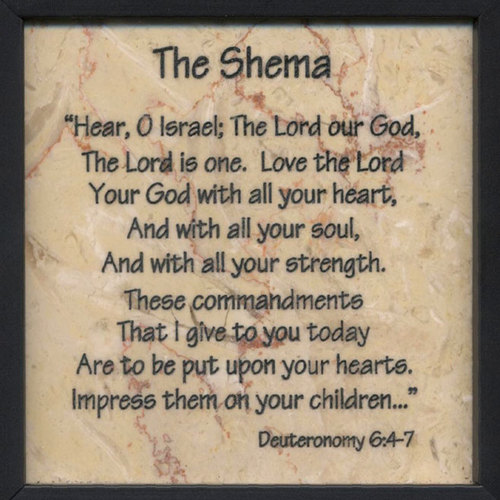
Chapter 6 is a must for memorizing. v4-9 is known as the Shema and is recited by some Jews daily. If you have children or have any influence on children you will notice them watching you and then mimicking your actions. This can be a good thing if you are doing what these verses command. There is no time of the day that is not a teaching moment for your children in God’s word. Noah preached for years and his family was the only ones that entered the boat; some may see that as a failure but his words and actions saved his family. I love v. 20 that says “when your son ask”, anyone who has been around kids know they will ask you who, what, where, when, and especially why. This is a time to tell them what God has done for you personally and all of us that believe have a testimony to share.

Chapter 7 states to completely destroy your enemy. Our enemy is sin and sometimes we get rid of the big things that people can see but we leave some small sins that we think are not a big deal. God tells the Israelites to not show mercy on their enemies but completely destroy them. Be sure to allow God to deal with us to get rid of anything that separates us from him. The last part of ch 7 is God telling them the benefits of keeping his commands. v12 states “God will keep his covenant of love with us”. This was shone to us: when we were still sinners, God sent his son.

Let these words you read today touch you and draw you close to a God who loves like no other. May God bless your reading, learning, and doing all that you read today.