God’s Home – My Heart (I Chronicles 17-20)

Sunday, November 20

1-chr-17-9-ww-mf-9x

I am just going to be honest here. This is the fourth devotion I have written after reading through 1 Chronicles Chapters 17-20. David always intrigued me after hearing that he was a man after God’s own heart and there is so much in these chapters to learn.

Chapter 17 opens with the acknowledgement that David is no longer living in caves or sheep pens, yet is unable to be content because God is living in a tent. David wants to build God a home! Nathan, the prophet, gives the ok. God quickly sends Nathan back to tell David, “no thanks”; explaining He was content walking with his people tent to tent. In chap. 17:10 God says, “I tell you that Yahweh will build you a house” and proceeds to explain how salvation will come through David’s family and an eternal home established. That had to be David’s ultimate WOW moment. And he had plenty to choose from.

David had the opportunity to receive Gods blessing with humility or pride. He chose humility and poured out his heart before God in thankful praise. It is a beautiful moment captured in scripture of a true servant’s heart, broken in worship before his God.

After hearing God’s promise of a Messianic Kingdom, David was emboldened to conquer his own kingdom and began attacking and driving out all enemies from the Promised Land.  18:14 says that Yahweh gave victory to David wherever he went. The verse goes on to say that David “reigned over all Israel; and executed justice and righteousness to all his people.”

David was doing what he knew to do externally to display God’s power, but battles with perceived enemies do not conquer the inner enemies of the soul and do nothing to build a home for God in our heart.

Chapter 19 offers plenty of wisdom regarding the importance of choosing good friends and advisors; along with a good lesson why you should not expect the worse from perceived enemies when they come offering peace. David faces some undeserved bad treatment, no doubt, and seems to change his focus. He sets aside his covenant to honor God with his life and tries to mask over bad decisions through ill treatment of others. He began trusting in chariots and horses and leaving the fighting to others while he stayed home and lusted after another man’s wife.

In Chapter 20, when David received the spoils of war that others fought on his behalf he brutally destroys the people because they were related to the giants he fought in his youth.

So, what does all this mean for our lives? God isn’t needy. God is a provider. He loves to walk with us and will live with us in any situation. The home he desires is an inward one in our hearts.  When we try to cover up sin in our lives and believe we are able to hide our heart from God, our guilty conscience can be found on full display in our poor treatment of others.

If we are to win our personal battles and take ground for the kingdom of God within our own hearts, we have to stay committed and focused and willing to walk daily in God’s mercy and maintain a humble attitude for every victory that unfolds.

Glennis Walters


David’s Psalm of Thanksgiving (1 Chronicles 14-16)

Saturday, November 19

1chron16-8

In 1 Chronicles 16:8-36, we see a Psalm that David dedicated before the ark of the covenant after it was brought to Jerusalem.  Having the ark back where it belonged was a huge deal for Israel, and David wanted something to show Israel’s thanks to God for this.  Here is a small section, verses 8-10

Give thanks to the Lord, call on his name;
make known among the nations what he has done.

Sing to him, sing praise to him;
tell of all his wonderful acts.

Glory in his holy name;
let the hearts of those who seek the LORD rejoice.

Now this is retold after returning from Exile.  Once again there is a great reason to give thanks to God, and to praise his name.

Skipping to the end of this Psalm we see the following in verses 34-36

Give thanks to the LORD, for he is good;
his love endures forever.

Cry out, “Save us, O God our Savior;
gather us and deliver us from the nations
that we may give thanks to your holy name,
that we may glory in your praise.”

Praise be to the LORD our God of Israel,
from everlasting to everlasting.

Again, this would have been very appropriate after returning from exile.  They were at risk of attacks from enemy nations, and this Psalm includes a request for deliverance from the nations.  They ask for deliverance so that they may praise God even more.

We also have many reasons to give things and praise the name of God.  We need deliverance from our spiritual enemies that attack us, so that we may continue to praise God.  What do you have to be thankful for today?  Let’s remember to praise God for all he has done, and the promises we know he will continue to keep.

-Andrew Hamilton

Faith of Our Fathers (1 Chronicles 11-13)

Friday, November 18

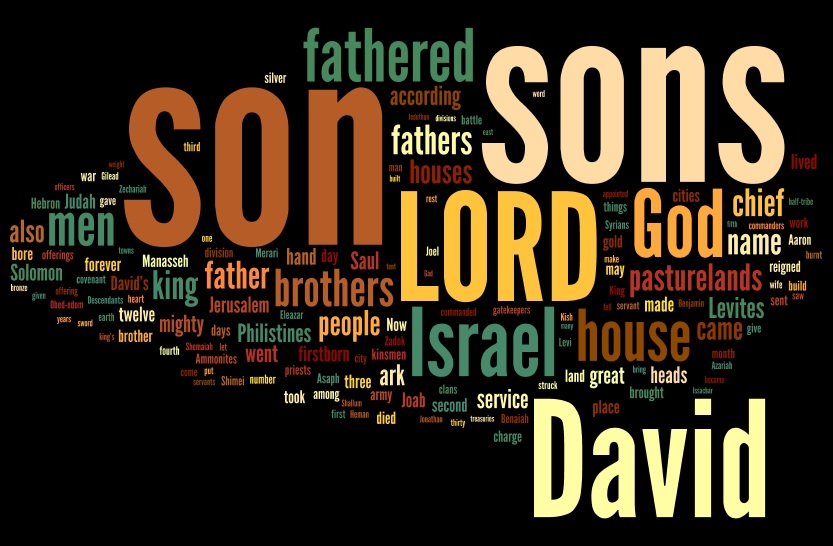
13-wordle-1-chronicles

As I mentioned in the devotion a few days ago for 1 Chronicles 1-2, tradition says that this book was probably written after the Israelites returned to Jerusalem following 70 years in exile.  This was probably during the time that Jerusalem was being rebuilt, a time with a lot of struggles and fear.   There were not walls around the city.  There were enemy nations around.  They had not had their own kingdom in the entire time most of the people had been alive.  This was all new for them.

These chapters start the retelling of the time when David was king, a prosperous time in their history.  In 1 Chronicles 11:4, it says:

David and all the Israelites marched to Jerusalem (that is, Jebus).  The Jebusites who lived there said to David, “You will not get in here.”  Nevertheless, David captured the fortress of Zion, the city of David.

Then in verse 8, it says about King David:

He built up the city around it, from the supporting terraces to the surrounding wall, while Joab restored the rest of the city.

This must have been very encouraging at this time to see that David had to conquer and then build up Jerusalem, including the walls, during his reign.  The nation was greatly blessed while David reigned, so why couldn’t they rebuild and be prosperous and be blessed again.  David had trusted God, and they were now trusting God, so they could look forward to blessings and protection just as the people in the time of David.

We can all look back to the people in the church before us, and see how they trusted God, and how the church has been blessed through them.  This may be people in our family, in our local church, or others that we know of.  Their examples and the things that they have done through faith should teach us that with faith, we can also have protection, peace, and blessings as we serve the LORD.

-Andrew Hamilton

God First (I Chronicles 8-10)

Thursday, November 17

god_first-1097943

We are coming to the end of the genealogy in 1 Chronicles.  It goes through chapter 9.  After 3 days full of genealogy, I was excited to have something to read and write about that wasn’t genealogy.  However, I was struck by the last chapter of this genealogy, and felt compelled to write one more devotion on it.

Chapter 9:1b-2 says, “The people of Judah were taken captive to Babylon because of their unfaithfulness.  Now the first to resettle on their own property in their own towns were some Israelites, priests, Levites and temple servants.”  The chapter continues by telling us that there were 1760 priests who returned, along with 212 gatekeepers guarding the Tent of meeting.  Four principle gatekeepers were responsible for the rooms and treasuries in the house of God.  Others who returned were responsible for the articles used in temple services.  Others were in charge of the temple furnishings.

The thing that struck me about this was that the first to return, the ones listed here, were dealing with the temple and the worship of God.  It wasn’t the masons to build a wall, or the warriors who would build the army to defend the city.  The Israelites were returning their hearts to God, and had their priorities straight:  worship God first and then deal with everything else.

How does this compare to us?  Do we prepare to worship God first?  I know it is very easy for me to get things backwards, get caught up in the busyness of life, and fit God in when there is time.  However, when I take time for God first, the busyness doesn’t seem so rushed and frantic, even when the circumstances stay the same.  Let’s focus on putting God first and worship him today.

-Andrew Hamilton

Finding Your Place (I Chronicles 6-7)

Wednesday, November 16

levite_musicians

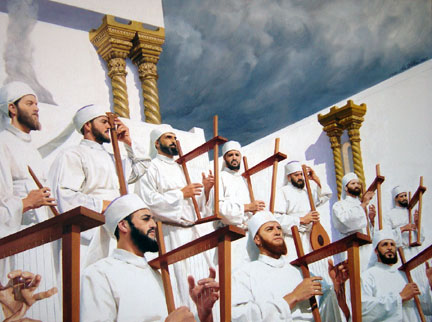
Chapter 6 starts with listing the descendants of Levi.  The tribe of Levi is set aside to be the priests, workers in the tabernacle and temple, and things like that.  In verse 11, it says “These are the men David put in charge of the music in the house of the LORD after the ark came to rest there.”  This is the list of men who had a specific job because of their genealogy.

In verses 48 and 49, it says “Their fellow Levites were assigned to all the other duties of the tabernacle, the house of God.  But Aaron and his descendants were the ones who presented offerings on the altar of burnt offering and on the altar of incense…”  Again, these other Levites had specific jobs or duties because of their genealogy.

As we move into chapter 7, we see lists of other groups of people, and for each one, it lists their number of fighting men or warriors.  Each of these also had a duty as warriors, both in defense and offense.

As I was reading this, I thought about how this could relate to us.  We each have special roles in the church.  If we look at the genealogy of the church, where do each of us fit in it?  Would you be listed as having “priestly duties”, the spiritual leaders in the church?  This could be as a pastor, elder, or a scholar possibly.  Would you be listed as a musician, giving praise to the LORD?  Would you be listed as a warrior, standing up for your faith on the defense and/or evangelizing and spreading the word on offense?

We are not cast into a certain position based on the tribe we belong to, but there is a place where each of us fit.   I encourage you to examine what roles God is leading you to, and follow God’s plans for you.

-Andrew Hamilton

Your Spiritual Genealogy (I Chronicles 3-5)

Tuesday November 15

cog-pastors

These chapters continue the genealogy starting with the sons of David.  We see some great people listed.  David ruled as king, and is considered one of the greatest kings of Israel, although he was definitely not without fault.  Solomon, who was granted great wisdom, and used that wisdom to judge the people of Israel.  He also had his faults and downfalls.   In this list are also people who turned against God’s plans and did evil.


Yesterday, I wrote about the genealogy of the country, and the families.  Something I read about this genealogy mentioned the spiritual genealogy that is in this list also.  These leaders listed sometimes helped improve the people’s relationship with God, and helped increase their faith.  Others tore down their faith.  This goes across family and ancestral lines.

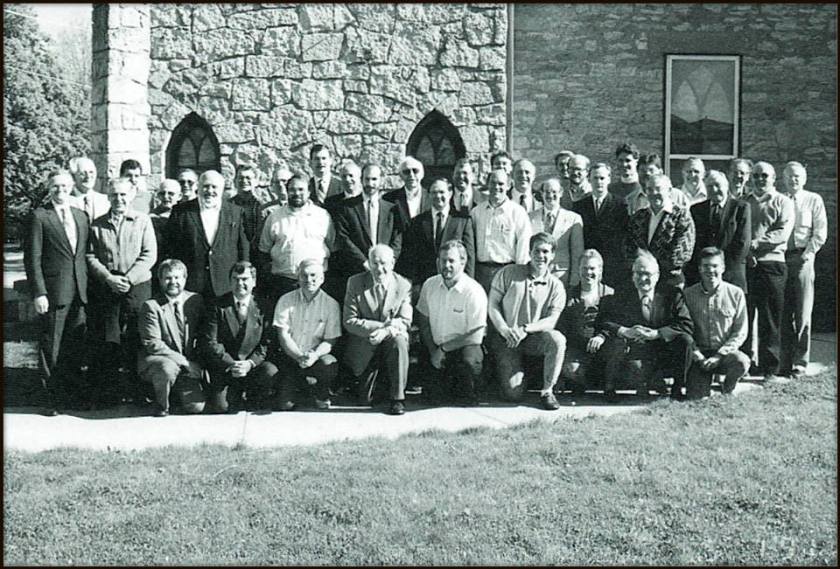
We have a genealogy of our faith too, and will be part of others genealogy.  There are people who have affected the faith of each of us.  Some people have built it up and others have torn it down.  The people who affected us were affected by others.  The people who founded your church have affected you, because they brought the church family together and passed their knowledge and experience down through generations.  Those that founded the Church of God, and the Bible College have affected your faith through training of pastors, among other ways.


All of us are influencing others, and not just those we encounter personally.  A Sunday school teacher can plant the seed that develops into a passion to be a pastor, a missionary, a teacher, or something else.  A friend can be the seed that brings a new person to church, and causes their family to know God.  On the other hand, someone can lead those around them into sin, cause them to doubt God, or something else negative.  This could stop them from being an influence for God.  Our actions can spread much further than we ever expected.


As a shepherd boy, how could David have ever expected to be king of Israel, or to be an example listed in the Bible that generation after generation of children learn.  Please consider the question, “What will my part be in the spiritual genealogy of those around me, and those that I don’t even know?”


I encourage everyone to pray that we will each see how we can build up the faith of those around us, so that they can build the faith of those around them, etc.  Our spiritual genealogy is much more important than our family genealogy.

– Andrew Hamilton


Adam, Seth, Enosh … (I Chronicles 1-2)

Monday November 14


i-chronicles

Andrew Hamilton

The list of names continues, and a majority of the words in these first two chapters are name.  We have the list from Adam to Jacob in chapter 1, and then the tribes of Israel through the time of David.  There are many names in here that are familiar, and many that I don’t recognize at all.   What is the purpose of this genealogy?  Who wrote it?   Why was it written?  Who was it written for?  Why do I care?


Although scholars do not all agree about who wrote it, and we can’t know all the details about why it was written, both Jewish and Christian traditions provide the same possible answer.  The writing is credited to Ezra, as are the books of Ezra and Nehemiah.  1 and 2 Chronicles were written after the return from exile, probably during the rebuilding of Jerusalem.

God’s chosen people had been in exile for 70 years.  At least most of the people returning to Jerusalem  had never actually been in Jerusalem, and all they knew was the Babylonian captivity.  This book was probably written as a reminder and source of hope for God’s people.  The genealogy shows them where they came from, reminds them of their great ancestors, the growth of the Israelites into a great nation, and where they fit into God’s plan.


So, the hard question for me is still why do I care to read all of these names, most of which I can’t pronounce.  If we want to understand and learn from the Israelites, Gods chosen people, we need to understand what was important to them.  Their genealogy and history of their people was one of these important things to them.  It was used to show how they were all related together, and remind them of all the great people in the history of their nation.


As you read this, try to read every name.  Try to think about the names, and why the ones you know were important to the history of Israel.  Try to imagine going to your promised homeland that you had never been to, that was destroyed, that needed tons of work, and think how knowing your history would give you hope.

What do we use to give us hope?  What do we need to look at daily to remember the hope we have?


God’s Grace Brings Release (2 Kings 24-25)

Sunday, November 13

jehoiachin

Chapter 23 ended with Jehoiakim becoming king and doing evil in the eyes of the Lord just as his fathers had.  Then moving into chapter 24, Nebuchadnezzar comes onto the scene.  He invaded Jerusalem, and made Jehoiakim his servant, to carry out his orders over Judah.  After 3 years Jehoiakim rebelled against Nebuchadnezzar.  The Lord sent armies against him for the evil he had done and he is killed.  His son Jehoiachin became king and continued doing evil in the eyes of the Lord as his fathers did.  The cycle is continuing.

After Jehoiachin had ruled only 3 months, Nebuchadnezzar laid siege to Jerusalem.  Jehoiachin surrendered and is taken prisoner.  All the treasures of the temple were taken, along with treasures from the king’s house.  All but the poorest people were exiled to Babylon.  Things were as low as they had ever been for Judah.  However, they kept getting worse, and Jerusalem was eventually destroyed.

This seems to just be a story of kings doing evil, and suffering consequences for it.  Fast forward 37 years and Nebuchadnezzar dies and Evil-Merodach becomes king of Babylon.  He releases Jehoiachin from prison and gave him a place of honor.  What a transformation overnight to go from prison to a place of honor with the king.

Have you ever felt that because of some mistake you made or some circumstances, that you can never get past it?  Have you felt that things are just going from bad to worse and you will never get past the problems you have?  I am guessing Jehoiachin felt that he was condemned to being in prison the rest of his life, and lacked hope at times.  However, his life turned around.  Doesn’t this sound like the grace of God?  There is nothing that shows Jehoiachin deserved this improved position, however he was granted it anyways.

Whether our problems are caused by our own mistakes or just circumstances we are in, we can have the hope of God’s grace, and have everything turned around.  We just need to accept God’s gift, along with repentance for our sins.

We can always have hope.

Andrew Hamilton

What Causes the People to Perish? (2 Kings 21-23)

Saturday, November 12

2-kings-22

Hezekiah’s son, Manasseh, is the next king of Judah.  And he does not take after his father.  Manasseh built pagan altars in the Lord’s temple and even sacrificed his own son in the fire to Molek – a pagan practice to a foreign false god.  Judah did more evil under Manasseh than the nations that were removed from the land before God established Judah (2 Kings 21:9).  God is not pleased and he foretells a coming “cleansing” of the land: “I will wipe out Jerusalem as one wipes a dish, wiping it and turning it upside down. I will …give them into the the hands of enemies.” (2 Kings 21:13,14).

Manasseh’s son, Amon, is the next wicked ruler.  He is assassinated.  His assassinators are then assassinated and his 8 year old son, Josiah, is given the crown.  It seems a certain recipe for disaster – civil unrest, kingly assassinations, violence, the son and grandson of some of the worst kings is handed the kingship at the age of 8.  However, somehow, with all these strikes against him, Josiah rises above his past and current circumstances.  It appears he has the benefit of some godly advisors, for we learn, “he did what was right in the eyes of the Lord… not turning aside to the right or to the left.” (2 Kings 22:2).  Eighteen years into his reign he commissions the cleaning of the temple.  A most valuable treasure is found – the forgotten, neglected, Book of the Law.  When it is read to Josiah he tears his robes, humbles himself and seeks the Lord for he sees how far the people had strayed from God’s will as well as realizing that punishment was getting closer.  Josiah leaps to action.  He calls together all of Judah and reads the holy words to them.  He calls for the people to repent and renew their covenant to the Almighty.  He jumps into action, purging Judah of idolatry and replacing it with the worship of the One True God.

Without God’s Word the people perish – both then and now.  In many communities and lives today God’s Word is forgotten, neglected, absent, dusty.  People are busy serving themselves and false gods.  They will be caught completely unprepared for the “cleansing” that will come.  How can you respond like Josiah?  After reading God’s words – who will you share them with?  How will you jump into action seeking to purge idolatry (in your own life first) and to then replace it with sincere and pleasing  worship of God Almighty?

Seek Him – Seek His Word – And Do it

Marcia Railton

Keep on Praying! (2 Kings 18-20)

Friday, November 11

2-kings-19-so-now-o-lord-our-god-save-us-please-from-his-hand

Watch out!  The Assyrians who just attacked and captured Israel are now on the doorstep of Judah, ready to do the same to the smaller neighbor to the south.  Judah is shaking in their boots – and wearing sackcloth – and PRAYING.  The Assyrian king sends a letter of doom to Hezekiah, King of Judah, in which he also questions the power of Judah’s God (big mistake).  Hezekiah goes directly to the temple and prays for his country:

Lord, the God of Israel, enthroned between the cherubim, you alone are God over all the kingdoms of the earth. You have made heaven and earth. 16 Give ear, Lord, and hear; open your eyes, Lord, and see; listen to the words Sennacherib has sent to ridicule the living God. 17 “It is true, Lord, that the Assyrian kings have laid waste these nations and their lands. 18 They have thrown their gods into the fire and destroyed them, for they were not gods but only wood and stone, fashioned by human hands. 19 Now, Lord our God, deliver us from his hand, so that all the kingdoms of the earth may know that you alone, Lord, are God.”      2 Kings 19:15-19

The prophet Isaiah sends a message to Hezekiah that God has heard his prayer.  And sure enough – THAT night a miraculous answer is given.  An angel of the Lord puts to death 85,000 Assyrian soldiers, and the rest run away in the morning.

All looks great – until Hezekiah becomes deathly ill.  And so, Hezekiah prays:

“Remember, Lord, how I have walked before you faithfully and with wholehearted devotion and have done what is good in your eyes.” And Hezekiah wept bitterly.

and God hears and answers and Hezekiah is told he will be given 15 more years of life.   When bold Hezekiah asks for a sign to be sure this is true, the shadow cast by the sun moves backward 10 steps!  This healing was no mere coincidence or just really good medicine at work.

Talk about some power in prayer!  Wouldn’t you love to go to a class on prayer taught by Hezekiah.  Prayer is powerful because the God Hezekiah prayed to is so powerful!  There is no enemy or illness too strong for the Almighty God!

So, what about when we faithfully pray for our crisis to be fixed and the answer is no or not now?  The enemy wins or the illness brings death?  Is it because God isn’t powerful enough?  NO.  Or perhaps we weren’t good enough?  NO, not necessarily.  Just a few chapters ago we were reading of Elisha, the God-fearing, power-praying prophet who performed many miracles: parting the water, healing leprosy, feeding a hundred men with just 20 loaves of bread, changing the deadly stew to nourishing, making the ax-head float and the oil over-flowing AND raising a boy from the dead!   Elisha was no doubt a man of God and God answered his prayers in mighty ways time and time again.  However in 2 Kings 13:14 we read “Now Elisha was suffering from the illness from which he died.”  Even on his deathbed he delivers another message from God to the king of Israel.  Then, he died.  And even in death his bones were powerful enough to raise the life of another (2 Kings 13:21).   Sometimes the miracle even comes after death – in the lives of others.

Not only is God all-powerful but He is also all-knowing and all-wise.  And, sometimes that means the good die or the enemy has a victorious day.  In 2 Kings 19 after Hezekiah prays for deliverance for his country, Isaiah delivers a message from God against the attacking Assyrians.  He says: “Have you not heard?  Long ago I ordained it.  In days of old I planned it; now I have brought it to pass, that you have turned fortified cities into piles of stone…but I know where you stay and when you come and go…and I will make you return by the way you came” (19:25,27,28)

God has got this.  Nothing He doesn’t see.  Nothing He doesn’t know. Nothing He doesn’t know how to handle.  He sees the big picture.  He IS the big picture.  Rest in that knowledge.  Pray big to the Almighty, just as Elisha and Hezekiah did.  You just might  witness a miracle!  Or it might be a day ordained for the enemy to win or the prophet of God to die.  Either way – God is God and He is all-powerful, all-knowing and all-wise.

Keep on Praying!

Marcia Railton

2-kings-20