When God Responds

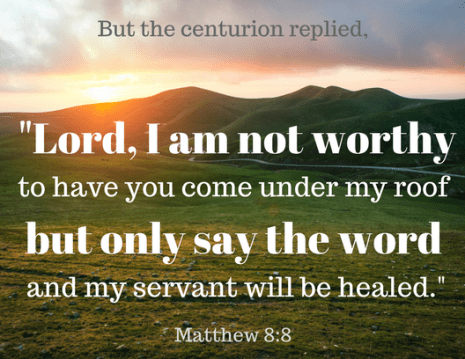
matt 8 8

Matthew 8:5-10

When he had entered Capernaum, a centurion came forward to him, appealing to him, 6“Lord, my servant is lying paralyzed at home, suffering terribly.” 7And he said to him, “I will come and heal him.” 8But the centurion replied, “Lord, I am not worthy to have you come under my roof, but only say the word, and my servant will be healed. 9For I too am a man under authority, with soldiers under me. And I say to one, ‘Go,’ and he goes, and to another, ‘Come,’ and he comes, and to my servant, ‘Do this,’ and he does it.” 10When Jesus heard this, he marveled and said to those who followed him, “Truly, I tell you, with no one in Israel have I found such faith.

In Matthew 8, Jesus is recorded as miraculously healing several distinct individuals that represent three classification of people who were viewed with lesser status in Jewish eyes. The first is a leper, who is considered unclean for a Jewish man to touch (vv. 1-4). Next is a servant of a Roman centurion, who was a Gentile foreigner and likely part of the oppressive Roman Empire, which Jews considered to be their enemy (vv. 5-13). Lastly, Jesus heals Peter’s mother-in-law (vv. 14-15), which is unique as women were not looked upon with much recognition or significance in Jewish society. In addition, the passage also reveals that Jesus healed numerous other people who were demon-possessed around Capernaum as well (vv. 16-17).

In verses 5-10 when Jesus is approached by the centurion, he concedes to the centurion’s request to come and heal his servant. Jesus’ agreement to come to the centurion’s home is quite a startlingly turn of events in this passage as a Jewish person would be deemed ceremonially unclean if they entered the house of a Gentile (cf. Jn 18:28; Acts 10:28). But nevertheless, Jesus humbly agrees to go and heal the man (vv. 5-7).

But the centurion replies quickly to Jesus expressing his “unworthiness” for Jesus to make the effort to come to his house. Rather, the centurion reveals a keen understanding of Jesus’ authority to speak with the power of God. The centurion explains that he knows what authority means because he speaks, and someone obeys, and the task is accomplished. In the same way, he claims that Jesus only needs to speak the “word,” and according to the authority of his “word,” the centurion’s servant will be healed (v. 8).

This proclamation amazes Jesus because the centurion understood the power and authority of God that Jesus represented. And in response to the centurion’s understanding of this reality, Jesus declares, “Truly, I tell you, with no one in Israel have I found such faith” (v. 10). What an unsuspecting pronouncement—that Jesus would confess such a great faith from this Gentile that superseded any he had seen in all of Israel. The emphasis here is that even a Gentile, who was not considered a member of God’s people, will see the power of God at work when they trust in Jesus, God’s Anointed.

What the passage can teach us is that God’s power flows in response to the exercising of faith (trust) in God as the source of all power and in Jesus as God’s Messiah. If we want to see God’s power at work in our lives, it begins by recognizing that God moves when we believe and trust in him, knowing that he is able to do even what may seem impossible in our eyes. Our trust in God doesn’t make God move; rather, God responds when we trust in him. And we must also trust in his character—that he responds as the good and loving God that we know he is.

-Jerry Wierwille

Call to Action

Matthew 7

matt 7 24

I have been taught that a good speech should always end with a call to action.  What this is depends on the type of speech.  A speech given by an election candidate will usually end by telling people they need to vote.  A product placement speech or demonstration will end with a way to buy the product.  Often a sermon will end with a life application.

As we look at the conclusion of the Sermon on the Mount, we see that Jesus ends with a call to action.  He has given us some other actions to take throughout this passage, but let’s look at this final section and see how we should respond to this sermon.

Let’s start by looking at Matthew 7:21-23:

“Not everyone who says to Me, ‘Lord, Lord,’ will enter the kingdom of heaven, but he who does the will of My Father who is in heaven will enter.  Many will say to Me on that day, ‘Lord, Lord, did we not prophesy in Your name, an in Your name cast out demons, and in Your name perform many miracles?’  And then I will declare to them, ‘I never knew you; Depart from Me, you who practice lawlessness.’

So, making the assumption that the goal is to be in the kingdom, Jesus says our action is to do the will of God.  This is obviously more than actions that we do.  Many times in chapters 5-7, Jesus talks about our thoughts, attitudes, and reasons for doing things being as important as the actions we take.

Jesus continues in verse 24 by saying, “Therefore everyone who hears these words of Mine and acts on them, may be compared to a wise man who built his house on the rock.”  Again, the key here is to act on the words that Jesus has spoken.

The call to action is to put all the things that Jesus taught into action, which includes our thoughts and attitudes.  I encourage you to spend some more time reading through Matthew 5-7, and reflect upon seeking God, his righteousness, and his kingdom.  As we seek these more, the actions will follow.

-Andrew Hamilton

Worry

Matthew 6

matt 6 27

I worry about things.  Big things or little things, or sometimes nothing at all.  As I mentioned in a previous devotion this week, I have a plan for things.  When things don’t go according to plan, I stress out, and at times let my worry and anxiety take over.  In the last week or so, I have had a series of issues with my house that have really caused me to worry.  First our freezer broke.  Then something caused our propane tank to go from 30% full to empty very quickly.  Then the heat for our house started having problems.  I have been extremely anxious over all of these problems.  So, when reading over Matthew 6 and trying to decide what to write about, I thought that the section I needed to learn from was the section on worrying.

So, what I am writing today is aimed at myself, and I hope you can also gain something from it.

In Matthew 6:25, Jesus tells us:

“For this reason I say to you, do not be worried about your life, as to what you will eat or what you will drink; nor for your body, as to what you will put on. Is not life more than food, and the body more than clothing?

He then compares us to the birds, to lilies, and to grass. God takes care of all of these items, and we are so much more valuable to God than these things.  Yet, we worry about these things, and try to handle them all on our own.

What good does worrying do us?  Worrying makes it hard to sleep.  It makes it hard to concentrate.  It makes us irritable and upset.  It can give us ulcers.  I can’t think of one thing that worrying actually accomplishes, but I can come up with a whole list of things it hinders.  Verse 27 sums this up nicely.  “And who of you by being worried can add a single hour to his life?”  In fact, worrying can only decrease hours in our life.

I think we all know that worrying is bad, and that we should trust in God more and release our problems to him.  I know it, and yet I still struggle with this frequently.  So, what do we do?

Jesus sums this section up with two verses, 33 and 34:

“But seek first His kingdom and His righteousness, and all these things will be added to you.  So do not worry about tomorrow; for tomorrow will care for itself. Each day has enough trouble of its own.”

I often hear each of these verses talked about individually.  I don’t remember ever looking at them together.  However, they are together.  If we seek the kingdom of God and God’s righteousness, all the things we worry about will be handled in God’s perfect method as well.  If we focus on God, we do not need to worry about all the other stuff.

So, I am not going to encourage you to stop worrying, because I don’t think that is the answer.  I encourage you to seek the Kingdom of God and God’s righteousness.  Seek it fervently so that you do not have time or room in your life for worry.   This ties back to Matthew 5:6, earlier in the Sermon on the Mount, where Jesus said, “Blessed are those who hunger and thirst for righteousness, for they shall be satisfied.”  Hunger and thirst for righteousness….I believe this is the cure for worry.

-Andrew Hamilton

Religion Turned Upside Down

Matthew 5

Matt 5 48

Matthew 5 is the beginning of the Sermon on the Mount.  There is so much wisdom packed into this chapter that it is difficult to pick out pieces to include.  So, I want to start at the end, in verse 48.

“Therefore, you are to be perfect, as your heavenly Father is perfect.”

This is Jesus’s concluding statement to this part of his sermon.  Reading this verse alone seems like Jesus is giving us an impossible task, and in this life, it really is.  However, we should still strive for it.  A lot of this chapter is telling us how to be perfect.

This is one of those times when Jesus is really flipping things upside down.  The Jewish people were under the law, and some of them at least followed the letter of the law without regards to the purpose of the law.  It was a specific set of rules, and consequences for not following them.

Starting in Matthew 5:21, Jesus takes some of these very specific laws, and really expands the meaning of them.  The law in the Old Testament was “You shall not commit murder”.  The consequence was that “whoever commits murder shall be liable to the court.”  Jesus continues in verse 22 with the spirit of the law instead of just the letter of the law by saying, “But I say to you that everyone who is angry with his brother shall be guilty before the supreme court; and whoever says to his brother, ‘You fool’ shall be guilty enough to go into the fiery hell.”  Calling someone a fool is much more difficult to guard against than killing someone.  For those that were following the letter of the law and felt they were perfect in the law, this would have completely destroyed their view of themselves.  How can we be perfect if something this easy to do makes us guilty before the court and makes us deserve the lake of fire?

Jesus then goes on to talk about adultery, and expounds on it by saying in verse 28, “but I say to you that everyone who looks at a woman with lust for her has already committed adultery with her in his heart.”  This may be the most difficult sin for a male to conquer.  I believe that every man has committed this sin.  So, how can we be perfect?

Jesus does not stop there.  He talks about vows and promises, about not holding grudges or repaying offences, and about loving your enemies.  He takes a set of laws that were difficult to keep, and shows us the spirit of the law, and how our hearts and thoughts separate us from God just like the physical acts separate us from God.  So, how is it possible for anyone to be perfect, or to ever be with God?

Was Jesus really changing the Old Testament laws with this?  Verse 17 answers this by saying, “Do not think that I came to abolish the Law of the Prophets; I did not come to abolish, but to fulfill.”  I think Jesus was telling them that this attitude and heart of the law was always there, but not understood by most.  So, he wasn’t really expanding the law, but explaining how it should be understood.  This still doesn’t make it any easier to be perfect.  How do we even have a chance of being perfect?

Obviously, we have to have the sacrifice of Jesus’s death, and his resurrection, to be made perfect.  We have to accept Jesus as our Savior and follow him throughout our lives.  This is the only way we will ever be considered perfect, and able to be in God’s presence in the kingdom.  However, that does not mean we should not strive to be more perfect each day, and with the help of God, and his Son Jesus, we can come closer to perfection each day (although never actually being perfect).

I think the beginning of Matthew 5 gives us a lot of traits to strive for, along with promises that go along with them.  Jesus starts in verse 3 with, “Blessed are the poor in spirit, for theirs is the kingdom of heaven.”  He continues the list with those who mourn, the gentle, those who hunger and thirst for righteousness, the merciful, the pure in heart, the peace makers, and those who are persecuted for the sake of righteousness.  As we work to have the attributes described here, we draw closer to God.  It isn’t about what we do, but where our heart is and why we do the things we do.

-Andrew Hamilton

Knowing Scripture

Matthew 4

Matt 4 4

It always impresses me when someone can quote scripture that is appropriate to the situation at hand, especially when they can quote it word for word, and know the reference.  Being impressed isn’t really because of their knowledge, but because if they can quote exactly what is in scripture, and tell me where to look it up and get more information means that I can know the truth from the Bible.

In Matthew 4, Jesus has spent 40 days and 40 nights fasting.  I think that would make it very difficult to remember anything clearly.  However, when tempted, Jesus is able to quote the necessary scripture to answer the temptations brought to him by the tempter.  When tempted with food, Jesus quotes Deuteronomy 8:3, “Man shall not live on bread alone, but on every word that proceeds out of the mouth of God.”  For each of the other temptations, Jesus again quotes Old Testament scripture that answers the temptation directly.  Because of these answers, the devil leaves Jesus.

How awesome is the power of scripture.  We can rebuff temptation with scripture in the same way Jesus did.  However, it requires us to know scripture, to memorize it.

I often find myself being able to paraphrase things, and maybe being able to get somewhere close to where it is found.  If given time, I can find it.  While this is helpful, it often falls short of what I need.  When I am having a difficult time, or trying to help someone, it is frustrating not being able to find the verses needed to help with the problem.

I encourage you to learn and memorize scripture.  Jesus is our example, and he knew the scriptures.  We should all follow that example.

-Andrew Hamilton


John the Baptist

Matthew 3

Matt 3 3

Matthew 3 revolves around John the Baptist, the forerunner of Jesus.  He was sent to prepare people for Jesus.  Jesus’s ministry was really radical when compared to what had been taught previously.  We will see more of that in future chapters.  John started that radical teaching here.

First though, we are introduced to John the Baptist and then in verse 3 we read a prophecy from Isaiah.

“The voice of one crying in the wilderness,
‘Make ready the way of the Lord,
Make His paths straight!’”

Again, this would have probably been a prophecy taught about the coming Messiah, and so the Jewish people of the time would need to see how this is fulfilled to believe Jesus was their Messiah. Obviously, a lot of them still did not believe, but for the ones that did, they needed to see each of these prophecies fulfilled.

John was baptizing people as they confessed their sins.  There are some similarities between baptism and some of the ritual cleansing listed in the old testament.  However, even with that, this was a huge departure from what people had ever done before.   Never before had people come to an individual, and not even a priest, to confess sins and then be immersed in the water.

In verse 7 we see that even Pharisees and Sadducees were coming for baptism.  I have no idea why they would have wanted to be baptized, and in the little bit of searching I did, could not find an explanation.  No matter the reason, we see John call them a brood of vipers, and warn them of what Jesus is going to do.  This is the first confrontation we see with the Pharisees or Sadducees, and it sets up what we can expect between them and Jesus.

The end of the chapter, starting in verse 13 shows us the baptism of Jesus.  Jesus comes to John to be baptized.  John does not feel worthy to baptize Jesus, but I think does it out of obedience.  He recognized the authority of Jesus and that it is necessary to obey Jesus’s requests.

Verses 16 and 17 show a super natural acknowledgement of who Jesus is from God.

After being baptized, Jesus came up immediately from the water; and behold, the heavens were opened, and [i]he saw the Spirit of God descending as a dove and[j]lighting on Him, 17 and behold, a voice out of the heavens said, “This is [k]My beloved Son, in whom I am well-pleased.”

If anyone present had any doubts before that, this should have erased them.  However, it seems like the Pharisees and Sadducees were probably still there, and as a whole, they did not believe.

What does it take for us to believe?  We have the whole Bible and know the beginning, middle, and end of the story.  This should be an easy answer for us with everything we know.  So, if we believe, are we being like John the Baptist?  Are we a forerunner for Jesus to people who don’t know him?  Are we preparing the way for people to come to know Jesus?

-Andrew Hamilton

Obeying Immediately and Without Questions

Matthew 2

Matt 2 14

How do you deal with situations where you have to completely change what you had planned?  I always think I have a long term plan for my life.  When it doesn’t work out, or I have to change something, I don’t always deal well with it.

I want to look at how Joseph reacts to some very difficult situations.  I am going to jump back to Matthew chapter 1 for the first example.  Joseph found out Mary was pregnant and planned to divorce her quietly.  Then, he is visited by an angel, and was told in Matthew 1:21-22, “Joseph, son of David, do not be afraid to take Mary as your wife; for the child who has been conceived in her is of the Holy Spirit.  She will bear a Son, and you shall call his name Jesus, for He will save His people from their sins.”  So, first Joseph plans to marry Mary.  Then, when she is pregnant, he plans to divorce her quietly.  So, his plans have already been messed up once before being visited by the angel.  He is given a message from God.  How does he react?  By everything we see in scripture, it appears Joseph just listened to what God told him through the angel, and accepted it.  That is amazing faith and obedience.

The second example is after the visit from the magi.  This was probably one to two years later.  We don’t have any real information about the life of Joseph, Mary, and Jesus during this time, but most likely they had settled into a routine and things were fairly normal.  Then, after the Magi visit, Joseph receives another message from an angel. Matthew 2:13 record this message to Joseph, “Get up!  Take the Child and His mother and flee to Egypt, and remain there until I tell you; for Herod is going to search for the Child to destroy Him.”  Again, his reaction was swift and decisive.  Matthew 2:14 says, “So Joseph got up and took the Child and His mother while it was still night, and left for Egypt.”  He didn’t even wait till morning but left immediately.

Then, sometime later, an angel appeared to Joseph a third time.  This time he was told, “Get up, take the Child and His mother, and go into the land of Israel; for those who sought the Child’s life are dead” in Matt 2:20.  So, he went back to Israel, but because he was warned in a dream, they went to Nazareth.  Again, there are no signs of questioning, just doing what he was told.

I have never been spoken to by an angel, so I don’t know how I would react in that situation.  However, I have received direction from God in some pretty clear ways.  I questioned what I was being told because it did not fit into my plans.  So, I know that this immediate obedience is extremely difficult, but when we put all our trust in God, it is possible.

-Andrew Hamilton

Know Your Audience

Matt 1 22

Matthew Chapter 1

I remember in high school English classes the teachers talking about knowing your audience.  I really enjoyed math and science classes, but English and literature classes were a different story.  I really didn’t like figuring out the audience, the theme, symbolism, etc.  However, I now know that in at least some cases, the teachers were correct.  You gain a lot of extra understanding when you know the primary audience for a book.  I say primary audience in this case because I firmly believe that all of the Bible was written to everyone who will take the time to read it or listen to it.  However, the author had a primary audience they were writing to at the time.

Each gospel was written for a different primary audience.  Matthew was writing to the Jews who had a good knowledge of the Old Testament scriptures.  They would have learned the prophecies regarding the Messiah and were looking towards the fulfillment of those prophecies.

The first chapter of Matthew starts with the genealogy of Jesus.  This is the first step to showing that Jesus is the Messiah they are looking for.  Several prophecies are fulfilled in this.  The first is that the Messiah is a seed of Abraham (Gen 22:18).  The Messiah is a descendent of Isaac (Gen 21:12) and a descendent of Jacob (Num 24:17), and a descendent of Judah (Gen 49:10).  Then, skipping a few generations, the Messiah is from the line of Jesse (Isaiah 11:10) and David (Jeremiah 23:5).  All of these names are listed in the genealogy of Jesus recorded in the first seventeen verses of Matthew.

They may not have each known every one of these prophecies, but the people who first read or heard the gospel of Matthew probably knew at least some of them.

After we finish looking at the genealogy, Matthew moves on to the birth of Jesus.  Compared to the gospel of Luke (which was written primarily to the Greeks), the account of the birth of Jesus is very brief.  Why would this be?  It goes back to the primary audience, and what was necessary to show Jesus is their Messiah.

Matthew basically tells that Mary was going to have a baby, Joseph was told about it and listened to what an angel said to him, and Mary remained a virgin until Jesus was born.  Matthew then quotes an Old Testament prophecy from Isaiah 7:14 in Matthew 1:23: “Behold, the virgin shall be with child and shall bear a son, and they shall call his name Immanuel.”

We can read scripture and learn tons without understanding who the primary audience was at the time each book was written.  However, understanding the audience, culture, etc., can add a whole new dimension to our understanding.

-Andrew Hamilton

A Lesson from Peru: Faith

peru children

Missions Spotlight: Peru

Within the past five years, ministry in Peru has boomed!  After studying Miguel Cervetes, Pastor Edwin Mauricio came to know the beliefs we hold dear, leaving behind a life of preaching to congregations of thousands. Pastor Edwin mentors several other pastors throughout Peru; we are learning of new pastors and congregations with each visit!  Pictured is a group of youth Yesenia Ruiz Castillo teaches each week in the northern-region of Peru.  


The “faith chapter” of the Bible is called the “faith chapter” for good reason.  Did you know, the word “faith” is mentioned 23 times in Hebrews 11? Starting with the first chapter, we are told that “faith is being sure of what we hope for and certain of what we do not see”.  People have faith in many different things.  We put our faith in our parents, teachers, doctors, and the government.  I have faith that when I flick the light switch, it will send electricity through the lightbulb and give us light. We as Christians know that faith is important because it is the vehicle of our salvation.  John 14:6 reminds us that Jesus is “the way, the truth, and the life; no one comes to the father but through [him].”  Paul tells us, “Believe in the Lord Jesus and you will be saved” (Acts 16:31).  This is nothing new, right?


Although you have most likely memorized the definition of faith in your 6th grade Sunday School class, I want to take a moment to reflect on the truly RADICAL things leaders have done in FAITH.  If they didn’t have faith, they surely would not jump out on a limb like this.  As you read through this list, try to put yourself in their shoes, imagine how they must have felt and thought.  I know these are stories we have likely heard before, but take a moment to capture how boldly these Christians stepped out in faith.

  • Noah – The whole world thought he was crazy for building a boat for the rains that no one had ever seen
  • Joseph – The man who stayed true to God even when he was betrayed by his family and sent to a strange land where he was a slave.
  • Moses – The man who returned to a country that hated him to command that Pharaoh set the Israelites free.  This same man had the faith to walk into the sea of reeds and watch as the sea parted before him and the entire Israelite nation walked on dry ground.
  • Daniel – The man who stood in the face of hungry lions with confidence knowing that God could deliver him from even the mightiest beasts.
  • Shadrach, Meshach, and Abednego – The men who put their faith in God and told Nebuchadnezzar that God can deliver us from the fire, but even if he doesn’t we will not serve your gods because we know YHWH is the one true God.
  • David – The man who went up against a mighty giant with only a sling knowing that if God is behind him, then no one could stand against him.
  • Peter – The man who stepped out onto the water to meet Jesus, defining the natural laws of the world.
  • Paul – The man who despite his imprisonments, beatings, and shipwrecks kept preaching the gospel to whoever would listen to him.


Now I want to share with you several others who have stepped out in faith and inspired me on a personal level.  These are believers that live in Peru, and believe as we do.

  • Maria Poma – The woman who continues to serve her community and church after the tragic death of her husband, the former pastor.
  • Edwin Mauricio – The man who left pastoring a congregation of thousands to shepherd a small group, knowing he held the truth.
  • Marco Gutierrez – The man who spends hours travelling long distances to come to church each week to preach and lead Bible studies.
  • Yesenia Castillo – The woman who leads large groups of youth, even after the flooding and destruction of the church building.


God never promises us that we won’t have hardship in this life, but he does promise to be with us in the hard time. He will protect us from the hungry lions of this world, but even if he doesn’t, like Shadrach, Meshach, and Abednego, we will still serve him. And because of that, we will spend eternity in God’s kingdom.


If you would like to support our family in Peru with money for transportation for Pastor Marco to travel to church, along with buying materials for a renovation of the Lima church kitchen, please follow this link. Thank you! https://www.givelify.com/givenow/1.0/MjM0MDg=/selection


Love,

Josiah & Amber Cain


A Lesson from Russia: Restoration


maxsim

Missions Spotlight: Russia

Maksim works tirelessly to spread the Gospel throughout Eurasia. While trials and tribulations hit Maksim, he stands firm in the power and grace God gives him freely each day.  The evangelistic website he runs has been hacked twice and Brother Uli, a dear friend, is undergoing intensive chemo for a brain tumor. Nonetheless, Maksim keeps traveling, preaching and baptizing.

Whenever something is going poorly in my life or when times seem really hard, I think of the restoration that is to come on this earth. In December, my grandfather passed away.  Looking back on it now, the only way that my family and I made it through that hard time so well is because we had hope of a future where everything will be made right again. Isaiah 35 gives me hope for the future and I encourage you to read it all on your own sometime, but for now I am going to select a few verses here that stand out to me.

3Encourage the exhausted, and strengthen the feeble.
4Say to those with anxious heart,
“Take courage, fear not.
Behold, your God will come with vengeance;
The recompense of God will come,
But He will save you.”
5Then the eyes of the blind will be opened
And the ears of the deaf will be unstopped.

10And the ransomed of the Lord will return
And come with joyful shouting to Zion,
With everlasting joy upon their heads.
They will find gladness and joy,
And sorrow and sighing will flee away.

It is no surprise to any of us that bad things happen to good people and I am convinced that sometimes Satan messes with our lives to try and make us lose sight of our hope and our future. He tries to get us to betray our hope and give up on God. Recently Maksim, our Christian brother in Russia, has gone through some trying events and deals with the sin of the world every day. He has had to deal with people hacking his website and undoing all of the hard work he has put in. His close friend has been diagnosed with cancer, which is trying on any Christian. He also sees the sin of the world in a unique way as he ministers to a young orphan through a big brother program. How can Maksim and others put up with the burdens that this sinful world brings? It is through our undying hope of restoration! We are looking forward to the time that God brings healing to all families, healing to all people, and puts a stop to all of the kinds of sin. Not only that, but we live with the current knowledge that God takes care of us through all things right now.

There is not a thing that we go through that God is not aware of.  That statement alone is comforting. This doesn’t mean that if you live a holy life, all things are always going to be perfect. It does, however, mean that in one way or another, in the end it will work out to your advantage, whether it be in this age or in the age to come. I know this because of Romans 8:28 which says, “And we know that God causes all things to work together for good to those who love God, to those who are called according to His purpose.” God works and it should be sobering to us that God works for us. He wants to make sure that we are taken care of but more importantly He wants to make sure that we never have to deal with sin again. This is why God is putting into place a kingdom age where things will be made perfect – where everything wrong with the world will be made right. The, “lame will leap like a deer, and the tongue of the mute will shout for joy. For waters will break forth in the wilderness” (Isa. 35:6). Let’s look forward to that day and let’s praise God for this amazing plan that He has set into motion for us! Hallelujah, praise God, amen!

It is also part of our Christian duty to support those in ministry through our money, through our gifts, and through our prayer. The order I put those in was no accident because I think of those three things money is the least important and prayer is the most important. If you would like to help support Maksim and his ministry in Russia, please pray and follow this link below. May the kingdom age come soon!

If you would like to support Maksim and his ministry in Russia, please follow this link. https://www.givelify.com/givenow/1.0/MjM0MDg=/selection Thank you!

Love,

Josiah & Amber Cain