God’s Character

Exodus 2

February 8

In today’s reading, we read what is probably a very familiar story of a Levite woman giving birth to a very fine baby. In spite of the pharaoh’s orders for every Hebrew boy that is born to be thrown into the Nile, she makes a courageous decision to hide him for three months. At that three-month mark, she makes an even more courageous decision. 3 “But when she could hide him no longer, she got a papyrus basket for him and coated it with tar and pitch. Then she placed the child in it and put it among the reeds along the bank of the Nile. 4 His sister stood at a distance to see what would happen to him.”

As a mother, I really can’t imagine the horror of being in her position. We are given a comforting reminder though in verses 23-25 that God cares when we go through tough things:

23 “During that long period, the king of Egypt died. The Israelites groaned in their slavery and cried out, and their cry for help because of their slavery went up to God. 24 God heard their groaning and he remembered his covenant with Abraham, with Isaac and with Jacob. 25 So God looked on the Israelites and was concerned about them.”

A couple of years ago, I heard about a challenge of reading the Bible all the way through with a specific goal of seeing what could be revealed about God’s character. I had never read the Bible through that specific lens—and let me tell you—it was powerful! It brings me great comfort to read in the above verses that the Israelites’ cries reach God and He heard their groaning and remembered His covenant and He looked on the Israelites with concern. I am often awestruck that the creator of the universe is mindful of us and our feelings and what we are going through. The truth is, He cares very much. It is almost incomprehensible to me that His son suffered and died so that we can have the hope of the kingdom and that God had to bear the pain of witnessing it while Christ called out, “My Father, My Father, why have you forsaken me?” God gave us a way out of our mess because He loved and cared about us just that much! Praise God!

-Kristy Cisneros

Questions for Reflection and Discussion

  1. How can you use this story to deepen your understanding of the character of God?
  2. How was God working even when it seemed hopeless for this baby left in a basket in the Nile? How was God still working when Moses fled from Egypt?
  3. When have you been reminded of God’s character – even during a scary, hopeless or uncertain time in your life? How has He provided what was needed, even if you thought you needed something else? How did He show His concern for you?
  4. What do you find most powerful in the sacrifice of Jesus planned and orchestrated by a loving Father who loves and cares for His Son and for you?

Tomorrow we will continue the account with Exodus 3

Faithful with the Little Things

Exodus 1

February 7

In this first chapter of Exodus, we see that the Israelites are viewed as a formidable threat due to their increasing numbers. There was a great fear that the Israelites would continue to multiply and if war were to break out, they would choose to join with Egypt’s enemies and eventually leave the country. In verse 16, we read of the horrific remedy that the king of Egypt concocted and delivered to the midwives: “When you are helping the Hebrew women during childbirth on the delivery stool, if you see that the baby is a boy, kill him; but if it is a girl, let her live.”

We then read with great relief in verse 17 that the midwives “feared God and did not do what the king of Egypt had told them to do; they let the boys live.” 

Do we always have the courage to do what is right in the eyes of God—even at great risk and cost to ourselves? We might think that we would never be put in such a dire predicament, but I believe our faith is tested in both big and small ways. Our faithfulness in the “small things” can actually speak to the overall health of our faith. As stated in Luke 16:10, “The one who is faithful in a very little thing is also faithful in much; and the one who is unrighteous in a very little thing is also unrighteous in much.” Imagine you are eating dinner at a restaurant and you notice the server forgot to charge you for that delicious artichoke and spinach appetizer. Do you think, “Ha! It’s my lucky day!” or do you remember that the right thing to do in the eyes of our Heavenly Father is to pay for everything that you ordered?

I have a theory. I think that it might actually be easier to make the right choice in dire circumstances as opposed to authentically living out our faith on a daily basis amidst the small trials and challenges of life that constantly wash up against us. Have you ever been in the ocean or even in a tidal pool at a water park and found it hard to regain your footing after getting knocked down by a wave? Even the smallest of waves can wipe us out and deplete us of strength if we don’t feel like we can catch our breath between the waves. Psalm 42 gives us some comfort for these times:

6 “My soul is downcast within me; therefore I will remember you in the land of the Jordan, the heights of Hermon—from Mount Mizar. 7 Deep calls to deep in the roar of your waterfalls; all your waves and breakers have swept over me. 8 By day the Lord directs his love, at night his song is with me—a prayer to the God of my life.”

May we be encouraged by this reminder that God’s song is with us and that He rewards our faithfulness. Verses 20-21 of Exodus 1 demonstrates how God rewarded the faithfulness of the Hebrew midwives: “So God was kind to the midwives and the people increased and became even more numerous. And because the midwives feared God, he gave them families of their own.”

May our goal always be to please our Heavenly Father in the big and “small” things and to lean into Him when the waves of challenge sweep over us.

-Kristy Cisneros

Questions for Reflection and Discussion

  1. Do you find it difficult to live out your faith authentically when faced with the big and small challenges of life? 
  2. How can we better lean into God during times of challenge?
  3. Which heroes of the faith inspire you with how they leaned into God during times of trouble?

Tomorrow we continue with Exodus 2

Joseph’s True Identity

Genesis 45

February 6

Next to the greatest story ever told, the story of Joseph is by far my favorite Bible story. There are so many valuable lessons one can learn from reading it. Some lessons that stand out to me are the sovereignty of God, the importance of trusting God even in the midst of tragedy and suffering, and the beauty and power of forgiveness. 

I have often asked myself if I would have had Joseph’s attitude in the midst of a seemingly unending chain of absolutely horrific events. In spite of the terrible hand that he continued to be dealt, we don’t see him being consumed by anger, self-pity or a quest for vengeance. There’s something very powerful about Joseph’s unwavering faith in God that inspires me. He seems to possess a quiet assurance that everything is ultimately going to be okay. 

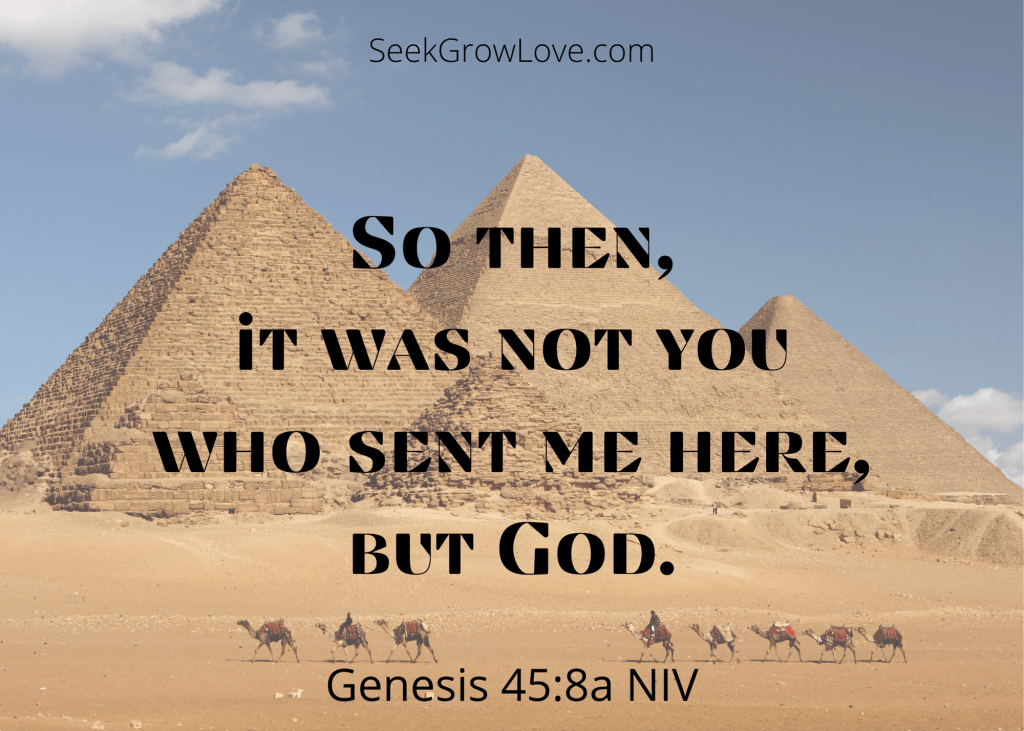
In this 45th chapter of Genesis, we see Joseph revealing his true identity to his brothers. We know he had risen to a very prominent position of power as second in command of Egypt. The stage could have been set for him to get the “perfect revenge” against his brothers. We read in verse 5 right after Joseph reveals his identity to his brother: “And now, do not be distressed and do not be angry with yourselves for selling me here, because it was to save lives that God sent me ahead of you.” I find it especially poignant that not only does Joseph not want to exact revenge in this situation, he actually chooses to comfort his brothers in this moment rather than “giving them what for.” We know from earlier scriptures that Joseph was clearly hurt by their previous actions, but he wants to spare them the hurt of being angry with themselves or beating themselves up because of their actions. He points them to an understanding of God’s sovereignty and that they were players in God’s plan. 

How differently that 45th chapter of Genesis could have played out if Joseph had been bent on vengeance. Instead, we see the true beauty and power of forgiveness and a reminder that God is in control even in the midst of our darkest hours. 

If we choose to be consumed with anger or self-pity, we miss the important lessons God is trying to teach us. We read in Romans 8:28, “And we know that in all things God works for the good of those who love him, who have been called according to his purpose.” Perhaps the answer in those dark times is to focus on loving God even more deeply and purposely than ever before.

-Kristy Cisneros

Questions for Reflection and Discussion


1) When you encounter hardships and tragedies, does your attitude reflect one of unwavering faith in God? If not, how can you further nurture and strengthen that faith so that it is at the ready when life’s storms come your way?

2) What action can help us love God more deeply and purposely than ever before?

3) What other lessons can you learn from the story of Joseph?

God is Working

Genesis 37

February 5

In our lives we all have dreams. We have plans and wishes that we hope and pray will come to pass someday.

Joseph is born, the son of Jacob, favored by his father over his other siblings. Jacob was the golden child if you think about it. He was hardworking, honest and kind. That is why his brothers hated him so much. Joseph reported his brothers wrong doings to his father, which made his brothers see him as a snitch. But the fact that their father, Jacob, loved Joseph more made their hatred even worse. Joseph was a young man of integrity, blessed by God with dreams of leadership and prosperity. These dreams and hopes brought jealously from his brothers. Because of this, his brothers set out to get rid of Joseph by selling him as a slave, where Joseph went through many hardships. Regardless of how tough things got for Joseph, he kept his faith, and God’s plan was brought to the light.

Even though Joseph’s brothers were in the wrong for their actions, Joseph also acted in pride when he went and talked about his dreams. We all have our short comings, but what matters is that we learn from them and let God rule our lives.

Joseph was called by his brothers, “the dreamer”. But because of their cruelty, he became a slave. He went through challenges. But because of Joseph’s faith, his struggles turned into blessing.

We can often be slaves to our temptations and sins. We get sidetrack by the things in our lives. The thing is, that when we really look at it, we choose what we let rule our lives. We have the power to move mountains with God on our side. God is working in us, our lives, and our world. Even in the struggles, he is working.

God has a plan for every one of us. That doesn’t mean it is going to be easy and without hardship. It does mean however, that we are going to receive God’s promises through our struggle, and it is going to be better than anything we ever expected or imagined.

-Hannah Eldred

Questions for Reflection and Discussion

  1. What in your life are you struggling through, or what temptation are you facing?
  2. How can you use your situation to grow?
  3. What is your dream for your life? How do you think God can use that?

Tomorrow we will read more of Joseph’s account in Genesis 45.

The Blessing With a Price

Genesis 27

February 4

This Bible story is one of the classics, and I am happy to revisit it because when I was younger, I had no clue what the moral of the story could be. Genesis 27 features Isaac, now old and blind, his wife Rebekah, and his two sons Esau and Jacob. In his old age, Isaac realizes that his death is drawing nearer every passing day, so he instructs his eldest son Esau to go out and hunt some wild game to prepare for him in exchange for his blessing. As Esau goes out to hunt, Rebekah, having heard all this, instructs Jacob to fetch two young goats to make just the way his father likes it. She then proceeds to dress Jacob in Esau’s clothing and adorned the open parts of his skin with goatskins so that he can receive Esau’s blessing from Isaac.

Their plan ends up working as Jacob receives Esau’s blessing, and I remember thinking as a kid, “Well, that just doesn’t seem fair.” I had all sorts of questions fill my mind, and I was so distracted by this that I neglected the second part of the story as a kid. When Esau returns and learns that his blessing has been stolen, he does not respond in a very loving manner. He makes plans to kill Jacob! Rebekah learns of this and warns Jacob, telling him that he must flee until Esau’s anger subsides and he forgets what happened in the first place. The chapter comes to an end with Rebekah setting Jacob’s escape plan in action.

After some reflection, it’s no wonder I didn’t understand the moral of the chapter as a kid because it’s something we’re told all the time but doesn’t really click until you’re older and more experienced. This part of the Esau and Jacob story teaches us that our actions have consequences. Here, Jacob receives all the blessings from his father and is set up to live a successful life, but once his brother found out what he did, Jacob had to leave behind everyone he loved and all he owned to go somewhere unfamiliar to save his life. All the deception was for naught as Jacob had to give up his peaceful life at home to live in strange new lands with only the clothes on his back and supplies to get there. As we go throughout life, it is easy to forget that every little thing we do has consequences. They may be seen immediately afterward or they may even show up way down the line, but as a family of believers, we must hold one another accountable to ensure that our actions produce consequences that are pleasing to God and the life that he wants us to live.

-Austin Kizer

Questions for Reflection and Discussion

  1. Why do you think Rebekah wanted Jacob to receive Isaac’s blessing instead of Esau? What would you have done in Jacob’s position if Rebekah proposed this idea to you?
  2. Was Esau’s reaction justified or overboard? How do you think this reaction will impact Jacob and Esau’s relationship moving forward?
  3. Was there ever a time when you recognized the consequences of your actions? What did you learn from this experience? How did it impact similar situations later on?

Tomorrow we will be reading Genesis 37

The LORD Will Provide

Genesis 22

February 3

There are many different times that different people in the Bible confess their true faith. At the beginning of Genesis 22, God tells Abraham to sacrifice his only son. We see Abrahams’s true faith when he doesn’t protest or complain. He just does what God told him to do. I for one am very jealous of his faith. 

As Abraham was stretching out his arm to slay his son, an angel of the Lord called to him from heaven telling him to stop. Then, they heard a rustle from behind them and it was a ram. This shows us that God is with us and He will always provide a way. We just have to have faith like Abraham. I hope that we can all grow our faith in the near future and fully trust in Him.

-Nik Ransom (youth who attended reFUEL: North last month, and son of one of our writers two weeks ago)

Questions for Reflection and Discussion

  1. Take a moment and think about what you love most in life. Would you be willing to give whatever it is if God told you to? Would you give it up with or without hesitation?
  2. Abraham is known as a man of great faith. Why? What does James have to say about Abraham in the New Testament? (James 2:14-26) Is it possible to have great faith without action/deeds/obedience? How can we practice growing our faith?
  3. Re-read the account of Abraham willing to sacrifice his son Isaac while knowing what you know of God’s sacrifice of His son Jesus. What similarities do you find? What differences? What does this say of God’s sacrifice and love for you?

Tomorrow we will be reading Genesis 27.

Promises & Blessings

Genesis 12

February 2

The first thing I think we should recognize when reading Genesis chapter 12 are the six things that God promised Abraham. He told him to go to a land that He would show him. Secondly he told him he would make him a great nation. 


I believe the next two promises go hand-in-hand. God said, “I will bless you” and “ I will bless those who bless you.” It was important for God to let Abram know that he was going to bless him. There would also be those that would be an encouragement to him. 


At the same time there would be negative people that came along that were a source of discouragement. God promised that he would take care of those people. 


And lastly God told Abraham that he would give him the land. He was going to give him the land as an everlasting possession. 


Ultimately what I believe this means for us in life is we need to have the same kind of faith Abram had. Our faith as a whole should be based upon that kind of belief in God. 


Where I look at this text in a different context is this. I think we can apply these promises to our personal ministries. When God instills something in your heart that we feel He is calling us to do, we need to believe like Abram did that God is showing us what He would have us do.  


 I believe that just like God made Abram a great nation, we too need to have the kind of faith that believes that God is going to work mightily in our ministry. I’m not saying that we will be great but that God will do great things through us.


I believe following our heart and believing those first two promises are so important, but don’t fool yourselves. There will be both positive and negative people that come along in your ministry. Keep yourself focused on the positive people in ministry and ignore the negative. Don’t let the naysayers discourage you into quitting what you wholeheartedly believe God has called you to do. 


In the end when we listen to God rather than men; we will find ourselves hearing the words that we all want to hear, “Well done, good and faithful servant; you have been faithful over a few things, I will make you ruler over many things. Enter into the joy of your lord.” (Matthew 25:23 NKJV)


As a result of our faithfulness; Abraham and all of the faithful together will see the fulfillment of God’s last promise. We will be given the land as an everlasting possession. Thank you God for that promise and may God richly bless each and everyone in your ministries.

-Rick Eldred

Questions for Reflection and Discussion

  1. What directions did God give to Abram before the promises? Do you think the promises will only come to Abram if he follows the directions God gave?
  2. What have you already left behind to go where God leads? What were the results (or maybe they are still in progress and hard to see)? Where may God be asking you to go? What may He be asking you to leave? Pray for God’s direction and guidance, as well as your own obedience.
  3. “I will bless you…and you will be a blessing” – God (Genesis 12:2). What blessings has God given to you? How have you used what God has blessed you with to be a blessing to others? What can you do to spread that blessing further this week?

So He Did

Genesis 6

February 1

Many of us know the story of Noah and the flood.  The earth was full of sin.  Noah was commanded to build an ark because God was going to wipe out all the earth.  Animals came two by two to enter into the ark which Noah had built.  It rained for 40 days and 40 nights.  At some time Noah sent out birds to see if the land was dry.  The dove returned with an olive branch or a freshly picked olive leaf, depending on what version of the Bible you are reading.  Noah and his family and all the animals went off the ark.  God promised to never destroy the whole earth with floods again and made the rainbow a sign of this promise.  But, there is more to the story than just this.

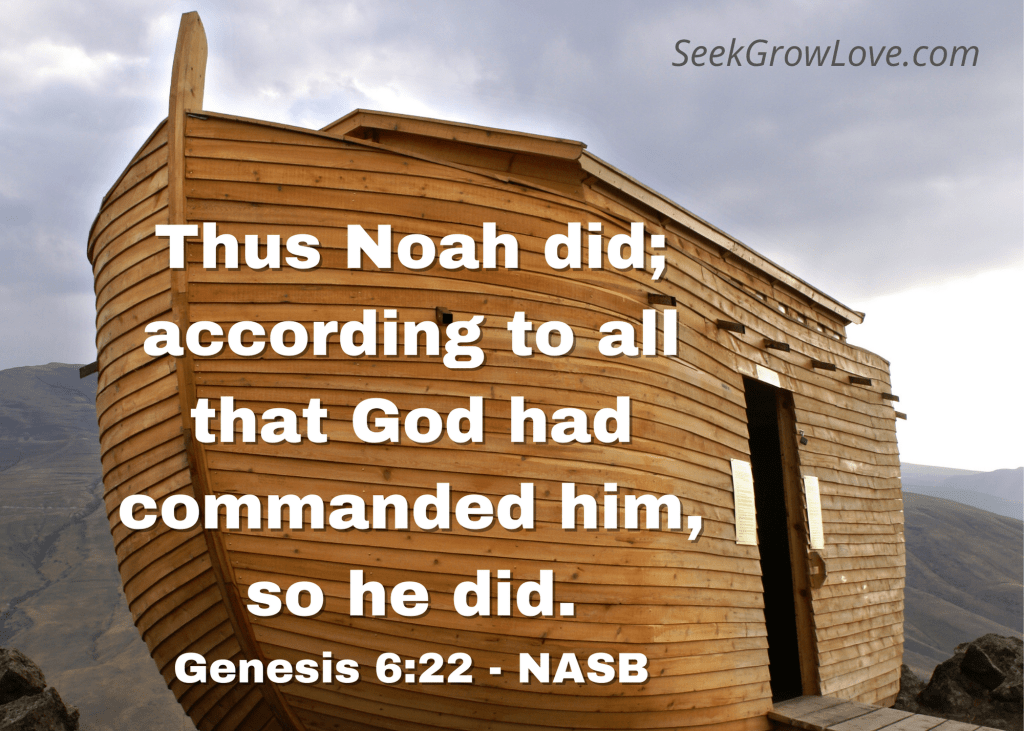
When we read the story of Noah and the flood, we see that Noah built the ark just as he was commanded.  Have you ever taken the time to imagine what would have happened if Noah had just said no?  What about if he had decided he would only take the animals he liked with him, leaving animals like mosquitoes, spiders, and snakes off the ark?  What if he had decided he knew a better way to build an ark than the way God told him?  But Noah didn’t.  We are told in verse 22 that “Noah did; according to all that God had commanded him, so he did.”

Noah built the ark exactly as he was told.  He built it out of gopher wood and covered it inside and out with pitch.  Noah made the length, breadth, and height of the ark exactly as he had been commanded to do.  He put the window and door at the exact location, which God had commanded him to.  Noah did everything according to what God had commanded him.

Not only did Noah continue to do everything as God commanded, which is difficult enough by itself, he also did it all while the earth was filled with corruption.  Noah spent years obeying God, building the ark, while he was living in a corrupt world. Not only did Noah build the ark while living in a corrupt world, he did it for many years, while the animals started coming to the ark, and the earth kept growing in its corruption.

We know that, in the end times, our world will be as corrupt as the world was in Noah’s time.  Our world is already starting to look similar to Noah’s.  We have to obey God while living in an evil world and continue doing so, overcoming whatever the world puts against us.  The question is: When the time comes will you be able to obey God while living in a corrupt world, not losing faith, for years, just as Noah did?

-Kaitlyn Hamilton

Questions for Reflection and Discussion

  1. Do a little research on the ark. Did it look like the photo above? What were the dimensions? Measure out what those dimensions would look like in your yard, neighborhood, church property or playground. You may find some interesting information online, including from the Ark Encounter site (a life-size ark museum Answers in Genesis built in Kentucky).
  2. Since our 2022 SeekGrowLove reading plan only includes 105 of the BEST chapters from the Old Testament, tomorrow we will be jumping forward to Genesis 12, rather than finishing the rest of Noah’s story. But take a little time reviewing the rest of this account (through 9:17). What do we learn about God? What do you think God may have been thinking or feeling as he watched the destruction of the flood? What about as he watched the faithfulness of Noah and his family?
  3. God probably isn’t asking you to build an ark, but what does He want you to do? What directions has he given you to follow as you work on the mission He has given? How well are you following those directions? What obstacles are in your way? How can you better deal with them in order to stay on track with God’s work? What rewards are there for sticking with His tasks, even when they are really difficult? What happens if you don’t? What will help you become a person known for doing what God asks of you?