Generations

* Old Testament Reading: Numbers 20 & 21

Psalms Reading: Psalm 69

New Testament Reading: 2 Corinthians 6

In Numbers 20-21 we encounter the Israelites at the end of their journey as they wrap up their years in the wilderness and prepare to enter the promised land of Canaan. Unfortunately, before they do that, we see a purging of a generation of people who had rebelled, distrusted, and quarreled with themselves and with the LORD. In Chapter 14 God had instructed them that only Joshua and Caleb would enter the promised land, and now we see God was serious. In Numbers 20:1 Miriam dies, in verse 12 Moses is told he will not be entering the promised land, and by the end of the chapter Aaron is dead. No special privileges here for being a priest, a leader, or related to a special someone who “was a really good person most of the time”.

In recent years I’ve heard more and more talk about generations.  Terms like X, Y, Z’s, Millennials, Zillennials, Baby Boomers. All have their strengths and weaknesses, and since I fall right in-between two, depending where I am or what is being said, I might want to associate with one more than another. That is because there are stereotypes of generations, but none are always accurate nor are they particularly important or beneficial. No matter what, as a body of Christ, we are an intergenerational people, and research continues to show the benefits of multigenerational worship and education. The year of your birth simply does not have anything to do with who we are in Christ. What does matter is our faith in Jesus and being a follower of him. In today’s reading, we see a generation dying out who knew God, yet had managed to waste the better part of 40 years not doing much to please Him, but doing a great job finding things to fight and complain about. We are currently living in a world where fights and complaints are the norm, and also one where our life expectancy is dropping. Many people born in recent generations have a lower life expectancy than their parents did. We are on this earth for a finite time, and unless we live until Jesus returns, we will “rest with our fathers” the same way people have been doing since the days of Numbers.

But, the story of Numbers doesn’t just end with death and burials, and ours doesn’t have to either. Joshua and Caleb (and crew) did get to the Promised Land. And we see more symbolism again in this idea since Yeshua can be translated as Joshua in Hebrew (our OT character leading them to the promised land) and when translated into Greek/from Greek can be translated as Jesus (our NT character through whom we have hope of our promised land in the kingdom). There is lots more out there to learn about as far as name studies if that interests you which I’ve learned a bit more about through a friend who has “Yeshua is my king” stickered across his back window. I couldn’t help ask about that one the first time I met him!

Another thing I found interesting as I read Numbers 20-21 is that a lot of the pagan enemies they are fighting on their way to the promised land are their “relatives”. The Edomites come from Esau (who was later named Edom), the Moabites and Ammonites come through incestuous relationships through Lot, and for that matter, all of them go back to Noah’s three sons! But, it didn’t matter if you were a descendant of Abraham or a relative of someone who once believed in the one true God. The people who entered the promised land were those who trusted and relied on Him, humbling themselves to allow Him to lead. Everyone else who didn’t worship the one true God as he instructed them to, set apart and holy according to his expectations. . . they were enemies. It didn’t matter if they had heard YHWH, the God of Israel, was powerful and real and they were a little scared of him. It mattered if they honored and obeyed him, and they certainly did not. While family trees can be interesting, that is about all they are good for when it comes to things of eternal perspective. The fact that your great grandpa was an elder who walked 10 miles uphill to go to church every Sunday doesn’t matter, and whether or not your relatives called themselves Christians or you attended church as a kid does not matter for your future. What matters is that in your present, regardless of which generation you are from or how much longer you may have left on this earth, you humble yourself before God and let Him lead.  The wilderness surrounds us, but the promised land to come is real.

Yesterday I ended with a verse I really liked about Jesus being the sacrifice for sins for all of us, for the whole world for all time. No more sacrifices required, and we are cleansed and forgiven. That is beautiful and true. But, the verse immediately following is too. It tells us how God expects us to respond to that gift and is a good way to wrap up our studies in Numbers this week I think.

“And by this we know that we have come to know him, if we keep his commandments.” (I John 2:3, ESV)

-Jennifer Hall

Reflection Questions

  1. What did this Israelite generation have going for them? What were strikes against them? What most important thing did they keep forgetting?
  2. Right now, this week, have you been more like Joshua and Caleb – intent on trusting a great big God who saves and will lead you into the Promised Land – or the generation that will not survive the wilderness – losing sight of God’s greatness as you focus instead on complaining, arguing, living in fear and negativity and quarreling with the Lord? Are there any changes that need to be made starting today?
  3. What does God reveal about Himself in the passages we have read from His Holy Word today?
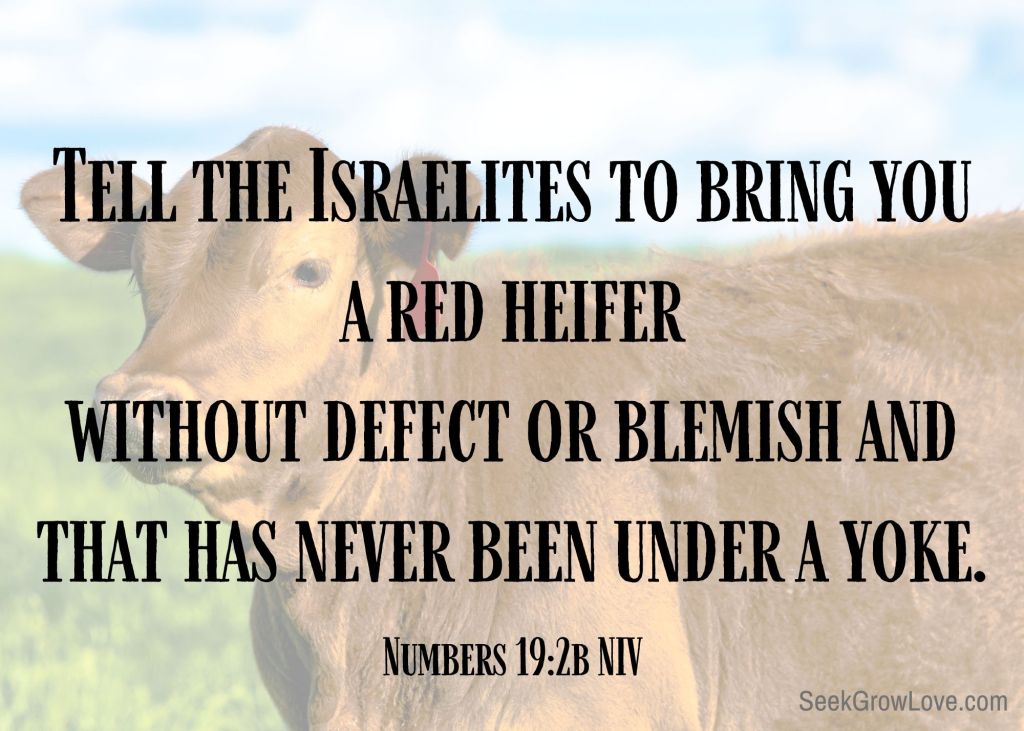
The Red Heifer

*OLD Testament Reading: Numbers 18-19

Psalms Reading: Psalm 68

New Testament Reading: 2 Corinthians 5

Numbers 18-19 continue laying out God’s specifics for his tabernacle with things like priestly duties, purification procedures, and one topic covered in detail in Chapter 19 is the sacrifice of the red heifer. This sacrifice is unique from others, and worth taking the time to look at a bit. The sacrifice of the red heifer was different than other animal sacrifices laid out in the law of Moses.

For one, this was a female animal instead of male. Also, this one was to be slaughtered outside the camp, burned in all of its flesh and blood (and dung!) with a few specific additions to the fire including cedar, hyssop, and scarlet wool. (Interestingly, I realized that I now have some hyssop popping up that I planted last year, and I added cedar shavings to the garden this past week. But, no scarlet wool and no red heifers around here!).  It seems this sacrifice was extremely specific and unique, and definitely similar to some things we see in Jesus’s sacrifice for us. If you want to read more about the symbolism and foreshadowing from the red heifer to Jesus, it is certainly out there. And, without looking too hard, we can definitely see connections including Jesus being killed in all of his flesh/blood outside of the temple, being perfectly flawless, being offered hyssop on the cross, being a sacrifice for our sins the way the red heifer was for the Israelites, etc., etc.

Evidencing that Old Testament stories are still relevant for us today, according to the Temple Institute, five blemish-free red heifers from Texas arrived in Israel in September 2022. Some view this acquisition as a step forward to the functioning of the new temple and related to Bible prophecy. No matter what, it is interesting to see how this reading from Numbers is still related to current events, and humbling to think what Jesus was willing to sacrifice for all of us.

“My little children, I am writing these things to you so that you may not sin. And if anyone sins, we have an Advocate with the Father, Jesus Christ the righteous;  and he himself is the propitiation for our sins; and not for ours only, but also for those of the whole world.” (I John 2:1-2, NASB)

-Jennifer Hall

Reflection Questions

  1. How was Jesus’ sacrifice different from the red heifer sacrifice – and different from all the other Old Testament sacrifices? What do all these sacrifices have in common?
  2. What can we learn about God through our Bible reading today?

Tabernacles of Yesterday to Tabernacles of Tomorrow

Old Testament Reading: Numbers 16 & 17

Psalms Reading: Psalm 67

New Testament Reading: 2 Corinthians 4

Today’s reading of Numbers 16-17 takes us back to the time of the Old Testament tabernacle which is super relevant to what comes later in the New Testament since the Bible is woven together from beginning to end. At this time, the tabernacle was a physical structure in the middle of the camp with the 12 tribes of Israel camped around. And there were some special rules/regulations regarding the tabernacle. Things like only the Levites could hand carry the ark of the covenant (versus toss it in the ox-cart and hope for the best), there were specific offerings at specific times and places, burning incense, priests had certain duties, the High Priest had a sacred role, etc. Given the expectations were literally put in place directly by the LORD himself, it seems unlikely that it was without reason or design or something to ignore. But, today’s reading starts with 250 Israelites fighting against the rules stirring up more rebellion like we see time and time again in them. . .and in us. Unfortunately, these were God’s rules set by his sovereign design, and as we know well, the Israelites, just like us, simply do not know as well as God does. So, God cleared things up for them. It involved a plague, a fire from heaven consuming some, and men falling facedown before Him, but His way was known.

Some of the OT readings about the tabernacle and all the details used to be areas I kind of avoided.  (Though to be fair, if you started telling me about the dimensions of your house and every piece of home décor, I would also likely find myself checking out). But, this past year I had a friend share some of a study she was doing about the symbolism of the tabernacle (and all its little details) and its foreshadowing to Jesus, and it was very interesting. The story of the Old Testament tabernacle definitely seems symbolic to the arrival of the Messiah and the promise of the coming tabernacle of God that one day will descend from heaven to earth. A place where those who are followers of Christ will finally be able to dwell with the LORD and His son.

Revelation 21:3 (ESV)

And I heard a great voice out of heaven saying, Behold, the tabernacle of God is with men, and he will dwell with them, and they shall be his people, and God himself shall be with them, and be their God.

-Jennifer Hall

Reflection Questions

  1. What do we learn from Numbers 16 & 17 about who God chooses? And what should our attitude be towards those he chooses for leadership?
  2. What do we learn from our reading today about the Lord God?

I Am the LORD your God

Old Testament Reading: Numbers 14 & 15

Psalms Reading: Psalm 66

New Testament Reading: 2 Corinthians 3

Today’s reading in Numbers takes us back to the scene of the Israelite crimes of complaining, grumbling, and not trusting God. If you have been reading in Numbers at all this week, you will know we’ve seen plenty of these in action already, and Numbers 14-15 is full of plenty more. It is interesting to consider that it’s not like the Israelites’ negativities had been ignored or that they were serving them well up until now. It had been the complete opposite, and there had been plenty of consequences already. Smitten with a plague with quail still in their teeth, a fire sent down from the LORD, Miriam struck with a leprous disease, delayed travels in the desert, etc. Yet, the Israelites were at it again.

In verse 3 we see a phrase that I am guessing hits close to home.  “Why did the LORD…?”.

In this case, the Israelites weren’t asking, “If the LORD is real, why did he….” They knew he was real and didn’t doubt that. But, as believers in the LORD, like us, they struggled to trust Him when things were tough and when they couldn’t see what our sovereign God knows. They focused on their doubts, worries, discomforts, and did not humble themselves and rely on God who had told them what His plans were for them. Along the way, things were hard. It is a broken, imperfect world full of problems just like the desert wilderness. Sometimes they are beyond our control. Sometimes they are because of our attempts to control. Enemies are real. Plagues and diseases are still a thing. Sin is rampant. But, while problems can seem to prevent us from seeing anything else sometimes, even then, we have an all-powerful, all-knowing, perfectly loving Father taking care of us through it all.

 And so did the Israelites. Reading further in chapter 14 we see Moses, Aaron, Caleb, and Joshua seeking to follow God even through the difficulties, and encouraging others. We see the LORD forgiving when asked in verse 20, and eventually, some Israelites did get to the promised land! Canaan still had some problems as far as promised lands go, but the promised land awaiting us in the coming kingdom of God is one without tears, sickness, and sorrow. Nothing to grumble and complain about at all.

Let us trust God to know best since compared to Him . . .we know a lot less! I like the last verse in Numbers 15  to help facilitate trust, love, and honor toward God. Even in the hard stuff.

 “I am the Lord your God, who brought you out of Egypt to be your God. I am the Lord your God.”

(Numbers 15:41, NIV)

-Jennifer Hall


Reflection Questions

  1. Seriously consider your own negativity. In what situations, and toward whom, do you find your negativity festering or exploding? How is this affecting your relationship with others and with God? Spend some time talking to God about this problem and what you can do to improve.
  2. How has the Lord shown Himself – and His desire and supreme qualifications to be your God – in your life thus far? What has He brought you out of? (Numbers 15:41)? What has He brought you into? Trusting in Him, what is yet to come?
  3. What do you know about the Lord your God because of your reading in His Scriptures today?

Be Humble

Old Testament Reading: Numbers 12 & 13

Psalms Reading: Psalm 65

New Testament Reading: 2 Corinthians 2

In the Numbers 12-13 reading today we start with what appears to be some sibling rivalry.  Miriam and Aaron are sharing some negative murmurings about their brother Moses (verses 1 and 2) in what appears to be some pride or opposition to his leadership.  Years after watching him float down the Nile river in a basket to safety to later lead the Hebrews out of bondage in Egypt,  Miriam now sounds envious. But, while she and Aaron are whining for attention, verse 3 indicates quite a contrast in Moses.  Moses was more humble than anyone on the face of the earth!

In this case, the word used for “humble” is a Hebrew word used of Israel itself many times in the OT, suggesting someone who is “poor, lowly, meek, depressed in circumstance, may be oppressed by rich and powerful. “

But, it appears that the LORD, who of course heard everything Miriam and Aaron said and thought, was displeased with what was in their heart. He rebukes their attitudes and speaking against His chosen servant. Miriam ends up with a leprous skin disease, banned from the camp for 7 days, and caused yet another bump along the road of the Israelites’ pursuit of the promised land. But, there was forgiveness and the chance to move forward, and in chapter 13 we find the Israelites starting to explore Canaan.

This story seems an example of  what we see in Proverbs 3:34:

Proverbs 3:34, ESV: Toward the scorners he is scornful, but to the humble he gives favor.

Miriam and Aaron in all their human efforts to be recognized, putting down others along the way, ended up chastised and scorned. Moses was in God’s favor. And while the definition we read of the word humble doesn’t sound all that appealing in some ways, God’s favor certainly does. We know verse 3 commends Moses for his humility, and as we seek to find God’s favor, it seems evident that being humble, lowly, and meek are crucial.

Numbers 13 starts with the exploration of the long-awaited Canaan, and in fact they finally saw the milk, honey, and fruit! But, they also saw the. . . men of great size! Forget that milk and honey! Did you hear about all those “-ites” mentioned in verse 29? And so, they spread some bad reports, show fear, and felt like grasshoppers in comparison.  But, of course the LORD is not a grasshopper, and the LORD had told them where they were going, so we’ll have to keep reading this week to see what happened.  And if you are looking for an interesting topic to study, check out the various thoughts/research available on the Nephilim mentioned in verse 33. Pretty interesting stuff!

-Jennifer Hall

Reflection Questions

  1. Who do you know who could be added to the list of most humble?
  2. How would you rank yourself on the humility/pride meter? What can you do to improve (lower?) your score? What is hardest for you about taking a lowly, meek attitude?
  3. What are God’s views and actions toward the humble and the prideful? What else do you learn about God in your reading today?

The LORD is God

Old Testament Reading: Numbers 10-11

Psalms Reading: Psalm 64

New Testament Reading: 2 Corinthians 1

Continuing in our Old Testament reading of Numbers 10-11 today, if you happen to have a silver trumpet handy feel free to get it out. For that matter, if you really want to act out Numbers 10, grab your hammers and make two trumpets of silver because this passage starts with a blast -remembering that the LORD is God.

In the reading yesterday we learned how the Israelites happened to be traveling around at this time in the wilderness. If the cloud above the tabernacle moved, they moved. If it settled, they stayed. In Numbers 10:12, the cloud lifted and the Israelites headed out. From one desert to another, landing in the Desert of Paran this time.  There they made some plans, divisions, and ended with rest.

Numbers 11 starts to get a little uglier. Whining, grumbling, hunger for meat (or “intense cravings” mentioned in verse 4), a consuming fire at Taberah, and even wanting to go back to lives as slaves in Egypt?! The people were displeased. The LORD was displeased with them. Whining kids are just the worst. I deal with a lot of kids at work, I was a kid, and I have a kid. There is something about the hideous voice decibel, the facial expressions, the drama, ungrateful, self absorbed nature of whining that makes us cringe. In this story it also made God “singe”!  If we complain in our head, God knows it. If we whine in a whisper, God hears it. If we blast a nasty social media post, God sees it. And, the LORD is displeased.

Moving beyond the grumblings in chapter 11, verses 21-23 remind me a little bit of the doubting we see prior to the miracles of feeding the 4000 and 5000 in the New Testament. Would all the fish in the sea be enough Moses wondered? The LORD answered clearly in verse 23, and in verse 31, approximately 3 FEET of meat rained down from the sky for an area as wide as a day’s walk!  Umm, yes, it was enough. He is enough.  Trouble was, the Israelites hadn’t thought so, and this chapter ends with a consequence for that.

Interestingly, tonight starts Purim which is a day when the Jews do various things to remember the story of Esther. Because of that, I found myself thinking of some connections between Esther and this reading.  In the story of Esther the “bad guy” is Haman, likely a descendant of the Amalekites…..an Arab tribe that lived in the Desert of Paran where the Israelites hung out in today’s reading.  Kinda interesting. Also, yesterday’s reading ended with instructions on Passover remembering the story of God’s provision saving the Israelites through the exodus, and Purim is a day remembering the story of God’s provision saving the same people through Esther.  Plus, Esther lived in royalty not known as a Jew initially, similarly to how we see Moses starting his life as prince of Egypt.

Whether we read Numbers, Esther, or something else, we can remember that the LORD is sovereign, He wants us to remember Him, to trust Him, and to be set apart for Him.  And if you want to look up some fun Purim ideas, there are plenty. At our house tomorrow in fact, I’ll have a “Girls Bible Club” of little ladies blowing noisemakers when they hear Haman’s name, eating Hamantaschen, reading the story of Esther. . . and hopefully. . . not complaining!

-Jennifer Hall

Reflection Questions

  1. What do you find yourself whining, grumbling or complaining about? What might God be thinking or feeling or even doing as a result of your whining/grumbling/complaining/bad attitude?
  2. What are some of the things the Israelites were forgetting when they were grumbling? How could a better memory help us complain less? What can we do to boost our memory?
  3. What has God shown about Himself in today’s reading? What do you learn about the length of His arm?

Set Apart But Connected

Old Testament Reading: Numbers 7-9
Psalms Reading: Psalm 63
New Testament Reading: 1 Corinthians 16

Today’s Old Testament reading takes us to Numbers 7-9 where we see the LORD speaking to Moses laying out some specific plans he has for how they are to live, worship, and remember Him.  Around 70% of the Bible contains the Old Testament, and it seems that the more I study the Bible, I continue to be struck how much the Old Testament foundation is integral to appreciating things that come later in the New Testament.  I definitely find that to be the case in today’s chapters.

Starting in Numbers 7:1, we find Moses at work,

“When Moses finished setting up the tabernacle, he anointed and consecrated it and all its furnishings. He also anointed and consecrated the altar and all its utensils.”

So, we have a good “churchy” word here in bold, and while I undoubtedly could have spelled it in third grade (spelling bees were my thing back in the day!), I realized I wanted to research a little more because if you asked me to define it today, I’d  start with “kinda like. . .umm. . .”, and this word comes up a lot in this passage!

Consulting my exhaustive concordance and Bible dictionaries, I see that simply put,

consecrated = set apart

In Numbers 7 we see a tabernacle set apart, offerings to the LORD set apart, and in Numbers 8, Levite priests set apart. In Numbers 9 the trend continues with instruction to keep days set apart for Passover. Interestingly, these days are specifically remembering the time when the LORD set his people apart from the Egyptians.

The Old Testament stands apart from the New Testament separated by ~400 years of history. Yet, they are extremely connected. The Israelites were instructed to be set apart from the world that surrounded them, yet connected to the LORD. The being set apart idea doesn’t stop in Numbers or the Old Testament, but continues as instruction for all of us as followers of Christ today. In fact, the idea of a consecreated, set apart people continues until the very end of Revelation.

Our reading today ends in Numbers 9 with a beautiful picture of the LORD’s consecrated people being set apart and relying on His leading. How many people can say they followed a cloud that appeared like a fire by night, and if the cloud descended they stayed/camped, and if it ascended, they went out? This certainly wasn’t a practice of the world around them, and I don’t know anyone today who camps that way.  Instead, Numbers 9:15-23 shows a unique, called-out, set-apart experience of obedience to our sovereign LORD. One that required patience and was beyond their understanding (check out the casual mention of waiting for the cloud to move for a year in verse 22!). 

Wouldn’t our lives be so much better if we trusted God more, followed His leading, and invested our energies in being wholly His.  We would look set apart and we should look set apart, and we need the practice because one day it will be essential to be set apart when the Tabernacle described in Revelation comes on the scene!

“At the command of the LORD the sons of Israel would set out, and at the command of the LORD they would camp, as long as the cloud settled over the tabernacle, they remained camped.”  (Numbers 9:18)

-Jennifer Hall

Reflection Questions

  1. Are you set apart from the world? If so, how? Do you think God would like to see you more set apart than you are now? What might that look like? What would it require?
  2. Are you connected to the LORD? If so, how? Do you think God would like to see you more connected to Him than you are now? What might that look like? What would it require?
  3. How do you see God in your reading of the Scriptures today? What would you have missed if you hadn’t read His words today?

Never Be Shaken

* New Testament Reading:  1 Corinthians 15
*Psalms Reading:  Psalm 62
Old Testament Reading:  Numbers 4-6

At first glance, the obvious place to focus today is 1 Corinthians 15 (The Resurrection Chapter).  It even says that it is of first importance – Christ died for our sins, he was buried, he was raised on the third day.  Our hope of eternal life in God’s kingdom is based on Jesus’ resurrection.  This chapter is a biggie and I really hope you read it and take to heart all God has to say here.  This chapter also has some wonderful verses that could be whole devotions individually. 

  • Verse 33 – Do not be misled: “Bad company corrupts good character.”
  • Verse 52b – For the trumpet will sound, and the dead will be raised imperishable, and we shall be changed. 
  • Verse 58 – Therefore, my beloved brothers, be steadfast, immovable, always abounding in the work of the Lord, knowing that in the Lord your labor is not in vain.

But, Psalm 62 has personal meaning to me, so I want to focus today’s devotion here.  There was a time when I experienced the betrayal of a very close friend.  I knew bad things were said about me and lies were spread.  I desperately wanted to counter them; to defend myself and prove my character.  I wanted to prove them wrong, and in doing so, make sure others knew their wrongs (sounds like revenge to me).   I had the opportunity to have a few days of solitude at that time and God brought Psalm 62:7 to me, “My salvation and my honor depend on God”.  I was convicted that I didn’t have to defend myself.  God would defend my honor if needed, and He did.   I only needed to concern myself with what God thought of me, not other people.  That became a life verse for me over the next few years.

The rest of this Psalm also lifted me up at that time. 

Verses 1 & 2 brought me peace and hope.  My world had been shaken, but my faith and my standing with God was not. 

Truly my soul finds rest in God;
    my salvation comes from him.
Truly he is my rock and my salvation;
    he is my fortress, I will never be shaken.

Verse 8 gave me a place to vent, to question, to rant (I knew God could handle it). 

Trust in him at all times, you people;
    pour out your hearts to him,
    for God is our refuge.

God helped me walk a path that didn’t come naturally.  In doing so, He also revealed His goodness as He protected me from me – from seeking revenge hidden in the cover of defending myself.  Once God had my attention and knew that I was following His path, He also helped me to forgive.  I know that isn’t in this passage, but it is.  It’s in every passage.  The whole of Scripture is showing us how to be restored to a relationship with God.  That is found in Jesus.  In his death and resurrection.  He died for me.  He died for you.  Because we need forgiveness.  Therefore, we need to forgive. 

-Todd and Amy Blanchard

Reflection Questions

  1. Is there someone you need to forgive?  Is there someone you need to ask forgiveness from?  Make the choice to forgive today.  You may need to make that choice daily for a while but, I promise you, it is worth it. 
  2. If you need to find rest (verse 1), you may need to find a place where you can silence all of the noise, the voices, the distractions of life.  Rather than try to make sense of things, just believe.  Rather than trying to do, work, or act, be quiet and listen.  Rather than go your own way, choose to go God’s way. 
  3.  What character trait of God do you need to hold onto today? 

Stay in the Shelter of the LORD

New Testament Reading:  1 Corinthians 14

*Psalms Reading:  Psalm 61

Old Testament Reading:  Numbers 1-3

I really enjoy a good thunderstorm.  Sometimes in the spring and summer in Minnesota we can watch the sky turn dark and see and feel the lightning and thunder.  I find it incredible, and it causes me to praise God for his awesome power and might.  I should clarify, I enjoy it when I am in the safety of my home.  If you have ever been trapped outdoors during a powerful storm it is amazing how weak and helpless you can feel.  The first four verses of Psalm 61 remind me of a time when that happened.

Hear my cry, O God,
    listen to my prayer;
from the end of the earth I call to you
    when my heart is faint.
Lead me to the rock
    that is higher than I,
for you have been my refuge,
    a strong tower against the enemy.

Let me dwell in your tent forever!
    Let me take refuge under the shelter of your wings! (ESV)

Amy and I were out fishing in Canada when a powerful storm swept in out of nowhere.  Being outside in a thunderstorm is scary enough but being in what amounts to a 16-foot aluminum lightning rod brings it to a whole new level.  We were far enough from camp when the storm started that I knew we couldn’t make it back before the serious weather hit.  In the middle of the lake, you are the tallest thing, especially if your wife is short.  As it turns out, what we did is not advised but it worked out for us.  We headed toward shore and pulled the boat under a large rock overhang and waited out the storm.  It was still nerve wracking but being protected under that large outcropping gave a feeling of safety and security that would not have been found had we stayed in the middle of the lake.  It’s good to know that in the storms of life, the only safe, reliable shelter is the rock that is higher than I.  Our God is a strong tower against the enemy that we can take refuge in.  Once we are there, verse 4 should be our heart’s cry:  Let me dwell in your tent forever!  Let me take refuge under the shelter of your wings!

-Todd and Amy Blanchard

Reflection Questions

  1. Has there ever been a time in your life when you felt very near to God?  What were the circumstances that brought you there?  Are you still there?  If not, why?
  2. Unfortunately, often we are closest to God when we are in dire circumstances.  What can you do to find/maintain that closeness with God in your everyday life?
  3. How did God show himself to you today?

The Most Excellent Way

* New Testament Reading:  1 Corinthians 13
Psalms Reading:  Psalm 60
Old Testament Reading:  Numbers Introduction – see below

1 Corinthians 13 (The Love Chapter) actually begins at the end of Chapter 12 with these words, “And now I will show you the most excellent way.”  Paul has just wrapped up his lists of Spiritual gifts, reminding us that we, as Christians, are all members of the body of Christ.  After telling us that we should desire the higher (more essential or useful) gifts, he states that there is an even better way to be useful to the body.  The most excellent way. 

Chapter 13 begins with an IF.  IF I am great, IF I can do great things, IF I can understand great things, IF I make great sacrifices…. 

What are you really good at?  Known for?  Everyone in our church knows Todd is phenomenal with numbers.  He has often said it’s too bad he can’t make a living impressing people with his quick math skills.  Everyone is good at something, but that might not matter in the big picture.

The IF part in the first three verses is followed each time with “but have not love”.  You can be the greatest at everything, but if you don’t have love you are “a noisy gong or a clanging cymbal”, “nothing’, “gain nothing”.  That’s pretty powerful.  What motivates us to do what we do obviously matters a great deal.  Paul is trying to communicate with us the overriding importance of love. 

You’ve probably heard verses 4-8a read at a wedding.  A beautiful description of how to love.  One that we cannot fully accomplish in our humanity.  Pulling from different translations, here is the description of true love:

Love is:  patient; kind; rejoices with the truth; bears all things; believes all things; hopes all things; endures all things; it always protects, trusts, hopes, and perseveres; it never ends or fails. 

Love is not:  it does not envy or boast; it is not arrogant, proud, or rude; it does not insist on its own way; it is not self-seeking; it is not easily angered; it keeps no record of wrongs; it is not irritable or resentful; it does not rejoice at wrongdoing.

Love won’t end.  Spiritual gifts, and our need for them will end.  Prophecies will end.  Speaking in tongues will end.  Knowledge will end.  Love will not end. 

Keep in mind as you read these lists that God loves us like that.  God loves YOU like that.  John 13:34-35 says, “A new command I give you: Love one another. As I have loved you, so you must love one another. By this everyone will know that you are my disciples, if you love one another.”  We are to love others how God loves us.  It’s what shows the world we are His.

-Todd and Amy Blanchard

Reflection Questions

  1. Do you KNOW that God loves you with a love that is described here?  Do you FEEL His love?  What steps might you need to take to assure yourself of that love?
  2. On a scale of 1-10, how well do you love others (following the description of love in this chapter)? 
  3. Which of the “Love is” or “Love is not” traits do you see from God in your life right now?

NUMBERS INTRODUCTION

The book of Numbers gets its name from the census that was taken both at the beginning of the book, while the Israelites were still at Mount Sinai, and also at the end of the book, when the Israelites were on the plains of Moab near Jericho 38 years later.  And in case you’re wondering why it took the ancient Israelites so long to travel from Egypt to the Promised Land, you’ll find out in chapters 13 and 14.  And by the way, this wasn’t just a small group of people walking through the desert – there were millions of them.

As you read through Numbers, you will see repeatedly that there are consequences for complaining and rebellion – and they aren’t good.  Punishments range from fire from the Lord to the earth swallowing people alive to plagues to snakes.  There will even be punishment for Moses’ striking a rock instead of speaking to it – because he didn’t obey God’s command.

You will read about Moses begging God repeatedly to spare the people, when God wanted to wipe them out because of their rebellion – reminding us of what Jesus is doing on our behalf in heaven right now.  You’ll also read about a bronze snake lifted up on a pole, which Jesus compared with himself.

The story of Balaam and his talking donkey show that God can use anyone, even a donkey, even me, even you.  You’ll also read about how Balaam told the Moabites what to do to cause God to curse Israel – even after Balaam had blessed Israel.  And you’ll read that he paid with his life.

Numbers is filled with excitement, and also with examples – both good and bad.  Paul tells us in 1 Corinthians 10:6, “Now these things occurred as examples to keep us from setting our hearts on evil things as they did.”  So pay attention as you read.

I’ll close with Numbers 6:24-26, “The Lord bless you and keep you; the Lord make his face shine upon you and be gracious to you; the Lord turn his face toward you and give you peace.”

-Steve Mattison