Don’t Just Skip It

Psalm 106-108

psalm-107-14-quote-lg

Friday, January 13

It’s amazing, when you love a book or a movie how much you can pour over it to soak it all in. In nerd culture, of which I am most decidedly a part, people discuss and debate and argue over things we find in the stuff we like. There are always questions as a matter of taste (changing something from book to movie form and how books have a 99.999% chance of being better). In the universes we love, there are strange theories. (Jar Jar Binks from Star Wars is a Sith Lord, or so some people say). There are even theories for Children’s Films (I personally believe that the Troll’s cursed Prince Hans into his betrayal of Anna in Disney’s Frozen.) While you may think these are dumb or take them super serious, they all hold something in common. The people who make up fan theories have poured over the source material so they don’t miss anything.
It’s hard to do this when we are reading through the Bible in a year, but the same thing happens in Scripture. When you know a general idea of the whole story, little details pop up that are fascinating. Notice that the children of the cursed Ham happen to be Egypt, a nation of oppressors, and Canaan, the ones God commanded the Israelites to kill. (Gen. 11) Today’s reading does the same thing. These verses are Psalm 108:7-9. I know I have tended to read them like this: “I will divide up [bad person/place], I will apportion [bad place]… Judah [I know that good place] is my scepter, [bad place?] is my wash basin.” You get the idea. But that is a sad way to read it. Don’t miss what God is trying to tell us.
—Shechem was a terrible man who did a terrible thing to a woman in Israel. (Gen. 34) God gave victory to the sons of Jacob over Shechem. God is saying I will divide up and give to my holy ones the land/wealth of the evil.
— The people of Succoth did not help Gideon, the valiant warrior of God. God gave victory to Gideon in multiple ways, one being humiliating the princes of Succoth and killing the men of their towns. (Judges 8) God will grant victory to his people over their enemies.
— By referencing Manasseh, Ephraim and Judah, God is saying that Both the Northern and the South Kingdoms are his. If David wrote this psalm, then it is a condemnation on the Northern tribes for breaking away from the rulers in Judah.
— Moab tried to stop Israel from dwelling in the Land God had promised to them and God struck them down. Edom also refused to allow Israelites to travel through their land.
— The Philistines (descendants of Egypt, according to Gen. 10) were what seems to be the arch-rivals of Israel’s claim on their ancient Land.
Just getting a small amount of information opens up so much about the text of the Bible. The truth is that it is good to read fast and cover a lot of material, but it is also good to read slowly and deeply and soak it in. Don’t let one overshadow the other, because if you read a lot it will help you read deeply. So, the next time you come to a list of names, or a bunch of cities, or weird visions, DON’T SKIP IT. Who knows what God expects you to find?
-Jake Ballard
(Photo credit: http://www.psalmsquotes.com/psalm-107-14-quote.htm)
He’s Not Abstract

Psalms 103-105

psalm-103-2-940x705

Thursday, January 12

If you attend a church (and I encourage you to do so), you probably hear prayer requests and prayers. Sometimes, in the interest of time, I have been known to say prayers and thank God abstractly for “all the good you have done” or “for another day of life” or something along those lines. In many worship services, the songs we sing tend to reinforce that kind of language as we talk to God. As kids we learn “Jesus Loves Me” and “Zacchaeus”, but these songs, while teaching us Bible stories and abstract truths, don’t make life real.
The psalmists don’t let things stay in the level of the abstract. They would think the way we think about theology is rather silly. We use big words like “omnipotent” (all-powerful) or “omni-benevolent” (all-good) to refer to God. The authors of psalms 103-105 are focused on the tangible ways God is working in the world, the concrete way he interacted, is interacting and will interact in creation. When you read psalm 104, the created order that is being displayed there is beautiful. It is a different look at creation, one that is intimate and yet shows God working in creation. He gives water even to a wild donkey. The dangerous and powerful leviathan is a work of God. The creation of trees and valleys all point to the wonder of the Almighty. Psalm 105 tells the work of God in the covenant people of Israel. The psalmist retells (probably with music) the great movement of God with Israel. The Exodus is such a significant moment, because God defeated the gods of the most powerful empire and proved that God is the only true God. He saved Israel and led them through the desert. In psalm 103, the author (David?) is speaking to his own soul when he says “He forgives all your sin”(3) and “he satisfies you with goodness” (5). The author is declaring his own story, that God saves him and gives him good things. Even though we are sinners, God takes care of us and makes sure we have all that we need.
The point is that when we praise God, there are times to tell of his “omni-“ qualities and there is a time to get down and talk about what he did. For me, God not only gives me love, but he has given me a wife that makes me laugh and makes my heart sing because she is wonderful in every way. He has given me a daughter that is fun, joyful and sweet. God gives me hope, and He assures me that though I have lost loved ones, that there will come a day that I will see them again. I praise God not just because he is loving or hope-giving in some abstract way, but because in my life and in the world God has clearly shown that he cares. He is a God that moves in concrete ways.
Live it Out Challenge: After you read the psalms, think of 7 concrete and specific ways God has worked in your life. Don’t make them abstract (“He loves me”) but make them concrete (“He has given me a wife and a daughter that mirror His love”). Make them about you, and take your time. Work and meditate on them all day if you need to.
-Jake Ballard
(Photo credit: http://www.spiritradio.ie/the-word-for-tuesday-psalm-1032/)

The Earth Cries Out

Psalms 96-102

psalms_96-1

Wednesday, January 11

The Appalachians are amazing. I grew up in the foothills of the Smokies and the Blue Ridge. On a clear day at the top of the hill you could see gracefully rolling mountains in the distance. If you live near the Rockies or even parts of Alaska, mountains in your imagination peak and may be white tipped year-round. However, in the imagination of a southern boy of the Carolinas, mountains are tree-covered rolling and majestic mountains. These are old and they feel even grander because of their age. I remember a time when I went hiking with some friends in the eastern mountains of North Carolina. We got to the top of the hike, and we could see the road cutting through the valley. The cars were smaller than toys; buildings, houses or stores were miniatures too small for a child and people were indistinguishable. However, the path they cut through the valley was noticeable. This was humanity’s doing.
The mountains, however, were the work of God. For miles, the green mountains, the golden-red sunset, the crisp, clean air, were the blessings and handiwork of a loving and caring God. And the mountains let you know it. The mountains “shout together for joy.” (98:8) The Psalmist knows well that creation praises it’s creator. When the author says “sing to the LORD, all the earth”(96:1) I have tended to read that one small phrase as a command to all the people. But just as importantly, he is telling ALL of creation to sing praises to God. The trees and the forest (96:12) resound with the praises of God, when they are displaying majesty in fall or even in the depth of winter when they are barren. The sunset over the mountain, or the sunrise over the ocean displaying the play of colors that God desires we all see in creation. (Or, on the more western states, the sunset over the coast.) Sometimes the glory God displays in the created world is not beautiful but terrifying. Darkness, like the inky blackness of night; fire burning up his foes; lightning striking the ground with thunder exploding and roaring all around, all these show the greatness of God.
In other places, it seems that creation because of it’s nature and the fact that it is nature, cannot help but show the glory of the God who created it. Jesus says that if those who were praising him (to the glory of the Father) were kept silent, that “the stones would cry out.” (Luke 19:40) But your worship isn’t. You must choose who you will worship. The author of these psalms we read show that God alone is worthy of worship and the created world, worshipped by other people in their world, worships YHWH. May we shout with joy along with the forest, the trees, the mountains, the rivers, the heavens, the depths, and all the earth. “Be glad in Yahweh, you righteous ones, and praise His holy name.” (97:12)
– Jake Ballard
(Photo credit: https://www.kingjamesbibleonline.org/Psalms-96-1_Inspirational_Image/)

Your Mind = Blown

Psalms 90-95

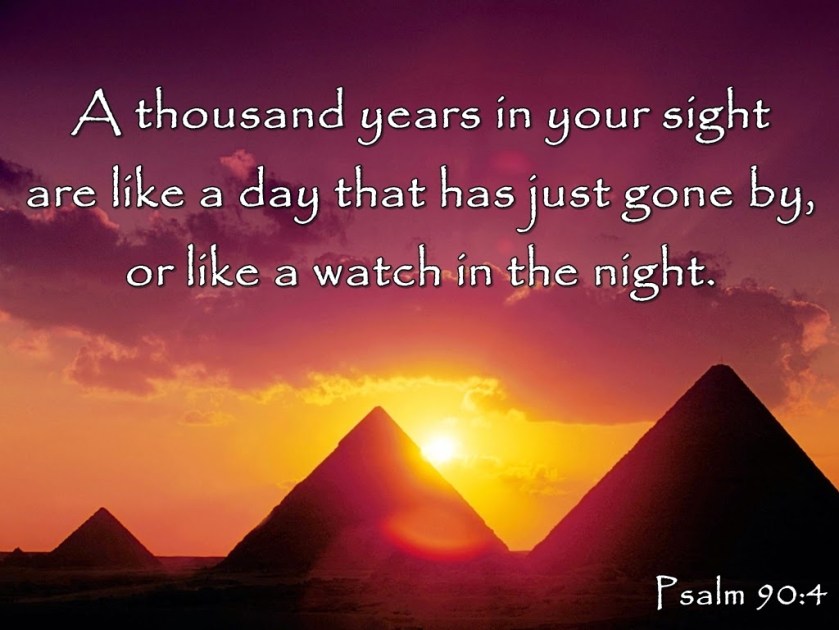
psalm-90v4

Tuesday, January 10

The universe is big. REALLY big. You know it and I know it, but I don’t usually stop and think about just how big it all is. I am not a whiz when it comes to science, but some scientists estimate that there is roughly 440 sextillion kilometers of space. I can’t even get my head around that number. When have we ever had to use sextillion to describe anything else? And this is all part of our observable universe, because we can’t see past a certain point for a variety of reasons. Therefore it is possible that the universe is INFINITE. Whoa. And if you really want to have your mind blown, in mathematics, we can learn that there are different sets or levels of infinity, meaning that some infinities are bigger than other infinities.
Now, if you are like me, you may need to take a moment to clear your head of all that big-ness. It is a lot to take in.
In the Ancient World of the Psalms, people thought of the world differently. The idea of an infinite universe would have been completely unthinkable. I won’t digress into their actual way of thinking about the world, but they thought space was limited to Earth. However, they had no such notion about TIME. Time, for the authors of the Psalms, was something that goes back forever and goes forward forever. Time is what the Earth will always experience and go through, and since Earth will experience it, so will people.
Psalm 90 is a big reminder that people are mortal, or that people are born, they live and they die. We all go through that process. Nobody that is can skip any portion. People “return to dust”, recalling the opening chapters of Genesis. The author uses a number of images to express what people are like; grass (90:5-6), a sigh or tale that is told (9). We are all a mist or a shadow, to use other metaphors in scripture. And the author even gives a longer estimate of life, because he says that we receive 70 or 80 years! But that is nothing in comparison to the world, to the sun, the moon and the stars.
And least of all to God. God is eternal; God does not suffer from the passage of time, God does not experience time as humans do, and some Christian thinkers even say that God is outside of time. The eternality of God is in beautiful contrast to the mortality of humanity. YHWH is God before the mountains were born or he gave birth to the world, from “eternity to eternity”.(90:1-2) A thousand years are like a day to the Almighty. (90:4) Just as your days pass by quickly, so do thousands of years for God, because he literally has all the time in the world.
Because of this we should rejoice! Not because we only have to endure a few decades of doldrums, but because we are connected to the God who reigns forever. Psalm 93 says “Your throne has been established from the beginning; You are from eternity.” God is praised for being the King, and the King forever. God’s holiness and beauty will be established for all the days to come (93:5). With all this in mind, it is understandable why the authors of the psalms would cry out “Come, let us worship and bow down; let us kneel before the Lord our Maker. 7 For He is our God, and we are the people of His pasture, the sheep under His care.” How amazing is it that the eternal, all-powerful, King of the Universe would want to be our shepherd. Let that truth sink in, and when it will, it will blow. your. mind.
-Pastor Jake Ballard
(Photo credit: http://hiswordinpictures.blogspot.com/2014/10/psalm-904.html)

No “Works Cited” In Prayer!

Psalms 85-89

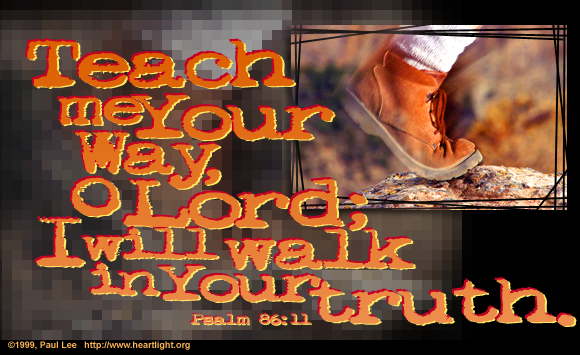
psalm86_11

Monday, January 9

Have you ever stopped to think about copyrighting? In our world, even words can be trademarked and copyrighted. For example, if I was going to start making a comic called “Superheroes of Scripture” (which would be awesome), I would be infringing on the trademarked word “superhero”, a trademark of Marvel and DC Comics. That’s pretty impressive that the word “superhero” can’t be used in a product that you desire to sell unless approved by Marvel/DC! Also, if I use someone else’s words or even information in a paper for school, it is considered stealing unless I cite my source. (I know my seniors doing research papers understand the pain of a “Works Cited” page.)
However, the authors of Scripture felt no such compunction to cite their sources or honor “copyrights” of previous authors. You’ll see tons of quotations of the Old Testament in the New Testament, when you get there. But there will be parts without quotes that you may recognize were pulled out of the OT without a reference to the original author. The authors of Scripture quoted, summarized, paraphrased and referenced previous books of Scripture with abandon, because the books and words were part of how they thought.
A prime OT example of this is Psalm 86:15. The author (David, here) writes “But You, Lord, are a compassionate and gracious God, slow to anger and rich in faithful love and truth.” If you have been following along since August, you may catch what is being referenced. Know what it is? It is Exodus 34:6 – “Then the Lord passed in front of him and proclaimed: Yahweh—Yahweh is a compassionate and gracious God, slow to anger and rich in faithful love and truth…”  In this Psalm, David turns the narrative of Yahweh passing in front of Moses, hidden in the cleft, into a prayer. YOU, Yahweh, are compassionate and gracious, etc. David knew that this was written before, but he is not writing something new, he is not breaking ground, he is using what God has already said about Godself to speak to God.
We can do the same. Sometimes, we have no words to say about God or our words to God sound so small. I’ve been there; thinking that what can I say to God? If you don’t know where to begin to pray, one of the best places is to look to Scripture and use the words you find there to pray. We have permission to pray using the words of Scripture in the Psalms and the Psalms themselves are great passages to use. If your prayer life is struggling, or if you are wanting to grow closer to God, may using God’s own words bless you!
-Jake Ballard
Pastor Jake attended Atlanta Bible College, and has been a professor there in the past. He would like to encourage those who want to know more about the Bible, about leadership and about Christian Spirituality, to get in contact with the college. It is a wonderful opportunity, and if you are one of those juniors or seniors working on research papers, as you are applying to and investigating different college options, don’t forget ABC!
(Photo credit: http://www.heartlight.org/gallery/psalm86_11.html)

The Full Gamut

Psalm 79-84

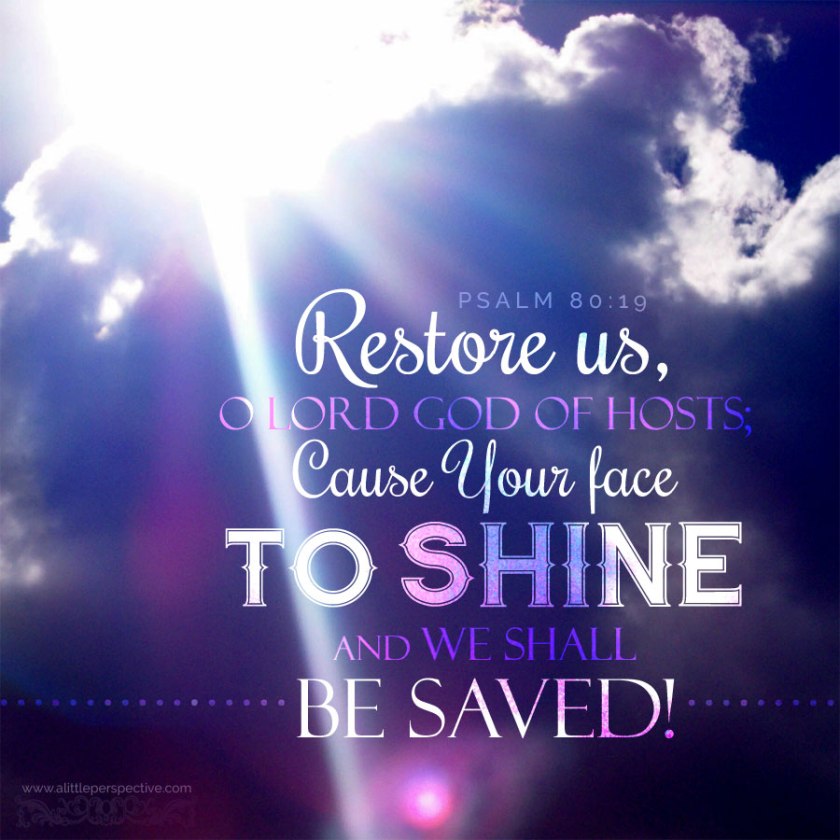
psa-80-19-ww-mf-9x

Sunday, January 8

In one of my favorite books, one character is shocked that someone could feel so much emotion at the same time. This leads him to say “One person can’t feel all that at once, they’d explode.” This comment makes his friend (a girl), chidingly reply “Just because you’ve got the emotional range of a teaspoon doesn’t mean we all have”.
At certain times or in certain churches, it feels like there is only one acceptable way to come to God, only one emotion that is allowable before the Almighty. There was a Baptist church that I visited in South Carolina that was grim and dark and full of hellfire preaching. It seemed that they believed only sorrow and repentance were acceptable before God. Other churches demand happiness, chipper-ness, cheerfulness; no matter what are your actual day-to-day circumstances, put on a smile (or else).
However, God doesn’t demand that from his people. As you read today’s reading, you will be greeted by the soaring highs of Psalm 81 (v1 “Sing for joy…shout in triumph”) and 84 (v12 “Happy is the person who trusts in You, Lord of Hosts!”). Approaching God with joy and shouting is something God admires and inspires. But this is not the only way the authors write these psalms. Psalm 79:5 reads “How long, Yahweh? Will You be angry forever? Will Your jealousy keep burning like fire?” These words are full of sorrow and pleading. It is what the broken, the hurt, the oppressed cry out to God, and it is in the inspired writing of the Psalms. But the very next verses give us EVEN more emotions, namely anger. “Pour out Your wrath on the nations that don’t acknowledge You,” because they have devastated your people. Normally we think anger is wrong; no ifs, ands, or buts. However, the inspired author is allowing his anger at the unjust system of the world, the anger at the sins that people do to one another, to be expressed to God.
If you are always happy, awesome! I’m usually a pretty happy guy myself. But if you experience emotion like a human, and if you experience some right side-by-side, the psalms provide avenues to express yourself to God and prove that you are not alone. God doesn’t demand that you come to him in only one particular way. Instead, he invites you to come as you are.
-Jake Ballard
teaspoon
Jake Ballard is a pastor of Pine Grove Bible Church in Brooklyn Park, MN, where he lives with his wife, Amber and daughter, Melody Grace. He is a gamer (board, card, video, etc.), a geek (currently watch Star Trek: Deep Space 9) and a student. He is in his third year studying to receive his Master’s of Divinity at Bethel Seminary in St. Paul, which he hopes to complete in May 2018. For questions, comments or game or show recommendations, contact him at  jakea.ballard@yahoo.com.
(Psalm 80 photo credit: http://www.alittleperspective.com/psalm-80-reverse-parallelism/)

Resolutions

Psalms 76-78

psalm-77

January 7, 2017

This week we celebrated the New Year and often people make a New Year’s resolution. Some common resolutions are to lose weight, go to the gym or exercise more, and to eat better. People focus on things that will make them feel better or improve themselves. And some people resolve to read their Bible more and improve their relationship with God. These are all good; however, most people give up within a month and go back to their old ways.

Ps 76:11 “Make vows to the Lord your God and fulfill them; let all the neighboring lands bring gifts to the One to be feared.”

                  In Psalm 78, David retells the story of the Israelites. He recounts the many times they called to God to help them and He answered. David also tells of all the times they turned their back on God. They chose to turn away to the easy path, the gods of the foreign lands. Is this how you will approach a vow with God? Stay close when the need is great and depend less when all is good? Just like with resolutions, having setbacks aren’t permanent. The only failure that is permanent is the failure to start again!

-Susan Johnson


(Photo credit: http://alifequest.net/AW82.htm)

Right Hand

Psalm 72-75

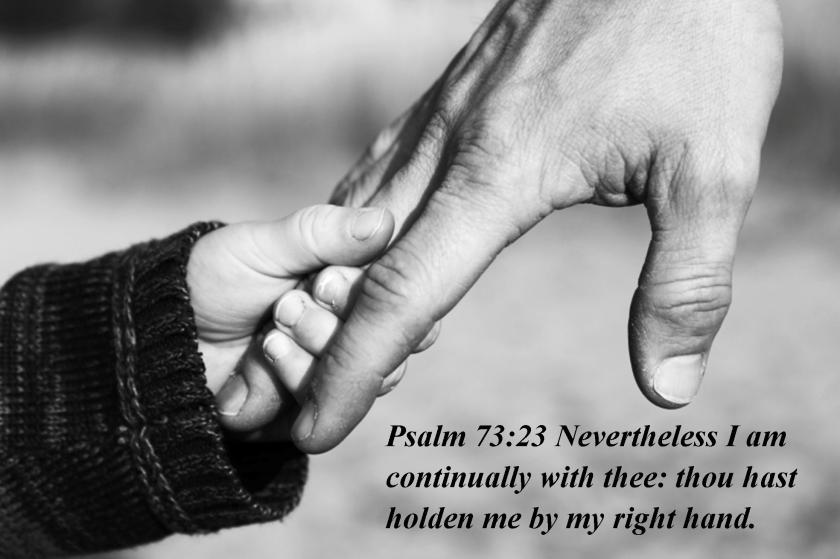
66-psalm-73_23

January 6, 2017

When I was a young child, my mom would hold my hand when we walked. She did this all the time, not just for safety reasons. And during storms, my dad would hold me and talk with me. Now, as a parent, I hold my son’s hands. I do this to keep them safe, to comfort them, and sometimes, to bring them back to me.

PS 73:23-24 “Yet I am always with you: you hold me by my right hand. You guide me with your counsel, and afterward you will take me into glory.”

Hands can be a comfort, even when they are rough from hard work. They can also cause damage, a fist in anger can put a hole in a wall. God with His hand, can save the world or destroy it. He can save His children and destroy His enemies.

Ps 74:10-11 “How long will the enemy mock you, O God? Will the foe revile your name forever? Why do you hold back your hand, your right hand? Take it from the folds of your garment and destroy them!”

With the difficult times we live in, it is easy to ask that God will take care of the problem. I prefer to focus on how God is holding my hand. Like a child being comforted by a loving father, steadfast and strong.

 – Susan Johnson

(Photo credit: http://goldenverses.org/i-am-with-thee)

Change of Perspective

Psalms 68-71

psalm-70_4

January 5, 2017

I was and still am, a stay at home mother. It is the best choice I have ever made and one of the most difficult! Spending all day with two young children often left me stressed and frustrated. This was made more trying by my strong willed second son. I prayed daily for patience until another mother of four, newborn twins with two toddlers explained I needed to pray for a change of perspective. This was a game changer for me! Now when I find myself stuck in my emotions, I step back and look from a different angle. This can often help me see what is really causing me trouble or help me get back on the right path.

Psalm 68 & 69 David is focused on all that is going wrong. His enemies fight against him. His friends talk behind his back. He is focused on the negative around him and has taken his eyes off God, and off the good around him. And then he remembers, God is always with him! He has again placed his focus in the proper place. David is a good reminder to keep our eyes on God, during the good and bad times.

Ps70:4 “But may all who seek you rejoice and be glad in you; may those who love your salvation always say, “Let God be exalted!””

-Susan Johnson

(Photo credit: http://www.godswordimages.com/wallpaper/joy/psalm-70-4/)

Fortress

Psalms 61-67

psa-61-2-ww-notrace-9x6

January 4, 2017

Living in Minnesota can be challenging, yesterday it was 35 degrees and it started raining. Shortly after that, the temperature started to drop. This caused a thin layer of ice making walking dangerous and driving difficult. Today, the temperature has continued to fall and the wind has picked up. I am counting on my house to keep me warm and safe. I do this because my house has kept me warm and safe for many years.

David claimed God as his shelter and source of protection against all that threatened him. Experience had shown how God cared for him and loved him. There were many times David called upon God to watch over him and God was always faithful to David’s pleas.

Psalm 62:1-2, “My soul finds rest in God alone; my salvation comes from him. He alone is my rock and my salvation; he is my fortress, I will never be shaken.”

David questioned God when he felt his enemies threatening him, and God always reminded him he was with him. God is our fortress, a place to rest and reset to face our troubles.

-Susan Johnson

(Photo credit: http://www.alittleperspective.com/psalm-61-chiastic-structure/)