Set Apart

Exodus 19-21

Exodus 19 5 6a NIV

Today’s reading is probably one of the most familiar passages in the whole Bible for it includes the Ten Commandments.  It is important to understand the context of these commandments.  God entered into a covenantal relationship with Abraham and Abraham’s descendants through Isaac and Jacob and Jacob’s sons who became the twelve tribes of Israel.  God promised to bless and provide for his people and in exchange His people promised to be faithful and obedient to God and worship God alone.

After 400 years of slavery, Israel has grown from 12 sons and their immediate family to millions of people.  These people, God’s covenant people, will be settling in a land where they will need to live in community.  They are no longer slaves.  They are now responsible to live in that community in peace and productivity.   They need help to know how to live together.  God provides His people with the structure of how to live together as God’s people.  The Ten Commandments and subsequently nearly 600 additional laws were all designed to help them be healthy and blessed representatives of God to the rest of the world.

God loves all people.  We must never falsely believe that God only loves certain people.  God considers all human beings His children and loves them all.  God wants to be in a right relationship with all of his children; however, many are disobedient and have no willingness to be in a relationship with God and many deny that God even exists.

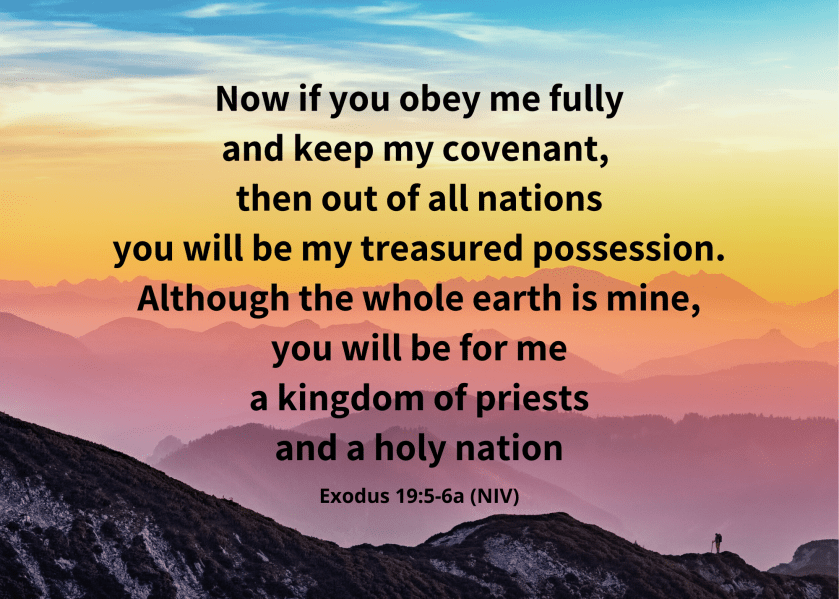
So God needed to start with one group of people and prepare them to be a special, chosen people who would bring the knowledge of God to others.  Exodus 19:5-6 says, “Now if you obey me fully and keep my covenant, then out of all nations you will be my treasured possession. Although the whole earth is mine, you will be for me a kingdom of priests and a holy nation.’

Israel was to be a kingdom of priests and a holy nation.  A priest is one who helps connect people and God.  God would go on to designate priests in Israel to help the people connect with God, but His expectation for Israel was that the whole nation serve as priests to help other nations connect with God.  Because the who nation was being set apart by God to be priests for the world, they needed to live holy or set apart lives.  There were behavioral expectations that they were to follow.  They had to  be exclusively loyal to God, they could not murder, steal, lie, cheat, they were to be respectful and honoring of parents and not misuse God’s name.

Now we are completing what God began in Israel.  Through Christ we have entered into a covenant with God.  We are now the covenant people, we are called to be a kingdom of priests and a holy nation.  That is the Church’s role.  And God expects us to live lives of holiness as we are set apart to serve God.  As you read through the many laws in the Old Testament, recognize that some applied very narrowly to the Nation of Israel and do not necessarily apply to us.  Dietary laws and sanitary laws were important in Israel at the time they were given but are no longer applicable.  However, some of the laws which pertain to morality have been reaffirmed by Jesus Christ for the Church.  In other words, as Christians we are free to eat pork and worship on Sundays, but we are not free to practice polygamy or murder.

God is truly a God of grace and mercy, but God is also a God who hates sin and punishes sin.  In this way we are still to live in fear of the Lord: Exodus 20:20 “the fear of God will be with you to keep you from sinning.”

Jeff Fletcher


Today’s Bible reading can be read or listened to at https://www.biblegateway.com/passage/?search=exodus+19-21&version=NIV

Tomorrow’s reading will be Exodus 22-24 as we continue on the 2020 Chronological Bible Reading Plan

Complaining

Exodus 16-18

stop complaining (1)

A number of years ago I led one of my churches through the 21 day Complaint Free Challenge.  The challenge was to go for 21 days in a row without complaining.  We each were given a purple wristband to wear throughout the challenge.  You were to wear the wristband on the same wrist for 21 straight days.  If you caught yourself complaining, then you had to switch your wristband to the opposite hand and start you 21 day challenge again.  Some of the studies I read said that it takes most people  about a year to go 21 consecutive days without complaining.  I forget how many months it took me to get to that point.

What was the purpose?  To help people break the habit of complaining.   For many people complaining is simply a bad habit.  Will Bowen, who invented the 21 Day No Complaining Challenge says that most people complain for one of 5 reasons using the acronym G.R.I.P.E.

Get Attention

Remove Responsibility

Inspire Envy

Power

Excuse Poor Performance

When we habitually complain to get attention, to remove responsibility (shift the blame) inspire envy, exert power or excuse our poor performance, we dig a behavioral rut and complaining becomes our default response to just about any situation.  That’s a sinful habit from which we need to repent.

In order to break the bad habit, like any bad habit, one must counter the undesired behavior with more desirable behavior.  The goal of the complaint free world experiment was to improve the world by reducing the amount of complaining that goes on.  During that process I became aware of just how often I did complain.  I don’t like hearing other people complain all of the time, I don’t think anyone does.  Parents don’t like to hear their kids complain all of the time.  Spouses don’t like to hear their husbands/wives complain all of the time.  Children don’t like to hear their parents complain all of the time.  Students don’t like to hear their teachers complain, and teachers, I’m sure don’t like to listen to their students complain.  Churches don’t enjoy hearing their pastor complain all of the time and pastors don’t like hearing church members complain a lot the time.  And guess what…even God gets fed up with human beings complaining all of the time.

In today’s reading, God has been busy taking care of Israel.  He led them out of slavery to the Egyptians by performing ten amazing signs.  When Israel was being chased down by Pharaoh’s army and looked like they were doomed for destruction, God miraculously parted the waters and brought them through on dry land.   God led them by cloud during the day and fire during the night.  God was taking them on a journey to a land that he was going to give them.  God was doing nothing but good for them.

And how did God’s people respond to all of this goodness?  They complained.  We’re thirsty… we’re hungry.  They sounded like a bunch of whiney kids on a long trip.  If you’ve gone on a long trip, the experience is very different for the parents up front and the children in the back.  Think about a family going on vacation.  The parents are the ones preparing for the trip.  Mom’s doing the laundry, packing everyones clothes, preparing snacks, arranging for neighbors to come and feed the animals and water the plants.  Dad is making sure the car is running well, changing the oil, getting the mail stopped, gassing up the car, checking the route to make sure there are no road closures.  The parents buy the tickets for wherever they are going, pay for the meals along the way, pay for the hotel rooms, make sure the kids have stuff to do in the car/van/suv.  And what do the kids do?  They complain: I’m hot… I’m bored… I’m hungry…I’m thirsty… I have to pee…  sisters looking… brother hit me… and are we there yet?  I had 11 children and I know what I’m talking about here.

Imagine Moses… and God.  They are moving roughly 2 million men, women and children across the wilderness toward the promise land.  There are no McDonalds on the journey.  There are no Holiday Inns with an indoor pool.  There are no air conditioned SUVs with built in blue ray players and no iPhones or Nintendo Switches to keep them occupied.  They are tired, they are hot, they are thirsty and hungry, and they are complaining… a lot!

If I’d been Moses or the Lord I would have been tempted to say “Ya’ll be quiet or we’re turning around and going back!”  Fortunately the Lord, and Moses have more patience and grace than I ever had:

Exodus 16:6 So Moses and Aaron said to all the Israelites, “In the evening you will know that it was the Lord who brought you out of Egypt, 7 and in the morning you will see the glory of the Lord, because he has heard your grumbling against him. Who are we, that you should grumble against us?” 8 Moses also said, “You will know that it was the Lord when he gives you meat to eat in the evening and all the bread you want in the morning, because he has heard your grumbling against him. Who are we? You are not grumbling against us, but against the Lord.”  9 Then Moses told Aaron, “Say to the entire Israelite community, ‘Come before the Lord, for he has heard your grumbling.’”  10 While Aaron was speaking to the whole Israelite community, they looked toward the desert, and there was the glory of the Lord appearing in the cloud.  11 The Lord said to Moses,   12 “I have heard the grumbling of the Israelites. Tell them, ‘At twilight you will eat meat, and in the morning you will be filled with bread. Then you will know that I am the Lord your God.’”

God heard their grumbling and he gave them quail and manna to eat.  There it was, as much as they wanted.  They were able to eat their fill.  And after that they never complained again. Well, that’s not true…. before long they were complaining about being thirsty too.

What God should have done was give each of them a purpose wristband to remind them not to complain.  It would take them a few more lessons before they quit complaining.

I’m sure God does get tired of hearing our complaining… but he still loves us and he even gives us ways to complain in the Bible.  Many of the Psalms are called Psalms of complaint and/or Psalms of lament.  Jesus himself, while he was on the cross prayed  one of those Psalms of complaint/lament, Psalm 22 which begins: “My God, my God why have you forsaken me?”   When we are suffering real pain, real sorrow, real trials, God wants us to turn those into heart felt prayer and we should.  God is able to handle our complaints and do something about them.  At the same time, too often our complaining comes from a place of ingratitude.  The ungrateful complaining that fails to acknowledge and appreciate God’s blessings needs to stop; legitimate complaining for true hurt in faith is something God is ready and able to hear and respond to for his glory and our blessing.

Jeff Fletcher


Today’s Bible reading can be read or listened to at https://www.biblegateway.com/passage/?search=exodus+16-18&version=NIV


Tomorrow’s reading will be Exodus 19-21 on our 2020 Chronological Bible Reading Plan

Growing in Trust

Exodus 13-15

Exodus 13 21 NIV

Sometimes, when a person makes a major purchase, like buying a new car or a new house they come down with a phenomenon known as “buyer’s remorse.”  Buyers remorse happens when you second guess that decision.  Yes, you like that new car and all.  You could think about how wonderful it would be when you drive it down the highway.  But when that first car payment comes due and you see how much of your paycheck goes out every month… and will continue to go out for the next 4 or 5 or 6 years, you can have buyer’s remorse.  It can be even worse when you realize that that dream house you’ve always wanted requires 1/4 of your paycheck every month and will for the next 30 years.  Yikes!  Buyers remorse has to do with regretting that important decision.

After the 10 plagues, the last of which included the death of his firstborn son, Pharaoh was so devastated that he let the Israelite slaves leave.  He wanted to be rid of them.  Their God had displayed His power and Pharaoh’s hubris was finally knocked down.  But like a boxer in a ring who has been knocked senseless by a much stronger opponent, Pharaoh still manages to get back up on his feet and try again.  He realizes that he’s suddenly lost a significant part of his workforce.  600,000-able bodied men were gone.  Who was going to build Pharaoh’s cities and pyramids and harvest their crops?  Pharaoh has buyer’s remorse.  He wants to get those slaves back.  So he assembles his army, the most powerful army in the world, and sends out the chariots and soldiers to chase down the Israelites traveling by foot.

Meanwhile, God is making his visible presence known to Israel.  He’s leading them with a pillar of cloud by day and a pillar of fire by night.  This was important.  God’s people were no doubt very disoriented.  They were leaving a place that was known and familiar to them.  For over 400 years they had been living in Egypt.  They were now going to a land which they had never been.  They may have heard stories from their parents and grandparents about this land, but chances are that after 400 years, it had all but been forgotten in Israel’s memory.  They had no idea where they were going.  So they needed some visible assurance that God really was with them.  So he made Himself visible.  I’m sure that this brought some comfort to the traveling Israelites… until they heard the sound of Pharaoh’s army, with it’s galloping hoofbeats bearing down upon them.  As they looked forward to their escape route, there was nothing but the vast sea before them, and behind, the most powerful army in the world.

In despair they cried out to Moses- “why did you bring us out here to die, weren’t there enough graves in Egypt to hold our bodies?”  The sarcasm would be funny if the stakes weren’t so high.  These people truly were terrified.  Yes, they could see that God was leading them- his tangible, visible presence was right there… and yes, God had performed 10 great signs in Egypt.  But they were still scared.

It is normal to get scared when scary things are about to happen to you.  It would take the nation of Israel a long time before they would begin to really trust God in all things.

I’m a baseball fan.  Over the last 8-9 years I’ve watched the Washington Nationals play a lot of baseball.  They have been a very good team for years, but unfortunately, too many times that great team fell apart during the playoffs.  Every time they were in a do or die situation in the playoffs, they lost that deciding game and were eliminated from the playoffs.  This happened over and over again.  So when the 2019 playoffs started, and the Nationals played the Milwaukee Brewers in the one game wild-card play off and they were behind by 3 runs, I started thinking “Oh no, not again!  We’re gonna lose once again.”  But they didn’t!  They came back and beat the Brewers.   Wow!  It was different.  After all these years they won a playoff series.  But then they played the mighty Dodgers.  Once again they go behind 2 games to 1 and were facing an elimination game.  They were behind and it was getting late in the game, and then miraculously, they tied it up and went into extra innings, and then Howie Kendrick hit a 10th inning grand slam and the Nationals won another series.  They moved on to the next round, where they swept the St. Louis Cardinals in 4 games.  By this time I was becoming a believer.  So much that when they played the Houston Astros in the World Series and got down three games to two and were facing elimination, I suddenly wasn’t worried any more.  I had become a believer.  I just knew that they would come back and win… and they did.

So Israel can be excused for fearing Pharaoh’s army and believing that the worst was was about to happen.  But once again, God showed up in a powerful way, the seas were parted and Israel went through on dry land, and Pharaoh’s army was drowned in the sea as they gave chase.

How many times does God need to show up before we begin to trust?  For me, it only took a few come from behind wins for be to begin believing in the Nationals and placing my confidence in their ability to come back and win.  It would take quite a few more wins before Israel would finally come to fully trust God.  What will it take for you to fully trust God?  Israel’s story is, in many ways our story too.  We can read these stories and have our faith strengthened to help us keep trusting God even in the middle of hard times.  God is with us and God has the power to display His ultimate victory over the forces of evil.

Jeff Fletcher


Today’s Bible reading can be read or listened to at https://www.biblegateway.com/passage/?search=exodus+13-15&version=NIV

Tomorrow’s Bible reading will be Exodus 16-18 on our 2020 Chronological Bible Reading Plan

Light Dawns on the Dark Night of the Soul

Exodus 10-12

Exodus 10 1 2 NIV

As we go through life, there are times when it seems like God is very active and involved in our day to day lives and we sense God’s love, nearness and active interest in our lives.  However, if we are honest, there are other times when life seems to just move along and God doesn’t seem to be saying much or doing much on our behalf.  The technical term for this awareness of God’s absence is called “the dark night of the soul.”  Many growing Christians have and do experience times of God’s apparent absence in our lives.

As we read through the Bible it becomes apparent that there are times when God gets actively involved with His people.  God was there in creation, making the earth, making the plants and trees, making the animals, making Adam from dirt and Eve from Adam’s rib.  God was there in Eden talking openly and directly with Adam and Eve.  God was there asking Cain about his brother Abel.  But then we don’t hear much from God.  We know that people like Enoch “walked with God”, but we’re told very little about what God is up to for hundreds of years, as the population of earth increases and also the sin of humanity increases.  There is a long period of God’s apparent absence from history until the days of Noah when God appears to Noah and tells him to build the Ark because a flood is coming.

After the flood there appears to be more years of silence, until the Tower of Babel gets built and God comes down and confuses people’s language.  Then there is more silence from God until he calls Abraham.  And so on and so on…There are intermittent times where God is active and involved and times when God seems silent throughout the book of Genesis.

At the end of Genesis God saves Abraham’s family from famine by bringing them down to Egypt.  At first, all is well as Joseph, Abraham’s great grandson is the second most powerful man in all of Egypt.  But Joseph eventually dies, and he is no longer able to protect his family from the powerful Pharaoh, and eventually the descendants of Abraham are enslaved by the Egyptians.  This lasts for a period of roughly 400 years.  During that 400 years it seems that God is once again silent.

During that time Israel is growing from a few hundred people, to millions of people.  Millions of men, woman and children living in bondage in a foreign land.  Perhaps stories about God and their ancestors Abraham, Isaac and Jacob were passed along by word of mouth, but we might imagine that so many years of silence may have left the nation of Israel in a permanent Dark Night of the Soul.  But then… out of the darkness and silence, Moses is born and becomes a member of the Egyptian royal family.  God is at work, but he’s not quite ready to make himself fully known to Israel.  Moses kills an Egyptian and flees to the wilderness and it seems that the darkness continues and the voice of God remains silent…until God appears to Moses in the burning bush and tells him to go back to Egypt.

In Exodus 10-12 the time has come for God to make himself known to His people… and to Egypt. Exodus 10:1-2 – “Then the Lord said to Moses, “Go to Pharaoh, for I have hardened his heart and the hearts of his officials so that I may perform these signs of mine among them that you may tell your children and grandchildren how I dealt harshly with the Egyptians and how I performed my signs among them, and that you may know that I am the Lord.”

Here, God tells Moses that He’s about to make his presence known in a powerful way.  God’s about to show up, the darkness is ending, the silence is over.  And show up He does!  God shows up in a profound and powerful display of his power and might.  Bear in mind, Egypt was, at the time, the most powerful empire in the whole world.  Pharaoh was the most powerful person in the whole world.  Pharaoh had been exerting his power in a ruthless way over God’s chosen people for hundreds of years.  Lord Acton once said “Absolute power corrupts absolutely.”  In the United States we live under a Constitutional system that intentionally balances power among three different branches of government- Executive, Legislative and Judicial.  This is to prevent any one person from having too much or absolute power.  These lessons were learned after observing thousands of years of kingdoms.  Pharaohs and other absolute monarchs have historically used their power in destructive and unjust ways.  And with such unmatched power comes hubris.

The Poet Percy Bysshe Shelly captures the hubris in his powerful poem Ozymandias:

I met a traveller from an antique land,

Who said—“Two vast and trunkless legs of stone

Stand in the desert. . . . Near them, on the sand,

Half sunk a shattered visage lies, whose frown,

And wrinkled lip, and sneer of cold command,

Tell that its sculptor well those passions read

Which yet survive, stamped on these lifeless things,

The hand that mocked them, and the heart that fed;

And on the pedestal, these words appear:

My name is Ozymandias, King of Kings;

Look on my Works, ye Mighty, and despair!

Nothing beside remains. Round the decay

Of that colossal Wreck, boundless and bare

The lone and level sands stretch far away.”

Pharaoh, like Ozymandias in the poem, was filled with hubris over his unmatched power.  He believed himself to be king of kings.  He needed to be taught a lesson in humility by the true King of Kings.  God showed up.  Ten plagues later and all of Egypt was brought to their knees.  Meanwhile, the people of God began to see first hand just how great and powerful their King, the true God, YHWH really was.  That story has been told for thousands of years, and today, the people of Israel continue to sit down and eat bread without yeast and drink wine and remember the Passover and how powerful their God really is.

Sometimes, God seems to be silent, but make no mistake, God is still there and God is still powerful and in the end, God will show himself to be greater than all human opposition.  May you know the true God.

Jeff Fletcher

So Egypt Will Know

Exodus 7-9

Exodus 7 5 NIV

Moses does not believe that he can speak adequately, so what does God say? He does not tell Moses, “I am sorry. I picked the wrong man.” No. Instead He says, “I picked you for a reason. If you can not speak, then delegate that duty to Aaron.” God still says that He is going to speak through Moses, not Aaron. Once Aaron has received the words from Moses, then Aaron can speak them to Pharaoh. In fact, this is the way that religion is going to work for the rest of human history. God will pick a prophet, whether that prophet thinks he is capable or not, and will speak to the rest of humanity through that single person. God is also able to set up leadership through this prophet and the prophet can lead others and coordinate with them in order to achieve more and reach more people. This is what is established in the Levitical priesthood.


I recently heard an interesting interpretation on the hardening of Pharaoh’s heart. I have usually not been able to define the phrase “hardened heart” when I read it. This interpretation however, defines the hardening of a heart as making a man brave. Under this interpretation, God did not force Pharaoh to refuse to listen. Pharaoh first chose to ignore the words of God. Then, when he became fearful because of the plagues, he was willing to let the Israelites go. It is at this point that God makes Pharaoh brave, allowing the Pharaoh to hold to his original decision not to let them go. I think this interpretation has some merit and is interesting at least.


Why did God choose the plagues that he chose? Why did he turn the Nile to blood? He could have turned it to mud or dried it up or anything. Why did he send a plague of frogs? Why not crocodiles or giant river snakes or something a little more intimidating? Why gnats? Gnats are just tiny little things, a nuisance at worst. Well God is the mastermind behind all of this, so He must have known what he was doing. Let’s try to think about all of these plagues in the context of Egypt. We know that Egypt is full of sorcerers who have a handful of tricks. We also know that the Egyptians were polytheistic and had many zoomorphic gods. Finally, we know that the Pharaoh had been oppressing the Egyptians with hard work and even worse, had slaughtered all of their baby boys.


God could have just dried up all of the water in the Nile and it would have had the same effect. All the fish would die and begin to rot and stink. There would be no water to drink. Yet God chose blood. This relates to what I said yesterday about turning people by degrees. God is starting with a plague that the Egyptians think is mere magic. The same thing occurs for the frogs, but the magicians can not create gnats. There is definitely some symbolism to blood in the Nile, possibly referring to the Pharaoh’s slaughter of the newborns. I also think it has to do with the significance of the river to Egypt. That river was a large part of the economy for them, they relied on it. So God took it away. Man should rely on God because he is the source of life. Even at this point in history, people knew that blood is an essential part of life and thought that a person’s life was in their blood. Thus, by turning the river to blood, God is saying, “I give life and I take away life.”


The plague of frogs is a weird one for me. The way it is described makes it sound like an inconvenience; they are just everywhere. One commentator I read said that this was poking fun at the Egyptians gods Hapi and Heqt. God was directly challenging the gods of Egypt.


The gnats are particularly nasty. Have you ever been out on a run in the summer when all of a sudden your mouth is full of gnats? Maybe that is just me. It is one of the most unpleasant experiences. Now have you ever been in a dry, dusty field running around and kicking up dirt? That is also quite unpleasant. It gets tough to breath. One time I was in a situation like this and I had to keep blowing my nose until it stopped coming out black. Now replace the dust in this field with gnats. That is a nightmare.


I am going to stop there and ask that you ask yourself these questions and see if you can come up with an answer. Why flies? Why livestock? Why boils? Why hail? God has every tool imaginable at his disposal, yet He deems these to be the best plagues for this situation. Why is that?


Thanks everyone for starting this plan and sticking to it! If you started from the beginning, great job making it this far and if you are just joining, I hope that you are able to find a routine of your own or hop in with this one. There is nothing better for the mind than to focus on God’s word daily.


Thanks for reading,

Nathaniel Johnson


Today’s Bible reading can be read or listened to at https://www.biblegateway.com/passage/?search=exodus+7-9&version=NIV

Tomorrow’s reading will be Exodus 10-12 on our 2020 Chronological Bible Reading Plan

Called – & Equipped & Planned – by God

Exodus 4-6

exodus 6 7

Anytime God asks a question, you should be thinking to yourself, “Why would God need to ask that question if he already knows the answer?” Here, Moses doubts that he has any ability to convince anyone that he had spoken with God. Then God asks him this leading question as if Moses should have known that he already had everything that he needed to fulfill the duty that God called him to. When you are given a task by God, you had better believe that he has already equipped you for the job. The staff is already in your hand.


The method that Moses is given of turning his staff into a snake is an interesting one. The Egyptians sorcerers already have tricks like this; they can perform a similar feat. God always has a plan and he knows the hearts of his audience. He knows that when Moses’ staff turns into a snake, no one will be surprised because they have already seen sorcerers perform the same feat. Then why would God use this method? This is simply the first of many signs to come that will change the hearts of the audience by degrees. This is the same method that Socrates extolls as the tool of a great rhetorician. The great rhetorician will not attempt to change a man’s mind by presenting him with facts. On the contrary, he will use his knowledge of the man’s heart and what is familiar to the man, even if it is false. In this way, you can slowly turn the man’s thinking towards your position by degrees, small increments. This is how I see the signs that Moses performs before Pharaoh and all of Egypt. In other times throughout the Bible, prophets perform different signs and these signs are more suited to the people of that time and region. If Elijah had performed the signs that Moses performed, he may not have been a successful prophet because the signs of Moses are too different compared to what his community was used to experiencing. If this is the case, what kind of signs might God use in our modern age?


Yesterday we saw some of the ignorance and incompetence of the Pharaoh, and again we see it today. When he takes the straw away from the Israelites and demands the same quota, he is acting as a bad leader. There are leaders like this who still exist today, be it our teachers or our bosses. The bad leader sees the failures of his subordinates and reprimands them by increasing their workload or taking away resources which he sees as a crutch. Doing this only makes their productivity decrease. The good leader sees the shortcomings of his subordinates and reinforces them in their areas of need so that they can be productive and produce good results. I don’t see Pharaoh’s action in this case to be cruel, merely foolish; he sincerely does not know how to lead people.


When God speaks to Moses again, he says that he has heard the groaning of the Israelites. What is incredible about that is that well before he heard their groaning, he had a plan in place to save them. He took the evil of the murder of all baby boys and turned it into good by allowing Moses to live. He allowed Moses to grow in knowledge by being raised as an Egyptian. Then He met with Moses to show him the way to deliver his people. This plan was set into motion before the Israelites even knew they needed saving. That is the power of a God who does not operate on our time. By the time we realize that we are in trouble, God has already been working to get us out of it.


Nathaniel Johnson


Today’s Bible reading can be read or listened to at https://www.biblegateway.com/passage/?search=exodus+4-6&version=NIV

Can you believe we are about 1/12 of the way through the Bible already!  (Genesis and Job are big books!)  The Bible has 1,189 chapters in all – which means on average reading 99 chapters a month to complete the Bible in a year.  Well Done!  And, if you haven’t been reading every day – February is a great time to get started!

Tomorrow’s Bible reading will be Exodus 7-9 on our 2020 Chronological Bible Reading Plan

God’s Deliverance Begins – Again

Exodus 1-3

Exodus 2 3 NIV

I had fun with today’s reading; I laughed out loud numerous times. I’m going to try to recreate some of the internal dialogue that was playing out in my head as I read it. Enjoy.


“We need to be shrewd with these Israelites. What should we do? I have a brilliant idea! Let’s enslave them.” – The new Pharaoh, probably.

Shrewd: having or showing sharp powers of judgment; astute.

I’m not sure the new king really knows what shrewd means. I suppose he was astute in his observation that the Israelites are more powerful than he, yet he is not displaying great judgement in putting shackles on the people who got to their current position thanks to a very shrewd man named Joseph. As Egypt will soon find out, God is great at providing the Israelites with shrewd men who are capable of delivering them at just the right time.


“Murder all the baby boys. Do it for king and country, why else? What’s that? It’s immoral to kill babies? Why would you possibly think that?” – Also the new Pharaoh, probably.

The midwives are smart enough to lie to the king and tell him that they aren’t responsible for the lives of these children (as if a person could be considered “responsible” for someone else continuing to live). They claim that the women giving birth are just so skilled at it that they do not need the assistance of a midwife. That is quite a longshot. When is the last time you heard of someone giving birth to a child without the assistance of a professional? Yet the king is dull enough to buy it. He sincerely believes that these women have no concept of morality other than to obey the edicts of their government. The midwives feared God over their government and followed the commands of morality and God instead of the king.


The mother of Moses saves him because she thinks he is beautiful. When is the last time a mother did not think their baby was beautiful? Every mother in this time must have been like her, attempting to hide their baby boys after seeing how beautiful they were. After all, the king made it the family’s duty to kill their own children. Moses’ mother was shrewd. She put him in a basket and set him out in the Nile, intending for him to survive. This sounds insane knowing what lurks in the Nile. She created the basket so that he would be protected, it was waterproofed with pitch. She placed it among the reeds so that it wouldn’t wash away. Finally, she had Miriam, Moses’ sister watch over the basket from a distance. His mother was certainly crafty. I believe she knew exactly what would happen next, otherwise she would not have done it. When Moses is found, his own mother is hired to raise him. That is the work of divine providence and the craftiness of Moses’ mother.


As a side note, the midrash states that Miriam had a significant role in leading Israel alongside Moses and Aaron after the Exodus. https://jwa.org/encyclopedia/article/miriam-midrash-and-aggadah


The bloodlust of Levi comes out in Moses when he kills the Egyptian.


The burning bush seems unique at this point in the story. In the past, God had interacted with people by sending messengers. Abraham speaks with God before the destruction of Sodom and Gomorrah. Jacob wrestles with God. Now we have Moses talking to God in a bush. It is a little different but this begins to be the pattern from here on out. We soon get the pillar of fire and cloud (which appears over the tent whenever Moses speaks with God), and the mountain covered in cloud when Moses receives the law. Later God identifies himself in a new way. He gives himself a name “I AM WHO I AM” or “I AM THAT I AM” which is the translation of the Hebrew YHWH. Up until this point, He has always identified Himself as “The God of your fathers, Abraham, Isaac and Jacob.” This encounter seems to be a turning point in the human story. From now on, a large group of people is going to interact with God in a personal way, they will address Him by name and they will be in close contact with Him.


Nathaniel Johnson


Today’s Bible reading can be read or listened to at https://www.biblegateway.com/passage/?search=Exodus+1-3&version=NIV


Tomorrow’s reading will be Exodus 4-6 as we continue the 2020 Chronological Bible Reading Plan

This Sounds Vaguely Familiar (Exodus 38-40)

Saturday, August 20

20-holiness-to-the-lord

We have made it to the end of the book of Exodus!  Even if this is your first time reading through the book of Exodus (and CONGRATULATIONS to you, if it is!), several parts of these final chapters should sound quite familiar – because we have read nearly the SAME thing just a few chapters back?  What is the difference?  Why the repetition?

In Exodus 27 & 28 God is giving explicit directions to Moses on how the priestly garments, the altar and the tabernacle courtyard are to be made – materials to be used, precise dimensions, and the exact designs God desires for His Holy Place and His Holy People.  And, in Exodus 38 & 39 we read that it WAS done exactly the SAME way – including once again all the materials, dimensions and exact designs.  In chapter 39 it says at least 8 times that the work was done “-as the Lord commanded Moses”.  At the end of the chapter (vs. 43-43) is says, “The Israelites had done all the work just as the Lord commanded Moses.  Moses inspected the work and saw that they had done it just as the Lord had commanded.  So Moses blessed them.”  It seems that details are pretty important to God.  He didn’t just want it done.  He wanted it done correctly.  He wanted it done HIS way.  Sometimes I think we are quick to pat ourselves on the back if we can just cross a job off the list.  But, have we done it correctly?  Have we done it God’s Way?  Is there a job that needs some more of your attention to do it correctly?  To get it done God’s Way?

Another related phrase that caught my attention was a saying that was to be engraved on a gold plate and attached to the priest’s clothing with a blue cord:  “HOLY TO THE LORD”.   Holiness – to be set apart – total devotion  – unlike any other.   As a member of the royal priesthood (as explained in 1 Peter 2), how is your holiness quotient looking today?  Are you set apart – or blending in?  Are you totally devoted – or only when convenient?  Is there a visual reminder (like the priest’s gold engraved plate on their clothes) that will help you remember to be HOLY TO THE LORD?

    “But you are a chosen people, a royal priesthood, a holy nation, a people belonging to God, that you may declare the praises of him who called you out of darkness into his wonderful light.  Once you were not a people, but now you are the people of God; once you had not received mercy , but now you have received mercy.  Dear friends, I urge you, as strangers and aliens in the world, to abstain from sinful desires, which war against your soul.  Live such good lives among the pagans that, thought they accuse you of doing wrong, they may see your good deeds and glorify God on the day he visits us.”         I Peter 2:9-12

  Live Today

HOLY TO THE LORD!

And All Your Tomorrows Too!

(Thank you to Josiah Cain who wrote this week.  Since he was working so hard serving in Louisiana the devotion for today (Saturday) was written by Marcia Railton.  Keep praying for Louisiana – and let’s jump into Leviticus next!)


It’s Time to Build …Finally (Exodus 35-37)

By Josiah Cain

holy of holies

After many chapters of instructions it is finally time for the people to craft these objects and put the tabernacle together. Not just any old person built things for God; only the ones filled with His spirit were builders. It says that these people were filled with craftsmanship and intelligence this way they could accurately build all that God commanded them.

I also liked how God provided for his tabernacle by having the people give but only if they wanted to give. God didn’t force people to give like He did with the flat tax rather He only wanted those who really cared to give. So many people were moved that Moses had to command the people to stop bringing stuff because they had more than enough to finish the project.

I always enjoy seeing God interact with His people and how He provides for what needs to be done. If we trust God with everything we won’t be disappointed by Him, I promise.

The Israelites Mess Up Again, Shocker! (Exodus 31-34)

By Josiah Cain

Tissot_The_Golden_Calf

There is a lot to cover in these chapters and a lot of cool and terrible stories take place. Of course, in normal Israelite fashion, we find the people of God disobeying orders. They make a golden calf statue to worship while Moses is away on Mt. Sinai. God tells Moses that the people are messing up and Moses then pleads with God not to destroy them; if it wasn’t for Moses the Israelites would not have made it very far. So Moses goes down to see what is happening and ends up destroying the tablets that God made and the golden calf the people made. Moses then orders the Levites to kill the people who disobeyed God and this is the same event that made the Levites the priestly tribe for the rest of Jewish history. In total 3,000 people ended up dying that day at the hands of the Levites but that wasn’t enough for God; God later in the evening sent a plague to kill some of the Israelites and finally all the punishment was over. The Jews really can’t seem to keep themselves out of trouble.

There are many things that I don’t envy about Moses, like the time he killed that Egyptian, but if there is one thing I am jealous of, it would be the way he talks to God. It says in chapter 33 that God talked to Moses face to face. What? How cool is that! Can you imagine talking to God face to face?!? It is incredible to think that Moses literally heard the voice of God and sat in the same place as God dwelt. I would give anything to commune with God in this way. Reading the way that God and Moses communicate just builds my anticipation for the coming kingdom even more.

Moses actually spent so much time with God that his face started to glow. I can’t imagine what this would have looked like but it was enough to scare some of the Israelites apparently. I wonder if we will have glowing faces when we spend a bunch of time with God? It did stink for Moses though that he had to hand carve the Ten Commandments again. I would still trade 40 days of no eating and stone carving for that much time with God.

Thanks for reading again and please take to heart the lessons that we can learn from the Israelites. If we follow God’s rules then everything works out for us in the end. I also think that we can learn patience from this story. The only reason they made the statue in the first place was because they were worried that Moses wasn’t coming back. We need to wait because God always has things under control.