Sayings of the Wise

Proverbs 22-24

There have been countless attempts to condense all the complexities of life into a few simple and concise rules to follow. If the steps are practiced effectively then success will be rewarded. Variations of these lists are reiterated over time through experience of generations adapting to changing societies. Each one tries to improve upon the previous list, but there are often more similarities than differences. While there are some noticeable differences between many of these lists and Proverbs 22-24, as a whole these chapters are simply a list of sayings meant to be followed for success. It certainly wasn’t the first list nor last, but it accomplishes the same goal, with the added benefit of being God’s trusted word. 

These thirty sayings are introduced in chapter 22, and it is encouraged for all to hear and pay attention to. “Counsel and knowledge” are provided with a reward of increasing trust in God along with honesty and speaking the truth (NIV, Proverbs 22:17-21). They don’t necessarily promise to bring worldly success, though many do, but instead offer the opportunity to further develop a relationship with God. These sayings align with seeking wisdom. Following them will result in the growth of truthful actions, trust, and an increased ability to love God and others. 

Each of the sayings provide guidance on some aspect of life, though there is overlap. Some of the sayings teach how to interact with others and develop meaningful relationships. For example, avoid exploitation, consider the perspective of others, and don’t be associated with people who will only cause trouble and be a bad influence. Other sayings claim that righteous character and behavior will be rewarded socially, and even if there is no benefit in today’s society God will reward those in the future. Similarly, the opposite is warned against. Another common theme is to not get caught up in chasing money or other common indicators of success, as they aren’t as meaningful as they may initially seem. Lastly, these sayings teach the value in learning and the willingness to be taught.

Study the sayings of the wise and learn from them. These thirty sayings are included in the book most known for wisdom, so if wisdom is loved these sayings should be considered in daily life. The increase in wisdom associated with applying these chapters will encourage genuine care and love for others through truthful words and actions. Further, trust in God is strengthened by wisdom in knowing how God defines success. Although it is still just a condensed list, follow these sayings and success will naturally be rewarded.

-Josiah Railton

Reflection Questions

  1. How is the wisdom found in Proverbs 22-24 similar to wisdom literature from other times and cultures? How is it different from what “the world” today says is wise and profitable for success?
  2. In your relationships with others which of these sayings of the wise would you benefit from focusing on this week?
  3. How can you work towards the ultimate success of having a better, growing relationship with God?
  4. Which verses would be great on your refrigerator, desk, bathroom mirror or bedside table for the next month? Post them.

Love is the Greatest Motivator

Proverbs 19-21

Every chosen action is a result of a complex combination of a variety of motivations, but each one can be traced back to a source of love. Some form of love is at the base of every decision, as people prioritize what they love most. The recipient of love could be God, oneself, another person, a physical object, or even intangible concepts such as happiness or power. Loving God is a common commandment and suggested motivator throughout the Bible, but not every other object or concept is as desirable to love from a biblical perspective. Wisdom is needed to differentiate between what should be loved, and what shouldn’t be, which will ultimately have a great impact on what decisions are made and what actions are taken. 

Proverbs is known for describing wisdom and contains numerous examples of valid sources of love and others that should be avoided. Wisdom itself is a great concept to love according to the Bible, as Proverbs 4:7 commands to “Get wisdom. Though it cost all you have, get understanding” (NIV). Wisdom is so valuable that it is worth sacrificing all else. In other words, the love for wisdom should be greater than the love of money, material resources, fame, power, or anything else. All those concepts and objects are discouraged as primary sources of love throughout Proverbs. 

While there are many things not worthy of love, Proverbs and the rest of the Bible offer several suggestions to give one’s love to. Most notably, aside from God, are other people. The command to love others is present throughout the Bible, but it is even more meaningful and impactful than simply being nice to one another. Not only is some form of love at the root of all motivation, but the recipient of that love is commonly love itself. People love to be loved. God designed people to need to be loved, and Proverbs 19:22 claims that “what a person desires is unfailing love”. Many people are willing to sacrifice a lot to be loved. It is the greatest motivator and is often the force causing many actions and behaviors. While it is still beneficial to simply be kind to a neighbor or provide for the physical needs of others, genuinely loving others requires providing what is needed most—love. Building a strong and unselfish relationship on unfailing love increases the impact one can have in the lives of others. It makes it easier to spread God’s word and His Kingdom. 

As with all things, it might require some sacrifices to love others effectively. However, that isn’t a problem if love for others is greater than the love of whatever is put aside. Sacrifices will always be made for what is loved the most. Therefore, carefully prioritize what is loved. Love God and love others to use the natural motivation to encourage godly choices, behaviors, and actions to have the greatest impact in the world.

-Josiah Railton

Reflection Questions

  1. “Some form of love is at the base of every decision, as people prioritize what they love most.” – What do your decisions show that you love most?
  2. What do you WANT to love most? What is getting more of your love now than it deserves?
  3. What sacrifices have you already made for what you love most? What additional sacrifices might be ahead? What sacrifices have others made for you?

Whatever You Do

Proverbs 16-18

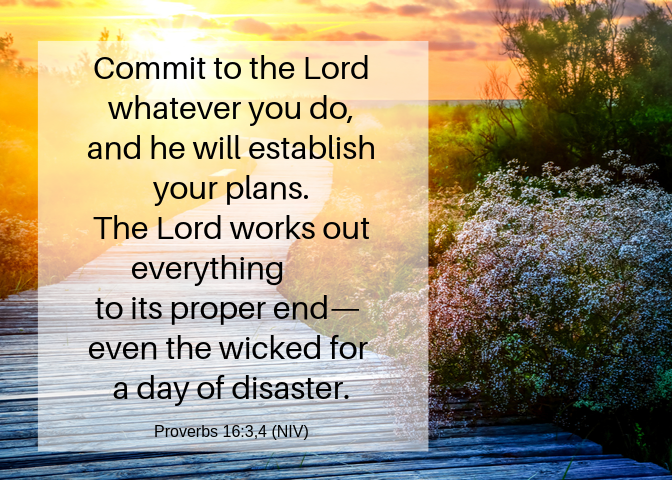
In the book of Proverbs, we find a treasure trove of wisdom that has the power to transform our lives. Chapter 16 is no exception, offering profound insights that speak directly to our hearts and the way we navigate this world. Today, let us take a closer look at verse 3, which encourages us to commit our work to the Lord, knowing that He is the one who establishes our plans.

In a society driven by achievement and self-reliance, it is easy to fall into the trap of thinking that success is solely dependent on our own abilities and strategies. We may spend countless hours meticulously crafting our plans and pursuing our goals, forgetting that we are called to acknowledge God’s sovereignty and seek His guidance in all that we do. However, Proverbs reminds us that true success comes from surrendering our efforts to the Lord.

Committing our work to the Lord involves recognizing that He is the ultimate authority and the source of all wisdom and understanding. It requires us to approach our tasks, aspirations, and dreams with an attitude of humility, acknowledging that apart from Him, we can do nothing of lasting significance. We are called to submit our plans to His will, seeking His guidance and trusting that He will align our desires with His purposes.

By entrusting our work to God, we are liberated from the burden of self-reliance and the anxiety that often accompanies it. We can rest in the assurance that the Lord, in His infinite wisdom and love, will establish our plans. This does not mean that we will be exempt from challenges or difficulties along the way, but it does mean that God will faithfully guide us, direct our steps, and use our efforts for His glory.

When we commit our work to the Lord, we invite Him to be an active participant in every aspect of our lives. We open ourselves up to His guidance and leading, allowing Him to shape our plans according to His perfect will. Our work becomes an opportunity to partner with God, to be instruments through which His purposes are fulfilled in this world.

As we reflect on Proverbs chapter 16, may we be encouraged to surrender our ambitions, our dreams, and our work to the Lord. Let us seek His wisdom, trust in His guidance, and find peace in knowing that He is the one who establishes our plans. By entrusting ourselves to Him, we embark on a journey of purpose and fulfillment, where our lives become a testament to His grace and faithfulness.

-Austin Kizer

(originally posted for Seek GrowLove on May 16, 2023)

Reflection Questions

  1. In what areas of your life would it be wise to surrender your plans to the Lord? What does that look like? What thoughts and feelings does it create? Pray for help in doing so.
  2. What does true success look like? Is it possible apart from God and His plans?
  3. What will God reveal to you about Himself in your Bible reading today?

The Real Right Thing

Proverbs 13-15

Have you ever found it easier to see the right thing for someone else to do than for yourself?  There is a reason for that.  We often times can tell someone what to do but can’t seem to do it for ourselves.

For example:

25 A truthful witness saves lives,
But he who utters lies is treacherous

In this proverb we see that lying only brings destruction.  We ourselves hate being lied to.  We hate seeing people live a lie. We know how much damage it can do.  We know this but I bet if I asked if you have ever lied or lived a lie you would probably say yes.  I bet if I asked you if you knew how to correct that in someone else’s life you would have an answer almost immediately.  It is so easy to see the foolishness in someone else.  It’s easy to know what to do to correct their wrong behavior.  But I bet it is harder to correct in yourself.  Why can we see the answer to foolishness in others easily but have such a difficult time correcting it in our own lives? 

   The answer is we have no emotional ties to their sin.  We won’t have to deal with the consequences of trying to correct our behavior.  I can tell you how to correct your behavior all day long because I don’t have to do it.  I don’t have to deal with the mess.  But if I have to correct a sin I know what that will take, and often times I don’t want to deal with the pain and hurt that comes with going back and fixing issues like lying bring about.

Read Proverbs 14 and see if you can see any foolishness in your life that you need to correct.  Are their verses in this chapter that really resonate with you?  Can you see the foolishness in those verses?  Can you recognize the wisdom it takes to realize that some of these verses apply to you.  Are you willing to recognize the wise thing to do and apply it to your life?  Your foolish ways become harder and harder to stop the longer you wait. 

The very first verse illustrates this perfectly:

The wise woman builds her house,
But the foolish woman tears it down with her own hands.

Are you tearing your life apart by not recognizing wisdom?

I’m praying for you.

Andy Cisneros

(originally posted here on August 15, 2017)

Reflection Questions

See Andy’s suggestions and questions in the last full paragraph.

    Love Covers

    Proverbs 10-12

    I was looking through the Proverbs in today’s reading, trying to decide what to focus on. There are just so many good ones! Proverbs is one of my favorite books, and as I meditate on different verses that hold meaning to me, I like to add artwork to them. When I look through my Bible, I’ve noticed that the ones I have marked up the most seem to have a common theme: they all have to do with how we treat others. 

    I wish that was more of a focus in the world. The internet is full of comment sections heaped with insults and negativity. I’m forever grateful that my kids are homeschooled with a smaller group of Christians because my heart breaks at the stories of bullying. Videos abound of people being cruel to others in stores, on sidewalks, in restaurants, even at home with their families. Even in our churches, people can be unkind. 

    The book of wisdom has a lot to say on how we treat those around us. Being kind, honest, and dependable is not only godly, but wise and leads to many benefits. 

    Verse 11:10 tells us how others feel about those who are righteous and those who are wicked. Proverbs 11:13 warns against gossip, 17 teaches us that kindness to others benefits us, 22 talks about how we should be modest around others, and verses 24-26 give us the benefits of being generous. Chapter 12 speaks on how our own poor words to others can destroy us in verse 6. Verse 10 is actually about how we treat animals. Verse 16 talks about overlooking insults and not becoming immediately annoyed with others, and 25 tells us one of the benefits of using kind words. 

    But I think my favorite verse about how we should interact with others is 10:12. “Hatred stirs up conflict, but love covers over all wrongs.” There are many types of people in this world, and we are bound to clash. I only have three children in my house, and they definitely don’t always get along. They don’t hate one another at all, but they sure do have some conflict. However, they also love each other. So, unless they are having a particularly bad, rotten kind of day, they aren’t purposely going out of their way to create issues. 

    I don’t think many of us reading this are likely to have a lot of hatred in our hearts. I’d like to think that most people don’t. So I feel like the most important part of this verse is actually the second half. I also think it’s the most difficult. Love covers over all wrongs. Have you ever tried to love someone who has really wronged you? It’s not easy. But how much better would the world be if we covered up the wrongs done to us with love and forgiveness? 

    Society would say that this type of reaction would make you a doormat or a pushover. This is a lie. Nothing takes more strength than loving those who harm you. That kind of strength comes from God. He allowed his only son to die for a lot of people who held no love for him or others. His love is that deep. Christ was willing to die for those who hated him. His love was that deep. 

    As you read through the Proverbs, seeking out wisdom, I hope you see the wisdom in this: actively loving those who wrong you will make your life, and the world itself, better. My prayer for you is that you will practice treating others with patience and kindness, and that those you interact with will do the same. I pray that you see the wisdom in covering wrong with love. 

    -Jenn Haynes

    Reflection Questions: 

    What verses speak to you today in these passages? Where is God trying to place wisdom into your life so that your path is easier? 

    Think about some of your interactions with others lately. What were the best ones? How can you go and bless others the way that you were blessed? What were the worst ones? Was your reaction one of love? How can you forgive the offences and react with love? 

    The Voice of Wisdom

    Proverbs 7-9

    Do you ever find yourself looking at someone else’s situation or decisions and think, “I would have done that completely differently”? Of course you have. We all have. The world is full of armchair quarterbacks and side seat drivers. It’s so much easier to look at someone else’s situation and evaluate it as an outsider without the pressures of personal consequence. 

    In the heat of the moment, standing at our own crossroads, however, we get wrapped up in the “what ifs” and the worries about whether or not we are making huge mistakes. So how do you know when you’re doing something wise or foolish? 

    Chapters 7 and 8 of Proverbs personify danger/foolishness and wisdom as two women. The first woman is the strange or adulterous woman, luring in a simple youth. She uses “smooth talk” and “persuasive words” to seduce him. I feel it’s worthy to note that sexual sin is being used in this personification, probably because it’s the most common and most dangerous. And her opposite is wisdom, who doesn’t use tricks or wordplay, but speaks plainly. She promises no shortcuts, but offers instruction, knowledge, and truth. 

    Both women have some similarities though. They are both crying out to those around them, trying to persuade others to follow them. They are both offering up benefits to listening to their words. So how do we know which to listen to? 

    It seems obvious when we read the chapters, right? It’s less obvious in our own realities, though. Less obvious, but it’s still possible to make the correct choice. As in all decisions, we should test our options against scripture. If you want to know if your actions are wise or dangerous, test them against God’s word. Discernment, the ability to judge well, is a skill that everyone can, and should, develop through practice. The more we know of God’s word, the better equipped we will be to look at the paths before us and choose the wise one, the one that aligns best with scripture. 

    When wisdom calls out to you, don’t you want to be familiar with her voice? 

    My prayer for you is that you become so familiar with the voice of wisdom, the words of God, that you are not easily fooled or led astray. I hope you will love instruction so that you will continue to grow in wisdom and righteousness. I pray that you find the benefits of wisdom listed in chapter 9: “For through wisdom your days will be many, and years will be added to your life. If you are wise, your wisdom will reward you.”

    -Jenn Haynes

    Reflection Questions: 

    What decisions do you face right now? Have you placed your options up against scripture? 

    How is your scripture study? In what ways can you make yourself more familiar with God’s word, and the voice of wisdom, so that you can easily recognize it?

    Are there any voices of temptation in your life right now that are trying to call out to you? Take a moment to honestly analyze and reflect. Often we want to shy away from facing the hard truth that there are likely things in our lives that we enjoy but that we should give up because they are unwise. Does that hold true for you? 

    Heart Protection

    Proverbs 4-6

    My husband and I went to an amusement park last week with our three kids. Though I suffer from motion sickness in a major way and I’m terrified of heights, I still love roller coasters. Going on them with my kids has been a fun, new blessing, and I love that they are all big enough to ride them with us now. But I’ve also noticed that they are slightly less enjoyable in another way. I now do something on coasters that I’ve never done before.

    I pray. Like constantly. Through the whole thing. The second we start going upside down all I can think is, “God, my entire family is on this contraption, please hold us safely in your hands!” I spend the entire ride begging for God’s protection. It eventually just turns into a long stream of silent pleas of, “Oh God, oh God, oh God pleeeeeeeease keep us safe!” All I can focus on is my family’s safety.

    I know that the older I’ve gotten, the greater my anxiety has grown. This especially holds true with my kids. They are all running around in this world like nothing can harm them and all I can think is that literally EVERYTHING can harm them. And I want so badly to protect them. We’ve invested a great deal into several devices all designed to help us care for our kids’ medical needs. We have an alarm on our house to alert us to danger at night. Smoke alarms in appropriate rooms, and carbon monoxide detectors as well. Our family is precious to us and we want to guard it with all we have. 

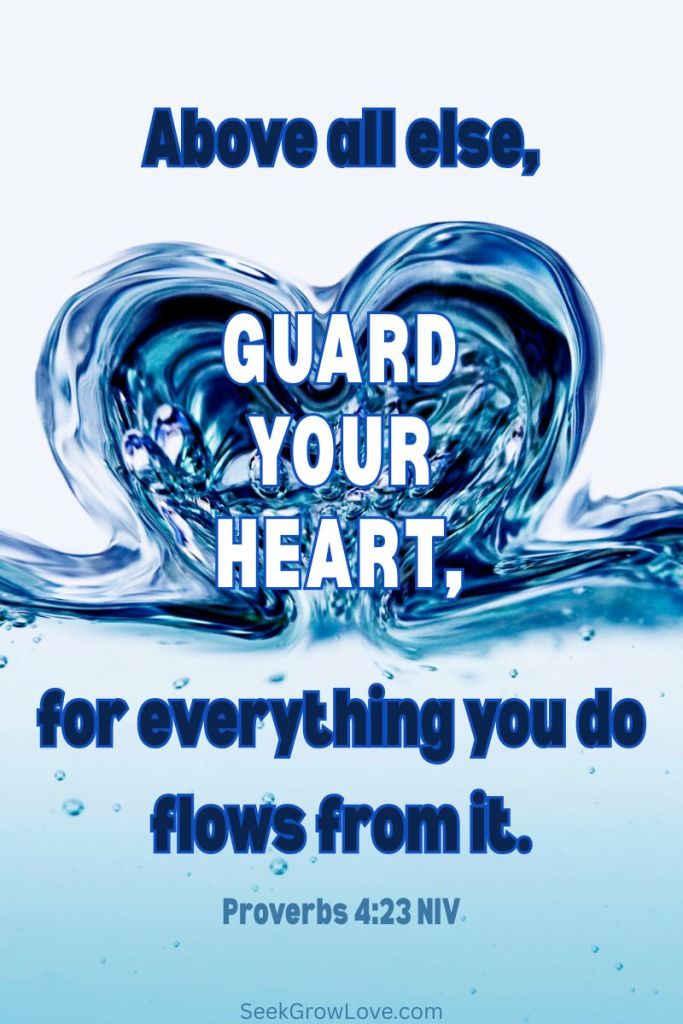
    But we also want to guard our hearts in the same way. Proverbs 4:23 says, “Above all else, guard your heart, for everything you do flows from it.” EVERYTHING we do flows from our hearts. Just as we all do certain things to keep our bodies safe, we should be protecting our hearts as well. Over and over in Proverbs, the importance of wisdom is repeated. If our hearts are filled with wisdom, love, truth, and righteousness, then these are what will come forth in our actions. Hearts full of wisdom will not only keep us on good, straight paths, but will also be a light for others to see as well. 

    -Jenn Haynes

    Reflection Questions: 

    What is attacking your heart right now? What is badly influencing you? How is this showing in your actions and your words? How can you better guard your heart from those things? 

    If you are a parent, how can you help your children protect their own hearts? 

    Is everything you are doing showing others a path toward God? 

    My prayer for you today is that you continue to find wisdom and instruction in these proverbs and use them in ways that will protect your precious heart. Fill it with all that is good and holy!

    The Root of Learning

    Proverbs 1-3

    I’m a homeschooling mom. I never meant to be one, it just kind of happened. It happened in such a weird way, actually, that I know it was God speaking into our lives. That being said, we follow what is known as a classical model of learning. I won’t go into details about it, but when you dive into homeschooling, or if you’re an educator, you have probably become familiar with pedagogy – the study of learning. Or, as most people think of it, the study of how to instruct. We’ve developed many different ways of learning over the years, trying to help people in various situations learn in different ways that speak to them more clearly. We require different methods because we are different people with a beautiful variety of brains. 

    But the root of learning is not teaching. It’s not the brain, nor the instructor. It is knowledge and wisdom itself. And behind all knowledge and wisdom is God. 

    God did an interesting thing when he created us and the world we live in. He placed a tree of the knowledge of good and evil and then told us not to eat from it. What a crazy thing, right? Why place the tree there at all? But to be completely free, he had to give us freedom of choice. And that means we have to have options to choose from. Humanity chose poorly. We continue to choose poorly. 

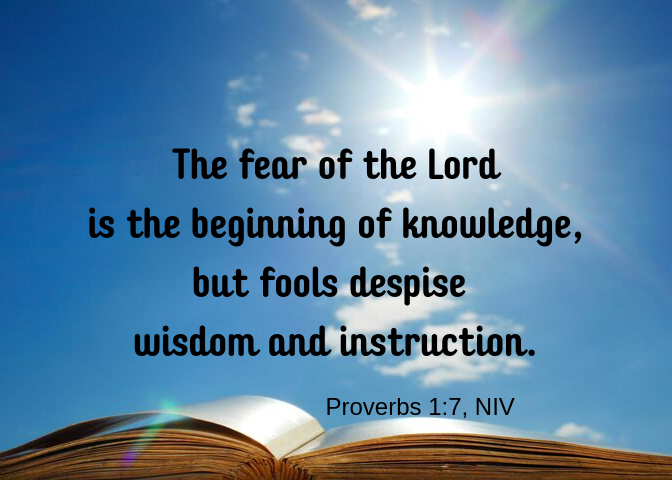
    How do we choose wisely? Proverbs 1:7 tells us, “The fear of the LORD is the beginning of knowledge, but fools despise wisdom and instruction.” The fear of the LORD means showing God the respect and awe that he’s due so that we long to obey him in all things. When we obey the instructions of the loving Father who wants only the best for us, then we are led to knowledge and wisdom. 

    As you start through the book of Proverbs, take note of how this wonderful book is not only trying to grant you wisdom and knowledge, but also moral guidance. Let these Proverbs speak to you in a way that helps you see how much God loves you and wants to guide you and protect you. I hope you start to see the benefits of wisdom, as they are beautifully outlined in chapter 2, show up in big ways in your life. 

    -Jenn Haynes

    Reflection Questions:

    What are some of the ways that God’s guidance has kept you from trouble? In what moments of your life do you feel you would have avoided trouble if you HAD followed God’s instruction more closely?

    Proverbs 2:10 says, “For wisdom will enter your heart, and knowledge will be pleasant to your soul.” What wisdom have you gleaned from scripture that has given you that sense of pleasantness in your soul? 

    My prayer for you today is that you will experience the truth in Proverbs 3:5-6. Trust in the LORD with all your heart and lean not on your own understanding; in all your ways submit to him, and he will make your paths straight. 

    Are you Listening?

    Old Testament: 2 Kings 11 & 12

    Poetry: Proverbs 28

    New Testament: Luke 10:25-37

    As Marcia mentioned in yesterday’s devotion, many of us were at Midwest Family Camp last week, where the theme was “Stand Firm”.  In a nutshell, if we don’t have a relationship with the Lord, it is critical that we repent and come into a relationship with Him. If we already have a relationship with the Lord, we need to strengthen that relationship, and stand firm in the faith – no matter what.

    In today’s reading in Proverbs 28, there are a few verses that jumped out at me which reinforced that message.  The first is found in Proverbs 28: 9, “If anyone turns a deaf ear to the law, even his prayers are detestable.”  This proverb tells us that if we’re not doing everything to live the life God called us to live, if we’re not following His rules, then He won’t listen to our prayers.  Since many of our prayers are about asking for God’s help with various things, if we selfishly want Him to answer our prayers, then we need to obey His rules, and live for Him.  As we grow in relationship with Him, we come to long for an even deeper relationship with the Lord. Then we learn that prayer is powerful, and we don’t waste it just asking for superfluous things.

    Proverbs 28:13 goes on to say, “He who conceals his sins does not prosper, but whoever confesses and renounces them finds mercy.”  This is saying if we pretend to be Christians, we won’t prosper (you can’t fool God).  But if we confess and renounce our sins, and turn completely to God, we will receive God’s mercy.  I don’t know about you, but I would much rather have His mercy than to have Him holding me back from prospering.

    As we continue to read through this chapter, we get to verse 20, which says, “A faithful man will be richly blessed, but one eager to get rich will not go unpunished.”  I’ll take a detour here and comment on the health and wealth teachings we often hear from people who don’t know better.  The theory goes sort of like this… “if someone follows God, God will bless every aspect of their life.  They will be rich, healthy, and blessed.”  Many people who call themselves Christians subscribe to this false belief.  Jesus told us in John 16:33, “…In this world, you will have trouble.  But take heart, I have overcome the world.”  We have to remember this life isn’t our reward.  This life is the test to see what reward we will receive when Jesus returns.  If we are faithful to the Lord now, we will enjoy peace with God now, and eternal life when Jesus returns.  If we are just trying to get rich, we are actually worshiping money, not God — our reward is in this life, and we will forfeit eternal life.  

    1 Tim 6:9-11 says, “People who want to get rich fall into temptation and a trap and many foolish and harmful desires that plunge men into ruin and destruction.  For the love of money is a root of all kinds of evil.  Some people eager for money have wandered from the faith and have pierced themselves with many griefs.  But you, man of God, flee from all this, and pursue righteousness, godliness, faith, love, endurance, and gentleness.”

    Instead of trying to get rich, we need to follow the advice given in Proverbs 28:27, “He who gives to the poor will lack nothing, but he who closes his eyes to them receives many curses.”  Again, I think the idea is that if I’m greedy, wanting to keep all my money for myself, I’m not trying to please God, I’m just greedy for money, and God will curse me for not following Him.  But if I’m generous with the things God has given me by giving them to the poor — this mimics God’s generosity to me.  When I am imitating God, God loves that.  In fact we’re commanded in Ephesians 5:1, “Be imitators of God, therefore, as dearly loved children.”

    So the bottom line is this.  We need to do everything we can to reconcile ourselves to God.  We need to confess and renounce our sins, obey His laws, be faithful, and be generous.  All these things are required to live in close relationship with God.  And if we live in a close relationship with God, we will have peace with God in this life, and an amazing reward in the life to come.  In Rev 21:4, we’re told, “He [God] will wipe every tear from their eyes.  There will be no more death or mourning or crying or pain…”   Rev 21:7 goes on to say, “He who overcomes will inherit all this, and I will be his God and he will be my son.”

    How well are you imitating Dad?

    Stand Firm.

    –Steve Mattison

    (Originally posted June 28, 2021 – but we did just return from another week of Family Camp, where the theme was “Pray Continually”. You can watch Steve’s Thursday Night sermon and story on Yield to God’s Will here.)

    Reflection Questions

    1. What are the prayer lessons to be remembered from Proverbs 28?
    2. How well are you following God’s instruction?
    3. When was the last time you confessed your sins to Him?
    4. What relationship do you have with money? Is it stronger than it ought to be? How would you rate your generosity? Why do you think God values our generosity?

    Wounds from a Friend

    Old Testament: 2 Kings 9 & 10

    Poetry: Proverbs 27

    New Testament: Luke 10:1-24

    The Proverbs are, in many cases, fairly self explanatory. Don’t be lazy, don’t be a wicked ruler, don’t be foolish but be wise, be a righteous ruler, be diligent in your work. Each Proverb has it’s own meaning but they go along those lines. But some are not so self explanatory. They are counterintuitive.

    A short example is found in 28:27. If you want to be prosperous and blessed, to never be in want, then we give our money to the poor. The world, our own sinful heads, and many economists believe that the way to grow our wealth and not be in want is to hoard our money. But that’s not the way God works. It is only in generosity and giving that we will be blessed. This comes from the fact that God will bless and many times he blesses us through the care of others in our time of struggle and hardship.

    Also, 27:5-6 doesn’t seem to be true in the moment. I don’t like to be rebuked. I don’t like it when a friend calls me out on the garbage way I am acting. But the Proverb teaches us that we should delight when a friend rebukes us because their correction comes from a place of love and they want our life to be one of wisdom and righteousness. This is especially true for  our brothers and sisters in our local church. Many times, we may feel judged by the people of our church, but more often than not, they are wanting the BEST for us. The “wounds” they give are better than any kisses of those who tell us we have nothing wrong with us. There could be people who act like a friend and hurt you in terrible ways, but here we mean TRUE friendship, TRUE companionship, TRUE love from a brother or sister in Christ. That true love is shown in forgiveness and compassion, especially in our moments of weakness and humility. Many times, when we are sinning and are fearing the rebuke of those people, we hide our sin away, like 28:13 says. But counterintuitively, by hiding our sins, we only hurt ourselves more when they are brought to light in some other way. We need to confess our sins and turn away from them. When we do, compassion and forgiveness are waiting for us from the people of God and from God himself.

    Jake Ballard

    (originally posted for SeekGrowLove June 17, 2020)

    Reflection Questions

    1. What other proverbs have you run across that seem counterintuitive and the opposite of how the world thinks or operates? How is God’s wisdom better than the world’s?
    2. Can you think of a time a true friend gave you correction or a rebuke? Can you think of a time you, as a true friend, gave correction or rebuke? What is the value of correcting a friend? What problems can develop if we don’t correct in love, or if we don’t accept the correction given in true love?