Keeping the Faith – with Help

I have kept the faith 2 Timothy 4:8

Nehemiah 3-4

Psalm 88

2 Timothy 4

-Devotion by Talon Paul (IN)

They say that “hindsight is 20/20”, which means that you see most clearly once it’s all over and you’re reflecting backwards. The apostle Paul is spending some time reflecting in his final letter to Timothy, and during this reflection he names multiple people that have influenced his ministry (for better and for worse). As Paul “finishes his race”, he wants Timothy to be aware of others that he can lean on once Paul is no longer around. We can gain much wisdom from this chapter that is unfortunately skipped over in most Bible reading plans.

The first piece of wisdom that this section has to share is that we should always be preparing the next generation well. Paul had been a mentor and a shining example to young Timothy throughout their time together, as it is written: “Brethren, join in following my example, and observe those who walk according to the pattern you have in us.” (Philippians 3:17) As a good mentor, he tries to set him up for success by warning Timothy about others who might betray him in the future, like Demas and Alexander.

Outside of warning Timothy about those who are dangerous to his ministry, Paul encourages Timothy about those who are helpful to him: Crescens, Titus, Luke, Mark, Tychicus, Carpus, Priscilla and Aquila, Onesiphorus, Erastus, Trophimus, Eubulus, Pudens, Linus, and Claudia. While we are very much unaware of what many of these people have done to help Paul’s ministry, it shows us two things that should motivate all of us in our Christian walk:

  1. The Christian walk and ministry are not supposed to be done alone: they are meant to be done in community with other believers (Luke 10:1; 1 Corinthians 12:13-14).
  1. We should recognize those who have made an impact in our lives, naming them specifically and rejoicing that God gave them to us (Galatians 6:6).

Questions

  1. Do you have a “Paul” in your life? An experienced, godly person to show you how to live in Christ, and who wants to set you up for success? If not, find someone in your church to invest in you.
  1. If you’re an experienced believer who has been a Christian for a while, do you have a “Timothy” in your life? An inexperienced believer who needs a mentor and guiding hand? If not, find someone in your church to invest in.
  1. Who are the people that have helped shape your spiritual life? Thank them personally and let them know how much they mean to you.

Prayer

Dear Father – You are worthy of all praise. Thank you for being a good God who has generously given the gifts of life, faith, salvation, Christian community, and ministry in many forms. Thank You for all those who have shared Your word and Your love with me and my family. I pray for Your strength and guidance as I in turn reach out to others with Your life-giving words. Help me to endure hardship, be committed to sound doctrine, and work with my Christian community well to raise up a next generation of believers who love and serve You with all their hearts, souls, and minds. I pray for Your Son’s return.
Dear Brothers & Sisters

2 Chronicles 25-26

Psalm 82

2 Thessalonians 1

-Devotion by Bethany Ligon (AZ)

2 Thessalonians 1:3 – “We ought always to thank God for you, brothers, and rightly so, because your faith is growing more and more, and the love every one of you has for each other is increasing.”

The summer between my second and third grade, my family moved from Michigan to Arizona. I left behind my first best friend, Jenny. We promised each other that we would write to each other frequently so that our friendship could continue even though we were 1900 miles apart. And that’s exactly what we did. All throughout elementary school, junior high, and high school we wrote back and forth sharing the excitements and disappointments of growing up. And while the time between the letters increased as we got older, we managed to stay in touch through college. There were some years even in our early adulthood that we exchanged Christmas cards. 

When was the last time that you either sent or received an actual, personalized letter from someone near and dear? What information was exchanged? How did it make you feel? How do you imagine it made the other person feel?

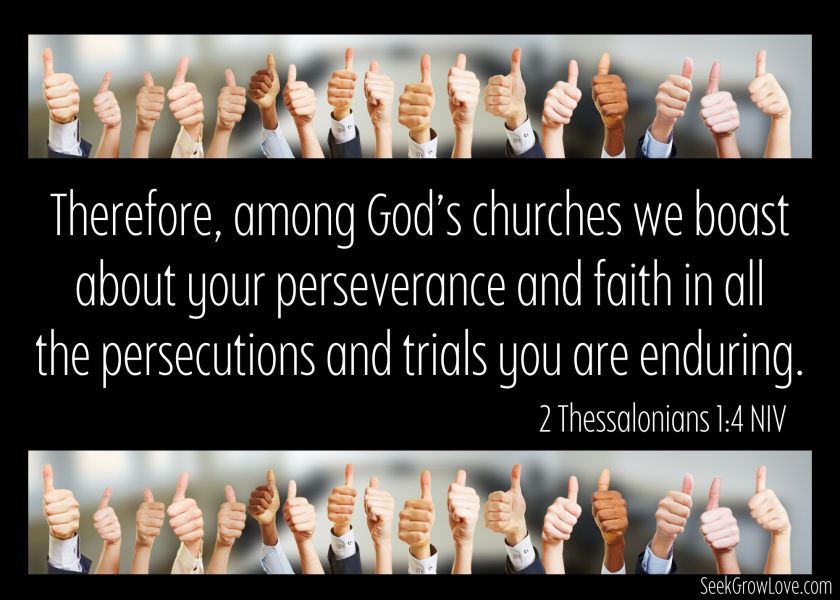
As part of today’s Scripture reading, we begin a second letter from Paul to the church in Thessalonica. His purpose for this follow up is to encourage the believers to continue to persevere in their faith, to correct misunderstandings that had begun to make their way into the teachings, and provide some discipline for those who were not being productive.  

It’s the third verse that captured my attention as I read this chapter. How often, in our communication, whether it be written or face-to-face, do we extend the message, “I see how your faith is growing” or “I am so thankful for you” or “I have been bragging about you to others” (see verse four). 

Admittedly, I am not good at this sort of talk, especially face-to-face, particularly on Sunday mornings. I am much more comfortable staying on topics that are related to the business of the church, or how the previous week went, and how I am anticipating the events of the upcoming week.

But I think that I should take a note from Paul and start noticing and sharing how I see my friends living out their faith actively. Because even in a church community that stays active and engaged, it can be easy to slip into the feelings of isolation. And I shouldn’t let my awkwardness and insecurities prevent me from telling people that I care about that I see them and their efforts in living like Jesus would want them to and to support them when they might be struggling with something.  

I sometimes wonder if Paul had any inclination that the words that he penned 2000 years ago to a specific group of believers would continue to have impact on Christian brothers and sisters centuries later on the other side of the world? But if his words of encouragement and teaching are able to keep us anchored in our faith, how much more would something that we said to another today make a difference? 

Dear brothers and sisters, 

I am so glad that we are striving together as one for the faith of the gospel. Seeing you dig deep when life throws you curveballs encourages me to stay the course in my own faith journey. I am so grateful to God that our paths have crossed and to know that I am not in this alone. To Him, be all glory and honor and praise!

Your friend in the faith,

-bethany

REflection Questions

  1. Who are Christian brothers and sisters you thank God for? Have you let them know?
  2. Whose Christian perseverance do you see that inspires you to keep the faith? Have you told them? (Perhaps if a person you have thought of is currently asleep/dead, there is still someone currently living who would love to hear the impact their loved one had on you.)
  3. Besides the encouragement and thanks found in verses 3 & 4, what else found in the rest of this chapter does Paul want his brothers and sisters in Thessalonica to know and remember? How often do you share this with others? Who do you know who could benefit from hearing this information or reminders this week? Will you tell them?

Prayer

Dear God, I thank You for being the Father with a Big Plan which includes the blessings of a church family today and the promise of an incomparable Coming Kingdom when Your Son returns. Thank You for all those who have taught me and encouraged me and helped be to grow my faith in You. Help me to be grateful and a wise motivator and encouragement to others.

Jobs for Everyone

1 Chronicles 26-27

Psalm 75

Ephesians 6

-Devotion by Kevin Shull (MN)

1 Chronicles 26-27 are chapters that can be easy to skim past as you are reading through the Bible.  However, hidden within these lists of names and positions, we can gain a glimpse of God’s order.  The Israelites were a nation that were set apart by God.  This can be seen in Leviticus 20:26 and 1 Chronicles 17:21.  What separated Israel from the rest of the nations was God’s Law, which provided the Israelites with the order that they needed to live a holy life.

1 Chronicles 26-27 puts a focus on the specific structure and design that God engineered for the Israelites’ success.  Within these chapters we see how King David is organizing the Levites to serve in the temple.  1 Chronicles 26:1-19 details the divisions of Levitical gatekeepers.  It is specific to their leading men, which gate they are assigned to, and how each watch should run.  26:20-28 focuses on the treasuries of God’s temple, and the individuals responsible for them.  26:29-32 highlights the work of the Levites outside of the temple, who are assigned to be judges and overseers for the tribes of Israel.  Each listing is detailed with their families and locations. 

This is continued in chapter 27, starting with the military.  From verse 1 we learn that the military is to be split into twelve divisions, with 24,000 in each division.  27:2-15 then lists the commanders of these divisions by name for their appropriate division.  In 27:16-22, the heads of tribes of Israel are also listed by name.  The chapter continues in 27:25-31 by listing those who were placed over the king’s various affairs and property.  Finally, 27:32-34 lists the king’s counselors and the commander of the king’s army.

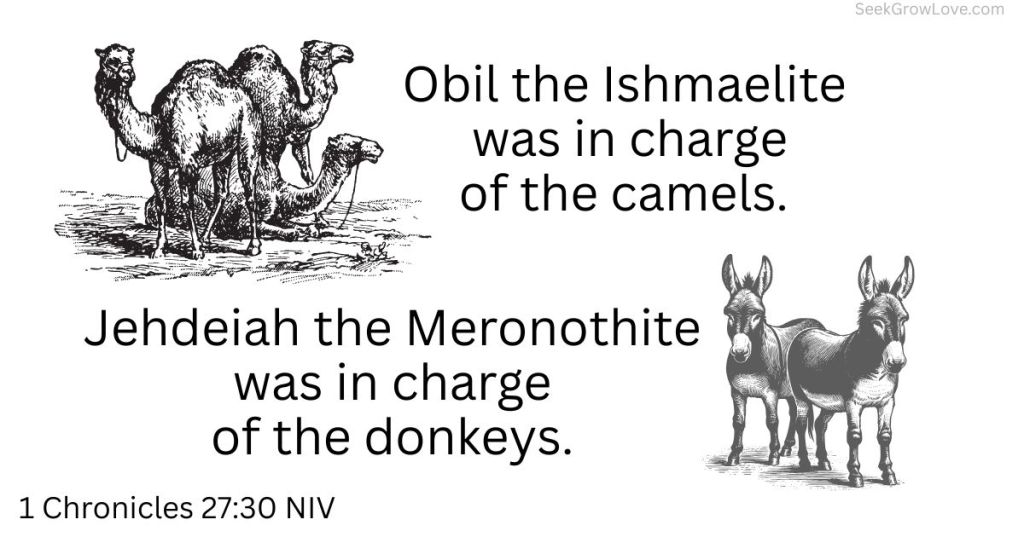
As I was reading through these lists, chapter 27 verse 30 stuck out to me.  “Obil the Ishmaelite was in charge of the camels.  Jehdeiah the Meronothite was in charge of the donkeys.”  In the greater scope of the Bible, I would not think of these as particularly noteworthy roles that would need to be listed.  But in the time of David, both camels and donkeys were vital to the success of the kingdom.  Camels were of key importance for desert transport and trade.  Donkeys were needed for their agricultural work and carrying heavy loads.  While not particularly flashy jobs, both Obil and Jehdeiah’s work was needed within the Israelite nation. 

We can apply these same concepts into our Church today.  The Church needs members in different roles to thrive.  We have all been given unique spiritual gifts for the purpose of serving our church.  1 Peter 4:10, “Each of you should use whatever gift you have received to serve others, as faithful stewards of God’s grace in its various forms.”  Not everyone is called to be a pastor or musician, but we can still find ways to serve.  God has given you gifts to better your church, even if it isn’t always in the flashiest positions.  1 Corinthians 12:21 reminds us that no part of the body of Christ should be looked down upon. “The eye cannot say to the hand, ‘I don’t need you!’ And the head cannot say to the feet, ‘I don’t need you!’”  It is pivotal that we don’t lose faith by neglecting the gifts God has given us.

While 1 Chronicles 26-27 are not the most riveting chapters of the Bible, I believe they are truly just as important.  God had a specific plan for the Israelites’ success, a clear order to ensure prosperity.  Lists like these remind me that God used each of these individuals for a specific purpose, as hard as their names might be to pronounce.  God used these people to orchestrate all the inner workings of complex bureaucracy that was David’s kingdom.  In comparison to a kingdom, imagine how simple our own lives must be to him.  Our God is a God of order, so why do we have such a hard time letting him lead?  I pray that we will be able to let go and follow where God’s plan is taking us.

Reflection Questions

  1. What did you find interesting in the description of the organization of the Levites and David’s kingdom?
  2. Of the jobs listed in 1 Chronicles 26-27, which one(s) would you have applied for if you lived during David’s reign and why?
  3. How has God gifted you for service? What role do you play in the church body? Why does it need to be done? What skills does it require?
  4. Where have you witnessed the God of order at work?

Prayer

Dear God, I thank You for creating the church as a body – not because You need us, but because we need You and we need one another. Help us to serve You well as an active, talented, giving part of the body of Christ.

Rumblings of Discontent

Joshua 15-16

Psalm 36

Acts 6

-Devotion by Stephanie Fletcher (MN)

Looking at the start of Acts 6, we see how as the church was growing, and growing quickly, there were “rumblings of discontent.” It goes into a specific issue that we might not directly deal with in our church, but I think everyone can understand discontentedness.


As numbers grow – in anything you are doing, not just church – it is harder to get everyone on the same page and not have some people who are upset with how things are going. Sometimes discontent can grow when there are a lot of people with differing opinions. There may not necessarily be something wrong, but one person wants to do things one way and another person a different way. Sometimes it grows when there is an issue, and it seems like that is what is happening here.


As the early church grew larger, the apostles weren’t able to keep up with all the things that go into the different aspects of church. I think this is something we see today. Pastors have a lot put on them to be in charge, overseeing their congregation. But realistically, they can’t oversee all aspects of ministry.


In chapter 6 of Acts, we see how the apostles, having been gifted in this way, wanted to be able to continue focusing on praying and teaching, but recognized that there are other needs that are out there that need to be met. So they put together a group of people who were well respected, full of the Spirit and wisdom to oversee this area of need (daily distribution of food).


Though we may not have this specific programming in our churches today, and our churches may not even have the same format, we can see how one pastor in many cases, can’t do all the work of the church on their own. Delegation can be a wonderful thing, but it means that there need to be qualified and willing people to let the church continue to do the work of the church.


Do we seek that in our churches today – to make sure that good work is being done without overburdening one person, or one group of people? How can you personally look to serve to ease someone else’s burden?


We will get into Stephen tomorrow as his story continues into chapter 7.


Reflection Questions

  1. “Do we seek that in our churches today – to make sure that good work is being done without overburdening one person, or one group of people? How can you personally look to serve to ease someone else’s burden?” What needs do you see that you can help meet?
  2. If you were seeking someone “full of the Holy Spirit and wisdom” what would you be looking for? What does it take to have a good reputation? In what ways can you work on improving your own reputation? Do you think others regard you as “full of the Holy Spirit and wisdom”? Why or why not? What could be done to increase your measures of Holy Spirit and wisdom?
  3. Where else have you seen the benefit of delegating and sharing the load – in Scripture and in your life?

PRAYER

Dear God, I thank You for creating the church! It is not without its challenges, but it is a beautiful way You have given for Your children to come together as a body to love and worship You, follow Your Son and prepare for his return, while loving and strengthening believers, and being a light to the world. Show me how you want me to serve, and perhaps where you want me to let others serve. I ask for more of Your Spirit and wisdom to do well the jobs you want me to do. Working together, help us be a church that brings glory and honor to You in what we do and how we do it. In Your precious Son’s name I pray, Amen.

Wise Hearted Men

Exodus 35-36

Psalm 6

Matthew 20

Then Moses called Bezalel, Oholiab, and every skillful person in whom the Lord had put skill, everyone whose heart stirred him, to come to the work to perform it.  (Exodus 36:2, NASB)

Devotion by Jennifer Hall (IN)

Our Exodus reading today gives a picture of what God’s people can do when working diligently and sacrificially together. God gave them guidelines to follow while they were creating the Tabernacle including the Sabbath rest, which materials to use, and even when they had worked enough at certain projects. In fact, I couldn’t help but think of my goat-loving friend, Amy, when seeing that anyone with access to goat hair would need to bring it to share. And I wondered who might have a “ram’s skin dyed red”, but it was asked for several times! I also thought of the many people from my church families who  have been a blessing to me in my Christian walk, but also to the greater body of Christ. . . those who have served with their God-given gifts, crafts, knowledge, and those who have allowed their hearts to be stirred by God in serving Him, but also who have been willing to do so as we see referenced in this passage.

I love that in these chapters we see so many men and women bringing so much to the work of the Tabernacle that God was able to say it was enough. Today, we live in a church world where there are jokes sometimes about “well once you become ________, you’ll be it until you quit!” or “10% of the people do 90% of the work in a church”. And workplaces, school projects, and anywhere else can be similar sometimes.  The beautiful thing about these chapters is that the Israelites were working together and sharing so much, generously and diligently, and things were accomplished.  While the lack of workers in a church can be a true challenge sometimes, we as Christians also need to collectively seek to share with and welcome the service of those with different personalities, skill sets, or histories. Once, I attended a musical put on by all special needs kids, two of whom were great buddies of mine. One actress accidentally threw a sword into the crowd. One guy sat down on occasion, deciding his lines were not necessary. No one was ever in tune. The curtain to backstage always had a few heads peeping out.  Despite this, I’m not sure there was a dry eye in the audience as we were applauding at the end, and the tremendous effort, love, and joy through their performance was a beautiful service to the community, their loved ones, and those kids. I have wondered at times if more “church things” operated like that play, things might just be pretty sweet.

The tabernacle of the Old Testament is a foreshadowing of what we get through Jesus in the New Testament, and I am grateful that he is the rock on which our churches are built. I long for the coming kingdom where we can live as the true church without sin and hurt and mistakes. I am thankful for those who have shared that hope with me, and dwelling on Exodus 36:2 a bit, I find myself thankful for a few workers in my Christian corners who have been willing to serve, made personal sacrifices to do so, and set an example to me. One of those is my pastor, Mark Tschaenn, who has given decades to the ministry, has taught and served others diligently, and who I hope and pray is feeling God’s strength today. One is John Railton, my former pastor and Family Camp worker extraordinaire, whose wisdom, humility, and forgiving spirit are an asset to the body of Christ. Another is Anthony Buzzard, who at 90 years old is still actively teaching and leading people to the kingdom, having sacrificed so much to do that.  Your list and names will be different than mine. Your gifts different than mine. Your story is different than mine. But, if you are a part of the body of Christ, we are called to work together doing kingdom work. Working hard, generously, lovingly, humbly, and bringing others to the cause as we long for Jesus’ return.

Reflection Questions:

What work is the LORD stirring in your heart?

What kingdom work do you see being done in your church families? What hindrances are in the way?

PRAYER:

Thank You, Lord God, for giving resources, skills, abilities and Your Spirit, to be used in building up Your kingdom work. Thank you for the fine examples You have given in Your Word and in our lives. Help me see the many valuable resources You have given me and help me generously share them with others. Stir my heart, Lord. Show me where You want me to serve today. And I pray for Your Spirit to help me do it well, all for Your glory. Help us together be the tabernacle for worship and the body of Christ you have created us to be.


Draw Near & Spur On

Hebrews 10-13

Devotion by John Tullis (OH)

It is easy to get discouraged.  It happens all the time.  As Christians, Christmas is a special time of year.  Our hearts turn to the Christ child and the miracle that is the birth of God’s son.  While this gives us hope, we live in a fast paced, difficult world.  All around us people are hurting.  Evil seems to grow every day.  Unbelievers ask us “Where is your Jesus”?  Before long, we find ourselves depressed and doubting the goodness of God.  At least I do.

The writer of Hebrews knew there would be days like this.  That is why he spent so much time writing in his letter to the Hebrews that “we can have confidence to enter the Most Holy Place by the blood of Jesus” (we can go before God Himself through our prayers)…so let us draw near to God with a sincere heart and with the full assurance that faith brings… (Hebrews 10:19-22a).  The wise writer knew that the people of God were hurting.  He continues by encouraging them to “consider how we may spur one another on toward love and good deeds, not giving up meeting together, as some are in the habit of doing, but ENCOURAGING one another… (10:24).

Sometimes the Christmas season can be lonely.  We remember Christmas’ of long ago and the fun we shared with people that we loved.  Parents, brothers and sisters, friends…perhaps gone now and only existing within our hearts.  As children of God, we can trust in the incredible hope that is found only in Jesus.  It is our duty, to help each other and encourage each other to keep on living…and loving.  Each of us pushing each other onwards towards good deeds – and new, happy memories.

In this Christmas season, my hope is that you dear reader will remember the love of Christ, the forgiveness and grace of the Father, and the promise of the coming Kingdom of God.

Questions for Discussion:

  1. Who might you “spur on to love and good deeds” this Christmas season? (10:24)
  2. What does it mean to “persevere” in the faith? (Hebrews 10:36)

Leadership

1 Timothy 1-3

Devotion by Jenn Haynes (OH)

There was a time when I didn’t think very much of Paul. It was as a teenager reading his instructions to Timothy here in Chapter 2. I had faith, though, that God was speaking through this man, and SURELY there was something here that I just wasn’t understanding correctly. It wouldn’t be the first or last time that I had to look at a scripture passage and throw up my hands, admitting that I just didn’t have an answer. 

I’ve gone back and forth, looking at explanations and trying to get insight on what exactly was happening at this church. I got the impression that the women there were not behaving the way they should be. Admittedly, some scholars use Chapter 2 as absolute reasoning for why women should not be leaders in the church. Obviously, this doesn’t sit well with me, being a female church leader. Many say that it’s specifically addressing a problem within that church, where women were using wealth, fashion, and beauty to loudly and boldly repeat false teachings that they didn’t fully understand, and it was turning others away. Also, some translations point not to Paul refusing to give women authority over men, but rather specifically not giving them authority over their husbands. I heartily agree here, as that would cause disharmony within a balanced marriage that is seeking to honor Christ. 

Looking into the whole of scripture, we actually do see female leaders throughout the Old and New Testaments. Those female leaders had wisdom, were full of grace and mercy, and were servant leaders as we are all called to be. They strove toward truth and righteousness, and they were held up for those qualities. We see many of those qualities listed here in the first chapters of Timothy, giving us a wonderful outline of what a good leader looks like. 

We are to worship and pray together without anger. We are to focus more on our actions than our appearances. We are to be faithful to our spouses and full of self-control, managing our lives, money, and families in a way that honors God. We are all to be worthy of respect. 

That’s a lot to place on an imperfect human being. We hear about scandals with our leaders all the time. They make for sensational news. But this is not what we want to see in anyone, especially in our church leaders who are to be leading others to Christ. 

Stepping up as a leader in our church means greater accountability. James 3:1 warns us about this: “Not many of you should become teachers, my fellow believers, because you know that we who teach will be judged more strictly.”

How many people have turned away from Christ because of the actions of those in his church? Too many. 

Reflection Questions: 

Are you a sort of leader in your church? Even if you don’t have a named role, are there those who would follow your example? Have you ever thought deeply about what kind of responsibility that is? People are looking to you and your example when you proclaim yourself to be a Christ follower. Are you following his example in your words and actions? 

Go through Paul’s list of qualifications of a good leader. Where do you hold up to the standard, and where could you use improvement? How could you do better to be a good example for others, someone others would respect and want to follow. 

Prayer:

My prayer is that we all take to heart the fact that we are representing Christ when we call ourselves Christians. Pray that God opens your eyes to where you can be a better example to others and that you lead those around you closer to a relationship with him. 

A Slippery Sin

Philippians 1-2

Devotion by Jenn Haynes (OH)

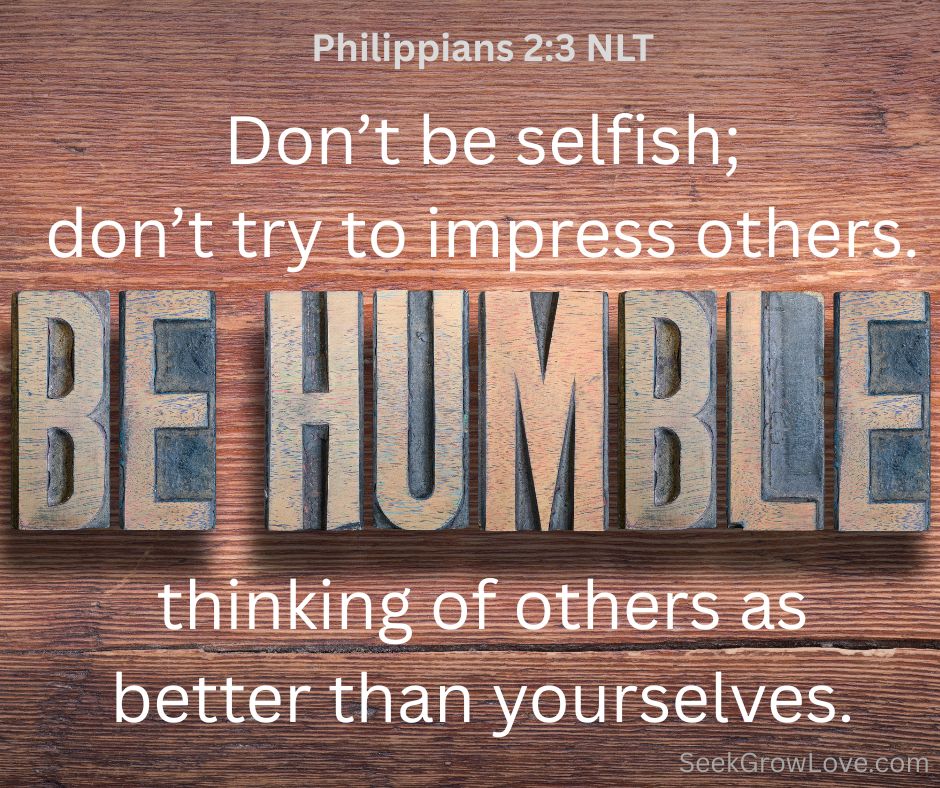
One of the sins that always frightens me most is the sin of pride. It’s slippery and hard to recognize because one of the symptoms of this particular sin is the inability to see a fault in ourselves. I’ve seen many people who claim humility – they are quick to point out their easily recognized flaws and will readily acknowledge when someone else is better than them at something that they are terrible at. I think of that as easy humility. It’s a quick reassurance to ourselves that we are not guilty of the terrible sin of pride. It makes us feel better about ourselves and our attitudes.

But pride doesn’t have to show up in every aspect of our lives. You can be humble about your skills playing an instrument, while still being enmeshed in pride in some other area. Sometimes pride disguises itself. For example, not seeking counsel because you believe you already have the answers? Pride. Insisting on things being done a certain way because you think it is the RIGHT way, when really it’s just the way you PREFER? Pride.

Philippians 2:3-4 says:

Do nothing out of selfish ambition or vain conceit. Rather, in humility value others above yourselves,  not looking to your own interests but each of you to the interests of the others.

It’s an easy thing to say. I bet most of us think we already place others before us. We serve others, we give of our time and resources, we pray over their needs. But Paul calls us to do more than this. He says do NOTHING out of selfish ambition or conceit. 

We all have agendas. We all have goals. Do every single one of our agendas and goals look out for the interest of others? I know mine don’t always. I struggle with shopping for gifts for others because I keep seeing things I would like to get myself! We are trained by the world to look out for ourselves! We must do what is best for ourselves! 

Let’s be clear – God wants you to take care of yourself and do good things for yourself as well. But in this letter Paul is talking to the church as a whole and to the people working within that church. We, as a body of Christ, are to be working together in complete humility, putting others before ourselves. I’ve had to say many times, both to myself and to others, “This isn’t about you.” 

Because it’s not. None of this is about you. The types of songs we sing in worship. How we conduct meetings. How the furniture is arranged. How we do prayer requests or announcements. What type of public events we hold. I could go on. None of those things are about you. 

We have one mission as a church. We are to live and serve like Christ. We are to go and make disciples, baptize, teach, serve, and love. We are to do Christ’s work, and not once did Jesus ever put his own agenda before God’s agenda. He was the ultimate example of what it looks like to put God’s will before our own. 

Reflection Questions: 

Where are you guilty of pride? Don’t stop at the easy answers either. Look deep. Do you find yourself getting frustrated over people in church doing things “the wrong way” when really it’s just not the way you would do them? Do you find yourself not asking for counsel in an issue because you think you already have the answer? Do you find yourself not praying over decisions?

What areas of your life would look different if you put others before yourself? What areas of your church would look different if you put others before yourself? (Note that I didn’t ask what areas would look different if OTHERS were more humble or selfless. We are looking just at ourselves, so don’t start down that dangerous path.)

Prayer:

My prayer for you is that our church bodies be united in humility to do Jesus’ work. I pray that we are able to keep the slippery sin of pride far away from us. I pray that others are able to see Jesus Christ in us because we are continually showing them love and putting them first above ourselves.

Relationship Inventory

Ephesians 4-6

Devotion by Jenn Haynes (OH)

Relationships are tricky things. They are a blessing to us, and yet they don’t come without thorns. God decided in the very beginning that we weren’t to be alone. We were created to be with others. The final three chapters of Ephesians center around how to be in relationships. From the bond found in church bodies and friendships,to slave/servant and master, to children and parents, to husband and wife, we see a wide array of relationships. And they all start in the same place: unity in Christ. 

What a tricky thing to do, being one in spirit and purpose when we aren’t always one in mind. For example, you could look at the political atmosphere in our country. I know Christians who are Democrat, and Christians who are Republican, and a vast array in between or beyond. They are definitely not of one mind, though I like to believe that most are of one spirit: they want our country to be a good, safe place to live. We just all have a different ideas of how that should happen, and we prioritize different ideals, right? 

The same goes in every relationship. In churches, I rarely see a lack of peace because someone desperately WANTS to go against Christ and destroy his church. Usually I just see different groups of people with different priorities and different ideas of how things should be done. One in spirit, but not one in mind. This holds true in every relationship. No matter how united we are in our goal, we will find differences that lead to conflict. 

So how do we handle relationships when we differ in mind? Paul gives us a lot of advice here, so I’ll list some highlights: 

1. Be humble, gentle, and patient in love. Show humility by admitting that maybe your way doesn’t have to be THE way. And of course be gentle and patient when you are disagreeing.

2. Seek God in determining your place in the body of Christ, as well as in your relationships. Many times our conflicts occur because we have stepped away from where God wants us. 

3. Deal with your anger in a Godly way. Don’t let it take root and stew in your bitterness. Evaluate what you’re actually angry about. Is it righteous anger? Is this anger God would have in the same situation, or is this YOUR anger – anger that things aren’t going the way YOU want them to. If it’s Godly anger, then you need to speak up in truth. If it’s your anger, then you need to stop letting it get in the way of the work God wants to do in you and through you. 

4. No unwholesome talk. This means you DON’T put others down. You don’t gossip, and you don’t say hurtful things about those who are one with you in the body of Christ. You don’t put down your children, you don’t put down your spouse, you don’t put down your friends, and you don’t put down your church body. You can’t be unified in mind and purpose if your speech is keeping you apart.

5. Ephesians 4:32 – Be kind and compassionate to one another, forgiving each other, just as in Christ God forgave you.  That verse is so important to good relationships that I put it to song and had my children memorize it when they were small. God forgave you for all your stupid, stupid mistakes, sins and words. So forgive others for theirs. 

6. Do not wait for others to follow Paul’s advice here. It starts with you. Paul didn’t say this, but we see it in every example of a good disciple. You can’t control others’ actions and emotions. But you can control yours. And good disciples take the first steps and live as an example to others. 

Paul goes on in the rest of Ephesians with more good advice, specifically pertaining to certain relationships. But these foundations he lays out in chapter four pave the way. You are called to be united in Christ. So it’s time for a relationship inventory. 

Reflection Questions:

 First, are you united in spirit in this relationship? (As in, do you have the same goal, and is that goal Godly?) If you aren’t, then maybe it’s time to place some safety distance in that relationship so that it doesn’t affect the work God would like to do in your life. If you ARE united in spirit, you can move on to further analysis. 

If you’re united in Spirit, are you currently not united in mind about an issue? 

Are there negative feelings attached to that issue? Are you angry, bitter, hurt, jealous, anxious, or something similar? You need to find out the root cause. Do those feelings stem from something that is ungodly, or do they come from a more personal place? If you look at it hard enough, is this really just a difference of opinion, or is this an issue of righteousness? Most of the time, it’s a difference of opinion. If that’s the case, it’s time to start looking at Paul’s suggestions there in chapter 4. Most of all, show love. Rather than saying, “I’m angry at this person because of….” start actively saying, “I love this person because…” and you will see a radical shift in your relationships with others. Even if you have to start small with, “I love this person because God told me to.” Doing what God asks is a wonderful place to start. 

Prayer Thoughts:

My prayer for you today is that you read through these passages and really try to apply them to your relationships. I pray that you are able to recognize a difference of opinion for what it is – a difference in how your beautiful brains think, not a reason to be angry and distrustful. I pray that you find unity in spirit and unity in mind in your relationships. I pray that when you don’t find that unity, you step up and be a good disciple by making the first move toward togetherness. I pray that you love and forgive others as Christ forgave you.

The Meaning of the Mystery

Colossians 1-4

Wow – today we have the whole book of Colossians to read and digest.   After Ephesians  Colossians is the next doctrinal and correction teaching which we have in our Bibles.  The message of the kingdom is proclaimed all through the Old Testament and the blessing to the Gentile nations is included in that message.  However, the fulness of the teaching of the mystery of the church of the body of Christ is hinted at in Romans 16:25, talked about in 1 Corinthians 2 and especially in 15:50-58, explained at length in Ephesians 3, and now the glory of the mystery proclaimed in Colossians 1:26-27.  What is this mystery and why is it so important to the church that Paul would put so much emphasis on it?

The book of Colossians is one of the ones written by Paul while in prison at Rome.  It follows Ephesians in the pattern where the first half of the book is doctrinal teaching and the second half of the book is a practical section correcting and teaching us how to live out this amazing Christ in us.  Read these 4 short chapters with this main distinction in mind.

Colossians 1:15-18(NKJV)  He is the image of the invisible God, the firstborn over all creation. 16 For by Him all things were created that are in heaven and that are on earth, visible and invisible, whether thrones or dominions or principalities or powers. All things were created through Him and for Him. 17 And He is before all things, and in Him all things consist. 18 And He is the head of the body, the church, who is the beginning, the firstborn from the dead, that in all things He may have the preeminence.

The meaning of the mystery is that it is the sacred secret of God’s purpose which has been revealed to those that have the ears to hear and eyes to see.  Christ died for our sin and to give us a newness of life which we now can receive.  This brings us as children into the family of God, members of His own household.  The body of Christ is a spiritually bonded people who all have the DNA of holy spirit to bring us together.  Whether Jew or Gentile, slave or free, male or female we all become one in Christ.  All tribalism is swallowed up by the coming of the one body of Christ with him as the head.  It is Christ in each one of us which then unites us together.  Amazing what God has done for us!!

The message of the kingdom changes on the day of Pentecost when the new covenant is instituted with believers in Christ. The time period between the passion of Christ and his glorious kingdom on earth was not revealed in the OT Bible.  That is why the apostles ask him before Jesus ascends whether the kingdom is going to be restored that day.  Jesus answers them that the timing of all these events are in the Father’s hands.  The mystery revealed by Paul and Peter later on is that the time of the church of the body of Christ is now and is alive in Christ.

Colossians 1:24-28 I(NKJV) now rejoice in my sufferings for you, and fill up in my flesh what is lacking in the afflictions of Christ, for the sake of His body, which is the church, 25 of which I became a minister according to the stewardship from God which was given to me for you, to fulfill the word of God, 26 the mystery which has been hidden from ages and from generations, but now has been revealed to His saints. 27 To them God willed to make known what are the riches of the glory of this mystery among the Gentiles: which is Christ in you, the hope of glory. 28 Him we preach, warning every man and teaching every man in all wisdom, that we may present every man perfect in Christ Jesus.

Ephesians 3:6-7(NLT) And this is God’s plan: Both Gentiles and Jews who believe the Good News share equally in the riches inherited by God’s children. Both are part of the same body, and both enjoy the promise of blessings because they belong to Christ Jesus. 7 By God’s grace and mighty power, I have been given the privilege of serving him by spreading this Good News.

How does the mystery revealed intersect with our preaching and teaching of the kingdom message?

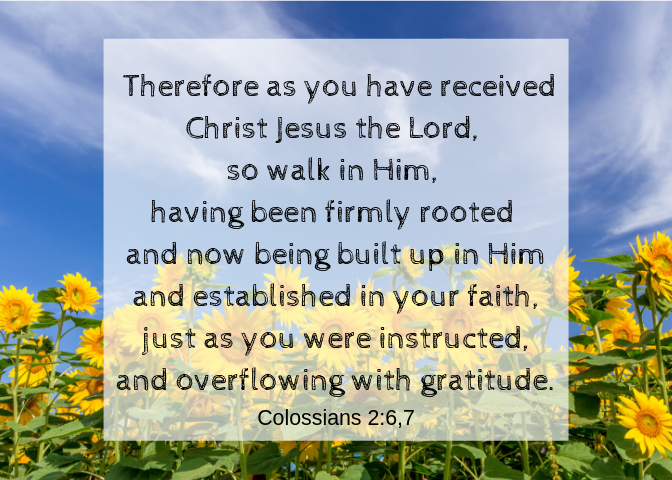
Colossians 2:6-10(NLT)  And now, just as you accepted Christ Jesus as your Lord, you must continue to follow him. 7 Let your roots grow down into him, and let your lives be built on him. Then your faith will grow strong in the truth you were taught, and you will overflow with thankfulness. 8 Don’t let anyone capture you with empty philosophies and high-sounding nonsense that come from human thinking and from the spiritual powers of this world, rather than from Christ. 9 For in Christ lives all the fullness of God in a human body. 10 So you also are complete through your union with Christ, who is the head over every ruler and authority.

Chapters 3 and 4 are the practical application teaching us about the doctrine taught in chapters 1-2.

How do the message themes compare between chapters 1-2 to chapters 3-4? 

Colossians 3:12-15(NLT) Since God chose you to be the holy people he loves, you must clothe yourselves with tenderhearted mercy, kindness, humility, gentleness, and patience. 13 Make allowance for each other’s faults and forgive anyone who offends you. Remember, the Lord forgave you, so you must forgive others. 14 Above all, clothe yourselves with love, which binds us all together in perfect harmony. 15 And let the peace that comes from Christ rule in your hearts. For as members of one body you are called to live in peace. And always be thankful.

What is our motivation for doing the good works God calls us to do?

Colossians 4:2-6(NLT) Devote yourselves to prayer with an alert mind and a thankful heart. 3 Pray for us, too, that God will give us many opportunities to speak about his mysterious plan concerning Christ. That is why I am here in chains. 4 Pray that I will proclaim this message as clearly as I should. 5 Live wisely among those who are not believers, and make the most of every opportunity. 6 Let your conversation be gracious and attractive so that you will have the right response for everyone.

How do we develop our willingness and ability to give a Godly answer to every person we talk to about Christ?

I pray for you as did Paul centuries ago that you will live out this wonderful mystery of Christ as part of the body of Christ, his church.  Remember who you are this day!

Love in Christ Tom Siderius