You Do You! or ?

Proverbs 14

Proverbs 14 12 NIV.png

“You do you!” This phrase is ubiquitous… I’ve seen it on social media, heard it on commercials,  and tween shows my daughter enjoys watching. I’ve even heard actual people say it directly to actual people. 🙂

On the face of it, it’s a pretty positive and encouraging phrase.  Don’t let others define you. Do what you enjoy. Do what makes you happy! And that’s all great and wonderful…to a point. That point is the Holy Bible. You can totally do You if the You that you do is aligned with God’s word. The problem comes when your You goes with whatever you FEEL is right, rather than what you KNOW is scriptural.

Here in Proverbs 14 (especially in verse 12) we are reminded that so many of the things, thoughts, and actions we think are right, actually lead to destruction.

Proverbs 14:1 really hit me hard in this area. Unlike the wise woman building her house, I was letting my struggle with anger threaten mine. For a season, my anger was quick, hot, and in my mind, justified. I was right to be angry. I was being taken for granted, no one understood what I was going through, why was everything up to me???  I often felt the anger from my stomach up to my jaw.  Proverbs 14 repeatedly warns of the folly of anger (16, 17, 29) but I was choosing to follow my feelings over wisdom.

I thought I was right…but only because of the grace of God and a forgiving family, my “rightness” did not lead to destruction.

Everyone should evaluate their You. If doing You involves sin (Galatians 5:19-21), you must let that go. Christ goes even further to say that if we are to be his disciples, we must DENY ourselves, take up our crosses, and follow him (Matthew 16:24).

When looking to Godly wisdom, such as found in Proverbs 14, You will start to look less like you and more like Christ. That is true wisdom.

So this song came out when I was 14 (1986). Having it tucked in my head has often helped me make choices to please God.


God Pleaser by Petra

So many voices telling me which way to go

So many choices come from those who think they know

There’s a way that seems right to a man

But it only brings him death

I want to go the way that leads to life

Till I draw my dying breath

Don’t want to be a man pleaser – I want to be a God pleaser

I just want to have the wisdom to discern the two apart

Don’t want to be a man pleaser – I want to be a God pleaser

I just want to do the things that please the Father’s heart

Some make a sacrifice and never let it show

Some make a point of letting everybody know

Some will live their lives as unto men

And they have their reward

I just want to do everything I do

With all my heart unto the Lord

I just want my life to glorify His Son

To make my Father proud that I’m His child before I’m done

No need to pat me on the back or stop to shake my hand

I just want to hear my Father say “Well done, well done”

I just want to hear my Father say “Well done”


devotion by Maria Knowlton

A Preserving Parable from Proverbs

Proverbs 13

Proverbs 13 4 NIV

Despite the fact that I’m an adult, I still occasionally give into peer pressure. Years ago, my friends were all into preserving fruits and vegetables, so I thought I should, too.  I didn’t want to miss out on the fun. Not knowing what I was doing, I was happy to find the book, Canning for Dummies, at the local bookstore. Reading through the book, I realized that what makes the book “for dummies” was the use of the pedagogical tool, repetition. Every important step was printed in bold, circled, and repeated…repeatedly.

I suppose you can call Proverbs 13, “Wisdom for Dummies.”  The writer, inspired by God, wants the readers to take into consideration the differences between the wise, upright, righteous, and hardworking versus the foolish, wicked, and lazy.  In this chapter, 6 verses point out the rewards of being wise, 6 verses point out the rewards of being righteous, and 7 verses point out the rewards of being disciplined and hardworking.  Clearly the author believes these values to be highly prized and worth remembering. Thus, the repetition! Read it, Know it, Live it, Repeat. Hide these words in your heart.

It turns out preserving food is hard work and messy (maybe that’s just me). But it’s also very satisfying.  I feel great at the end of a day of canning. I also feel great months later when I serve my family home-preserved corn and green beans while it’s snowing outside. And because I’ve read Canning for Dummies so often and done it so often, I can tell you how to can green beans and blanch corn by heart.

Similarly, there is much satisfaction in learning and living the importance of wisdom, discipline, hard work and knowing it by heart.

Maria Knowlton

How to Be Stupid

Proverbs 12

Proverbs 12 1 NASB

As I read though this chapter, one of the things I noticed was a handful of verses talking about taking criticism and counsel, and what type of counsel we give others.  This starts in verse 1.

Whoever loves discipline loves knowledge,
But he who hates reproof is stupid.

When we mess up, how do we accept it being questioned or pointed out?  Do we want to grow and not make the same mistake again, or do we hate to be told we messed up?  This verse doesn’t pull any punches.  If you hate reproof, you are stupid.

Verses 5 and 6 continue this:

The thoughts of the righteous are just,
But the counsels of the wicked are deceitful.
The words of the wicked lie in wait for blood,
But the mouth of the upright will deliver them.

Where are we getting our counsel from?  Are we listening to the righteous, or to the counsel of the wicked?  If we are listening to the wrong people, we have a serious problem.  Their words are lying in wait for blood.  They are working to drag us down with them.  We need to make sure we are surrounding ourselves with people filled with Godly wisdom, and listening to their counsel.

Verse 15 says:

The way of a fool is right in his own eyes,
But a wise man is he who listens to counsel.

Maybe we aren’t listening to the wicked, but we also aren’t listening to the wise.  Instead we think we know it all and don’t need to get help from anyone else.  Maybe we are ashamed to admit we don’t know how to deal with a problem we have and because of that we try to deal with everything on our own.  No matter what the reason, we are a fool if we do not seek counsel.

We need to get counsel from wise and righteous people.  We also need to give wise counsel, and in some cases this may mean admitting we don’t know the answer.

There is a ton of other things we can learn from this chapter so take time to look it over.  The chapter ends with a familiar sentiment:

In the way of righteousness is life,
And in its pathway there is no death.  (Proverbs 12:28)


Andrew Hamilton

Don’t Slip to the Default

Proverbs 11

Proverbs 11 3 NASB

Today is another comparison between the righteous and the wicked.  This time most of the comparisons are about outcomes.  Although it may already be clear, there is a relationship between wisdom and righteousness.  There is also a relationship between fools and the wicked.  Because of temptation always trying to lead us astray, fools turn towards wickedness, but it takes seeking wisdom to be righteous.

Verse 3 through 6 say:

The integrity of the upright will guide them,
But the crookedness of the treacherous will destroy them.
Riches do not profit in the day of wrath,
But righteousness delivers from death.
The righteousness of the blameless will smooth his way,
But the wicked will fall by his own wickedness.
The righteousness of the upright will deliver them,
But the treacherous will be caught by their own greed

We see that the upright or righteous person will be delivered from death.  The fool or wicked person will be destroyed.  The money, possessions or whatever else they have gained from their crooked ways cannot save them.  We see people who have gained wealth and power from all kinds of things that are not pleasing to God.   We see people that appear to have it made who are not seeking God’s wisdom.  We see righteous people who are seeking God’s wisdom go through struggles.  However, It is made very clear that no matter what people gain from their wicked ways, in the end it will catch up with them and they will be destroyed.  In the end, the righteous ones will be delivered.

Another example from this chapter is verses 24-26

24 There is one who scatters, and yet increases all the more,
And there is one who withholds what is justly due, and yet it results only in want.
25 The generous man will be prosperous,
And he who waters will himself be watered.
26 He who withholds grain, the people will curse him,
But blessing will be on the head of him who sells it.

There are people who teach that this is specifically talking about wealth in the current time.  They say that if you give away $10.00, you will get $100.00 in return.  I don’t think that is accurate, and I don’t think it is even a great blessing compared to all the blessings that God does give us.  However, the generous man is the one who is doing what God wants, which makes it a wise decision.  The generous will be blessed.  The miser who withholds everything for himself will be cursed.  I think some of this comes in everyday life.  If someone who is generous and helpful has a problem, often people will help that person.  However, when someone who is greedy and never helps anyone else has a problem, people are unlikely to help that person.

Verses 29 and 30 say:

He who troubles his own house will inherit wind,
And the foolish will be servant to the wisehearted.
30 The fruit of the righteous is a tree of life,
And he who is wise wins souls.

The outcome of seeking Godly wisdom and following in God’s righteousness is life for themselves and for the souls they win.  We have to choose daily to seek after wisdom.  If we make no choice, foolishness and ultimately destruction are the default choice.

Andrew Hamilton

Watch Your Words

Proverbs 10

Proverbs 10 8

This chapter contrasts the righteous person versus the wicked person.  There are so many things that could be written about, and I started to pick and choose a few to write about.  As I read the chapter a few times, I was struck by how many times the mouth, or what we say was mentioned.

Blessings are on the head of the righteous,
But the mouth of the wicked conceals violence

The wise of heart will receive commands,
But a babbling fool will be ruined.

11 The mouth of the righteous is a fountain of life,
But the mouth of the wicked conceals violence.

13 On the lips of the discerning, wisdom is found,
But a rod is for the back of him who lacks understanding.
14 Wise men store up knowledge,
But with the mouth of the foolish, ruin is at hand.

18 He who conceals hatred has lying lips,
And he who spreads slander is a fool.
19 When there are many words, transgression is unavoidable,
But he who restrains his lips is wise.
20 The tongue of the righteous is as choice silver,
The heart of the wicked is worth little.
21 The lips of the righteous feed many,
But fools die for lack of understanding.

31 The mouth of the righteous flows with wisdom,
But the perverted tongue will be cut out.
32 The lips of the righteous bring forth what is acceptable,
But the mouth of the wicked what is perverted.

These are some of the verses, but maybe not all.  We can often see a lot about ourselves (and others) by what is said or not said.  Listen to what comes out of your mouth.  Are you listening, or receiving commands, or are you babbling and therefore unable to hear the instruction?  Are you choosing when to talk and when to refrain?  Are you speaking righteousness?  It is often hard to control what we say but doing this is a sign of wisdom and righteousness.

This topic is something that shows up several other places in proverbs, as well as other places in the Bible.  I think of James 1:19.

This you know, my beloved brethren. But everyone must be quick to hear, slow to speak and slow to anger;

We often speak without thinking or think about what we should say instead of listening to the other person.  Then, what comes out of our mouth is either not appropriate or not helpful.  We often don’t like silence, so we say something just to have noise, even if it is not useful.

I encourage you to pay attention to what you are saying, and when you are talking.  Take time to listen.  Take time to gain from what others are saying.  Take time to allow silence to occur.  Our words are a good indicator of whether we are seeing wisdom or being fools.

Andrew Hamilton

The Battle Rages On

Proverbs 9

Wisdom vs. Folly

This chapter starts with wisdom again calling out to the naïve and the foolish.  Wisdom is calling for everyone to forsake folly and proceed in understanding.   This is very similar to what we saw in chapter 8.

Starting in verse 7, it changes topics a bit.

He who corrects a scoffer gets dishonor for himself,
And he who reproves a wicked man gets insults for himself.
Do not reprove a scoffer, or he will hate you,
Reprove a wise man and he will love you.

It seems like we should try to help everyone gain wisdom, and that would be great.  However, is someone does not want to gain wisdom, or isn’t open to listening to you, you need to be prepared for their reaction.  You may be insulted or even hated for trying to impart wisdom.  I don’t think this means that you should give up on those who insult you, but possibly there are times to back off or change tactics.

On the other hand, we should each look at how we respond to someone who is trying to Proverbs 9 9 NIVhelp us seek wisdom.  Are we upset when someone points out that we are not making the best decision?  Or, do we appreciate the instruction being given to us.  This is a sign of where each of us are in our pursuit of wisdom.  Verse 12 says:
If you are wise, you are wise for yourself,
And if you scoff, you alone will bear it.

If we are scoffers, we are lacking in wisdom and will have to deal with that ourselves.

Then, starting in verse 13, we see another section where folly is being personified and calling out to people, trying to pull them away from wisdom.  There is a battle between wisdom and folly shown between the beginning and the end of the chapter.  This is showing us that gaining wisdom is not easy, even when that is what we want.  We know the outcome of seeking wisdom, and the outcome of folly.  So, we need to make sure we are continuing to seek wisdom and not be lead astray by folly.

Andrew Hamilton

A Word for the Fools

Proverbs 8

Proverbs 8 35 NIV

This chapter is very poetic and filled with a personification of wisdom.  It is used to draw people in and make the writing more personal, and to have greater impact.  I think this is a way of showing how important Godly wisdom is, and how important it should be to each of us.  The idea that wisdom is calling out at the entrance of the city so that we can each hear “her” is an interesting idea.  Obviously, wisdom is a virtue that we should aspire to, not a being.  However, it is so important, and so beneficial to each of us, something that God desires each of us to have, it is as if wisdom is crying out to us, and we need to listen.

If wisdom is something that we aspire to, why do we need this chapter showing all the strengths of wisdom?  Why do we need to hear wisdom calling out to us?  Why do we need to be told again to heed instruction?  This has already been stated multiple times in the first 7 chapters of proverbs.

Verses 4 and 5 say:

To you, O men, I call,
And my voice is to the sons of men.
“O naive ones, understand prudence;
And, O fools, understand wisdom.

Maybe this isn’t for all of us.  We are all “men” (or people) and sons (or children) of men, but verse 5 specifically talks to naïve ones and fools?  So, maybe this is just for people who aren’t getting it yet.  But, maybe if we are thinking it is just for the naïve or fools, we are being naïve and foolish.

Verses 7 and 8 say:

“For my mouth will utter truth;
And wickedness is an abomination to my lips.
“All the utterances of my mouth are in righteousness;
There is nothing crooked or perverted in them.

When I look at this, I have to admit that not everything I say is done in righteousness.  I say things out of anger at times.  I say things at times when I should jut keep my mouth shut.  So, I still need help with wisdom.

I can read through this chapter and point out things in nearly every verse that shows how important wisdom is.  We obviously need to be reminded of this often, based on how often it is written about.  I encourage you to read through this and pick out each of these items.   The end of the chapter summarizes why we should do this:

“Now therefore, O sons, listen to me,
For blessed are they who keep my ways.
33 “Heed instruction and be wise,
And do not neglect it.
34 “Blessed is the man who listens to me,
Watching daily at my gates,
Waiting at my doorposts.
35 “For he who finds me finds life
And obtains favor from the Lord.
36 “But he who sins against me injures himself;
All those who hate me love death.”

Wisdom comes from God and will only be gained when following God.  This will lead to eternal life.  If we turn away from wisdom, we are turning away from God, and that leads to death.

Andrew Hamilton

Seduced by Temptation

Proverbs 7

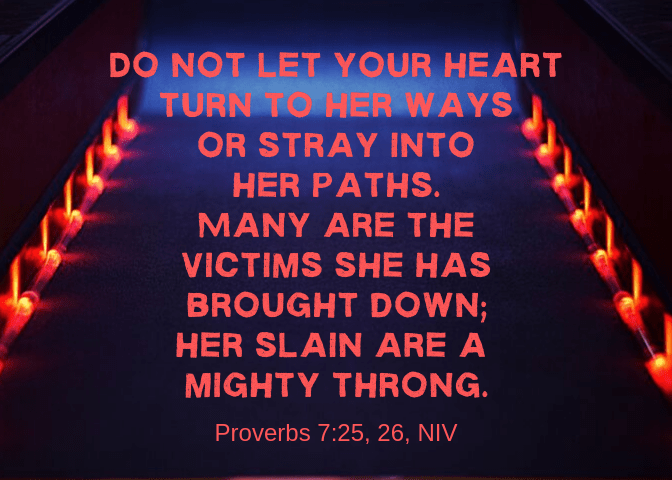
Proverbs 7 25 26

The first five verses of this chapter again talk about how important it is to have wisdom.

My son, keep my words
And treasure my commandments within you.
Keep my commandments and live,
And my teaching as the apple of your eye.
Bind them on your fingers;
Write them on the tablet of your heart.
Say to wisdom, “You are my sister,”
And call understanding your intimate friend;
That they may keep you from an adulteress,
From the foreigner who flatters with her words

This is re-iterating what a lot of chapter 1 talks about.  It is not enough to just know the commands and teachings.  You must consider them as some of the most important things you know.  Following the commands and having wisdom will allow you to live.  This implies that a lack of wisdom will bring death.  The rest of the chapter details how this can lead to serious harm, and death.

The rest of the chapter can be a literal case of a man being seduced by a woman, or it can be symbolic of any person being tempted and falling to that temptation.  This shows a pattern of falling.  The first step is going to a place where the temptation is found.  This is in verse 8 where it talks about passing near her corner, and then going all the way to her house.  Wisdom would show that we should avoid going around things where we know we will be tempted.

Then, verse 9 says that this is being done in the darkness, or when we don’t think people can see us.  In most cases, if we are going to sin, it is going to be when people are not watching, or at least people that we know would be bothered by what we are doing.  Again, if we are wise, we will surround ourselves with people who will help us avoid temptation and stay away from those who draw us in to sin.

Then, when we are close to temptation, the sin can look very appealing, and it appears that we won’t get caught – so it is okay.  Verses 17-21 are showing this when talking about the couch and bed being adorned, and when it talks about the husband being gone for a long period of time.

With all of this, the man being talked about in this passage falls into temptation and sins.  He does not know this will cost him his life according to verse 23.  This is not saying that falling into temptation once and sinning means death, but when we fall into a temptation and are not wise enough to run from that in the future, we are going to fall into that same temptation again and again.  Then, we will escalate the sin, and get sucked into it until it is a lifestyle.

Wisdom, specifically Godly wisdom, is critical to both avoiding unnecessary problems in this life and in having eternal life in the kingdom.  This can only be accomplished by treasuring scriptures and a relationship with God.

Andrew Hamilton

What Do You Owe?

Proverbs 6

Proverbs 6 23 NIV

This chapter can be broken into two sections.  The first section is about how we deal with situations where we owe something to someone.  Some of you may be thinking that you don’t owe anything to anyone, and you have not offered a security for what someone else owes, so this doesn’t apply to you.  That is good, but remember it is unlikely you will go through life without owing anything, so be prepared.

So, how do we deal with owing someone?  Verses 3 and 4 say:

So do this, my son, to free yourself,
since you have fallen into your neighbor’s hands:
Go—to the point of exhaustion—
and give your neighbor no rest!
Allow no sleep to your eyes,
no slumber to your eyelids.


We need to work hard to free ourselves.  We need to repay what we owe as quickly as possible.  We also need to repay this through honest measures.  Verses 16-19 talk about this:


There are six things the Lord hates,
seven that are detestable to him:
17         haughty eyes,
a lying tongue,
hands that shed innocent blood,
18         a heart that devises wicked schemes,
feet that are quick to rush into evil,
19         a false witness who pours out lies
and a person who stirs up conflict in the community.

These verses by themselves are good wisdom, but don’t seem to have anything to do with owing someone.  However, in the context of working hard to repay what we owe, it could be tempting to scheme, or cheat our way out of what we owe.  Doing this would cause us to do at least one of the things God hates.  So, when we owe anything, we need to take responsibility for it , and work hard and honestly to pay it back as quickly as possible.

The chapter then transitions to talking about adultery.  This seems to be an abrupt transition to me, and I thought about that for a while.  Then, I thought of the 10 commandments, and specifically Exodus 20:17:

“You shall not covet your neighbor’s house; you shall not covet your neighbor’s wife or his male servant or his female servant or his ox or his donkey or anything that belongs to your neighbor.”

So, both parts of this really come back to wanting what we don’t have.  We borrow to get what we don’t have, and adultery comes from wanting what we don’t have.

Acting on either of these will cause us trouble, but the problems caused by adultery will be much greater.  Verses 30-33 show this:

People do not despise a thief if he steals
to satisfy his hunger when he is starving.
31 Yet if he is caught, he must pay sevenfold,
though it costs him all the wealth of his house.
32 But a man who commits adultery has no sense;
whoever does so destroys himself.
33 Blows and disgrace are his lot,
and his shame will never be wiped away.


I think the chapter really shows the perils of not being content with what we have.   We can be content with everything we have in live because God is always with us as stated in Hebrews 13:5:

Make sure that your character is free from the love of money, being content with what you have; for He Himself has said, “I will never desert you, nor will I ever forsake you,”


Andrew Hamilton

Judy’s Candy Bar Story

Proverbs 5

Proverbs 5 23 NIV

Solomon begins Proverbs 5 again reminding us to seek out God’s wisdom. We must not only hear the wisdom offered, but we must absorb that wisdom and apply it to our lives, so that we can make wise and moral decisions.  Then your “lips may preserve knowledge”.  In other words, the things we say will be full of knowledge and insight.  Solomon knows that we need God’s wisdom to help us make wise choices, because we are constantly facing temptations.

Solomon continues the chapter talking about our temptations, using the example of an adulterous woman.  He says, “For the lips of the adulterous woman drip honey, and her speech is smoother than oil.” (Proverbs 5:3) Simply put, this means that this immoral woman may come to you with sweet, flattering words.  She will look and sound very tempting.  She will tell you whatever it takes to lure you into believing that sexually sinning with her will bring you nothing but joy and happiness.

However, the next few verses go on to say, “But in the end she is bitter as gall, sharp as a double-edged sword. Her feet go down to death; her steps lead straight to the grave.  She gives no thought to the way of life; her paths wander aimlessly, but she does not know it.”  (Proverbs 5:4-6)  In verse 3 it seemed as though the woman was offering bliss, but we find out in these verses that she actually will lead us to suffering and death.  You notice it says “her steps lead straight to the grave”.  We are all moving on a path.  Each day we make countless decisions that are leading us down a path.  We need to be using the wisdom God has provided to us in the Bible to make sure we are making choices leading us on the right path.

In verse eight Solomon goes on to offer this advice, “Keep to a path far from her (the adulteress), do not go near the door of her house.”  The message here is stay as far away from temptation as possible.  Do not put yourself in situations that will tempt you to sin.

The story of Judy’s chocolate bar is the perfect illustration of the stay-as-far-away-from-temptation-as-possible principle.  Judy loves chocolate.  In fact, Judy loves chocolate too much, so she decides to not eat chocolate for a month.  One day, after deciding to give up chocolate for a month, Judy is at the grocery store buying food for dinner.  While at the store, Judy decides to just go down the aisle where the chocolate is.  She is not going to buy any, she just wants to look at it.  As she gets closer to the chocolate she notices that it is on sale.  Judy decides to purchase just one bar of chocolate.  She will not eat it now, but it is on such a good sale, she wants to take advantage of the bargain and buy it for later.  When she gets home from the store, she keeps thinking of the chocolate bar that is now sitting in her cupboard. Judy believes that just getting to smell the chocolate will be very satisfying and help her to stop craving the chocolate, so she unwraps the chocolate bar and takes a large whiff of the delicious chocolate.  It smells incredible.  Judy sets a small piece of the chocolate on her tongue, not to eat it, but just to take a little lick.  You guessed it, soon the chocolate is gone!  Judy devours the entire bar.  The question is, when would it have been easiest for Judy to refrain from eating the chocolate? Would it have been easier to not eat the chocolate when it was sitting in the wrapper in the cupboard, or when it was sitting on Judy’s tongue?  What if Judy had never gone down the chocolate aisle at the store, but had instead just gone to the fresh produce section?

We need to constantly pursue wisdom, so that we can make God-pleasing choices.  We must be vigilant so that we do not believe any of the world’s lies. And finally, when we have identified what our stumbling blocks are, we must stay far away and avoid those temptations.

Jill McClain