Oh Dear Lord, please be with my mouth and teach me what I shall speak! Because my mouth is not eloquent.
Sometimes it is downright rude. Sometimes it lies. Sometimes it gets angry. Sometimes it hurts people.
Oh Dear Lord, please be with my mouth and teach me what I shall speak! Sometimes it stays shut when it should open to speak your words. Sometimes it forgets to give you praise. Sometimes it prefers to be grouchy or selfish instead of thankful.
Oh Dear Lord, please be with my mouth and teach me what I shall speak! Sometimes it doesn’t speak up for the oppressed. Sometimes it misses opportunities to spread joy and hope and your love. Sometimes…
Oh Dear Lord, please be with my mouth and teach me what I shall speak!
In Exodus 3 & 4 Moses is giving God lots of reasons (excuses) why He should pick someone else for the job of delivering God’s first-born child (the Israelites) out of slavery in Egypt.
I am nobody special
I don’t even know your name
The elders won’t believe me
I am not eloquent
Somebody else can do it better
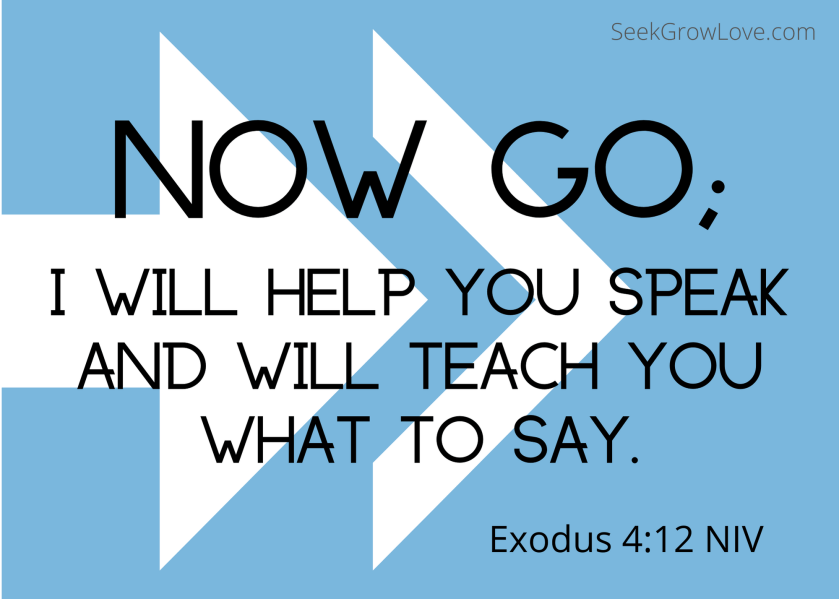
God has answers for it all. I love the Lord’s words in Exodus 4:12 (ESV): “Now therefore go, and I will be with your mouth and teach you what you shall speak.” What a beautiful promise! Yet, Moses still pleaded with Him to just send someone else! God got angry at that one. How many times does this child of God need to be reassured that his God is bigger than any fear that comes with doing His Work. The maker of your mouth can teach you how to use it – when you step up and GO where He wants you to GO! Did you notice that little two letter word at the start of God’s promise to be with Moses’ mouth and to teach him what to say? You’ll never know what words God is waiting to teach you to say if you say no and don’t go.
God graciously compromised with Moses and rather than sending someone else instead of Moses, He sent someone else to go along with Moses, his brother Aaron who was not ‘coincidentally’ coming out to the wilderness to meet Moses.
Maybe it’s time I spend less time on my excuses and instead say YES, step out and GO and trust God to do what He says He will do – be with my mouth and teach me what I shall speak!
-Marcia Railton
Reflection Questions
What excuses have you tried giving God for not stepping out to do a job He wants you to do? How do they stand up to your GREAT BIG GOD?
How can you be someone’s Aaron and come alongside him/her to do a job for God that perhaps neither of you would feel you could do “on your own”? Though, you are of course never “on your own” when you are doing the Lord’s work!? What are some other instances that God used the buddy system and what were some advantages to having a partner?
So – the big question is – where does God want you to go? If you aren’t sure yet, be praying. And then, thank Him for being with your mouth and teaching you what you shall speak.
I never grow tired of hearing my children belt out uplifting lyrics from the back of our van! I especially appreciate the passion in their voices reverberating throughout the vehicle every time we play Rachel Platten’s “Fight Song” :
This is my fight song
Take back my life song
Prove I’m alright song
My power’s turned on
Starting right now I’ll be strong
I’ll play my fight song
And I don’t really care if nobody else believes
‘Cause I’ve still got a lot of fight left in me
While I’m encouraged by the song’s positivity, I can’t help but think of how little fight I feel I have left in me some days. I doubt I’m the only one who is burdened under anxiety, societal pressures, responsibilities at work and home, fear of the future, difficult decisions, sickness and death of loved ones, mysterious health issues, spiritual warfare, and a plethora of other emotional and physical plagues. I often feel like I just. can’t. do. it. The fight requires too much of me sometimes, and there is little motivation or strength left with which to fight. Can you relate?
Nehemiah’s construction team could relate! Sanballat and Tobiah were relentlessly hurling insults, threats, and discouragement at the builders. Not only was there oppression from outside their walls, but there was turmoil with them as well. The motley crew was trying to fix the wall – a monumental aspiration! – while also dealing with the other negative issues of daily life, which seemed to be compounding. And it was wearing on them. They already felt defeated, but the work was not yet complete. They were nearing the ends of their metaphorical ropes, anticipating the last symbolic straw that would break the camel’s back.
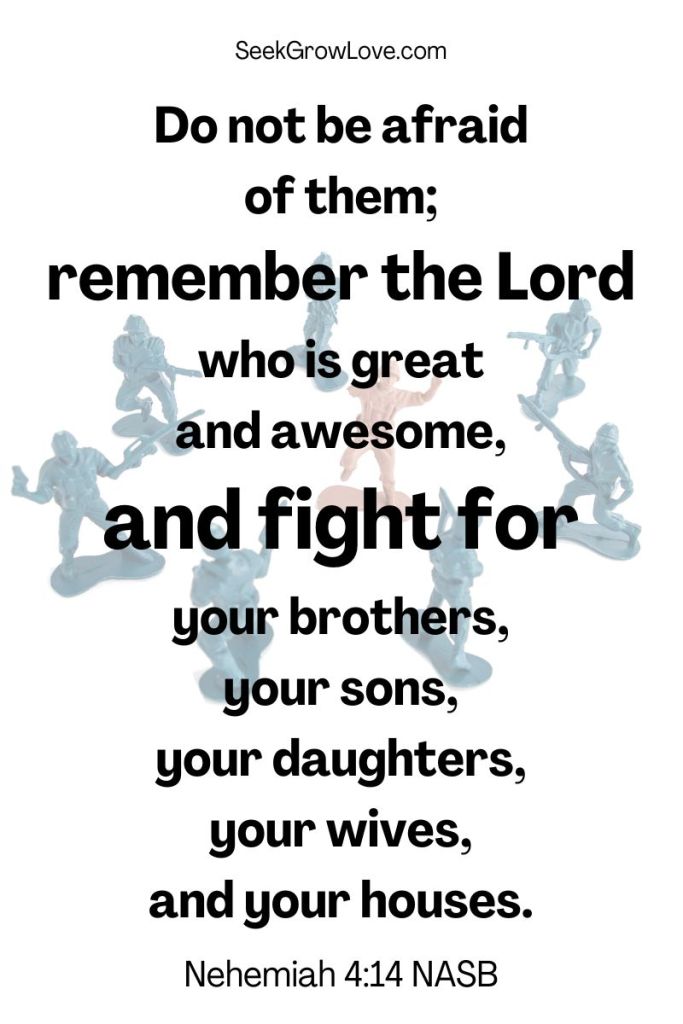
Nehemiah took action to provide defense for the workers, but most of all, he encouraged them to keep going! “… I stood up and said to the nobles, the officials and the rest of the people, “Don’t be afraid of them. Remember the Lord, who is great and awesome, and fight for your families, your sons and your daughters, your wives and your homes… Wherever you hear the sound of the trumpet, join us there. Our God will fight for us!” (4:14, 20)
Not only did Nehemiah help resolve some of the immediate burdens of the people and foil the plans of their enemies, he also helped them remember the reason for their work so they could be filled with the mettle needed to recommence this noble work .
Not long after I prayed for God to revive the fighter’s soul within me, a new-to-me song by Rend Collective called “Shackles” rang through my speaker on autoplay. I paused in awe when I heard the chorus:
You’re my deliverer
My anthem through it all
When my strength and my fight is gone
I know You will come through
As I soaked in the life-giving lyrics, I was humbled by God’s gentle reminders of His provision. When my strength and my fight are gone, God will be my strength. He will fight for me (see Exodus 14:14). He will give us the strength and courage to do what he has called us to do. Remember your God; He will fight for you.
These verses from our poetry reading apply to the Nehemiah story:
Psalm 147:2-3, 10-11:
The Lord builds up Jerusalem;
He gathers the exiles of Israel.
He heals the brokenhearted
and binds up their wounds…
His pleasure is not in the strength of the horse,
nor his delight in the legs of the warrior;
the Lord delights in those who fear him,
who put their hope in his unfailing love.
-Rachel Cain
Reflections:
Think back on some of the dark times in your life. How was God faithful to encourage you and bring you through it?
Keep a journal of ways God has answered prayers and provided in big and small ways so you can look back on it during times of doubt.
If the teacher or professor accidentally leaks the answers for the upcoming final, and EVERYONE (it seems) is going to ace would you look too? Isn’t that cheating?
If EVERYONE at your job takes home free items, like drinks, or food, or sauces, and just call them “perks”, would you also do it? Isn’t that stealing?
If EVERYONE is going to the party, and it would tank your social standing to miss it, but you know there are going to be… less than savory activities, would you go? Is that really wise?
It’s that much harder when these things are encouraged by leadership. If your manager also takes stuff from the store, even encourages it… how wrong can it be?
In today’s story in Daniel 3, King Nebuchadnezzar sets up a statue, and every powerful person is going to participate in worshipping it. Not only that, but all these leaders will lead all peoples, all nations, all languages, to bow down and worship at the command of the King and the music he calls for. And so everyone does. In a world where there are easily too many gods to keep track of (seriously, two- to three-*thousand* gods), what’s the difference if you bow to one more?
But not so with Hannaniah, Azariah, and Mishael. They have one God and no more; that’s all the God they need and all the worship they give. It makes Nebuchadnezzar hopping mad, with him declaring “Who is the god who will deliver you out of my hands?” He throws them in a super-heated furnace and they are delivered and saved by their faith.
There are a few things that stand out to me:
1. The King told “the boys” what they must worship. The world and the devil continue to tell people what they must worship. The gods of Babylon and Egypt and Rome all had different names and different stories, but in their core, these gods are really the same. Whether it was Enlil, or Ra, or Jupiter, *power* and *strength* have always been worshipped, and the power of the military or the force of personality of leaders is still worshipped in our day. Beauty is worshipped, and her sister, Lust. Money. Fame. Wealth. All these gods are simply humans worshipping the things we most desire for ourselves. Satan wants you to worship these same gods, and even better if you don’t believe in the supernatural while you do it! How much better to be a person worshipping science, knowledge, and the arrogance they can produce while thinking that gods and angels and demons are all old fables for weak minds; or, a person who worships celebrities and the fame they embody while not thinking at all! And as soon as you tell the devil exactly what you think of his puny fake “gods” that gets *him* and his minions mad.
2. The King said “what god can deliver you from my hand?” Satan whispers that question into the ear of believers as well, “what god can save you from the consequences of turning your back on…” and then fill in the blank. But what Nebuchadnezzar and Beelzebub mean for intimidation, for those who know their God, it becomes a rather simple question. YHWH, the God of Abraham, Isaac, and Jacob, the God who can do all things, he can.
3. “BUT EVEN IF HE DOESN’T.” The most amazing thing about this entire encounter, for me, is not necessarily the walking around in the fire and not being singed (though that is really cool) and not the Babylon stamp of approval on God (though that did help out with Daniel and the boys). It is that Rack, Shack, and Benny say, in essence, “God can save us, we trust he will, but even if not, we will not serve other gods.” (3:16-18) This is belief in the power of God, it is trust in the compassion of God, and it is loyalty to the worth of God. They recognize that it would be better for them *to die* than to betray their commitment to the worship of YHWH. THAT is a faith that changes the heart of Kings and can overcome Empires. Which, coincidentally, is exactly what happens.
4. God sends an angel (3:28) to protect and deliver his people. Not only does God protect them from the harm of the fire, he protects them from even the smell of the smoke, even the smallest amount. God protects his people, even in the midst of chaos, he can and still does, deliver them.
Praise God for his protection, for his worth and his empowering so we can remain committed and faithful, and for the beautiful truth that he is a saving and powerful God, greater than anyone or anything else that we could worship.
Questions:
While we live in a world with a growing number of those who do not believe in a god or the supernatural, we are not less worshipful. What are the golden idols of our world today? Who is telling us to “bow down and worship” these different idols? How many are roped into worship, even if they might not see their dedication as worship?
If you are not a believer or are a new believer, does the faith of the boys intimidate you? Could you see yourself ever saying “even if he doesn’t, we will still not bow”?
If you are a long time believer, does the faith of the boys intimidate you? Or does it inspire you? Pray that you won’t have to say something similar, but also pray that in the face of whatever fire you might be thrown into, you will remain faithful
While God sent an angel to help Hananiah, Azariah, and Mishael, God has now sent truly the “son of God”, Jesus, to help God’s people know him, and has sent his spirit into our hearts. Do you believe God will protect his people and send help in the form of angels and the Holy Spirit in this age, in the name of Jesus? How can Jesus help us in those moments when we are called to remain true to God?
The next time someone asks you to “go above and beyond” at work, or to “give 110%” in a game, just be thankful your boss or coach isn’t Nebuchadnezzar. Nebuchadnezzar, King of Babylon in Daniel 2, had a dream and wanted to know the meaning of the dream. But instead of telling his dream to his wise men, he expected, even demanded, that *they* tell *him* the dream. Notice what the wise guys say to the King. “There is not a man on earth who can meet the king’s demand.” (2:10) My friends, that’s *exactly* the point. Only “the gods” or more accurately, only God, can make know the contents of the dreams of the King. But the wise men of Babylon don’t know the God who knows all things, they don’t worship the God who sees everything, even into the hearts of people.
The King even asks Daniel “Are you able to make know to me the dream?” Daniel replies “No… no one can.” But “there is God in heaven who reveals mysteries… This mystery has been revealed to me, not because of any wisdom that I have more than all the living, but in order that the interpretation may be made known to the king.” Over the next few days we will try to understand what is going on with the Kingdoms of the world in Daniel and try to understand this vision better, but today I want to make this very practical.
Sometimes people tell us ideas that are not entirely Biblical because they are trying to be nice. One such idea is that “God will never give you more than you can handle.” It sounds good; we will never be overwhelmed and we will always succeed. However, as soon as our lives meet the real world, we find out that God consistently “gives us” situations that are overwhelming; try balancing getting good grades, doing extracurriculars, volunteering to pad our college applications, and then getting into and maintaining relationships, not to mention work! It’s overwhelming to write; how much more to live. But beyond the normal chaos of life, there are times when people we love are sick, when we need surgeries, when we have huge doubts about what is happening next. Just like the King demanding that the wise guys explain his dream, the world very often gives us far more than we can handle… *on our own*.
What God has promised is that we are never on our own. No one can handle this world with joy, hope, peace, and love *by themselves*. But there is a God in heaven who gives the joy, hope, peace and love we are looking for. There is a God in heaven who gives his spirit to his people, not because we are wise or smart, or pretty, or popular, or good. God gives because we trust him, and all of our faults doesn’t stop him from loving us, and he does not leave us on our own. The world often gives us more than we can handle; the world can NEVER give us something God can’t handle.
-Jake Ballard
Reflection Questions
What differences do you see between Daniel and Nebuchadnezzar? Are you ever more like Nebuchadnezzar than Daniel?
What characteristics of Daniel’s do you admire? Which would you like to work on growing in your own life? How would one go about that?
When has the world given you more than you could handle? In what ways did God provide what you needed? Thank Him!
Over the next two weeks, we are going to spend some time in the book of Daniel. Daniel is a book that has generated a lot of discussion: it has been the subject of at least TWO retellings by our favorite cast of talking vegetables and at least one cookbook based on mostly eating those vegetables. However, we might miss the mighty story of this man of the Almighty when we get too hung up on cucumbers, mushrooms, and other morsels. Is the story of the fiery furnace really about chocolate bunnies? (See “note” below.) Are the health benefits of a “Daniel-Diet” the point of the refusal to eat the King’s food? But, if not, then what is the point of Daniel?
To be clear, this book is one of the most discussed in scholarship from the Old Testament canon. Any statement made about date, authorship and the rest of the book has been discussed ad nauseum by Jewish rabbis and Christian thinkers since the pen was put to paper. The author, Daniel for our devotions, wrote in Hebrew but also in Aramaic; not common for the Old Testament. Moreover, the genre of the book is more similar in style to Revelation than anything else in the Biblical canon. These two books are full of big, bombastic images, metaphors, poetry, talk of beasts, monsters, dreams, the clash of Empires and the Kingdom of God. But, if we are ready to work, to interpret Daniel on his own terms, and to clearly see what he was writing about and what he was prophesying, we will get much more out of Daniel than we have before.
For example, in chapter one, Daniel, and his buddies Hananiah, Mishael, and Azariah (rather than Shadrach, Meshach and Abednego), who we will call “the boys” today, decide to not eat the king’s food. The boys decide that they are going to eat vegetables and water. They look better after ten days and they prove that this is the diet everyone should eat and life is good… right? Not quite. First, what are the boys giving up? “Meat and wine and choice foods”. In the ancient world, those who worked with the King were expected to be plump (“fat”) because of the wealth and excess of the King. The steward over the boys was *concerned* that they would lose weight, not hoping for it! At the end of ten days, by a miracle of God, though the boys ate only vegetables and water, they look good and FAT. Not a divine diet, not wisdom-based weight loss; it was a miracle of God to keep them healthy and plump!
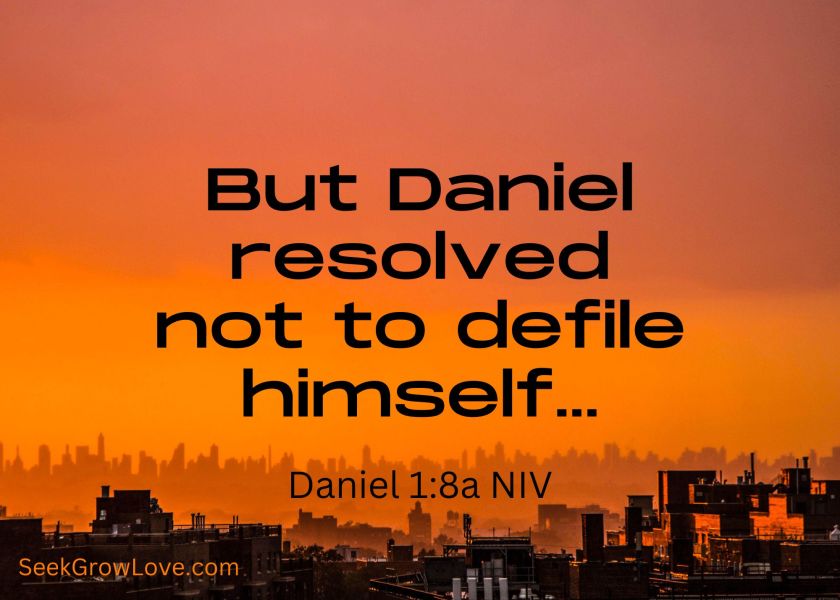
But again, the weight and food was never the real point in the first place. Look back at verse 8, “Daniel resolved that he would not defile himself with the king’s food or with the wine that he drank.” Daniel, as a good Jewish boy, knew that the King’s meat was probably slaughtered in the honor of a god of Babylon (much like the meat in the marketplaces in Greece, see 1 Cor. 10:27) and the wine was probably prepared in much the same way. Daniel’s choice to avoid this food was to honor God. YHWH, the God of Abraham, Isaac and Jacob, would be the only God that Daniel would follow; his law the only commands Daniel would obey, food laws as well as moral laws. Daniel’s obedience is blessed by God. The boys were able to understand the administration of state and Daniel was able to understand dreams and visions from God.
Chapter one is not a weird story about the diet of Jewish kids in a strange land. It is the story of God’s people, God’s Kingdom, clashing against the Kingdom of this world. Daniel and his buddies had a choice to make, to follow the ways of this world’s Empire, to eat the way everyone else ate, to drink what everyone else drank, to *worship* what everyone else worshipped. The choice they made was to follow God even at personal cost and they realized that resulted in blessing they could not have expected.
That is a story worth working to understand.
It’s the story Bob and Larry were trying to tell us all along.
Reflection Questions
I’ve been a little harsh on “The Daniel Diet,” but it’s not just one diet or fast or book that makes this mistake. In fact, many have tried to take parts of Daniel to make a diet, or used Ezekiel 4:9 as a recipe for bread, without reading down to Ezekiel 4:12. Are you ready to use the Bible as it was intended? To work to interpret God’s word in a way that impacts you, not a small change but to lead a life of difference?
In light of the first question, are you willing to make the choices that might cost you personally, if it means you remain faithful to God? Are you willing to look different, act different, eat different, vote different, shop different, wear different, **be different** if it means you can be more like Jesus? What strikes you as the first change you can make today that may cost you sounding or appearing cool, just like everyone else, but will make you more like Jesus?
Are there other sections of scripture (beyond Daniel 1 and Ezekiel 4) where you think we may have missed the point? Talk to your mom, dad, grandparent, pastor, youth pastor, or Sunday School teacher about those ideas. What do they think about those harder sections that seem to be about more than surface level ideas?
Note: The author LOVES VeggieTales. In no way should his words be perceived as mocking or belittling the greatest show about talking vegetables ever made.
In Revelation 21 we have come to the climax of events. In the Garden of Eden God set out to undo the separation between Himself and us, and that goal is at last complete. Humans may have been short sighted during history and at times tied themselves in knots over other issues, but God wanted to return to our sides. With “the first things” passed away there will be no more pain. Evil is removed from the scene and God is changing the universe, making everything new. He intends to freely give the water of life to those who overcome (John 4:14).
God lists some of those who will not receive what He offers, addressing several issues that were raised in the book, murder, sorcery, idolatry – but it begins with the cowardly (v. 8). I wonder if that is directed at early readers, facing persecution in the Roman Empire and possibly hesitant to commit. But it extends to later readers, who might question if they wish to stand up for Jesus’ name and his authority and risk conflict, or if it would be simpler and safer not to, even to appear to be unsaved. Some of God’s servants, like Gideon, were called to serve while not eager to act on their own. That may seem to give a basis for seeing hiding as credible. But I think God chose from the reluctant to make a point, and to stir the hearts of others. And those were not Christ’s disciples, already gifted with the Spirit. He expects something else from us. Not that I am saying we are to be abrasive and offensive in an eagerness to act, there are proper and wise moments and ways to stand up, and we are not always the right people to do so in a situation. Like I said, the appearance of that word first in the list strikes me. It convicts me, all too often, of taking an easier route. But I work for Jesus, and I’ve never heard of anyone braver than him. I leave it to you how it makes you feel.
John is taken to a tall mountain by an angel to see “the bride, the wife of the Lamb” and arrives at “the holy city, Jerusalem” (v. 9, 10). It is reminiscent of Ezekiel being shown the new temple, which was on a mountain (Ezekiel 40). I have taught about Revelation 21 numerous times. I have considered taping a cardboard mockup on a globe of the world to show the size of New Jerusalem. I didn’t end up attaching it, and I wasn’t sure if it should be a cube or a ziggurat, or a pyramid (we are told its base is square, and the height). Just describing my idea to the students got the gist across. New Jerusalem is large.
Earth’s breathable atmosphere extends out for about eleven miles at the equator. Perhaps you have heard the idea about being able to see the Great Wall of China from orbit. You can’t. You could bump into New Jerusalem in orbit. We aren’t totally sure of the size of the city, it depends on how you understand twelve thousand stadia, the 1995 NASB says 1,380 miles and some other versions say 1,500 miles. The International Space Station orbits about 250 miles from Earth. The Hubble telescope is 340 miles out. The upper range of what are known as “low Earth orbit” satellites is 1,243 miles, so the city would tower above all of them, if they were still around. (Which they won’t be.) But the geostationary satellites are much further out, at 22,236 miles. And the Moon is 238,900 miles away, which is nowhere near it. Speaking of the Moon, it has a diameter of 2,159 miles. Earth is 7,917.5 miles in diameter. Under the smaller estimate for the city (1,380 miles) it is 15.69% of the width of Earth, and my cardboard mockup needed to be 1.88 inches wide for a standard 12-inch globe.
We are told that with God’s new heaven and new Earth there is no longer a sea (v. 1). If that refers to the Mediterranean Sea it seems like a necessary removal, to give New Jerusalem ground space to fit. If it was centered on the location of Jerusalem it would extend about halfway through Greece, assuming it was aligned square with the equator. It also couldn’t be flat on the bottom since the Earth curves, which matters at this size.
I think this raises some questions. When God replaces the Earth, will it be the same size as the old one? What is being described here sounds like God planned on expansion. The millennium just took place, a thousand years without plagues, famine, and war. It didn’t start off with very many mortal people, but I think the population had a good opportunity for growth. It may be that the number saved during human history leading up to Christ’s return will be just a fraction of those who will ultimately be saved, guided in part by the priests we are being prepared to be. Oh, may it be so.
My questions are skipping over a rather obvious point. The angel who volunteers to show New Jerusalem to John does so under the description of “the bride, the wife of the Lamb” (v. 9). It isn’t clear to me whether that is because the bride (the population) is inside the city, or because the city is simply a symbol of those who have been accepted as Christ’s bride. The names inscribed on it, of the twelve tribes and the twelve apostles, may not simply be honoring those figures but symbolizing all who came from the lineage of those figures. Consider the description of its size and splendor, and the statements that none with bad character will enter. It says that God and the Lamb provide it with temple and light and lamp. All of this fits the idea that New Jerusalem is the people of God. Now, perhaps the language here presents people and city in another of the Bible’s double fulfillments and both cases are true. Whatever God intends it will be wonderful, and the beautiful description given in this chapter leaves me in awe and anticipation. I say, rejoice in your Lord!
Thank you, Father, for giving us this glimpse of the glory that lies ahead. Thank you for your commitment to us, that you did not give up on the work of Your hands, but took such care and effort to restore what had been damaged. Please help us to value what you value, to seek what you desire. There are so many lost sheep, so many hurting hearts, that you desire to be blessed by the love of your son. Please shape me into who you desire me to be, until I am complete. Thank you, in the name of Jesus, Amen.
-Daniel Smead
(originally posted November 17, 2023 for SeekGrowLove)
Reflection Questions
What does God’s commitment to fixing what was broken tell you about Him? What does it say about how God sees us?
What are some of the “first things” that will have passed away when the events of Revelation 21 have come to be?
Might God count you among the cowardly? When have you taken a courageous stand for Him? If (when) you are tempted to hide, what helps you overcome that temptation and stand up?
Have you ever thought that it was too hard to stand for God in the middle of this dark world? Have you ever feared ridicule that kept you from sharing your faith with someone? I know that I have thought both of these things at times in my life.
One example in Scripture that serves to encourage us in this category is Jeremiah. Jeremiah served as a prophet in one of the darkest days for the people of God, beginning his ministry right before the exile into Babylon. Jeremiah 1 chronicles the “call” of Jeremiah to serve God.
Jeremiah 1:4-5 (ESV)
4 Now the word of the LORD came to me, saying,
5 “Before I formed you in the womb I knew you, and before you were born I consecrated you; I appointed you a prophet to the nations.”
God tells Jeremiah that He knew him before he was born! Not only that, God called Jeremiah to be a prophet before he was born. What an incredible calling! And Jeremiah would need this kind of encouragement and consolation, because the people of God at this point in history were not inclined to listen to the Lord’s instruction. In fact, Jeremiah’s whole life would be filled with heartache and sorrow as he fulfilled his role as a prophet to the people of Judah in this time before and during the exile.
Jeremiah, just like Moses and many throughout the Bible (and perhaps some of us, too!), argued with God’s choice. God responds with the only words that Jeremiah needed to hear (and the only words that we often need to hear):
“Do not be afraid of them, for I am with you to deliver you.”
They continue talking — God shows Jeremiah some visions. At the end of the chapter, God reiterates this simple word to Jeremiah:
“They will fight against you, but they shall not prevail against you, for I am with you, declares the LORD, to deliver you.”
Jeremiah faced many challenges in his life. He was tempted to be discouraged at every turn. And yet, in his darkest moments, he could remember the simple words that God told him the day that he was called:
“I am with you.”
Today, you can rest knowing that God is with you, just like He was with Jeremiah. We may face different types of battles than Jeremiah did, but the same God that was with Jeremiah is with us. He will deliver us.
-Will Barlow
Reflection Questions
What do you notice in your mind and body when you face opposition? Do you tense up, get angry, feel intimidated? How can you acknowledge and hold space for these feelings while also living your faith out the way that you desire to?
What can you do to be more intentional to stand for God bravely as Jeremiah did?
Have you ever argued with God when He has asked you to do something? What did you do? What can you learn from that experience?
(You will notice we are not done with 2 Kings yet, but we are taking a pause to add in the book of Jonah at this point. Through the rest of 2nd Kings and 1st and 2nd Chronicles we will be inserting the 17 books of prophecy and the rest of the books of history – Ezra, Nehemiah and Esther – in a chronological fashion. However, when we start a book of prophecy we will read the whole book even though the events might span a good chunk of history throughout Kings/Chronicles. Thank you to Robert Jones of Atlanta Bible College for his help in ordering these books amongst the Kings and Chronicles.)
The story of Jonah is one of the most well-known stories in the Bible. However, the book of Jonah is one of the least read books in the Bible! Let this devotion serve as a challenge to read this book with fresh eyes this week.
Jonah is perhaps the most unique prophet in the Bible. Isaiah, Daniel, Elijah, and so many others serve as intensely righteous men who carry about the Lord’s message with great zeal. Habakkuk shows shocking honesty and transparency in his prayer life. Amos shows us that the most humble people– yes, even the shepherds– are called into ministry of some kind. But what about Jonah?
Jonah shows that rebellious streak that runs within all of us at some time or another. God has called him to preach to the city of Nineveh, the capital of Assyria, and Jonah does not listen. It’s understandable; Nineveh is nearly 700 miles away from Jerusalem. That would take well over a month to travel there in his time! But wait– Jonah doesn’t just say no to God. He actually runs away in the opposite direction!
So Jonah runs away and God lets him know that there’s no running from God. In fact, throughout Jonah’s refusal to minister to the Assyrians, it still brings glory to God. The sailors he’s traveling with tremble with fear when they discover who Jonah’s God is. Notice that, in 1:11, the sailors want to please Jonah’s God, and instead of saying, “Let’s turn this ship around and head to Nineveh,” he says, “Just throw me overboard.”
But God wasn’t done with Jonah. Jonah’s saved. But more importantly, Jonah experiences a spiritual reckoning: (Sneak peak into tomorrow’s reading of Chapter 2…) Jonah has a moment of complete clarity and offers up a remorseful, prayerful praise to God. He recognizes that God is the one in control (2:3). And he recognizes that salvation comes only from the LORD.
So here are a few questions for us to consider in all this:
Do we listen for God’s voice like Jonah does?
Do we reject God’s call like Jonah did? Probably more than we realize.
Do we expect God to call us to the “Nineveh” of our lives?
Do we learn from our mistakes like Jonah did, and pray about it?
Will Jonah learn from these events, and change his ways? We’ll have to find out this week.
-Levi Salyers
(originally posted for SeekGrowLove December 15, 2021)
A major theme in 2 Corinthians 3 is boldness. 2 Corinthians 3:12 states:
“Therefore, since we have such a hope, we are very bold.”
In this verse we also see the word hope. Hope is different in the Bible than it is in the English language. Hope as an English word often conveys doubt, but almost always in the New Testament the word hope is the Greek elpis/elpizo. There is no doubt attached to this word. This means that when we see the word hope in the Bible, we know it means confidence and security.
So, if there is no doubt in this type of hope, let me ask you a question. What would change in your demeanor if you knew… I mean really knew that the hope you have is assured? If you already knew you won the game or aced the test, you would be bold and confident in what you are trying to do. Biblical hope is a reality, not just a feeling. It’s a sure foundation that we can build our lives on.
Kirk Cameron once asked the question, if you had the cure for cancer would you keep it to yourself, or would you share it? If you knew you could save someone’s life you would be more bold. As Christians we have the opportunity to save people by being bold with our faith. We are called to give an answer to anyone that would ask.
“But in your hearts revere Christ as Lord. Always be prepared to give an answer to everyone who asks you to give the reason for the hope that you have. But do this with gentleness and respect” (1 Peter 3:15).
When was the last time you were bold enough to share your faith?
-Brooke Cisneros
Reflection Questions
What would change in your demeanor if you knew… I mean really knew that the hope you have is assured? How would you explain your hope – and how it is different from a hope with doubt?
When was the last time you were bold enough to share your faith?
How can you boldly share your faith today? Will you?
Ahh, don’t you just love the political campaign season?! The mud-slinging ads, heated debates, and unwelcome solicitation of political literature are so refreshing to the soul! (Can you detect any sarcasm?) While I care deeply about this world in which my children are growing up and will always be grateful for the brave men and women who paved the way for freedom and suffrage, all the negativity and animosity around the primary and general elections, especially in a presidential election year, wear on my spirit.
Speaking of elections and leaders, did you know that George Washington never wanted to be President? The great military general was relieved when the Revolutionary War ended so he could continue living simply on his Virginia farm, Mount Vernon. The only president to be voted in unanimously by the Electoral College, Washington spent exactly zero dollars on his campaign. He took his role as President very seriously, but feeling the weight of the country on his shoulders, he set the precedent for serving only two terms because he was more than ready to retire. One could argue that it was his humility that made him a great leader; others had grievances against him, claiming that many of his actions were quite negative. Though we can be prone to consider him a flawless leader, George Washington definitely had his share of critics by the time he left office.
Biblical leader Moses had been a great guide for his people (the Israelites) and Joshua became leader of Israel following the death of Moses. He had been an assistant to Moses and, like Washington, seemed to have unanimous support. The theme of Joshua chapter one could be COURAGE. God knew that the tasks ahead seemed impossible, from crossing the flooded River Jordan to fighting all of the established cities that stood between the Israelites and their Promised Land. God reminded them that He would be present every step of the way. It wouldn’t be easy, but they only needed to obey, and He would fight with them. The people rallied around Joshua, promising in verse 16 to do whatever he commanded.
Did you notice the directive (Joshua 1:7b-8) sandwiched between the reminders to “be strong and courageous”? The LORD reminds his people to follow all the commands given to Moses and to “meditate on the Book of the Law day and night, so that you may be careful to do everything written in it. Then you will be prosperous and successful.” God wants His people to have success and to enter their Promised Land, but it is conditional; they must stay true to Him, not straying from His ways and His laws.
Though these words were spoken to a distinct group of people at a specific time in history, I think they are still applicable to us today. God wants us to be strong and courageous to do the work He has called us to do for Him, but it is important that we are careful to follow His ways and stay in the Word. While you and I will most likely never be in charge of a country or even millions of people, we all lead in some ways. As a parent, I lead my children so they can become responsible, God-fearing adults. As a tutor, I lead my students in understanding math and reading concepts. In my church family, I try to encourage and help other people, both tall and small, learn more about God. In all of these areas, if I did not depend on God’s wisdom and strength to help me, I would fail. I could say that my leadership doesn’t matter all that much compared to being a President or a famous leader from the Bible, but in reality, the small steps you and I take as leaders can have eternal influence, especially when we are investing in the spiritual lives of others in the family of God. Lead with God as your Guide. Keep focused on His Word as you do His work.
-Rachel Cain
Reflection questions:
– Make a list of all the big and small ways you lead – at home, at your job, at church. How do you (or should you) rely on God’s strength to lead?
– Where might God be calling you to step up as a leader, or back down so you can pursue other things he has for you?





 Seek Grow Love