There are many different times that different people in the Bible confess their true faith. At the beginning of Genesis 22, God tells Abraham to sacrifice his only son. We see Abrahams’s true faith when he doesn’t protest or complain. He just does what God told him to do. I for one am very jealous of his faith.
As Abraham was stretching out his arm to slay his son, an angel of the Lord called to him from heaven telling him to stop. Then, they heard a rustle from behind them and it was a ram. This shows us that God is with us and He will always provide a way. We just have to have faith like Abraham. I hope that we can all grow our faith in the near future and fully trust in Him.
-Nik Ransom (youth who attended reFUEL: North last month, and son of one of our writers two weeks ago)
Questions for Reflection and Discussion
Take a moment and think about what you love most in life. Would you be willing to give whatever it is if God told you to? Would you give it up with or without hesitation?
Abraham is known as a man of great faith. Why? What does James have to say about Abraham in the New Testament? (James 2:14-26) Is it possible to have great faith without action/deeds/obedience? How can we practice growing our faith?
Re-read the account of Abraham willing to sacrifice his son Isaac while knowing what you know of God’s sacrifice of His son Jesus. What similarities do you find? What differences? What does this say of God’s sacrifice and love for you?
The first thing I think we should recognize when reading Genesis chapter 12 are the six things that God promised Abraham. He told him to go to a land that He would show him. Secondly he told him he would make him a great nation.
I believe the next two promises go hand-in-hand. God said, “I will bless you” and “ I will bless those who bless you.” It was important for God to let Abram know that he was going to bless him. There would also be those that would be an encouragement to him.
At the same time there would be negative people that came along that were a source of discouragement. God promised that he would take care of those people.
And lastly God told Abraham that he would give him the land. He was going to give him the land as an everlasting possession.
Ultimately what I believe this means for us in life is we need to have the same kind of faith Abram had. Our faith as a whole should be based upon that kind of belief in God.
Where I look at this text in a different context is this. I think we can apply these promises to our personal ministries. When God instills something in your heart that we feel He is calling us to do, we need to believe like Abram did that God is showing us what He would have us do.
I believe that just like God made Abram a great nation, we too need to have the kind of faith that believes that God is going to work mightily in our ministry. I’m not saying that we will be great but that God will do great things through us.
I believe following our heart and believing those first two promises are so important, but don’t fool yourselves. There will be both positive and negative people that come along in your ministry. Keep yourself focused on the positive people in ministry and ignore the negative. Don’t let the naysayers discourage you into quitting what you wholeheartedly believe God has called you to do.
In the end when we listen to God rather than men; we will find ourselves hearing the words that we all want to hear, “Well done, good and faithful servant; you have been faithful over a few things, I will make you ruler over many things. Enter into the joy of your lord.” (Matthew 25:23 NKJV)
As a result of our faithfulness; Abraham and all of the faithful together will see the fulfillment of God’s last promise. We will be given the land as an everlasting possession. Thank you God for that promise and may God richly bless each and everyone in your ministries.
-Rick Eldred
Questions for Reflection and Discussion
What directions did God give to Abram before the promises? Do you think the promises will only come to Abram if he follows the directions God gave?
What have you already left behind to go where God leads? What were the results (or maybe they are still in progress and hard to see)? Where may God be asking you to go? What may He be asking you to leave? Pray for God’s direction and guidance, as well as your own obedience.
“I will bless you…and you will be a blessing” – God (Genesis 12:2). What blessings has God given to you? How have you used what God has blessed you with to be a blessing to others? What can you do to spread that blessing further this week?
Many of us know the story of Noah and the flood. The earth was full of sin. Noah was commanded to build an ark because God was going to wipe out all the earth. Animals came two by two to enter into the ark which Noah had built. It rained for 40 days and 40 nights. At some time Noah sent out birds to see if the land was dry. The dove returned with an olive branch or a freshly picked olive leaf, depending on what version of the Bible you are reading. Noah and his family and all the animals went off the ark. God promised to never destroy the whole earth with floods again and made the rainbow a sign of this promise. But, there is more to the story than just this.
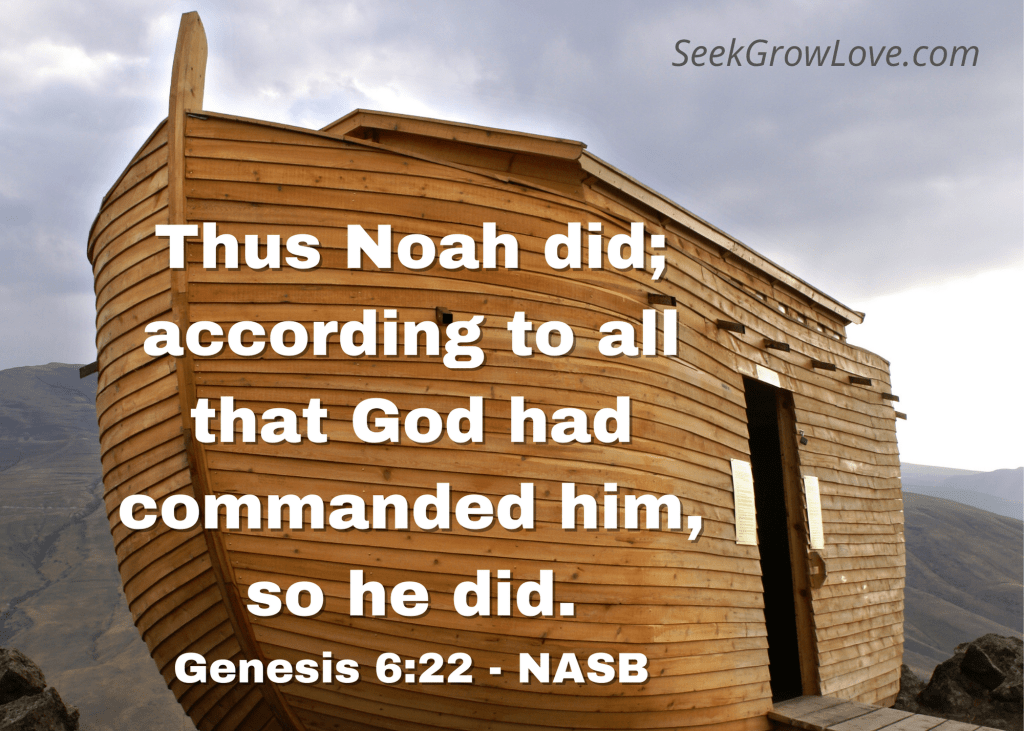
When we read the story of Noah and the flood, we see that Noah built the ark just as he was commanded. Have you ever taken the time to imagine what would have happened if Noah had just said no? What about if he had decided he would only take the animals he liked with him, leaving animals like mosquitoes, spiders, and snakes off the ark? What if he had decided he knew a better way to build an ark than the way God told him? But Noah didn’t. We are told in verse 22 that “Noah did; according to all that God had commanded him, so he did.”
Noah built the ark exactly as he was told. He built it out of gopher wood and covered it inside and out with pitch. Noah made the length, breadth, and height of the ark exactly as he had been commanded to do. He put the window and door at the exact location, which God had commanded him to. Noah did everything according to what God had commanded him.
Not only did Noah continue to do everything as God commanded, which is difficult enough by itself, he also did it all while the earth was filled with corruption. Noah spent years obeying God, building the ark, while he was living in a corrupt world. Not only did Noah build the ark while living in a corrupt world, he did it for many years, while the animals started coming to the ark, and the earth kept growing in its corruption.
We know that, in the end times, our world will be as corrupt as the world was in Noah’s time. Our world is already starting to look similar to Noah’s. We have to obey God while living in an evil world and continue doing so, overcoming whatever the world puts against us. The question is: When the time comes will you be able to obey God while living in a corrupt world, not losing faith, for years, just as Noah did?
-Kaitlyn Hamilton
Questions for Reflection and Discussion
Do a little research on the ark. Did it look like the photo above? What were the dimensions? Measure out what those dimensions would look like in your yard, neighborhood, church property or playground. You may find some interesting information online, including from the Ark Encounter site (a life-size ark museum Answers in Genesis built in Kentucky).
Since our 2022 SeekGrowLove reading plan only includes 105 of the BEST chapters from the Old Testament, tomorrow we will be jumping forward to Genesis 12, rather than finishing the rest of Noah’s story. But take a little time reviewing the rest of this account (through 9:17). What do we learn about God? What do you think God may have been thinking or feeling as he watched the destruction of the flood? What about as he watched the faithfulness of Noah and his family?
God probably isn’t asking you to build an ark, but what does He want you to do? What directions has he given you to follow as you work on the mission He has given? How well are you following those directions? What obstacles are in your way? How can you better deal with them in order to stay on track with God’s work? What rewards are there for sticking with His tasks, even when they are really difficult? What happens if you don’t? What will help you become a person known for doing what God asks of you?
I had an art teacher in elementary school who was used to students making mistakes, and at the start of a school year he would advise his students about the need to be careful in his classroom. He told us about the student who spilled a pot of melted wax on his pants. He told us about the student who was sliced with the paper cutter. He told us about the student who, having been warned that the pottery kiln remains hot long after it shuts off, chose to unlatch and open it to see how the artwork looked. Our teacher wanted to make sure we would not be harmed, and he used the damage that others had suffered to warn us. He knew about the risks, and his knowledge had been proven and tested.
I think that is part of the problem we see played out in Genesis 3. Adam and Eve were like inexperienced children, so unused to the risks they faced they would not take them seriously. And what could God point back to? No one had ever died, it seems, so saying that they risked dying may not have meant much to them. It even seems like somewhere along the way someone started trying to expand on the rules, not just saying the fruit wasn’t supposed to be eaten but that it wasn’t supposed to be touched. We don’t know whether Adam invented that idea in passing on the rule to Eve, or if Eve created that rule as a reminder for herself to keep herself mindful not to do what God said not to do. But making extra rules can just be a distraction from what God wants, they are hard to justify. When she looked at the fruit it seemed like the kind people could eat, which was totally beside the point – nobody ever said the reason people shouldn’t eat it was because it was poisonous. God entered into this situation like my art teacher if he had simply said “don’t touch these pieces of equipment in these ways” – and students would have invented reasons for why that mattered, and worked out their own solutions for how to avoid the problems they thought were the issues.
The whole scene with the serpent reminds me of someone getting dared. It isn’t how it is presented, but it is how it comes across. The nudging, suggesting ideas that wouldn’t have come into the mind otherwise, and like so many dares getting a person to cross lines into a bad idea.
I hate dares.
And the results of the situation are such incredible losses we can’t really understand them, because we are only used to the results. A world with death and suffering. A world with toil and sweat. One of the most disturbing is what happened to Eve, she had been created to be an appropriate helper for Adam. In chapter 1 they had been blessed and told to rule over the animals of the world. But by chapter three we are told that the man would seek to rule over the woman, and the desire of the woman would be for the man – perhaps meaning she would desire to return to the closeness and openness they previously had.
Happily, I see no rule requiring us to treat these words as a command. Just as farmers can use pesticides and herbicides rather than letting the struggles of the soil continue as they were originally set up, we can try to improve our situation as humans with each other. Jesus offers us a new pattern for living, based not on rule but on self-giving. The core promise of this passage is that a child would come who would allow changes to be made, breaking the head of the serpent. This is part of the classic “now and not-yet” that affects so much of what the Bible teaches, we know that the ultimate fulfillment is for later, but the start of what we have been offered is already with us and we can rejoice to have it.
-Daniel Smead
Questions for Reflection and Discussion
In what ways today does the Deceiver still use the line, “Did God really say…”? How are God’s words and commands being questioned, twisted and discarded?
What are your greatest temptations? What excuses have you used when you gave into them? Any blaming? How can you better fight the urge to give in to these or other temptations? What do you think would have happened if Eve would have taken her new questions raised by the serpent back to God before eating the fruit? How can God be a part of your fight against temptation?
In their guilt they tried to hide from God. Can you think of a time your guilt has led you to try to distance yourself from God, the church, your family or your Christian brothers and sisters? What was best for Adam and Eve when they were ashamed? What do you think is best for you?
How has the serpent attacked Jesus, the child prophesied? In what ways has Jesus already beat the serpent? What battle is yet to come – with what results? Which side will you be on?
Having attended Refuel north earlier this month, I’ve realized more than ever the importance of companionship in Christ. This is referenced in Genesis 2:18
“Then the Lord God said, ‘It is not good for the man to be alone; I will make him a helper suitable for him.’”
While this verse is more commonly used in the context of marriage, I think it works here as well. God knows it is not good for us to be alone, we need human interactions. We need friends that can hold us accountable, and support us always. That is a friendship only found in your brothers and sisters in Christ. God wants us to connect, to fellowship together, and to love each other.
-Julia Simon
Questions for Reflection and Discussion
Why do you think there are two accounts of creation – one in Genesis 1:1-2:3 and one in Genesis 2:4-25? What do they have in common? What differences do you see? What is emphasized in each account?
How is the Garden of Eden described? Where have you most enjoyed a paradise setting created by God? How would you describe it? What do you most appreciate about God’s creation? What work do you like to do (or would like to try doing) in God’s creation?
List as many reasons as you can why it is not good to be alone. Some might come from Scripture, some from personal experience or what you have seen in others.
How do you view being created as a helper? God is described many times as being a helper (for example, Psalm 115:9-11). In what relationships can you become more of a helper? How?
How one starts a story has quite a lot to do with how the rest of the story plays out.
Once upon a time…
A Long Time Ago in a Galaxy Far, Far Away…
It was the best of times, it was the worst of times.
It was a bright cold day in April, and the clocks were striking thirteen.
And my personal favorite in fiction:
Mr. and Mrs. Dursley, of number four, Privet Drive, were proud to say that they were perfectly normal, thank you very much.
Today we start the story of creation, and the first four words tell us quite a lot.
In the beginning God…
Anything and everything that comes next depends on this text and, as such, these words are fascinating.
Apologetics is an art form and a science. Apologetics means, simply, “defending ones faith,” and so Christian Apologetics is about giving reasons for why we believe anything we believe. Why do we believe the Bible is the word of God? Why do we believe Jesus is the Son of God and Messiah? Why do we believe God exists at all? These are good questions and it’s important that you have general answers to them.
But Genesis 1:1 doesn’t answer them. Genesis 1:1 assumed God is. There is no argument for or against him. There is no argument about other gods or goddesses, about how this book is his word versus other books that say conflicting things, nor does it defend the “contradictions”that some non-believers point out in the text.
Genesis 1:1 just says “God created.” Simple. Easy. Plain.
But of course, it is anything but simple and easy and plain.
I could spend quite some time talking about my own interactions with the text, trying to understand it and science at the same time. I could work to show you whether this text is poetry or narrative and how the text in chapter 1 relates to the order of creation in chapter 2. I could tell you that through strong but loving conversations with important people I have worked out the perfect explanation to the text. I could tell you exactly how you should read this text, end of story, done, nice and easy.
I could tell you that, but I won’t.
My own interactions with the text have been difficult.
People smarter than me read this text literally verbatim as the God’s-eye view of what happened in Genesis. Other people, still smarter than I, say “it’s a metaphor and symbolical account of creation and we need to understand how to read this literately.”
I have come to some strong conclusions but truthfully I hold them loosely because I know what a struggle it was to get to where I am, and I could change tomorrow.
The only thing I can tell you with certainty is that this text tells us with all seriousness that God is not a distant observer of space-time, nor one and same with the universe, but a powerful mover-and-shaper of all things by the word of his mouth.
And because the story starts this way, it changes how the rest of the story plays out. God makes light and calls it good, and the metaphor of light is good in the rest of Scripture. God calls for the earth to bring forth plants. He invites creation to participate with him in the creative act, it would seem. God makes the creatures of the ocean, from the great “tanninim”, which could be interpreted as sea monsters, whales, or dragons, worshipped by other cultures. God creates with his mouth the very things that others worship, because all things exist due to his will.
Speaking of the will of God for creation, that brings us to the most important part of Genesis 1 in our reading today.
Humanity is part of but also the fulfillment of creation. God not only makes us, but he makes us in his image. He not only invites us to participate in the creative act, but even invites, empowers, and also demands that we rule over creation. And this is not one man given this role, but humanity, the many as both male and female. We ALL are made in the image of God.
Whatever we think about Genesis 1, what we learn is that humanity is made in the image of God, meaning we have value and worth given by God which cannot be taken away. We learn that God created so that there would be a people who would love him, as Genesis functions are the precursor to the central story of the Old Testament, the Exodus. And we learn that when God looks at his creation, with humans in the midst of a world he lovingly called into being, he says it is
“Very Good.”
-Jake Ballard
Questions for Reflection and Discussion
How do you interpret Genesis One? I encourage you to accept church tradition/theology and challenge church tradition/theology, to accept scientific discoveries and challenge scientific discoveries. In both “church” and “science”, we find truth. But, we need to balance truth with wisdom, and see that much that comes from both “church” and “science” are interpretations and value judgments, rather than simple, plain truths. How will you continually seek to understand God’s word? Who do you turn to listen to about church tradition, theology, science and how to interpret each of those factors?
Even though Genesis One assumes the existence of God, and doesn’t try to argue for him but just proves him via his actions with his people, how do you answer the questions presented above? : “Why do we believe the Bible is the word of God? Why do we believe Jesus is the Son of God and Messiah? Why do we believe God exists at all?” What is your answer for your friend who might ask you any one of these questions. If you don’t have a ready answer, then are you “prepared to give an answer to everyone who asks you to give the reason for the hope that you have”?(1 Peter 3:15)
Too often we are told that humanity and all life is a cosmic accident brought about by the random chance of amino acids bursting forth into life in a hot pool of water millions of years ago (a bad interpretation of science, see above). However, this is not true. You are not a cosmic accident, but the keystone of God’s creative act. How does it make you feel that you are part of the final creation of God in Genesis One? Do you believe that God made this world and then declared that it is all very good? How can you honor the role to rule over creation that God has given you and how might you enjoy the very good creation of God this week?
After Jacob had served Laban in Padan Aram for 20 years, God told him to go back home. It was finally time for him to face his past. Remember, he had cheated his brother Esau, and had run for his life. He had about 500 miles to go to get home. He sent some servants ahead to let Esau know he was coming home. When the servants returned, they told Jacob that Esau was coming to meet him with 400 men. Jacob was terrified, and prayed a beautiful prayer that is recorded in Genesis 32:9-12.
He started, “Oh God of my father Abraham, God of my father Isaac…”. In this section, I see Jacob acknowledging the history his family had with following God, ever since God called Abraham in Genesis 12.
He continued, “O Lord, who said to me, ‘Go back to your country and to your relatives, and I will make you prosper’. ” In this section, I see Jacob acknowledged what God had told him to do, and he had followed what God had told him to do.
Next, he acknowledged his own unworthiness, praying, “I am unworthy of all the kindness and faithfulness you have shown your servant. I had only my staff when I crossed this Jordan, but now I have become two groups.” And he acknowledged what God had done for him, even though he was unworthy.
He continued, “Save me, I pray, from the hand of my brother Esau, for I am afraid he will come and attack me, and also the mothers with their children.” In this section, he admitted his fear to God, and then he finally got around to begging God for what he needed help with – “save me”. Note that he didn’t give God suggestions as to how God could solve the problem. He just turned it over to God.
He concluded with, “But you have said, ‘I will surely make you prosper and will make your descendants like the sand of the sea, which cannot be counted.’.” He closed with reminding God of His promises.
In this prayer, I see a potential model for our own prayers. It goes sort of like this:
Start by thanking God for his provision until now for our family, including for our ancestors.
Today, God speaks to us through His word. I think it is important to be familiar with his word and follow his word. And I think that’s a perfectly fine topic to bring up in prayer, “God, you said to …, and I have done that as you commanded.”
I believe we need to humble ourselves before God, and acknowledge that we don’t deserve all he has done for us. I think it also helps to remind ourselves in our prayers what God has done for us. (We don’t need to remind God. He already knows.)
We should admit whatever we’re feeling to God. (He already knows anyway, but it helps us maintain an open channel of communication with Him.)
We are finally at the point in our prayer where we should clearly lay out the problem we’re facing. And we don’t need to offer God suggestions as to how He could solve our problems. He can come up with solutions better than we can even imagine.
I think in the closing of Jacob’s prayer, he was not just reminding God of the promises God had made. I think he was also looking forward to those promises himself. We should do the same.
And I think it’s fine to pray something like, “God, you promised that everything works for the good of those who love you. I don’t understand how that is possible in the situation I’m in right now. Please open my eyes to understand that, or at least to accept it as truth. I know you have promised that nothing can separate us from your love, not even death. God, things aren’t looking very good from my perspective right now, but I’m holding on to your promise that when Christ returns, you will wipe every tear from our eyes, and there will be no more death or mourning or crying or pain. God, I’m really wanting that now. Please keep me focused on you, and living for you. And please send Jesus soon. Amen.”
In Genesis 29, Jacob arrived in Padan Aram and found his first cousin, Rachel, at a well. I’m immediately reminded of Genesis 24, where Abraham’s servant came to this same place, probably to this same well, and found Rebekah, the then-future wife of Isaac. We’re not told if Jacob had prayed for God’s direction like Abraham’s servant did in Genesis 24. But we do know Jacob went there not only to run away from his brother, whom he had cheated, but also to find a wife. And bonus, Rachel was a virgin and was gorgeous.
After spending a month working for Laban, Jacob’s uncle, and working hard the whole time, Laban asked what wages Jacob would like as he continued to work for Laban. In Genesis 29:18, we read, “Jacob was in love with Rachel and said, I’ll work for you seven years in return for your younger daughter Rachel.” He must have really been in love, because we’re told, “So Jacob served seven years to get Rachel, but they seemed like only a few days to him because of his love for her.” Wow, that sounds like a romance novel (although I haven’t actually ever read one).
At the end of seven years, there was a big wedding ceremony. When Jacob woke up the next morning, he woke up with Rachel’s older sister, Leah. Laban had tricked Jacob, and had him marry the wrong girl! Personally, I can’t imagine how this happened. Did Jacob celebrate a little too much to notice who he was marrying? Leah had to be complicit in this subterfuge. Did Leah keep her veil on until it was dark? Did she not talk, because presumably the two sisters’ voices sounded different. Where was Rachel while all this was happening?
Regardless of the answer to any of these questions, Jacob had been tricked into marrying the wrong sister. After complaining to Laban, he agreed to work another 7 years for the wife he really wanted, and married her a week later.
Polygamy may sound wrong to us, but there are several examples in the Old Testament of men marrying multiple women. Having said that, there are no examples of this working out well anywhere in the Bible. According to Jesus in Matthew 19:4-9, God intended from the beginning that one man would be married to one woman for life.
Anyway, Jacob had tricked his father, and had cheated his brother. Now, Jacob was tricked by his father-in-law, and (spoiler alert) he would be cheated by his father-in-law repeatedly for 20 years.
This is an example of a principle that we see demonstrated throughout scripture, and in our lives today. We read in Galatians 6:7, “Do not be deceived, God cannot be mocked. A man reaps what he sows.” You may have heard the old axiom, “What goes around comes around.” Basically, these both mean the same thing – everyone eventually has to deal with the consequences of their actions.
But wait, God had promised rich blessings to Jacob. Shouldn’t God have prevented Jacob’s problems? Sorry, it doesn’t work that way. Followers of God are promised, in 1 John 1:9, “If we confess our sins, he is faithful and just and will forgive us our sins and purify us from all unrighteousness.” This takes away God’s punishment for our sins, but it doesn’t take away the natural consequences of our actions.
Despite this, we can still rely on another promise, found in Romans 8:28, “And we know that in all things God works for the good of those who love him, who have been called according to his purpose.”
In his early life, Jacob was opportunistic and deceitful – looking out for number one. After working for Laban for 20 years of hardships, Jacob grew to understand that God was looking out for him (See Genesis 31: 38-42).
I think this isn’t just the story of a historical character and his family. I think these truths still hold true for us today, and we can learn from them. God will forgive us if we confess and repent. But we will receive natural consequences for our actions. Despite this, if we are living in a right relationship with God, everything, even those natural consequences will turn out for our good.
There is an easier way. We can save ourselves a lot of pain and trouble by just following God from the start. But we each have to make that choice for ourselves. What’s your choice?
In Genesis 28, we find the story of “Jacob’s Ladder.” Jacob had deceived his father, Isaac, and had “stolen” the blessing intended for Esau. Jacob was on the run to move in with his uncle, roughly 500 miles away, so his brother Esau wouldn’t kill him. That night Jacob had a dream with angels going up and down a ladder between God and Jacob. When God spoke to Jacob, He didn’t condemn him for his trickery; instead, He extended the covenant to Jacob that He had made with Abraham and with Isaac. God promised Jacob that he and his descendants would inherit the promised land, his descendants would be numerous, and all nations on earth would be blessed through Jacob and his descendants. God also promised He would be with Jacob wherever he went.
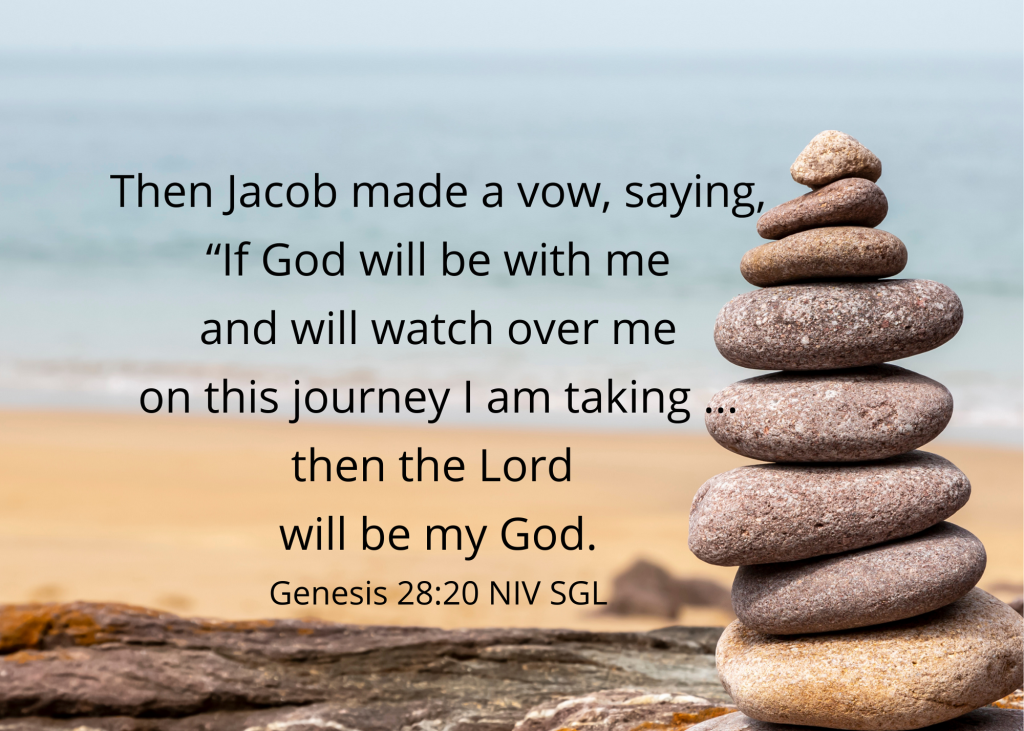
When Jacob woke up, his first response was surprise and fear. He named the place “Bethel” which means “the house of God”. He set up this stone pillow as an altar and worshiped. Finally, he dedicated his life to God.
According to “The Wiersbe Bible Commentary” by Warren Wiersbe, “The ‘if’ found in many translations of verse 20 can also be read ‘since’. Jacob wasn’t making a bargain with God; he was affirming his faith in God. Since God had promised to care for him, be with him, and bring him back home safely, then Jacob would affirm his faith in God and would seek to worship and honor Him alone.”
I see several applications for us.
As I understand it, the ancients believed gods (with a little “g”) were local, and if you left an area, you left the protection of the local god. In this encounter, Jacob thought he had stumbled into the “house of God”, but found that God isn’t limited like that. Since God would be with him everywhere, everywhere can be the house of God. According to James 4:8, if we come near to God, God will come near to us.
Once Jacob encountered God, his first response of surprise and fear quickly turned to worship. When we first encounter God, we may also be struck with surprise and depending on the circumstance, fear too. I think it is important for us to continue on to the worship stage as Jacob did. Note that the altar he built wasn’t for offering sacrifices, it was really more of a memorial that reminded him of his encounter with God. When we encounter similar milestones in our own lives when God has done something noteworthy for us, I think it is important for us to set up a memorial of some sort. Ideally this is something physical, that we can look at and be reminded of what God has done for us.
Jacob’s next step was to dedicate his life to following God. I think this step is imperative for us. Given what God has done for us so far, our natural response should be, “Since you have brought me this far, and since you have made such great promises to me – the promise of eternal life if I remain faithful until Christ’s return, because of these things, I will live the rest of my life for you, God.”
As the story continues, Jacob had many hardships throughout his life. Despite them all, God was still with Jacob. And Jacob remained true to God for the rest of his life.
Psalm 46:7 says, “The Lord of hosts is with us; the God of Jacob is our refuge.” God kept his promises to Jacob, and he will keep his promises to us.
The real question is, will you remain true to Him?
After serving God for 100 years, “Abraham breathed his last and died at a good old age, an old man and full of years”. This fulfilled a promise God had made to him in Genesis 15:15, when God had promised Abraham that he would die in peace at a good old age.
In addition to a great quantity of life, I think Abraham had also enjoyed a great quality of life for all those years. At the end of his life, he could look back with satisfaction, and even then could still look forward with anticipation to God’s promises. Promises including: Abraham and his descendants would inherit the promised land forever, his descendants would be as numerous as the sand and the stars, and that all nations on earth would be blessed through him.
I suspect only a small minority of people can face death like this. I’m guessing most look back at their life with regret, and look ahead with fear.
You may be wondering how Abraham could die in peace, with peace. I believe it all comes back to his relationship with God. We’re told that Abraham was God’s friend (2 Chron 20:7, Isaiah 41:8, James 2:23). In Hebrews 11, we’re told that Abraham died in faith, having not received what was promised, looking forward to the city with foundations, whose architect and builder is God.
You may be wondering how Abraham developed such a close relationship with God. I’ll give you a hint, it wasn’t by following the law. He died hundreds of years before God would give the law to Moses. He didn’t become righteous by circumcision, because he was declared righteous years before he was circumcised. Back in Genesis 15, God made a promise to Abraham, and in verse 6, “Abram believed the Lord, and He credited it to him as righteousness.” Abraham became right with God, because Abraham believed God. And in so doing, Abraham became a model of how all of us can become right with God. Paul used this example in Romans 4 to argue that all are justified through faith alone.
Ephesians 2: 8-10 tells us, “For it is by grace you have been saved, through faith —and this is not from yourselves, it is the gift of God — not by works, so that no one can boast. For we are God’s handiwork, created in Christ Jesus to do good works, which God prepared in advance for us to do.”
In chapter 2, James used Abraham as an example to demonstrate the importance of proving faith by deeds. We aren’t saved by works, but those works prove our faith. And lack of works proves lack of faith.
Abraham left quite a legacy. When God reiterated His promise to Isaac, as recorded in Genesis 26:3-6, we read, “…I will be with you and will bless you. For to you and your descendants I will give all these lands and will confirm the oath I swore to your father Abraham. I will make your descendants as numerous as the stars in the sky and will give them all these lands, and through your offspring all nations on earth will be blessed, BECAUSE (emphasis added) Abraham obeyed me and kept my requirements, my commands, my decrees, and my laws.” Did you catch that? All of this was because Abraham was faithful to God.
The New Testament starts with, “A record of the genealogy of Jesus Christ the son of David, the son of Abraham.” God had promised Abraham that all the world would be blessed through him, and God kept his promise.
I’d like to leave you with a few questions..
Have you thought about preparing now to face death when it comes? Ecclesiastes 12 encourages us to start young. Ecclesiastes 12:1 says, “Remember your Creator in the days of your youth, before the days of trouble come and the years approach when you will say, “I find no pleasure in them.” Verses 13-14 go on to say, “Now all has been heard; here is the conclusion of the matter: Fear God and keep his commandments, for this is the whole duty of man. For God will bring every deed into judgment, including every hidden thing, whether it is good or evil.”
Are you living by faith? Hebrews 11:6 says, “And without faith, it is impossible to please God, because anyone who comes to him must believe that he exists and that he rewards those who earnestly seek him.” And are you demonstrating your faith by your actions?
Finally, what legacy are you leaving? Exodus 20: 5-6 says, “…I, the Lord your God, am a jealous God, punishing the children for the sin of the fathers to the third and fourth generation of those who hate me, but showing love to a thousand generations of those who love me and keep my commandments.”








 Seek Grow Love