Strategic Righteousness

Ruth 3 11

Ruth 3: 1-13

The third chapter of Ruth has always been a little strange to me. Culturally I didn’t understand what Ruth was doing when she went to Boaz. Furthermore, I wondered was this action a little scandalous or was it appropriate for Ruth to go to Boaz in the night and lay at his feet?
In Ruth’s interactions with Boaz we can see Naomi’s hope is being restored. She is no longer focusing on the sadness of their past but making plans for the future.  We can boldly act on our hope with strategic righteousness because we know God fights for us and He does not withhold good from us.
After doing some research on Naomi’s instruction and Ruth’s following actions it became clear to me that all she did was with meaning and appropriate. When Ruth went to Boaz and lay at his feet this was an acknowledgement of his duty as their Kinsman, which also means he is a likely option for her as a husband.  In a commentary on Ruth 3 it explains, “She has gone willingly and now she takes the initiative to make clear to Boaz why she is there. “You are next of kin.” Or literally, “You are the redeemer: the one who can redeem our inheritance and our family name from being lost. I want you to fill that role for me. I want to be your wife.'”
As Ruth went boldly to Boaz he also responded to her with boldness saying in verses 10-11, “The Lord bless you, my daughter,” he replied. “This kindness is greater than that which you showed earlier: You have not run after the younger men, whether rich or poor. And now, my daughter, don’t be afraid. I will do for you all you ask. All the people of my town know that you are a woman of noble character.”
Ruth, Naomi and Boaz all act righteously but are bold in their actions toward one another and their requests to God. What we can institute in our own lives is to truly run after God and not have a spirit of fear or timidity. God has given us a commission to pursue holiness with a bold spirit.
2 Timothy 1:7
For the Spirit God gave us does not make us timid, but gives us power, love and self-discipline.
-Shelby Upton

Thankfulness and Greater Blessing

Ruth 2 13

Ruth 2:13-23

Ruth exemplified a beautiful thankful heart in the beginning of this passage. She recognizes that she is being blessed by the customs of a culture where she really has no right to reap (pun intended) the benefits. Ruth thanks Boaz for treating her with such kindness, tells him that he has put her heart at ease and hopes that she will continue to find favor in his eyes. He immediately responds to her humble heart with greater blessings that are above and beyond the custom. He invites her to eat with him — a prominent and wealthy man — as well as indicating to his servants in verse 15, As she got up to glean, Boaz gave orders to his men, “Let her gather among the sheaves and don’t reprimand her. Even pull out some stalks for her from the bundles and leave them for her to pick up and don’t rebuke her.”
When Ruth returns to Naomi with the fruit of her labor, Naomi can tell that she had been truly blessed in her work and that someone had shown her great kindness. Here we see that Boaz is actually a close relative and Naomi and she determines that he is being kind and gracious due to the familial ties.  Naomi blesses Boaz for taking notice of Ruth and encourages her to stay with Boaz’ female servants as she knows no harm will come to her while she works in his fields. I believe the most important aspect of this passage that we can take away is thankfulness and humility.  Ruth is a hard worker who also shows great thankfulness in how she speaks to Boaz.  Not in every situation are we returned greater blessing when we have a thankful heart but we are called to be thankful to God. Ruth is really living out her faith by being grateful. Take a moment to search verses in the Bible on thankfulness. The Psalms especially are riddled with praising God and being thankful to him! One way to love God more deeply is cultivating this spirit of thankfulness and gratitude. In prayer today really thank God for who HE is and what HE has done — especially through Jesus to provide a way for salvation and our hope in the coming Kingdom of God.
Praise the Lord, all nations!

    Extol him, all peoples!
For great is his steadfast love toward us,
    and the faithfulness of the Lord endures forever.

Praise the Lord! (117:1-2)

-Shelby Upton

God’s Blessings

ruth 2 12

Ruth 2:1-14

Ruth saw an abundance of God’s blessings as she followed him. In the Jewish law it was custom to let the poor and widows glean from the edges of the field in Israel. Ruth, abiding by this custom went into fields where Boaz had authority. When he saw her he asked who she was in Ruth 2:5. When the other workers commented on Ruth’s heritage and her work Boaz was impressed. He could see by her actions, the dedication and devotion she held to God and her family to protect and care for Naomi.
In response to this realization Boaz heaped a blessing on Ruth. He encouraged her to stay in his fields under his protection and gave her drink although she was a foreigner. By her loyalty Ruth was blessed by Boaz in very tangible ways.
Ruth 2:8-13 says,
“Then Boaz said to Ruth, “Listen, my daughter. Don’t go and gather grain in another field, and don’t leave this one, but stay here close to my female servants. See which field they are harvesting, and follow them. Haven’t I ordered the young men not to touch you? When you are thirsty, go and drink from the jars the young men have filled.” She bowed with her face to the ground and said to him, “Why are you so kind to notice me, although I am a foreigner? ” Boaz answered her, “Everything you have done for your mother-in-law since your husband’s death has been fully reported to me: how you left your father and mother and the land of your birth, and how you came to a people you didn’t previously know. May the Lord reward you for what you have done, and may you receive a full reward from the Lord God of Israel, under whose wings you have come for refuge.”
Ruth’s dedication to her family and God was seen very clearly by Boaz. In response to her actions he was moved to protect her and care for her. In these ways today our dedication to God can invoke such respect and provision. As we pursue God it is not beyond the realm of expectation to see God working in our lives especially as we make sacrifices to love and serve him. Have you seen God or others bless you as you have made sacrifices and commitments to serve him?
-Shelby Upton

Loyalty in the Family of God – Ruth 1

Ruth 1 16
In the first chapter of Ruth we see a beautiful example of Ruth choosing her allegiance wisely. Some may think at the surface level, Ruth stayed with her married family for provision and protection. However, Naomi was a widow—poor, needy and vulnerable in the culture. Especially during the time of a famine in a foreign land. The most advantageous move Ruth could have made would have been to weather the famine, stay in Moab and remarry therein ensuring her safety and security. Naomi even encouraged her to do so in Ruth 1:8-9. However, Ruth remained steadfast in her loyalty to Naomi and the God she had come to know when she became one with her husband and family so many years before. Ruth makes a bold declaration after her sister in law Orpah leaves saying to Naomi,
“But Ruth replied: Do not persuade me to leave you or go back and not follow you. For wherever you go, I will go, and wherever you live, I will live; your people will be my people, and your God will be my God. Where you die, I will die, and there I will be buried. May Yahweh punish me, and do so severely, if anything but death separates you and me.”
‭‭Ruth‬ ‭1:16-17‬ ‭HCSB‬‬
Ruth returned to Bethlehem as a Moabitess. She faced the possibility of being rejected and ostracized in a culture where she is not of the same heritage in Israel. Ruth takes this risk to lay hold to her loyalty to her family and God no matter the outcome as she goes alongside Naomi—who has lost all provision and security. What we can take away from Ruth’s example in this first chapter is the willingness to forsake all else as we follow God. Today it is common that we may have to renounce titles, friendships, status, position etc as we pursue a dynamic relationship with God. We are called to live differently and that is not without sacrifice. What may God be calling you to renounce as we die to self and commit our lives to knowing Him more deeply and allowing Him to love us fully?

Are you Blind?

john 8 34 35

Are you blind!?!  This is one of our favorite questions to ask when those around us are missing something that is so obvious.  It is extremely frustrating to us when they just don’t get it or they just don’t believe us when the truth is right in front of their eyes to see.  This is how Jesus felt when he was dealing with the Pharisees.  His frustration with them oozed all the way through John 8 and 9 because they just “didn’t get it”.  They didn’t believe he was who he was even though it should have been very obvious to them.  They were closed-minded and not willing to listen to witnesses like the blind man who had been healed.
In John 8:34-35, Jesus says that anyone who commits sin is the slave of sin, and the slave does not remain in the house forever.  If you have a sin in your life that you deliberately keep doing, you’re going to get kicked out of the house because you are a slave to that sin.  When you keep choosing to sin, God is getting very frustrated with you, just like Jesus was frustrated with the Pharisees.  He’s probably thinking, “They know I don’t want them to do that, but they keep doing it anyways.  I have given them my Word to read, but they don’t see how they are supposed to act.  Are they blind!?!  They just don’t get it.”  Don’t be that guy.

-Rick McClain

Notes from Paul

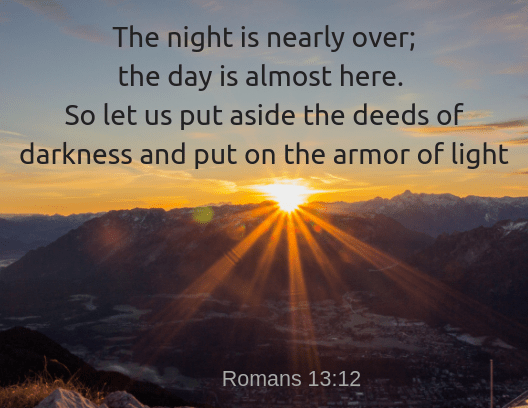
Romans 13 12

In Romans, Paul is describing the sorrow he feels that the Jews he has been trying to teach have not accepted the good news of Jesus Christ.  Even though he recognizes it is in God’s plan, he is mourning their stubbornness and their hardened hearts.

It is important to God why we follow Him…what motivates us.  He wants us to pursue Him because our faith compels us to do so, not as a result of our obligation to the law.

Paul begins to bring his message around again to the idea that Christ came for all people.  Paul continues to hope that the Israelites will listen and allow their hearts to be opened to God’s message of love and mercy. (Romans 11:11-16)

I believe Paul is saying to the early believers who are not of Jewish descent that they are the branches which come from the foundation of the Israelites.  If the root is holy, then so are the branches. As a result they need to continue to live and work together in the hope that the Jews’ eyes and hearts will be opened to a new understanding of God and Jesus Christ as Savior.  Paul points to this idea more clearly by instructing them in Romans 12:9-17…

 Love must be sincere. Hate what is evil; cling to what is good. 10 Be devoted to one another in love. Honor one another above yourselves.11 Never be lacking in zeal, but keep your spiritual fervor, serving the Lord. 12 Be joyful in hope, patient in affliction, faithful in prayer. 13 Share with the Lord’s people who are in need. Practice hospitality.

14 Bless those who persecute you; bless and do not curse. 15 Rejoice with those who rejoice; mourn with those who mourn. 16 Live in harmony with one another. Do not be proud, but be willing to associate with people of low position.[c] Do not be conceited.

17 Do not repay anyone evil for evil. Be careful to do what is right in the eyes of everyone. 18 If it is possible, as far as it depends on you, live at peace with everyone.

As we do our best to live at peace with everyone, Paul gets into more controversial subjects next…it could be controversial yet today too.  In Chapter 13, Paul includes the authorities which govern the members of the early church in his statements about how to treat one another if we are followers of Christ.

Romans 13:6 & 7

This is also why you pay taxes, for the authorities are God’s servants, who give their full time to governing. Give to everyone what you owe them: If you owe taxes, pay taxes; if revenue, then revenue; if respect, then respect; if honor, then honor.

I am guilty of not appreciating those who are in authority over me.  I speak out against the actions, decisions and judgements those in civil service make sometimes.  There are many times that I don’t agree and wish the government didn’t appear so corrupt and hypocritical, but rather than allowing my anger to rise and my resentment to grow, I should be praying for those in power.  I should be blessing them…tough pill to swallow Paul, tough pill to swallow…sometimes it is bitter too.  Nevertheless, if I am to be obedient to God’s call on my life, this is one area I can improve…I think Paul was speaking the early believers about this subject because he knew they could do better too.

The next part is a little easier to accept, though not necessarily easier to accomplish:

Romans 13:8-10

Let no debt remain outstanding, except the continuing debt to love one another, for whoever loves others has fulfilled the law. The commandments, “You shall not commit adultery,” “You shall not murder,” “You shall not steal,” “You shall not covet,”[a] and whatever other command there may be, are summed up in this one command: “Love your neighbor as yourself.”[b] 10 Love does no harm to a neighbor. Therefore love is the fulfillment of the law.

Why do we do this? Why do we live this way?  Because the day is near…

Romans 13:11& 12

And do this, understanding the present time: The hour has already comefor you to wake up from your slumber, because our salvation is nearer now than when we first believed. 12 The night is nearly over; the day is almost here. So let us put aside the deeds of darkness and put on the armor of light

Let us also join that high calling, that of putting aside the deeds of darkness and putting on the armor of light…let us love one another in spirit and in truth, in action as well as in word…the day is near

Come, Lord Jesus, Come…

Joyanne Swanson

Paul’s Mess, God’s Message

acts 28 31 (1)
At the end of the book of Acts we are following Paul in his ministry as he shares his testimony and all he is learning from God with established groups of believers as well as with those who have not yet heard the good news of Jesus Christ. He is told through a prophet that he will be bound by the Jewish leaders and sent to the Gentiles to share his story.  He is accused by the Jewish leaders in Jerusalem, then arrested and imprisoned while the Roman authorities try to figure out which side of the story to believe.  Over the course of Paul’s imprisonment he is moved to various cities and meets with several governors as well as King Agrippa.  Then finally he is sent to Rome.  During each of these transitions, Paul has an opportunity to share the story of his conversion…who he was…who he is and who he will continue to be through God’s grace.  Every time he is questioned he says something like the following phrase from Acts 23:1 “My brothers, I have fulfilled my duty to God in all good conscience to this day.” 
Paul faced so much opposition during this period of time and yet he continued to stand firm in his belief that God had a purpose for him which would be fulfilled no matter what…arrest, false accusations, storms, shipwrecks, imprisonment, isolation, death threats, nothing was going to stop God’s message from being spread.
As the book of Acts closes we are given a chance to witness Paul as he teaches a group of Jewish leaders in Rome. 
Acts 28:23-30
They arranged to meet Paul on a certain day, and came in even larger numbers
to the place where he was staying. He witnessed to them from morning till evening,
explaining about the kingdom of God, and from the Law of Moses and from the Prophets
he tried to persuade them about Jesus. 24 Some were convinced by what he said,
but others would not believe. 25 They disagreed among themselves and
began to leave after Paul had made this final statement: “The Holy Spirit spoke the truth
to your ancestors when he said through Isaiah the prophet:
26
“‘Go to this people and say,
“You will be ever hearing but never understanding;
you will be ever seeing but never perceiving.”
27
For this people’s heart has become calloused;
they hardly hear with their ears,
and they have closed their eyes.
Otherwise they might see with their eyes,
hear with their ears,
understand with their hearts
and turn, and I would heal them.’[a]
28 “Therefore I want you to know that God’s salvation has been sent to the Gentiles,
and they will listen!” [29] [b]
30 For two whole years Paul stayed there in his own rented house and welcomed all
who came to see him. 31 He proclaimed the kingdom of God and taught about the Lord
Jesus Christ—with all boldness and without hindrance!
Some of those who were listening, heard Paul’s message and their lives were changed.  Others found that they couldn’t believe what Paul was preaching and left.  They heard but didn’t understand, they saw but didn’t allow comprehension. Paul kept right on teaching, preaching and sharing his mess so that God’s message could get through.
Oh to have Paul’s boldness and eloquence!  There are many times that we are provided the opportunity to share our own stories of faith with others and we often let them pass us by.  Are we afraid?  Maybe we don’t think they would be interested, or that we’ll be bothering them if we share.  Or maybe we don’t want to offend anyone…but if we are learning from Paul’s example, we need to be sharing our stories of faith regardless of the personal costs.  God’s message will be heard, don’t you want to be a part of that exciting adventure? I promise it’ll be a good one!
-Joyanne Swanson

Who I Am

l jones mon

“But by God’s grace I am what I am, and His grace towards me was not ineffective…”

1 Corinthians 15:10


It is easy for us to focus on our inequities. It is easy to dwell on our shortcomings, failures, and insecurities. The truth is the world thrives on the failures of others. One’s shortcoming is another’s gain. The world tells us to find our worth in relationships, friendships, and our careers.


But, the truth is that we weren’t created to find sufficiency in any of these things. We were created to glorify God and follow in the footsteps of his Son, Jesus Christ.


I know it sounds cliché, but we can only find our true worth in God. He is the only one who looks at us, can count the hairs on our head, wipe the tears from our eyes, and see us for what we are actually worth.


We are who we are. God created each of us in a unique, precious way that should be celebrated. None of us are perfect. And, all of us will fail. But, it is important to realize that even though we haven’t earned it, the God we serve will give us grace and favor.


This week, we are going to dive into what it means to find empowerment and confidence in God. Because, when it comes down to it, we cannot experience true joy without him.


-Leslie Jones

Trust Conquers Uncertainty

Eccles 10 2

Ecclesiastes 9:13-11:6

“An example of wisdom that greatly impressed me.” Wisdom that greatly impressed the man that chose wisdom over all of the world’s riches? Okay, you have my attention. It was wisdom that impressed him and saved a city from a superior force. But fools neglect and forget the wise. In times of trouble the wise find themselves surrounded by the lost and afraid, looking for direction. But as soon as they feel safe again they cast off the wise and get back to their hollow lives.

Forget about the wise. Besides it only seems to take a little bit of foolishness to nullify all that the wise do. Whether it is a wise man doing himself harm from his own stupidity or being harmed from someone else, we have seen this and have likely experienced it firsthand. “One sinner destroys much good.” Foolishness is so common. It almost seems incomprehensible that people continue to act the way they do. But I guess that it is easier to believe the unbelievable, to follow the fools way that appears flat and smooth rather than to face the hard truth, to take the difficult path of wisdom and honor. Jesus said it best when he said, “Enter through the narrow gate. For wide is the gate and broad is the road that leads to destruction, and many enter through it. But small is the gate and narrow the road that leads to life, and only a few will find it.” Matthew 7:13-14. The great value of wisdom is lost on the foolish.

Despite what many might think, verse 2 has nothing to do with our modern political party system or whether you are conservative or liberal. The people of Israel understood that the right hand of God is a place of authority and protection. The wise, who we have described as godly, would seem to naturally be inclined toward the right while fools go in the opposite direction. What’s more, the fool flaunts his stupidity. It says he “walks along the road” and “shows everyone how stupid he is.” If you doubt the truth in this I suggest you take an objective look at social media! “Preach it brother!”

Solomon spends a lot of time in these passages reminding us that life is not fair. We may work hard and not get the results that our works merit. Someone else may get all the benefits of what we do while not contributing to it themselves. And of course there are dangers all around us, accidents do happen after all. He urges us to see the dangers, to be aware of them. Preventing us from falling into a pit, literally and metaphorically. The fool though will walk himself right into a pit, into “wicked madness.”

I want to take a moment to address 10:19, specifically “money is the answer for everything.” This is how my NIV puts it and this is a great example of a red flag moment in Bible reading. I personally look at this and I am stunned by most of the commentaries I read concerning this verse. At best they say this is Solomon’s wry humor or his attempt at sarcasm. At worse it is a passage that feeds all the prosperity preachers out there. “You may be struggling to pay your bills right now but God will provide a great bounty, a time of plenty. God knows what you need.” Yes, God does know what you need! We need a relationship with Him, with His son Jesus, and with one another. We need to be like the flowers of the field and be content with what we have. So why does Solomon say this? The original Hebrew reads something more like the NEB version, “money is behind it all” or the NIrV, “people think money can buy everything.” I find it interesting that the young reader version of the NIV is so dramatically different from the standard version on this passage. Apparently kids can handle this truth better than adults can.

Solomon urges us to be diligent and trust in God else we find our heads in the clouds and daydreaming. We cannot get caught up playing with “what ifs” and “what could have been”. We can only affect what we can and trust God to handle the rest.

God has asked His people to trust Him from the very beginning. He has made promises and He has kept those promises. He has worked in and through various people and revealed Himself in many ways. And then the world went dark. For 400 years God was silent, still working but not revealing as He had been. That all changed when an angel of the LORD appeared before Zechariah letting him know that his wife Elizabeth would give birth to a son. That son, known as John the Baptist, would herald in the time of Jesus’ ministry. Jesus, the son of God, knew what he must ultimately do. He could only go to the cross with confidence if he fully trusted in God. After he ascended to the right hand of God the world once again seemingly went dark. …

Indeed it is dark for those who lack trust in God, who do not have a hope through His son Jesus. God calls for trust. Solomon wrote God’s words to teach us how to trust. Jesus’ sacrifice was a display of trust. We remember that sacrifice and know that his was the only death that actually has meaning, for Jesus’ death is the one that gives life.

-Jeff Ransom

What We Deserve

eccles 9 10

Ecclesiastes 8:2-9:12

Solomon begins here with examples of improper decorum before a king. In his great authority he can do whatever he pleases, his word is law. So who in their right mind would say to him. “What are you doing?” We see this same idea applied to God in Job 9:12 and Isaiah 45:9. So Solomon says to obey the king, be loyal and not rebellious. Do not do something that is bad or wrong just because you do not like or agree with someone. Seems like common sense but we see it every day on the street level all the way up to those with the greatest wealth, power, and influence. There is even a saying that goes with it, “You cut off your nose to spite your face.”

So do not ask, “What are you doing?” but submit, for “whoever obeys will come to no harm.” This is the way of the wise. The wise person has a better chance of knowing the best course of action and when to act, knowing the proper time and procedure. And yet they still find misery as none knows what the future holds. Misery because we do know that there are consequences for our wickedness. And just as no one can control the wind or delay death, no one can escape the consequences for our wicked, sinful ways.

Life is not fair! … Solomon talks about the wicked being buried. In this context it implies that they receive undeserved respect. A proper burial given to an undeserving wretch. False believers who say the words and make a show of faith. So much so that they receive praise, but they are wicked none the less. They reach this status when justice is not dealt out in proper time. He may commit a hundred crimes and yet live a long life. Worse, he is adored by others who wallow in their own sin, rejoicing that this glorious example has been set for them to work towards. But there will be judgment! The righteous, God-fearing man will have life and the wicked … death!

Life is not fair! … Righteous men get what the wicked deserve and the wicked get what the righteous deserve. Circumstances and choices can lead to what might appear to be unrighteous judgment. Verse 13 tells us that justice will come … in time. Until then, verse 15 points to the wisdom of trusting God and enjoying the many ways in which we are blessed. See, we do not see the “big picture” that God does so we cannot fully understand why things happen when and in the ways that they do. It is better to accept what we are capable of and not stress ourselves with what we are not.

We are in God’s hands. He alone knows what awaits the righteous and the wise and all that they do. “All share a common destiny – the righteous and the wicked, the good and the bad, the clean and the unclean, those who offer sacrifices and those who do not.” … Death! Death is the destiny we share and the answer to the question, “What does the future hold, what awaits us?” Solomon refers to this as “the evil in everything.” It cuts down the young and old alike. Death does not care whether you are good or bad. Some believe that because death is so arbitrary that it is excusable to rush into sin, to relish in it all their days. It is where we get sayings like, “Live like there is no tomorrow, live life to the fullest” and of course the most popular one in recent years, “YOLO, you only live once.”

For the wicked I guess this is pretty much true. They have no hope for the eternal life promised by God through His son Jesus so this is all that they have. But the living, those who have life through Jesus, they have hope. But in death we will know nothing. No longer able to learn or grow and in time we will be forgotten. God will not forget you though. We can believe this, we can trust it. He did not forget Saul who became Paul. He did not forget Peter, who denied Jesus. He did not forget Ezra, Nehemiah, Joseph or Job. He will not forget you!

Life is not fair! … I hear this all the time from people of all ages. I used to say this myself in frustration, thinking of the ways that I have been hurt or wronged. I stopped saying it when I took Romans 6:23 to heart, “For the wages of sin is death.” If life was fair and was as immediate as our impatience would hope it was, we would be dead the moment we sinned for the first time. In other words, man-kind would be extinct! If we got what we deserved we would not exist! Instead we have received mercy and compassion that goes beyond our comprehension and that we do not deserve.

I for one am grateful, not for what I deserve but for what I do not.

-Jeff Ransom