
Loving the Things in the World

OLD TESTAMENT: Jeremiah 10-11

POETRY: Psalm 115

NEW TESTAMENT: 1 John 2

What do you love? Love is such a flexible word. I love God. I love my wife. I love my children. I love my favorite sports teams. I love eating a good fettuccine alfredo. I love ice cream. The way we use the word “love” varies widely on the context.

In 1 John 2, John spends some time contrasting the way that we love the things of the world with our love for God. And while his words may sound harsh, there is a great lesson for us in them:

1 John 2:15-17 (ESV)

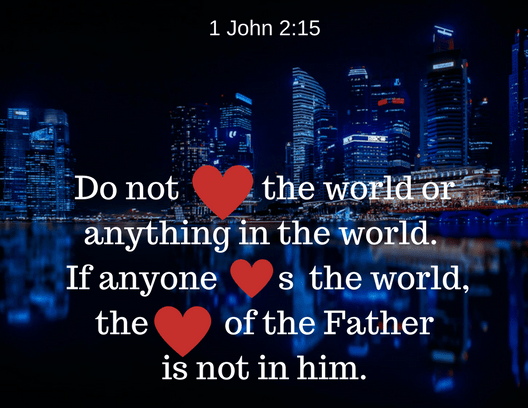
15 Do not love the world or the things in the world. If anyone loves the world, the love of the Father is not in him.

16 For all that is in the world–the desires of the flesh and the desires of the eyes and pride of life–is not from the Father but is from the world.

17 And the world is passing away along with its desires, but whoever does the will of God abides forever.

John commands us to not love the world or the things in the world. Does this mean that we are not to love people, like Jesus commands us to? Of course not! John is using expansive language to remind us of a key point: we are not to love the evil things we find in the world.

There is evil all around us: in the media, on TV, in movies, and on the Internet. We are bombarded with images all day everyday. While they had evil imagery in the ancient world, our modern world far outstrips the ancient world in how easy it is to see evil things and how often we are assailed with these images.

So what is John asking us to do? He is asking us to love the things of God, which means that we should avoid the evil of the world. We all have innate desires in our flesh that are not godly. If we act on those desires, we are separating ourselves not only from God through our sin, but we are also consciously deciding that our way of living is better than living the way God says that we should.

Friends, that is a dangerous place to be. I know that I have walked in darkness at times, enjoying the desires of the flesh and of the eyes. But what I found is that those dark places lead nowhere good. God does not want us to avoid sin because we are good little trained creatures. It’s not like God is running a circus, and we get to play the part of the circus animals, just jumping through hoops of fire to prove to God that we love Him. That’s not it.

God designed life. God designed us. He loves us. He wants the best for us. Just like I tell my children “no” from time to time, that does not mean that I do not love them. I want what is best for my kids, even when something wrong or dangerous looks attractive to them.

Let’s avoid the evil things that our world is trying to sell to us. Let’s be examples of love and light instead. As we do so, we are examples to others of what life will look like in the coming kingdom of God. The kingdom of God and the things of God will abide forever.

-Will Barlow

REflection Questions

Do you have a love for the things of this world that is unhealthy? What can you do to return to a purer love for God?

    Have you ever noticed that when you feed your mind something, it focuses on that concept more and more? How can you guide your thoughts in a healthier direction?

    When people look at your life, can they recognize the kingdom of God? Can they see the fruit of the spirit, evidence of a changed heart and life?

    Continue in Him

    1 John 2

    Sunday, October 16, 2022   

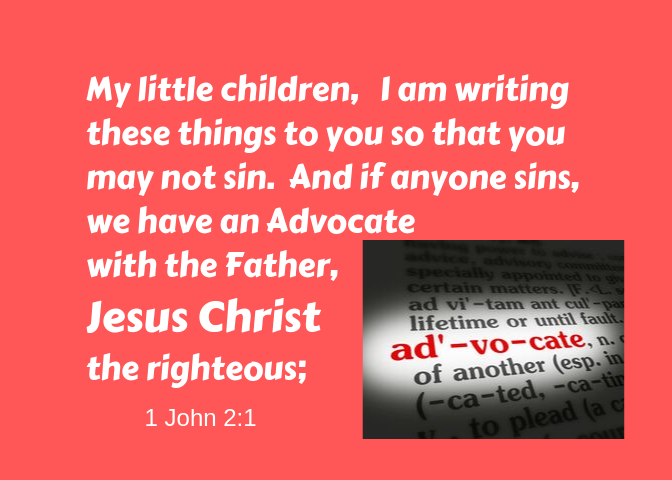
    “My dear children, I write this to you so that you will not sin.”

    That is how this chapter starts off.  Good plan, more easily said than done.  Thankfully, John doesn’t stop writing here.

    “But if anybody does sin, we have an advocate with the Father—Jesus Christ, the Righteous One. He is the atoning sacrifice for our sins, and not only for ours but also for the sins of the whole world.”

    If you are reading this, you probably already know it.  You have read it before – in this chapter, or elsewhere in the Bible.  But isn’t that a good reminder?  We are not perfect, but thankfully, we have an advocate. 

    This whole chapter is full of “good reminders.”  And John presents them in little different ways.

    In verses 12-14 he went about it in a positive way.  Instead of saying don’t forget this, don’t slip back into your old ways, he turns it to the positive and says “you are strong” and “you have overcome the evil one.”

    He approaches it from the other side too in the next verse saying “Do not love the world…”

    But throughout the chapter, I am drawn back to the positive affirmations that he writes to his audience.

    20 But you have an anointing from the Holy One, and all of you know the truth

    24 As for you, see that what you have heard from the beginning remains in you. If it does, you also will remain in the Son and in the Father. 25 And this is what he promised us—eternal life.

    28 And now, dear children, continue in him, so that when he appears we may be confident and unashamed before him at his coming.

    Good instruction can come from both telling people what not to do, but also telling people what to do, and telling them to keep doing the good they are doing.  It is an encouragement as well as a reminder, and that sticks with me today as I write this.

    ~Stephanie Fletcher

    Reflection Questions

    1. Reread 1 John 2 looking specifically for the things John tells us to do, as well as those things we are not to do. Which instructions do you find easiest to follow? Where do you need a little push in the right direction to keep yourself on the right path – or off of the wrong path?
    2. What do you think our “advocate with the Father—Jesus Christ, the Righteous One” sees you doing and would tell you to keep doing? What will you do today to keep doing that! How will you ‘continue in him’?

    Some observations from 1 John, chapter 2

    1 John 2 1

    “From the beginning…”


    The phrase “from the beginning” which was used in the first verse of the book (1 John 1:1), is used 5 more times in chapter 2. In John 1:1 “that which was from the beginning” was that which they had heard, seen and touched, “the word of life”. This “beginning” refers to Jesus the Messiah and his ministry on earth communicating God’s word, not to the beginning at creation. The occurrences of “from the beginning” in chapter 2 are verses 7, 13, 14, and 24 (two times). It is important to keep in mind that “from/in the beginning” in the Scriptures does not always refer to the Genesis creation.


    Context must help determine which “beginning” is meant. For instance, in the Gospel of John, the phrase “from the beginning” does not usually refer to the creation, but to Jesus ministry on earth. Note these references:

    • “For Jesus knew from the beginning who those were who did not believe, and who it was who would betray him” (John 6:65)
    • “So they said to him, ‘Who are you?’ Jesus said to them, ‘Just what I have been telling you from the beginning’” (John 8:25).
    • “I did not say these things to you from the beginning, because I was with you” (John 16:24).
    • “And you also will bear witness, because you have been with me from the beginning” (15:27).

    In each case mentioned above, from the beginning means the beginning of Jesus’ ministry.

    With only two exceptions (John 8:44 and 1 John 3:8 which refer to the devil) “from the beginning” in the Gospel of John and in the Epistles of John (1 John 1:1; 2:7, 13, 14, 24; 3:11 and 2 John 1:5-6) refers to the beginning of Jesus’s ministry. This may help us understand “In the beginning…” of John 1:1. Some One God believers see John 1:1 as a reference to the beginning of Jesus’ ministry. Similarly, Luke mentioned “those who from the beginning were eyewitnesses and ministers of the word” (Luke 1:2). Mark 1:1 mentions “the beginning of the Gospel of Jesus the Messiah.”


    “My little children”


    Several times the writer refers to those whom he writes as “my little children” or “children” (2:1, 12, 18, 28). This should not be understood as if the writer is derogatorily chastising his listeners for being immature. Rather, these references should be understood as a terms of endearment and care, just as when he calls his listeners “beloved” (1 John 2:7, 3:2, 21, 4:1, 7, 11). As children of God (3:1-2), those that believe that Jesus is the Christ are a family, brothers and sisters, who must love one another (5:1).


    An Advocate with the Father


    The writer explains that we do sin, but there is a path to forgiveness (1 John 1:8-10). He writes to us “so that we may not sin, but if anyone does sin, we have an advocate with the Father, Jesus Christ the righteous.” Jesus is our advocate, like a lawyer on our side. This should give us great encouragement. Jesus is the honest, righteous lawyer on our side. He is for us. As an expert lawyer, Jesus knows the rules. He knows how to take our case before the Father. He has access to the Father and successfully intercedes for us (cf. 1 Tim. 2:5 and Hebrews 8:1).


    We lived in Israel and all our children were born there. Most countries do not grant citizenship to foreign children by virtue of being born in the country. Two of our young adult children applied to become citizens in Israel. They were denied several times over three years. However, not long ago a lawyer, an advocate, took up their case and presto, my children received their citizenship. The lawyer knew the rules, had the connections, authority and knowledge on how to present my children’s case, and succeeded. Jesus is our expert, righteous, successful advocate before the Father.


    “Do not love the world…”


    The author’s admonition to “not love the world or things of the world” are perhaps the best known verses of chapter 2 (vs. 15-17). He defines what “loving the world” is: the lust of the flesh, the lust of the eyes, the pride of life. It is a love of the way of the world, or of this world’s system. This doesn’t mean that we shouldn’t have an appreciation for the beauty and grandeur of God’s creation, the work of God’s hands, which is “very good” (Gen. 1:31). After all we wait for the regeneration of this world, and indeed the regeneration of this world’s system (Matt. 19:28, Heb. 2:5).


    “The last hour”  and “anti-christs”

    The author says it is the last hour. What a long hour it has been! He knows that it is the last hour since many anti-christs had already come. Specifically, here he says that the anti-Christ (anti-Messiah) is anyone who denies that Jesus is the Christ (the Messiah). The text does not say, as many traditional trinitarian Christians say, that the anti-Messiah is anyone who denies that God is the Messiah, or that the Messiah pre-existed as God. Rather, the text says that the anti-Messiah is anyone who denies that Jesus, the man Jesus, is the Messiah. “Christ” (Messiah) is never a title for God himself.


    Of these anti-christs, the author says: “They went out from us, but they were not of us; for if they had been of us, they would have continued with us…” (1 John 2:19). It is easy to see how a text like this could be mis-interpreted and mis-applied. Especially as centuries passed, anyone could use the text to condemn any kind of a reformer. For instance, Catholics could apply it against Protestants.  Today it is leveled against anyone who denies that Jesus is God. But in its original context it was directed against anyone who denied that the man Jesus is the Christ (Messiah).


    The promise of God – eternal life

    1 John 2:25 says that God has promised us eternal life (immortal life in the age to come). We can take comfort and joy that God is pretty good at keeping His promises.


    Having confidence, and not shrinking back in shame


    1 John 2:28 says that if we abide in Jesus, that is, live according to knowledge of who he is, we can have confidence so that when he appears, at his coming, we won’t shrink back in shame. Since we know who Jesus is — the Messiah of God the Father, risen from the dead, exalted to God’s right hand, appointed to rule the world, we can look forward to his return. There is a similar admonition in Hebrews 10:39: “But we are not of those who shrink back and are destroyed, but of those who have faith and keep their souls.”

    -Bill Schlegel