
Learning from Philip

Joshua 19-20

Psalm 37

*Acts 8

-Devotion by Stephanie Fletcher (MN)


There is a lot going on in this chapter, but I am going to focus on the last section of Philip and the Eunuch. There are 3 main things that stick out to me reading through this story that I want to share some thoughts on.


First is how open Philip is to hearing the voice of God and the movings of the Holy Spirit. That last section starts (Acts 8:26) with an angel of the Lord directing him where to go, followed by the Holy Spirit giving him specific directions on talking to a specific person, and finally at the end, “the Lord snatched Philip away” to move him to the next place he wanted him to minister. All of those instances seem amazing to me. There have been times in my life that I have felt clear direction and would even say that I heard God speaking to me, but these instances with Philip are still awesome to me. Whether this was unusual for him or not, every instance of hearing God’s direction – through an angel or the Spirit – is pretty amazing. And the final instance of being snatched away to a new place is beyond my full comprehension because I just have never seen or experienced that. Maybe this had happened to Philip before, but I like his reaction. After what sounds like to me to be teleportation, he just keeps going on sharing the Good News of Jesus in the town he ended up in and every town on his way to the next place. It definitely seems like he was tuned in to God and following His leading well.


The next thing that stands out to me in this passage is the Eunuch’s response to Philip asking if he understands what he is reading – “How can I, unless someone instructs me?” On one side of things, I see his humility here. Sometimes I think we have been raised in this world to try to be too independent. To feel that we should be able to figure things out for ourselves and to not seek help. But the Eunuch here is just open and honest and completely willing to have someone help explain things to him. I think of my daughter, who once she learns something, believes herself to be an expert on the subject. My husband and I frequently have to remind her that while she is learning a lot, in most instances, the adults in her life still know more than her and she needs to continue to listen to advice and direction. Even when we think we know what passages of Scripture are about, we can still benefit from hearing someone else instruct on them. Maybe giving a different perspective than you are used to, or maybe truly learning something completely new. But we have to be open to being instructed. And then on the flip side, there have to be those willing to instruct! Again here, I appreciate Philip following God’s leading and being a person who is out there instructing people about the Good News of Jesus.


The final piece that stands out to me in this story is how the Eunuch responds to the Good News. He sees water and says “Why can’t I be baptized?” No hesitation, no waiting to have more information, just someone who is ready to go all in after hearing about Christ. I think this resonates with me because as someone raised in the church, I was probably baptized later in life than most in similar situations. I kept waiting, finding reasons to say, “not now.” At the time, the reasons I gave were that I wanted to make sure my decision was my own, that I wasn’t being influenced because someone else I knew was getting baptized, or because someone else had suggested it, but in looking back, I can see that there was pride there and I isolated myself through that. I wanted there to be no doubt that decision I made was because I believed it and not because of anyone else’s actions. In the end, I very clearly made my choice because of what someone else had shared. And I am thankful for that because it broke the pride that I had built up and led me to say it doesn’t matter what anyone else thinks of this – I want to be baptized. I didn’t and don’t have a perfect understanding of things – I am still learning, I am still struggling with a variety of things, but I am not alone. If you are waiting for the perfect time or to have things all figured out first –there isn’t one, and you don’t need to. If you believe, why shouldn’t you be baptized?

Reflection Questions

  1. How open are you to the Spirit’s leading? Would you be willing to change your plans for today if you felt the Spirit urging you to “Go” – talk to that neighbor, write that text, initiate that conversation, go out into “the desert” to be shown what to do next?
  2. How have you grown by listening to someone else’s explanation of Scripture? Where do you go when you have a question about what you find in the Bible? To whom and how can you share what you are learning from Scripture?
  3. What do Scriptures teach about baptism? Have you been baptized? If not, why not?

Prayer

Dear God, thank You for the gift of Your Scriptures which have been used for thousands of years to draw people to You and Your plan of salvation. Help me to read, meditate, be instructed in, discuss, share and live them well. Thank You for Jesus, your great Son, servant, and Christ who was prophesied throughout the Old Testament, shared in the gospels and explained by Philip and Peter and John and those who teach me, too. May I be rooted in the truth of Your word and led by Your Spirit to do the work You want me to do. Help me be faithful to You always.
Focus

Joshua 17-18

Psalm 36

*Acts 7

-Devotion by Stephanie Fletcher (MN)

One thing that surprised me recently when our church was going through a study of Acts, was thinking about the timeline. I don’t know that I ever realized (or maybe I just forgot), that Stephen’s story doesn’t take place just right after Jesus ascends into heaven and the Holy Spirit is poured out. Depending on different sources I looked at, it was 5-7 years later that Stephen’s story here in Acts 6-7 takes place.

Why that sticks out to me here is that when Stephen gets into a debate with some men, and they are essentially embarrassed and then get people to lie about him in order that he can be arrested, it isn’t happening right in time after Jesus’ ministry. It is years later, but groups of people are still seeming to be freshly bothered by the impact of his ministry. This isn’t something that died down – it only got stronger through the faithfulness of those in the early church.

So Stephen is falsely accused, and does he go into a heated defense of himself? Nope. He launches into a history lesson of the people who accuse him, reminding them of God’s relationship and covenant with the Jews over time, and of the failures too of these people. And then he says to them

51 “You stubborn people! You are heathen at heart and deaf to the truth. Must you forever resist the Holy Spirit? That’s what your ancestors did, and so do you! 52 Name one prophet your ancestors didn’t persecute! They even killed the ones who predicted the coming of the Righteous One—the Messiah whom you betrayed and murdered. 53 You deliberately disobeyed God’s law, even though you received it from the hands of angels.” (Acts 7:51-53)

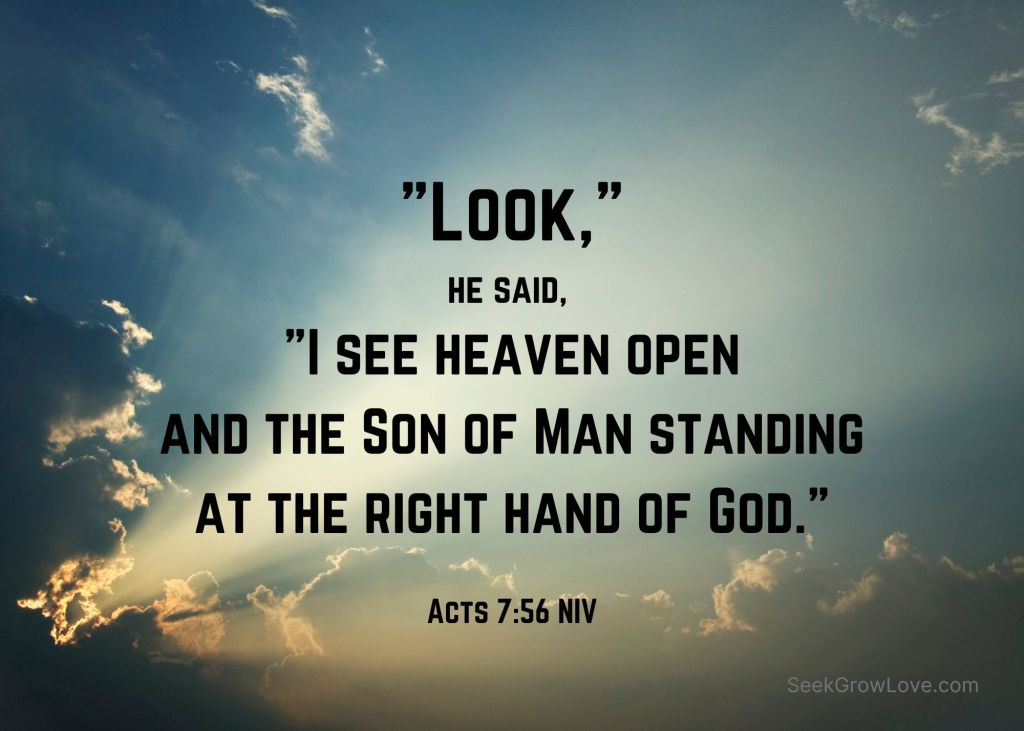
Never in his defense is Stephen trying to argue for himself. Through all of it, he is focused on God’s righteousness and as this group stones him, he is rewarded by getting to see the glory of God and Jesus standing in the place of honor at God’s right hand.

And despite this stoning, Stephen’s final words are “Lord, don’t charge them with this sin!” which is so reminiscent of Jesus’ words of “Father forgive them, for they don’t know what they are doing.”

This is such a great example and reminder of forgiveness and loving others that are treating you wrong/hold different beliefs. Advice that I have heard before when dealing with difficult people is to ignore them or not focus on what they are doing and God will “make it right” or enact justice in the end. But Stephen didn’t try to ignore the fact that they were stoning him. Instead, he chose to ask for them to not have his death on their hands which is just so much more loving than the concept of not taking things into your own hands but still looking forward to people receiving “justice” for wrongdoing. As he was literally murdered, he asked for them to be forgiven. Can we offer this much love to people in our lives that probably aren’t trying to murder us, but are doing things that we don’t like?

Reflection Questions

  1. What impresses you about Stephen?
  2. What do you do when you feel you are being falsely accused? What happens when we are quick to defend ourself?
  3. What can we learn from what God allowed Stephen to see and share right before his death?
  4. Why do you think Stephen chose to forgive them? What do you think is the hardest part of forgiving someone who has/is hurting you? Pray about who God wants to see you forgive.

Prayer

Dear Lord God, I thank You for Your Son Jesus, and his follower Stephen. Forgive me of the times I have not shown the faithfulness, wisdom, courage, love and forgiveness Stephen displayed. Help me forgive, Father, so I can be forgiven. I pray for Your Spirit and wisdom to guide my decisions and words. May I be focused on You and not myself. Show me how You want me to be a faithful witness of You and Your Son today and in the future, and help me do it whatever the cost.

Rumblings of Discontent

Joshua 15-16

Psalm 36

Acts 6

-Devotion by Stephanie Fletcher (MN)

Looking at the start of Acts 6, we see how as the church was growing, and growing quickly, there were “rumblings of discontent.” It goes into a specific issue that we might not directly deal with in our church, but I think everyone can understand discontentedness.


As numbers grow – in anything you are doing, not just church – it is harder to get everyone on the same page and not have some people who are upset with how things are going. Sometimes discontent can grow when there are a lot of people with differing opinions. There may not necessarily be something wrong, but one person wants to do things one way and another person a different way. Sometimes it grows when there is an issue, and it seems like that is what is happening here.


As the early church grew larger, the apostles weren’t able to keep up with all the things that go into the different aspects of church. I think this is something we see today. Pastors have a lot put on them to be in charge, overseeing their congregation. But realistically, they can’t oversee all aspects of ministry.


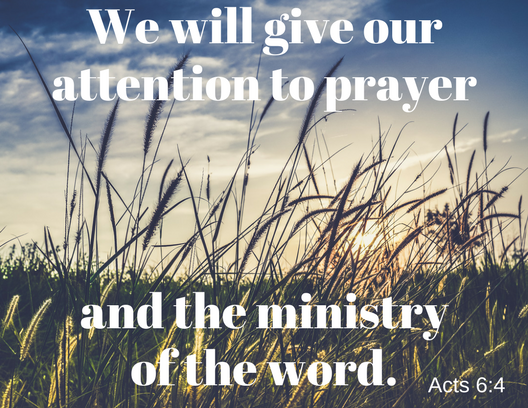
In chapter 6 of Acts, we see how the apostles, having been gifted in this way, wanted to be able to continue focusing on praying and teaching, but recognized that there are other needs that are out there that need to be met. So they put together a group of people who were well respected, full of the Spirit and wisdom to oversee this area of need (daily distribution of food).


Though we may not have this specific programming in our churches today, and our churches may not even have the same format, we can see how one pastor in many cases, can’t do all the work of the church on their own. Delegation can be a wonderful thing, but it means that there need to be qualified and willing people to let the church continue to do the work of the church.


Do we seek that in our churches today – to make sure that good work is being done without overburdening one person, or one group of people? How can you personally look to serve to ease someone else’s burden?


We will get into Stephen tomorrow as his story continues into chapter 7.


Reflection Questions

  1. “Do we seek that in our churches today – to make sure that good work is being done without overburdening one person, or one group of people? How can you personally look to serve to ease someone else’s burden?” What needs do you see that you can help meet?
  2. If you were seeking someone “full of the Holy Spirit and wisdom” what would you be looking for? What does it take to have a good reputation? In what ways can you work on improving your own reputation? Do you think others regard you as “full of the Holy Spirit and wisdom”? Why or why not? What could be done to increase your measures of Holy Spirit and wisdom?
  3. Where else have you seen the benefit of delegating and sharing the load – in Scripture and in your life?

PRAYER

Dear God, I thank You for creating the church! It is not without its challenges, but it is a beautiful way You have given for Your children to come together as a body to love and worship You, follow Your Son and prepare for his return, while loving and strengthening believers, and being a light to the world. Show me how you want me to serve, and perhaps where you want me to let others serve. I ask for more of Your Spirit and wisdom to do well the jobs you want me to do. Working together, help us be a church that brings glory and honor to You in what we do and how we do it. In Your precious Son’s name I pray, Amen.

A Discerning Heart

1 Kings 3-4, 2 Chronicles 1, Psalm 72                                   

In these accounts (1 Kings 3 & 2 Chronicles 1), we see Solomon following the LORD and God coming to him in a dream to ask him whatever he wants.

In the start of his reign here, Solomon presents himself with humility before God in his answer.

1 Kings 3:7-9 says

“Now, Lord my God, you have made your servant king in place of my father David. But I am only a little child and do not know how to carry out my duties. Your servant is here among the people you have chosen, a great people, too numerous to count or number. So give your servant a discerning heart to govern your people and to distinguish between right and wrong. For who is able to govern this great people of yours?”

He could have so easily asked for more, yet what he wanted was to be able to do the job that God had appointed to him well.  I really appreciate this and want it to be an example to me to want to do my job(s) well.  I am thankful that for the most part, I enjoy my job, which makes it easier to work hard at it.  But I know that is not always the case.  For those jobs that I am maybe not fully equipped for, or maybe especially in the ones I think I am, I want to be reminded to ask God for wisdom in how I work or lead so that I can do it well.

As we continue reading, we see the wisdom of Solomon here, and we see how he became a great king, but seeing this positive start here also saddens me when we read how he fell and how he turned away from the God who gave him this great wisdom, wealth, and honor.  You’ll read about that later, but I just wanted to note that again (from earlier in the week), we can’t let pride get in the way – even those viewed as some of the “greats” have fallen when led astray.

~Stephanie Fletcher

Reflection Questions

  1. How would you define wisdom?
  2. What is one decision you have made that showed a lot of wisdom? What is one decision you have made that lacked wisdom?
  3. In what jobs/roles/areas of your life should you pray for a more discerning heart to distinguish between right and wrong?
  4. How does pride mess with wisdom?

Loving Laws

Psalm 119:1-88

As I read through the first half of this Psalm, one thing that stuck out to me was the repetition of the thought of loving God’s law/commands/decrees or desiring to love them. 

When we think about laws, we don’t usually think about loving them.  We follow the laws so we don’t get punished.  Some laws, we understand and agree that they are good, so it makes sense to follow them, and some, we don’t and the only reason to follow them is to not get in trouble (like prohibiting nursing homes from playing Bingo more than two times per week or not crossing state lines with a duck on your head).

The concept of loving laws makes much more sense when you consider a loving God that created them.  Though we may not understand all of them, we can know that God put them into place for the good of people.

Though the requirements of the law were fulfilled in Christ and there wasn’t an expectation for the Gentiles to follow the law, we can still look at the law and see valuable guidance like washing your hands.  You can see how the instructions on dealing with dead bodies or blood would have made sense, especially before more medical advances were made.  And whatever doesn’t make sense to you at this time, if you believe that God is good and loving, you can trust that the laws were made with a reason.

When we look at the direction given by Jesus that went above and beyond the call of the law, we can also believe that he gave those directives because he loves people too and wants us to as well.

When we want to do good because it is good rather than because of a fear of punishment (or a promise of reward), we can live our lives differently than the world around us.

God, teach us to love your ways, to truly believe that your ways are good and trustworthy.

~Stephanie Fletcher

Reflection Questions

  1. What are your favorite 3 verses in Psalm 119:1-88? Why did you choose each one?
  2. What is the benefit of having good laws? What laws help your home, school or work environment run more smoothly?
  3. Do you trust that God’s laws are good? Pick one of God’s good laws that God might want you to love more. What would that look like?
  4. What do we learn about God’s laws from Jesus?

So Be Strong

1 Kings 1-2 & Psalm 37, 71, 94

As David gets ready to die in 1 Kings 2, the beginning verses as he speaks to Solomon stuck out to me.

“I am about to go the way of all the earth,” he said. “So be strong, act like a man, and observe what the Lord your God requires: Walk in obedience to him, and keep his decrees and commands, his laws and regulations, as written in the Law of Moses. Do this so that you may prosper in all you do and wherever you go and that the Lord may keep his promise to me: ‘If your descendants watch how they live, and if they walk faithfully before me with all their heart and soul, you will never fail to have a successor on the throne of Israel.’”

“So be strong, act like a man” – what does that look like?  I think this statement connects with the next one.  To be strong and act like a man is to observe what the Lord your God requires which is to walk in obedience to him and keep his decrees.  Doing those things takes strength because it opposes the way of the world.

I am not a man, but I am raising a young one, and this is what I desire for him.  I want him to be strong, that is, to stand firm in faith and not give in to pressures from this world, but to instead walk in obedience to God.  I want him to be strong as in to stand up for those who can’t, to defend and protect the weak. 

Our culture puts definitions on what it wants men to be like, and that changes throughout time (for example, I read recently that pink used to be a very masculine color in the past), but those things don’t really matter.  How they follow God matters.  How they care for others matters.

As you continue reading in 1 Kings 2, you see poor examples of men in Adonijah, in Abiathar, in Joab, in Shimei as they tried to usurp the leader God put in place or followed the wrong people or refused to listen.  These aren’t poor examples of men in a cultural sense, they are poor examples of men in the sense that they were not walking in obedience to God.  They were not being strong/faithful to what they were told, but instead were led astray, or were trying to lead others astray.  If we can raise up men who follow God and care for others, we raise up men who are like Jesus and that is the strength that I hope to see.

~Stephanie Fletcher

Reflection Questions

  1. How is God’s definition of what it takes to be a man different from what the world currently says men should be?
  2. While it is not discussed in this text specifically, what do you think God would say to women about how they should act?
  3. Man or woman, how have you showed strength in opposing the way of the world? Is there an area where God would like to see more strength in you – more doing what God requires?
  4. What good examples have you had of men or women who were strong in the Lord?

Praise the Lord!

Psalm 111-118

                  Psalm 111-113 – all start with “Praise the LORD.”

I have started a homeschool journey with my child, and one thing I am enjoying about the curriculum we are using is that it tries to draw things in the lessons back to God, and to remind us to be thankful and grateful in our lives.  I think when we start with “Praise the LORD” it can shift our focus and alter the way we live our lives.

                  115:1 – Not to us, Lord, not to us
    but to your name be the glory,
    because of your love and faithfulness.

As humans, we often crave praise and glory, but when we seek after those things, we create idols (though maybe not the physical ones mentioned in the following verses). 

But our God is great and wonderful, and we need to trust in Him – He blesses people, He gives to us.  And simply because of who God is, we ought to offer Him praise, “both now and forevermore.” (verse 18b). 

I have enjoyed reading the Psalms, and I appreciate how so many of them are focused on praising God.  I think if we re-framed our life to have that much focus on that, we would be better off.

~Stephanie Fletcher

Reflection Questions

  1. What stood out to you most in these Psalms?
  2. What have you praised God for this week?
  3. What happens when we don’t praise God?
  4. How can you be more intentional about praising God more regularly?
  5. What can you praise God for today?

Chosen – for Something

Be Strong and Do It!

1 Chronicles 26-29 & Psalm 127

Have you ever had an idea, or plans for something that you spent time putting together, but were not able to actually carry it out?

It might be because you don’t have the means, the talent, the time, but whatever the case, it can be disheartening, so I appreciate David’s example here on not being downtrodden about it but instead taking an opportunity to guide the nation and his son, directing them to serve God.

I also think it is pretty cool that despite David not being allowed to build the temple, we see an example of God’s Spirit working in David to come up with the plans.  Just because he wasn’t allowed to build, didn’t mean that he wasn’t able to still do something for the LORD.

In this case, David wasn’t allowed to build because of being a warrior who had killed others, but it is also a reminder to me that there isn’t just one thing to do.  God may call us differently or gift us differently to accomplish more things.  God didn’t use David to build the temple because of David’s actions over the past. But in other cases, God is just using people in different ways – not because one thing is better than the other (thinking of Paul describing the body – each part needs the others to properly function), but because multiple things need to be done.  We might sometimes feel saddened by being unable to do what we want, but that shouldn’t stop us from doing something.  We are all able to serve, but that service might look different from how others serve depending on our skills, or physical abilities, or God-given direction.

And then as we continue reading, we see how things are generously donated to the building of the temple, and to keep us all in check, David offers this in 29:14 “But who am I, and who are my people, that we should be able to give as generously as this? Everything comes from you, and we have given you only what comes from your hand.”

In a world/culture that is heavily focused on earning what we have, sometimes we need that reminder that the only reason we have is because God has given us things.  And that can fill us with gratefulness and love and inspire us to give as well.

~Stephanie Fletcher

Reflection Questions

  1. Is there a job that you have wished God would chose you for, but He has not? What can you learn from David? What other jobs do you think God IS asking you to do? In what ways are God’s plans better than ours?
  2. What has God given to you that you can use to serve Him?
  3. Our Psalm today was written by Solomon and he wrote: “Unless the Lord builds the house, those who build it labor in vain.” (Psalm 127:1 ESV). What did Solomon learn from his dad? How can you apply these words to how you are building your house/life/family and how you are building/supporting/growing God’s house/church?

Fully Known

Psalm 138-139, 143-145

I picked just one Psalm today to write about (139), but I think you can grow and find comfort in all of them.

You have searched me, Lord,
    and you know me.

This is both comforting and frightening.  God knows us fully, He knows all that we think and do.  That can be scary when we think about how unruly our minds sometimes are.  But it is also an amazing comfort and blessing to know that there is someone that knows you 100%. 

Though we often try and hide aspects of our lives, I believe that most people do have a desire inside to be fully known.  To have someone you can go to and have no façade and completely let your guard down.  We search for that in people, but it isn’t something that we can find in them, only God. I think that desire can even cause us hurt and frustrations in our relationships with people because we want that other person to fully know us, and when they don’t [can’t], we can feel let down if we aren’t viewing them in the proper light. 

I often wish my husband could read my mind when I say that I want a snack, but I don’t know what I want – I want him to know what I want.  But other people weren’t made to know us fully.  Only God gets to hold that position, and that is a good thing.  People are imperfect, they can let us down by their imperfections, but God never does.  And so thanks be to Him that He is the one that knows us completely.

The following verses continue a similar idea and expand into the fact that there is nowhere we can go that is away from God’s Spirit.  I want to just copy all the verses and paste them here, but you can go read them.

Even when we try and run from God, there is no where we can go that He is not there.  And not only is He there, but He loves you so fully and deeply. 

13 For you created my inmost being;
    you knit me together in my mother’s womb.

16 Your eyes saw my unformed body;
    all the days ordained for me were written in your book
    before one of them came to be.

Before you were even born, God knew you, and He loved you so fully and completely that our human minds cannot understand. But we can trust and know that that is true. 

I’ve had the privilege to carry two children within me, and that concept of loving someone in an inexplicable way before you have even met them connects with me.  And what is crazy to me is to think of how much deeper and wider the love God has for us – stronger than any earthly parent can have for their child, and I know, that love is already deep.  And it humbles me and brings me to tears to know that God loves my children more than I ever could.  And I am so thankful for that, and that He loves us all in that way.

~Stephanie Fletcher

Reflection Questions

  1. What do you find most striking in Psalm 139?
  2. In what ways do you desire to be known by others? How have you been disappointed when they have not met your expectations and desire?
  3. How do you feel knowing God knows everything about you, and always has, and loves you still?

Not God

1 Chronicles 23-25, Psalm 131

We are going to be in the Psalms today.  [Personally, I did not pick either of my children’s names from the Chronicles reading, but if you are looking for some unique names, there are lots of options here!]

I have been reading a book with my small group looking at the concept of how we are not like God, and how that is a good thing.  There have been a variety of topics related to this, but one thing that has been a common theme is how we humans strive after some of God’s attributes, and that when we do so, we inevitably fall short, and often these shortcomings lead to issues when we think we should have been able to do it.  And I think that is pride.  We pride ourselves on being able to take care of ourselves, to know things, to understand things, to create things, to do X, Y, and Z, but we cannot do things to the extent that God does.

1b 
I do not concern myself with great matters
    or things too wonderful for me.
But I have calmed and quieted myself,
[…]

Israel, put your hope in the Lord
    both now and forevermore.

Instead, we can rely on God to lead those things that are too great for us, we can find rest and comfort in Him.  We can be content and thankful of our limitations because we have an amazing Father with no limitations.

I actually wrote a devotion on this Psalm a couple of years ago, and it was interesting to see how my perspective has changed based on what I am going through, what other things I am reading, etc.  Some of my thoughts are similar, but some are focused on another area.  And that reminded me of another thing from the book – how because of God’s limitlessness, we always have more to learn about Him, from Him.  We can keep reading through the Bible over and over and there is always more for us to glean, always room for us to grow closer to God.  We need to view ourselves with humility to realize we aren’t done growing – there is always room for improvement.

And I think you balance that with contentedness of being ok with our place as limited humans while still trying to grow closer to our great God.  We can be content while still seeking to become more Christ-like as Jesus was and is God’s reflection to us.

~Stephanie Fletcher

Reflection Questions

  1. What are some of God’s amazing attributes that you enjoy and strive for in your own life?
  2. Where have you seen your own growth: in learning about God, drawing closer to Him and emulating His attributes? How would you like to grow next? What can you do to help you with that growth?
  3. What contentment do you find knowing you can rely on God to be God and you can’t and don’t have to? Enjoy relying on Him today!