
Perfect Love

OLD TESTAMENT: Jeremiah 14 & 15

POETRY: Psalm 117

NEW TESTAMENT: 1 John 4

There are some pretty confusing messages about love out there in the world. I’m sure you’ve seen some of them. Oftentimes it’s defined as an emotion, a feeling. (How vague and disappointing a definition.) Some say it’s something you cannot help. You fall in and out of it, with little to no control. (Yikes. No accountability there.) Some say it’s something you have to work at, and that love takes effort. (Ok, I have to agree with that one a bit.) The Greeks separated love into 8 categories: eros, ludus, philio, agape, storge, mania, pragma, and philautia. (Talk about complicated.) I very clearly remember listening to a lot of DC Talk as a kid in the 90’s and they told me that love is a verb. (Or maybe that was Luv. It has been a long time since I was “d-d-down with the DC Talk.”) And then there’s the currently popular, on bumper stickers everywhere, “Love is love.” (Not super helpful, thanks.) 

John here tells us God is love. And if that doesn’t tell you how amazingly wonderful and powerful real, actual love is, then I don’t know what will. And fortunately for us, John goes into this a bit more.

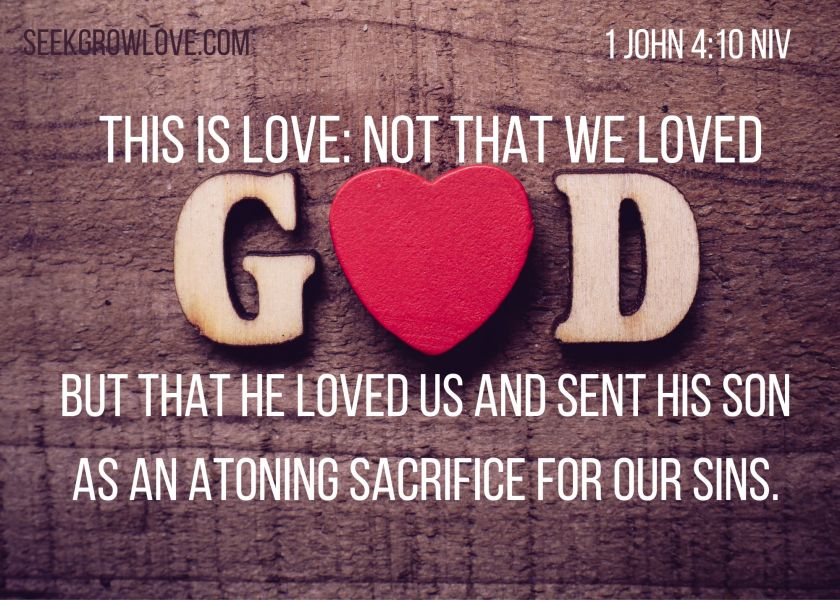
 “Dear friends, let us love one another, for love comes from God. Everyone who loves has been born of God and knows God.  Whoever does not love does not know God, because God is love.  This is how God showed his love among us: He sent his one and only Son into the world that we might live through him.  This is love: not that we loved God, but that he loved us and sent his Son as an atoning sacrifice for our sins.”

We know what love is when we know God. And we know God by listening, and learning, and understanding exactly what kind of sacrifice was made in order that he could have a relationship with us. I think we sometimes miss the gravity of this. When you sit and truly contemplate it, it sits heavy on your chest and chokes you. This love is devastating. 

I have a son. I love him dearly. I would die for him without hesitation. And there’s not a person on this planet that I want a relationship with badly enough to put my son through the torture and death that Christ suffered. I can’t fathom it. My heart breaks with the thought. 

God did not love his son any less than I love my little Oliver. In fact, God, in his perfect love, loves his son more, I’m sure, though that’s hard for me to understand or admit because I feel like I love my boy without end. But God is love, and God is perfection, and God loved his son Jesus. And yet he offered his son as a sacrifice. 

WHY!? Why would he do that!? If he loved his son so much, HOW could he do that!? 

That same perfect love extends to each of us as well. Though we are imperfect, ungrateful, selfish, and sinful, God’s perfect love covers us. He loves us SO MUCH, that he gave us his son. Jesus Christ was the model of all things good and perfect and brought us hope of a kingdom and eternal life with God and then he willingly suffered and died to make that future a possibility for all of us. And God allowed it. God gave us everything. And that is real Love, with a capital L. That is God’s Love. 

And God asks us to show that Love to others. I’ll admit immediately that I’m not capable of that kind of perfect Love. It hurts. It’s difficult. I don’t always understand it. My imperfect self, with my petty thoughts and frustrations and impatience… I’m only capable of love with a lowercase l. I’m not sure I can Love like God Loves.

But even when I’m not able to Love like that myself, I am VERY capable of sharing God’s Love with others. My version of love fails, but my God never does. 

“This is how we know that we live in him and he in us: He has given us of his Spirit.  And we have seen and testify that the Father has sent his Son to be the Savior of the world.  If anyone acknowledges that Jesus is the Son of God, God lives in them and they in God.  And so we know and rely on the love God has for us.”

We must know and rely on the Love God has for us. We are not capable of this kind of Love on our own, but God grants us his Spirit, and we know what his Love looks like. Share His Love with others. Love your neighbors enough to share God’s true and perfect Love with them. 

Reflection:

Who do you struggle to love? Do you have any relationships in your life where you find it difficult to love your neighbor? 

With whom can you share God’s perfect Love? Who do you know that desperately needs to see that Love in action? Who do you know that needs to hear that they are loved SO MUCH that God wants a personal relationship with them? 

Do those around you see God’s Love in your actions and in your words? Do they recognize God’s Spirit working in you? If not, or if not often enough, how can you do a better job of allowing God to work in you? 

My friends, I hope that this was a message of Love to you today. I pray that God’s perfect Love overcomes you this week. I pray that it overwhelms you so much that you have to share it with others.

– Jenn Haynes

The Implications of Living in God’s Love pt. 3 

Old Testament: Jeremiah 35 & 36

Poetry: Proverbs 21

New Testament: 1 John 4

“There is no fear in love, but perfect love casts out fear. For fear has to do with punishment, and whoever fears has not been perfected in love.” 1 John 4:18 

Implication #3: we don’t have to live in fear 

What is fear? 

Fear is often ugly, manifesting itself in ways that harm our sense of peace. Anxiety, worry, and terror are all results of fear hampering our mental health. What is not mentioned often (or, maybe I just don’t hear it) is that our spiritual health plays an essential role in fear’s impact on our lives. I think fear is generally caused by not knowing (with certainty) what is going to happen, what has happened, or what is happening. We worry after an autopsy is performed because we don’t know if the doctor will come back with “cancer” or “not cancer”. We stress when we cannot get in contact with our spouse because of what may or may not have happened to them while they were running errands. And we are terrorized by the creaking we hear in the ceiling above because we’re unsure of what it could be. In all these things, there is fear in not knowing.  

Love and fear 

Perhaps thinking about fear in this way will help unlock John’s meaning behind the phrase “perfect (or, complete) love casts out fear”. The beloved disciple tells us that fear is related to punishment and, particularly, within the context of this section of the letter, punishment on the day of judgment. So, the fear is not knowing “will I be punished, or will I be rewarded?”. Contemplating the difference between everlasting life versus everlasting death seems like a perfectly reasonable motive for fear. John, I think, recognizes this, which is why he wanted to assure his readers that there is no need to fear for the ones who are children of God, which is to say, the ones who love one another. Those who love one another are the ones who have understood and embraced the love of God. Only because God first loved us can we love Him and each other in the way commanded by Jesus. It is because of this love that God showed us that we can know there is no punishment for those who know Him—that is, those who have embraced Him, His son, and have His spirit working through them).  

Doesn’t stop at fear of punishment 

But not being afraid of judgment day is only part of the story. We can live life without fear and its many manifestations. As Paul says in one of his letters, there can be a peace beyond comprehension. It seems easy to have peace when everything is going right for us, but it is quite rare for this state of serenity to last for more than a few moments. The real trick is to have peace at all times despite what is going on around you, despite not knowing everything that has happened, is happening, or will happen. The key is abiding in and trusting the One who made all things and will, through His son, make all things new.   

For the one who believes and lives in the love of God, there is no fear because they know that God is going to one day redeem this broken world and that even if they suffer here and now, the never-ending glory experienced in the redeemed world will make anything faced now blur from focus and memory. What many of us fear now will have no power when one has placed their hope and life in the hands of a loving Father. The mark of a fearless child of God is that they love one another. If you aren’t yet living without fear, worry, or anxiety, it seems like John would suggest it is because you haven’t yet truly known the love of God and begun to live in that love and live it out. If that’s the case, return to the gospel written by the beloved disciple (John) and read of the one who reveals God’s great love for us. 

-Joel Fletcher

Reflection Questions

  1. What impact has fear had on your life? How have you let it control what you do or don’t do?
  2. How has God given us an example of how to love? What does it mean to you that He loved you first?
  3. The end of 1 John 4 says we can’t love God and hate our brother. How can you show better love for all your brothers and sisters? Who in particular do you need to love better?

This is Love

1 John 4

Tuesday, October 18, 2022

Kid play songs of the day are from 1 John 4: 9 & 10 “This is how God showed his love among us: He sent his one and only Son into the world that we might live through him. 10This is love: not that we loved God, but that He loved us and sent His son as an atoning sacrifice for our sin.” (Aaron Winner has a great song with these verses too).

Having grown up in the Christian church, I think this wonderful news is something that I can often gloss over.  God loved us, so he sent Jesus to die on the cross for our sins that we might be saved.  Yeah, I know. 

But when you stop and read it, it is really amazing, especially from our human perspective.  It is pretty easy to do something nice for other people when they love you, when they are nice to you.  But God did this for a people who had turned away from Him, and for future people that would continue to turn from Him.

Thankfully, God’s love does not have a prerequisite.  Based on literally nothing we or anyone else has done, He loves us.  And loved us enough to put His son through excruciating pain to the point of death so that we might be reconciled to him.

How do we show our love?  Do we have requirements for who we show our love to?

The concept of loving someone no matter what they have or have not done goes against our human nature.  It is something we probably need to ask for God’s help for.  It’s ok if we can’t do it on our own.  Because of God’s great love for us, we can be reconciled to Him, and we can ask Him for help in loving others.

I don’t know about you, but I forget to ask for help sometimes.  It is not even always conscious, but my pride gets in the way.  I think I should be able to do what I’m supposed to do on my own.  But as humans, we are flawed.  And I do believe that it is ok to ask God for help in loving people the way we are supposed to.

~Stephanie Fletcher

Reflection Questions

  1. Take time to consider Stephanie’s questions: “How do we show our love?  Do we have requirements for who we show our love to?”
  2. How is God’s love different?
  3. How can we show our thanks for God’s great love?

The Love Chapter

1 John 4

i John 4 11

This chapter starts out with an admonition to “test the spirits to see whether they are of God.” Not every teaching or spirit is true. There is a very important test which can be used to know if a spirit is from God, or not. “By this you know the spirit of God: Every spirit that confesses that Jesus Christ has come in the flesh is of God” (4:2).  The test does NOT say:

  • that Jesus Christ has come in the flesh and yet is fully God
  • that God has come in the flesh as Jesus Christ, taking on a human nature
  • that Jesus Christ came from some pre-existent state into the flesh.

We must be very careful to read the text for what it says and not read into it what it doesn’t say! The phrase “come in the flesh” means that Jesus the Christ (Messiah) is a real human being, not just dressed up like one.

1 John 4 is actually the “love chapter” in the Bible as love is mentioned 26 times, almost three times as many times as in 1 Corinthians 13 (9 times). A friend once read this chapter as a devotional thought on Valentine’s Day, and it stuck with me as the “love chapter.” So much so that when I read it last February 14th, I thought that maybe the children’s song could also go “Yes, God loves me, yes, God loves me… the Bible tells me so.”  Ultimately, it’s God’s love that ignites our love for others through His Son, Jesus the Messiah. A key verse that summarizes this chapter of love showing how love is of God is verse 9.  “In this is love, not that we loved God, but that He loved us and sent His Son to be the propitiation for our sins.”

God took the initiative, motivated by love, to remedy our sin problem.

Knowing that “God is love” (4:8,16) should motivate us to love others. But the author is not calling for a hippie kind of “All you need is love, love”. He is admonishing us to a love of other “brothers” who believe that Jesus, the human Jesus, is the Messiah/Christ (5:1). This admonition to love is a call for unity among like-minded believers, because they are family as the children of God. The way we love other like-minded believers whom we can see demonstrates how much we love God, whom we can’t see. And this commandment we have from Him, that the one who loves God should love his brother also (4:21).

Beloved, let us love one another, for love is from God, and whoever loves has been born of God and knows God. (4:7)


Bill & Stephanie Schlegel