
Quiet Living

Old Testament: 2 Chronicles 7-8

Poetry: Psalm 93

New Testament: 1 Thessalonians 4

1 Thessalonians 4 continues in the instruction of how believers should be living. Paul commends the people in Thessalonica for doing well in following God’s commands and encourages them to do even more. Paul writes that God calls us to sanctification. Sanctification means to be made clean or holy. God calls us to be clean and holy. He provides this cleansing through Christ’s death and resurrection. Hebrews 10:10 says “By this will we have been sanctified through the offering of the body of Jesus Christ once for all” (NASB95). This verse is in the midst of a passage that expresses that Jesus’s sacrifice is sufficient for us and there will be sanctification and forgiveness through his sacrifice. It aligns with what Paul writes confirming that we have been made clean from our sins through Christ. 

In the 2 Chronicles reading for today, some of that same theme of cleansing/forgiveness of sin can be seen. God appears to Solomon after the finishing of the temple and tells Solomon that He will be present in the temple. In 2 Chronicles 7:14, God says “and My people who are called by My name humble themselves, pray and seek My face, and turn from their evil ways, then I will hear from heaven, forgive their sin, and heal their land.” God has often reminded His people that He will forgive their sins. In the time of Solomon, the cleansing of sins was sought through prayer with an animal sacrifice. Hebrews shows that the sacrifices are no longer needed because of Christ and 1 Thessalonians encourages how to live out this cleansing of sins. 

In 1 Thessalonians 4:9-12, Paul discusses one of the ways to live a sanctified life. Paul reminds the readers to love one another which God has taught them previously. In the case of the Thessalonians they were doing well with showing this brotherly love to those around them. Because they are doing well, Paul encourages them to love even more. What a high praise to have received from Paul and great encouragement to continue not only in doing well but to do it even more! If Paul wrote you a letter inspired by God, would he praise you for the love you show others or would he need to teach you what it means to love those around you? 

            1 Thessalonians 4:11 says, “to seek to lead a quiet life, to mind your own business, and to work with your hands, as we commanded you” (HCSB).  This reminds me of Hebrews 12:14 which says, “Pursue peace with all men, and the sanctification without which no one will see the Lord” (NASB95). A quiet life that pursues peace with all people can be a difficult life to lead. Living a quiet life that is minding your own business and seeking peace with those around you is centered around living out our sanctification. Through our forgiveness, we are called to love those around us which looks like living quietly, minding our own business, and seeking peace. 

            If you’re in any social setting where people are involved, it can be difficult to both love them deeply and also mind your own business while trying to pursue peace. Everyone has something that you won’t like about them. It might annoy you and get on your nerves. It could be anything from a difference of beliefs or political views, to the way someone pronounces a specific word. It’s really easy to get frustrated and lash out at someone who is annoying you, but that is not living out our sanctification. When a moment comes where you are feeling frustrated, annoyed, upset, or angry with someone, try to take a moment to remember the two verses from the previous paragraph. When in a place of disagreement or frustration, seeking peace and loving the person takes priority over being right and having your way. Showing grace and forgiveness will display the forgiveness you have received. It will also allow the person to feel loved and cared for. 

-Makenna Landry

Reflection:

  1. How do you live out sanctification in your life?
  2. When someone is getting on your nerves or you come to a disagreement, how do you seek to live peacefully and quietly with them?

Death and Kingdom: Euphemism

THEME WEEK: Death and Kingdom – 1 Thessalonians 4
Old Testament: 1 Kings 19 & 20
Poetry: Psalm 125

I find euphemisms to be imprecise. Usually, they are used to make taboo topics a bit easier to discuss in public, because saying words with plain meanings are just too forward. 

There’s the innocuous “over the hill.” (People just get old, and that’s OK. “Gray hair is a crown of glory” Prov. 16:31)

There are quite a number of euphemisms to describe the most intimate act of marriage, which are understandable, because sex is often uncomfortable to talk about. 

My least favorite are the ways we try to cover over the fact of death. “Passed on” and “crossed over” both imagine death as a journey. When I’m gone, please say “Jake has kicked the bucket”, because that phrase is stupid and I love it. 

But the Bible, strangely, does something similar. Death, the cessation of life, the moment when our bodies cease to self-renew, our brains cease to function, and we cease to exist … is called sleep

And this is not uncommon. At the death of David, he was said to sleep and join his fathers. (1 Kings 2:10, compare Acts 13:36) Daniel speaks of those “who sleep in the dust of the earth.” (Daniel 12:2) This is extremely common in the New Testament, starting in the life of Christ, where he speaks of those whom he is about to raise as sleeping and waking up, when they clearly died, like the young woman (Matthew 9:24, Mark 5:39, Luke 8:52) or Lazarus (John 11:11). Some saints, at the death of Christ, were raised to life again, after mentioning that they were sleeping. (Matthew 27:52) The language of sleep is continued by the early church. Stephen, dying a violent death of martyrdom, “falls asleep.” (Acts 7:60) Peter uses this euphemism in 2 Peter 3:4; Paul, in 1 Corinthians 15:6, 51, and 1 Thessalonians 5:10.

But, the Bible as the word of God and Christ as the Word of God, teach us something even while using this euphemism. Instead of concealing death from what it is, the Bible and Christ use this as a metaphor that makes more clear what death entails, not less. 

In 1 Thessalonians 4, Paul is instructing his dear friends who were grieving the death of loved ones. He wants them to understand their situation, so when he uses the phrase “those who have fallen asleep,” it is used to bring MORE clarity to the subject of death. But, how does it bring this clarity? What does sleep teach us about death? In sleep, when we are at our most tired, we do not dream; we just go down and wake back up, with no memory of the time between. It seems that this is what the lessons we have been going through this week teach us. In Ecclesiastes 9, there is no memory, no work, no knowledge. Death is the cessation of a person but one that is sleep-like. The brain stops firing. Humans are not a kind of spirit-being inside their body but intimately connected to it. So when we die, we cease to be. That is why Lazarus could not tell us about his “afterlife” experience. There was none. And why is it such good news that Jesus was attested by God and raised to life (Acts 2) and how Paul can prove this by the word of over 500 people, and by his own experience, and the continued experience of the church (1 Corinthians 15). Death is not a passage on to a better place, but a time of cessation. When Christ is raised to life, he comes back. That’s good news. 

Death is like a sleep we don’t remember.

Sleep is resting and waiting. 

For some, it is waiting for reward; for others, punishment. 

Daniel 12:2 says in it’s fullness “And many of those who sleep in the dust of the earth shall awake, some to everlasting life, and some to shame and everlasting contempt.” Yes, death is a sleep, but like sleep, human death is a sleep from which all will be awakened. But not to a human life again and again, as in Eastern reincarnation, nor a spiritual life in some other place, as with many Western Mythologies. Daniel promises that all people will be raised and judged. We know now that those who are in Christ are those who will receive the gift of eternal life (Acts 2). We are told that whether we live or die, we belong to the Lord (Romans 14:8), and the reason can be found back in 1 Thessalonians 5. Paul twists together the metaphor of being awake with both being alive and being holy, and the metaphor of sleep with both being dead and being unholy. But whether we live or die, whether we are awake or asleep, let us remain spiritually awake and holy (5:9-10), and when the trumpet call blasts out across the cosmos (4:16), we will be raised or we will be changed. That’s good news.

When I have lost family members or friends, people tried to encourage me with the idea of them partying among the angels, or, less vividly, at perfect peace. Very often, people were saying (without meaning to say it), “If you grieve, you wish your loved ones weren’t happy.” However, 1 Thessalonians 4 says that we will not grieve AS THOSE WHO HAVE NO HOPE. Because we know the reality and pain of death, that those who have died are gone from us in sleep, that death was never meant for any of us but a curse from a fall, that it is an enemy that will be defeated, we can live like Jesus. 

At the grave of our friends and loved ones, we can cry. 

Jesus gets that. 

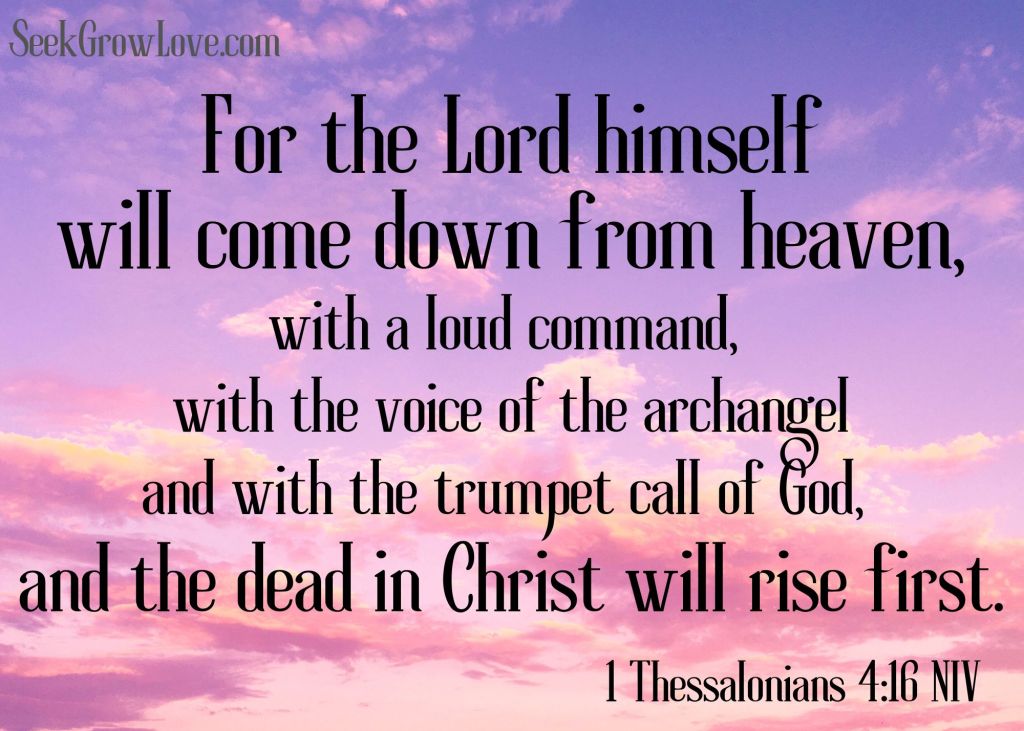
And then, we can take encouragement in the truth that they will one day hear the call of the trumpet, the voice of the archangel, and their Lord, their Savior and their Friend will pull them out of the grave. 

Death could not hold him. 

Death can not hold our loved ones in Christ. 

And, in Christ, death cannot hold you. 

So let’s trade our euphemisms for the euangelion; 

Trade our “nice words” for the Good News. 

-Jake Ballard

Reflection Questions

  1. Can you think of some euphemisms for death that are not supported by Scripture? Where do those ideas come from?
  2. Why does Paul want to correct ignorance regarding death, resurrection and the return of Jesus? Why does it matter what one believes about these topics?

An Even Better Story Coming

1 Thessalonians 4

Wednesday, August 31, 2022

I have always enjoyed reading the Chronicles of Narnia.  As I read them, I love to compare the story to what is written in the Bible.  Of all the books in the series, my favorite is The Last Battle.  I love seeing the old characters, the Pensieves, returning to the series.  1st Thessalonians 4 is describing the time when people come back into the story, just like the Pensieves coming back into the Chronicles of Narnia.


Verse 17 says, “Then we who are alive and remain will be caught up together with them in the clouds to meet the Lord in the air, and so we shall always be with the Lord.”  Can you imagine being able to see the dead in Christ?  There will be the reunions to loved ones and the meeting of the heroes of faith.  In The Last Battle, those who were still alive at the very end are excited to meet Lord Diggory and Lady Polly because they were in Narnia in the very beginning.  But, even more, they loved meeting their old relatives and friends.


While seeing the dead in Christ will be great, there is an even better promise in verse 17: “We shall always be with the Lord.”  We get to spend eternity with the Lord!  That is a great promise that we can look forward to the fulfillment of.  We know that when the kingdom comes, it will be a life beyond comparison.  A life that none of us will ever be able to even start to imagine.  


The Last Battle ends with these few sentences: “[T]he things that happened after that were so great and beautiful that I cannot write them.  And for us this is the end of all the stories, and we can most truly say that they all lived happily ever after.  But for them it was only the beginning of the real story.  All their life in this world and all their adventures in Narnia had only been the cover and the title page: now at last they were beginning Chapter One of the Great Story which no one on earth has read: which goes on forever: in which every chapter is better than the one before.”


The lives of Peter, Edmund, and Lucy as they were written in the earlier books, with the amazing adventures in the land of Narnia, was nothing to compare with their life in the new Narnia.  They were beginning an even better book which no one on earth will ever read, where life just gets better and better.  We have this to look forward to where we also will have such amazing lives in the kingdom that they will be nothing to compare to this life.  There is an even better story coming that we can’t even begin to fathom!

-Kaitlyn Hamilton

Questions to Discuss and Reflect Upon

  1. What order of events does Paul relate to the Thessalonians in chapter 4 so that they will not be, “uninformed about those who sleep in death” (verse 13) ? Is this the same or different as what you hear at most Christian funerals? Could it be there are many today uninformed about those who sleep in death?
  2. What are you most looking forward to at the time of Jesus’ return? Remembering this, how will it change your day today?
  3. After telling the Thessalonians what they have to look forward to, Paul said to, “Encourage one another with these words” (vs 18). How can you do that today?