
-Devotion by Jeremy Martin (TN)
In the beginning of today’s reading we are in an extremely tumultuous time in the history of Israel. The kingdoms of Israel and Judah have split apart from each other and throughout the books of Kings they give a recounting of each nation separately. Starting out today in 2 Kings 17, we begin in the nation of Israel, and in verse 6 we see that “the king of Assyria captured Samaria and took Israel away into exile”. I’m sure some of the people back then were asking the age old question, “why would God let something like this happen?!”. Well, as we read on, we’re told exactly why, and if we’re being honest we can probably apply that same answer to when this question is asked even now.
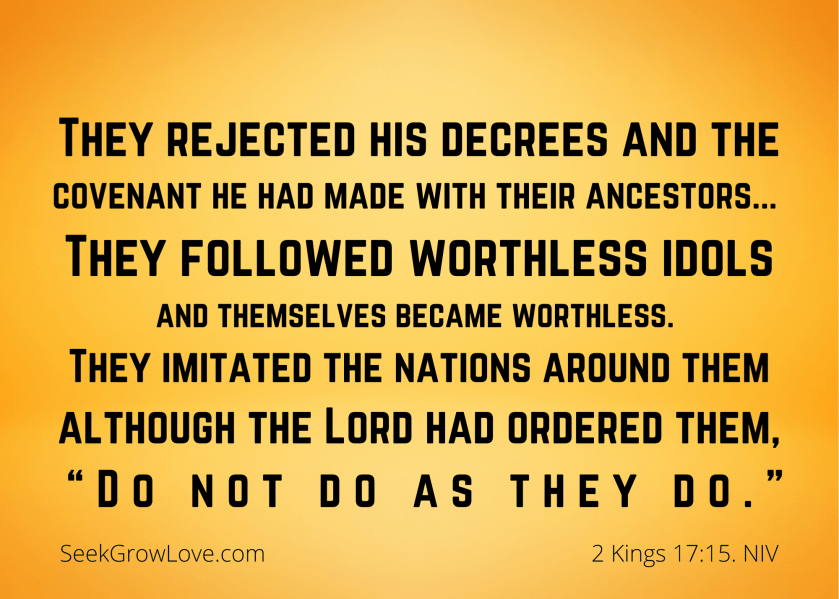
In 2Ki 17: 7-18, it explains: “Now this happened because the sons of Israel had sinned against Yahweh their God (v7)…And the sons of Israel did things secretly which were not right against Yahweh their God (v9)…and they did evil things provoking Yahweh to anger (v10b)…So Yahweh was very angry with Israel and caused them to depart from His presence…(v18a)” (The LSB translation is used throughout this devotional, unless otherwise noted). In between the lines of the above, scriptures give a pretty long laundry list of their offenses as well, including some pretty pronounced idolatry (which you may recall as being the first of the “Thou shalt not”s listed in Exodus 20, so… probably a pretty big deal). They forsook the commandments of Yahweh (v16), sacrificed their children to other gods (passed through the fire refers to human sacrifice to a specific pagan god), and practiced sorcery (v17), among other things.
Can you imagine the pain, as a Father, of your children acting in this manner towards you? Especially considering that He had done so much for them, and saved them miraculously from their oppression in Egypt, feeding and caring for them as they went, performing miracles and signs and wonders. Over and over. I can imagine it, I’m a father now. I was also that wicked, rebellious child who acted the same way towards my own father when I was younger. I’m sorry Dad, and I’m sorry Father God. My dad was a rock, he was faithful and true even when I wasn’t, and kept on loving me. Just like my heavenly Father. What can I say, words alone cannot express my sorrow or regret. I hang my head in shame and weep, I repent of my foolishness; but just like my dad, my heavenly Father came running towards me when I began to come home. It is heartbreakingly humbling, and still brings me to tears.
All of this rebellion was in spite of the fact that our loving Father, the most merciful, the most gracious, continued to reach out to his children Israel. In 2Ki 17:13-15 we see that even though Israel continued to be wicked and rebellious toward Yahweh God, He continues to reach out to them and warn them”by the hand of all of His prophets and every seer, saying “Turn from your evil ways and keep My commandments…“”, “However, they did not listen, but stiffened their neck like their fathers, who did not believe in Yahweh their God…”. How much foolishness can be tolerated, though? We see in v18 God has finally had enough, and “kicks them out of the house” essentially.
In 2Ki 17: 24-28 there’s a great little sub-plot to the main story. When God kicks the Israelites out, the king of assyria moves some new tenants in. I absolutely love the very tongue-in-cheek start of v25: “Now it happened at the beginning of their settlement there, that they did not fear Yahweh…” (LSB), and then, lions. Eventually an Israelite priest was sent back to teach the new residents “how they should fear Yahweh“(v28b) but the lions had already given them a pretty good start, it sounds like. God is holy, and freely (and sometimes painfully) offers instruction to His children when they forget Him. I like the phrasing of Ps 50:22 on this topic, it’s (not) subtle.
Meanwhile, back in the nation of Judah…A king is born who pleases God
Enter Hezekiah, king of Judah, who “did what was right in the sight of Yahweh” (2Ki 18:3). It goes on in the reading to list some of the good that he did, including a very interesting note in v4b, “…And he broke in pieces the bronze serpent that Moses had made, for until those days the sons of Israel were burning incense to it: and it was called Nehushtan“. Wait, what?! Stop for a moment and go read Nu 21: 4-9, it’s one of those little sub plots that passes by so quick that if you’re not paying attention, you’ll miss it entirely. Then read that (2Ki 18:4) again.
Here’s what to extrapolate from this: anything can become an idol to us, if we let it. The bronze snake which once was a tool for salvation to the Israelites became an idol, an implement of destruction instead which led many astray. I’m sure it even seemed right at the time. Shema (Listen up, pay attention), ecclesia (church)! Our prayers, our rituals, our practices, our doctrines, our holy days, our fasts, our scriptural readings, even the things which may have once saved us, all of these things are just tools to help us attain our true purpose: the unconditional and overwhelming love towards the Father that He deserves. Use the tools you have to fulfill your purpose, but do not let them become the purpose.
Here are some phrases that are used to describe Hezekiah: “He trusted in Yahweh…(v5), So he clung to Yahweh; he did not turn away from following Him, but kept His commandments…(v6), And Yahweh was with him…(v7)”. This trust and seeking after God is what saves him, coming up in the next chapter, because God loves him back. If you read 2Ki 18:13-37 you can see the situation setting itself up. I don’t want to give any spoiler alerts from tomorrow’s reading, but in the next chapter is one of the most beautiful and humble prayers in the Bible (2Ki 19:15-19) and (spoiler alert) God saves him, and (spoiler alert) again in the next chapter. The reason that God intervenes on his behalf is because he trusted in God. He clung to God. He didn’t turn away, but kept the commandments of God. This is the description of a man trying to love God with his whole heart, as stated in Deut 6:4-5 and quoted in Matt 12:29-32 as the primary of all the commandments.
We have one job: to love the Father with everything we’ve got. When we do this, and understand, then we will also love our neighbor (our fellow creation) as ourself. Everything else will follow. We will trust Him. We will cling to Him. We will follow and obey Him. If the things that you are doing are helping you to achieve that goal, God is good, give glory to God! If not, consider your ways and where they are leading. We often in our arrogance and pride remove God from throne of our heart and sit there in His place. That’s not your spot (as I often tell my giant dogs when they try to sit on the couch). He has shown you, O man, what is good… (Mic 6:8). He has “spread out My hands all day long to a rebellious people, Who walk in the way which is not good, following their own thoughts” (Is 65:2). Isn’t it time, like a small child wanting to be held, to hold out our hands toward our Father, and cling to Him?
REFLECTION QUESTIONS
What are some practical steps we can take to trust God more, and ourselves less?
What things can we do differently to please our Father?
Is there an idol in your heart that you have clung to?
If yes to the above, what is it, and why have you kept clinging to it?
PRAYER
Father God, please forgive me for my many shortcomings. Help to trust in You completely, to cling to You above all else, and to model the love that You have shown me to all of Your creation in order to honor You. May the lips of all of Your creation offer You the praise You deserve. Please instruct me, discipline me when I err, and guide me along the path that leads to Your kingdom. In Jesus’ name, Amen.

