The Day God Needed a U-Haul Truck!

Ezra 1-4

ezra

Monday, November 5

God could have used a U-Haul truck when His people were allowed to go back to Jerusalem after being taken captive into Babylon for 70 years.  God moved King Cyrus of Persia to allow the repatriation of the Jews back to their home in Jerusalem.  There were a lot of people who went , especially those who were from priestly lineage.  To find out just how many people went on this journey back to Jerusalem take a calculator and add up the number of people listed in chapter 2 verses 2-65!  They also had to pack up all the dishes that were to be used in the house of God that had been previously ransacked from God’s temple in Jerusalem some 70 years before.  That’s a lot of people, and things, to move all at once.

When the Jews did return to Jerusalem they began to re-instate the priestly duties of sacrifices even though the foundation of the new temple had not yet been poured.   They also began to celebrate their festivals as was their religious custom.  Cyrus had agreed to help them build the temple so orders for the cedar wood from Lebanon which was to be used, were issued.  The main contractor of this building project was a man by the name of Zerubbabel.  His job was to take this pile of rubble and figure out how to help make it into a beautiful place for God’s temple once again.  The people were overjoyed when the foundation of the new temple was laid and a celebration was held.  Things seemed to be looking up for God’s people but then some of their jealous neighbors in the land began to complain.  They sent complaints to Cyrus and the following kings of Persia making up all sorts of claims about the Jews who had returned which were not necessarily true.  So, with the distractions of unhappy neighbors in the land, and many hassles and arguments about the rebuilding that the Jews were doing, soon they became discouraged and left the project of rebuilding God’s house undone.  Not until the second year of the reign of King Darius of Persia did the completion of the temple happen.

Having been through a recent cross country move myself what caught my eye was all those dishes that were to be used in God’s temple that had to be transported.  5,400 to be exact!  They were made of gold and silver so they would have to be packed very carefully as not to be scratched or broken.  This gives dish duty a whole new meaning.  In my move a few of my dishes broke.  Thinking about this it makes me think of how broken the city was and the temple of God was when the people returned to their beloved city.  They must have been excited at first at the prospect of going back, but once there I’m sure that seeing all the brokenness of the city must have been very discouraging.

Think about one of the greatest things God can do — He can fix what is broken.  Sometimes we may feel broken , or tossed about by the circumstances in our lives.  So did the Jews.  The good news is that God can fix what is broken.  He helped the Jews to rebuild the temple to Him, and their lives after being exiled for so long – He made them beautiful again.  He can help us too by fixing the broken parts of our lives and shaping it into something beautiful.  Key thought:  Think about how God has helped to fix the broken parts of your life and think about how He chooses to make it beautiful.

-Merry Peterson

Hey, Listen Up!

II Chronicles 35-36

2-chron-36

Sunday, December 4

Have you ever wondered if God gets frustrated when people don’t listen to Him?  The people of Jerusalem had a great king while Josiah was ruler of Jerusalem but things quickly turned sour after his death.  Under King Josiah the people had experienced the re-instatement of the religious commemoration festivities of Passover.  The celebration was even mostly funded with animal sacrifices given by  Josiah and his officers on behalf of the laypeople.  We are told that such a tremendous Passover had not been celebrated like that in Israel since the days of Samuel the prophet, and that no other Passover celebration was quite like the one that Josiah had with the Priests of God.  But then something tragic happens.  Josiah, who normally would have listened to God, and his messengers decides to not heed God’s warning and goes to war unnecessarily where he is wounded and dies.

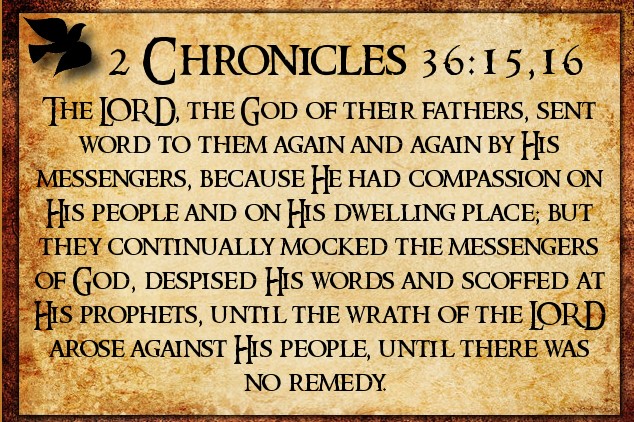
This is where the story of the people of Jerusalem takes a dramatic, terrible turn for the worse.  Under their next two kings who are ungodly men the country goes into a spiritual downward spiral.  The people forget the goodness of God, their devotion to Him and refused to listen to the prophets such as Jeremiah that God would send to warn the people to turn from their wicked ways.   Again, and again they were warned but they continually mocked the messengers of God, thus  raising  the wrath of God until there was no remedy.  The people and their kings did not listen, so God allowed King Nebuchadnezzar of Babylon to overtake their beloved city and carry many of the people off into exile in the land of Babylon.  To make matters worse the Babylonians carried off the sacred vessels and treasures of God’s house to their own land, slew many of the people, burned the house of God, and tore down the protective wall around Jerusalem.  The people stayed exiled in Babylon, and the city of Jerusalem lay in ruins for 70 years before God brought about a change by stirring up within Cyrus King of Persia’s spirit that the people that had been taken captive in the previous conquests should be allowed to go back to their homeland and worship in their beloved city once again.

What caught my eye in this passage is that the people would not listen and mocked the messengers of God and scoffed at the prophets God sent.  Doesn’t that  sound like the society we live in today?

Many of us have friends who are unbelievers, or even friends who claim to be Christians but their life choices and their actions don’t seem to follow God’s standards.  Many of them are doing the same thing today by scoffing at the idea that there is a God who is in control of the Universe or mocking God by not following his standards instead choosing to do whatever makes them feel good.  People often make excuses why they are the exception to God’s rules.  Does God like this?   From what we have read, God doesn’t.   Scripture reminds us that we should not be deceived, God will not be mocked, people reap what they sow.  By sowing disobedience to God, in turn God removed his protection from the people of Jerusalem and allowed them to be overtaken by enemies.

Every action has a consequence, every choice has a consequence.  Choosing not to listen to God, and honor him  has its consequences as well.  The people of Jerusalem found that out the hard way.  If only they had just  listened to  God how differently things might have turned out!     Key thought:  Choose to hear when  God is speaking to you!

-Merry Peterson


A Little About The Writer:

Merry Peterson is an Associate Pastor at Freedom In Christ Church in Welland, Ontario, Canada.  She grew up in Canada and recently moved back there after  pastoring a church in Wenatchee, Washington for 15 years.  She is a graduate of Atlanta Bible College, and Clayton State University.  She enjoys hiking, baking, reading, and often has pet goldfish.  Merry has enjoyed being at FUEL as a camper and as part of the staff. 


God First (I Chronicles 8-10)

Thursday, November 17

god_first-1097943

We are coming to the end of the genealogy in 1 Chronicles.  It goes through chapter 9.  After 3 days full of genealogy, I was excited to have something to read and write about that wasn’t genealogy.  However, I was struck by the last chapter of this genealogy, and felt compelled to write one more devotion on it.

Chapter 9:1b-2 says, “The people of Judah were taken captive to Babylon because of their unfaithfulness.  Now the first to resettle on their own property in their own towns were some Israelites, priests, Levites and temple servants.”  The chapter continues by telling us that there were 1760 priests who returned, along with 212 gatekeepers guarding the Tent of meeting.  Four principle gatekeepers were responsible for the rooms and treasuries in the house of God.  Others who returned were responsible for the articles used in temple services.  Others were in charge of the temple furnishings.

The thing that struck me about this was that the first to return, the ones listed here, were dealing with the temple and the worship of God.  It wasn’t the masons to build a wall, or the warriors who would build the army to defend the city.  The Israelites were returning their hearts to God, and had their priorities straight:  worship God first and then deal with everything else.

How does this compare to us?  Do we prepare to worship God first?  I know it is very easy for me to get things backwards, get caught up in the busyness of life, and fit God in when there is time.  However, when I take time for God first, the busyness doesn’t seem so rushed and frantic, even when the circumstances stay the same.  Let’s focus on putting God first and worship him today.

-Andrew Hamilton

God’s Grace Brings Release (2 Kings 24-25)

Sunday, November 13

jehoiachin

Chapter 23 ended with Jehoiakim becoming king and doing evil in the eyes of the Lord just as his fathers had.  Then moving into chapter 24, Nebuchadnezzar comes onto the scene.  He invaded Jerusalem, and made Jehoiakim his servant, to carry out his orders over Judah.  After 3 years Jehoiakim rebelled against Nebuchadnezzar.  The Lord sent armies against him for the evil he had done and he is killed.  His son Jehoiachin became king and continued doing evil in the eyes of the Lord as his fathers did.  The cycle is continuing.

After Jehoiachin had ruled only 3 months, Nebuchadnezzar laid siege to Jerusalem.  Jehoiachin surrendered and is taken prisoner.  All the treasures of the temple were taken, along with treasures from the king’s house.  All but the poorest people were exiled to Babylon.  Things were as low as they had ever been for Judah.  However, they kept getting worse, and Jerusalem was eventually destroyed.

This seems to just be a story of kings doing evil, and suffering consequences for it.  Fast forward 37 years and Nebuchadnezzar dies and Evil-Merodach becomes king of Babylon.  He releases Jehoiachin from prison and gave him a place of honor.  What a transformation overnight to go from prison to a place of honor with the king.

Have you ever felt that because of some mistake you made or some circumstances, that you can never get past it?  Have you felt that things are just going from bad to worse and you will never get past the problems you have?  I am guessing Jehoiachin felt that he was condemned to being in prison the rest of his life, and lacked hope at times.  However, his life turned around.  Doesn’t this sound like the grace of God?  There is nothing that shows Jehoiachin deserved this improved position, however he was granted it anyways.

Whether our problems are caused by our own mistakes or just circumstances we are in, we can have the hope of God’s grace, and have everything turned around.  We just need to accept God’s gift, along with repentance for our sins.

We can always have hope.

Andrew Hamilton