
Where is your citizenship?

Old Testament: 2 Kings 23-25

Poetry: Ps. 138

New Testament: Philippians 3

The place where we live is so central to who we are as people. It truly is one of the most important parts of our identity. It changes everything: from the foods we like, the music we listen to, the political parties we vote for, our priorities… basically everything. I’m from the south, and I remember going to our national church camp, FUEL, in the summer and being teased for the way we talk, the types of drinks we like (Who doesn’t like sweet tea? Oh right, all you northerners.), and the music we listen to. Before going to these camps, none of those things even struck me as weird. It was just the way everyone around me lived. Where we live can define us. But, we have a more important citizenship – a more important place of belonging – than just our physical address. 

Today, we read about the final demise of the Israelite nation. From the beginning, when God called Abraham out of the future land of Babylon and into the promised land of Canaan – the future land of Israel, there was a beacon of hope and assurance that God was for the Israelite people and would come to their aid. They were his people. 

Even though Josiah instituted reforms to bring his people back to God, the evil the people of Judah had done was so great that God promised, “I will remove Judah also out of my sight, as I have removed Israel, and I will cast off this city that I have chosen, Jerusalem, and the house of which I said, My name shall be there” (2 Kings 23: 27). The devastating consequence of sin is the removal of belonging with God. This meant that the people of Judah – the last remnant of the Israelites who had settled in Canaan – could no longer find their citizenship in the Promised Land. Instead, they were taken captive by the Babylonians and returned to the land that God had called them out of. This is a harsh statement of rejection of the Israelite people. The one whom God had said, ‘I called you out of Egypt to be my chosen possession’ had been returned to the places of captivity. 

Citizenship, rejection. Freedom, captivity. These opposite poles of human existence that the Israelites could choose based on how obedient they were to God’s commands. Because they rejected God’s commands, he rejected them. The freedom they would have in submitting to God and setting boundaries on their freedom based on his law became captivity under other rulers due to their desire to do whatever they pleased.

We have the same promise and warning today. The same choice is set before us. We can choose for our citizenship – our place of belonging – to be in heaven (Phil. 3:20-21) or to be enemies of Christ (v. 18). Phil. 3:19 describes these enemies in the following way: “Their end is destruction, their god is their belly, and they glory in their shame.” This statement could have been written for the people in Judah and Israel. And it could be written to those today who choose to do whatever is right in their eyes rather than follow God’s word. 

To be citizens of heaven, we must follow Paul’s example. I “press on to make it [the resurrection of the dead, aka the Kingdom Life we are promised] my own, because Christ Jesus has made me his own. Brothers, I do not consider that I have made it my own. But one thing I do: forgetting what lies behind and straining forward to what lies ahead. I press on toward the goal for the prize of the upward call of God in Christ Jesus” (v. 12-14). Hold fast to God, and obey his commands! Choose to be a citizen of God’s Kingdom! 

~ Cayce Fletcher

Reflection Questions: 

  1. How does the place where you live affect who you are as a person?   
  2. How would a citizen of the Kingdom act differently than those of the world? Where do you find your citizenship?   
  3. There’s a glimmer of hope in 2 Kings 25:27-30. Jehoiachin is able to “put off his prison garments. Every day of his life he dined regularly at the king’s table.” How do you put off your prison garments of sin and dine at the table of the King in your everyday life?   
sgl23bibleplanDOWNLOAD

Into Exile

2 Kings 24-25 and 2 Chronicles 36

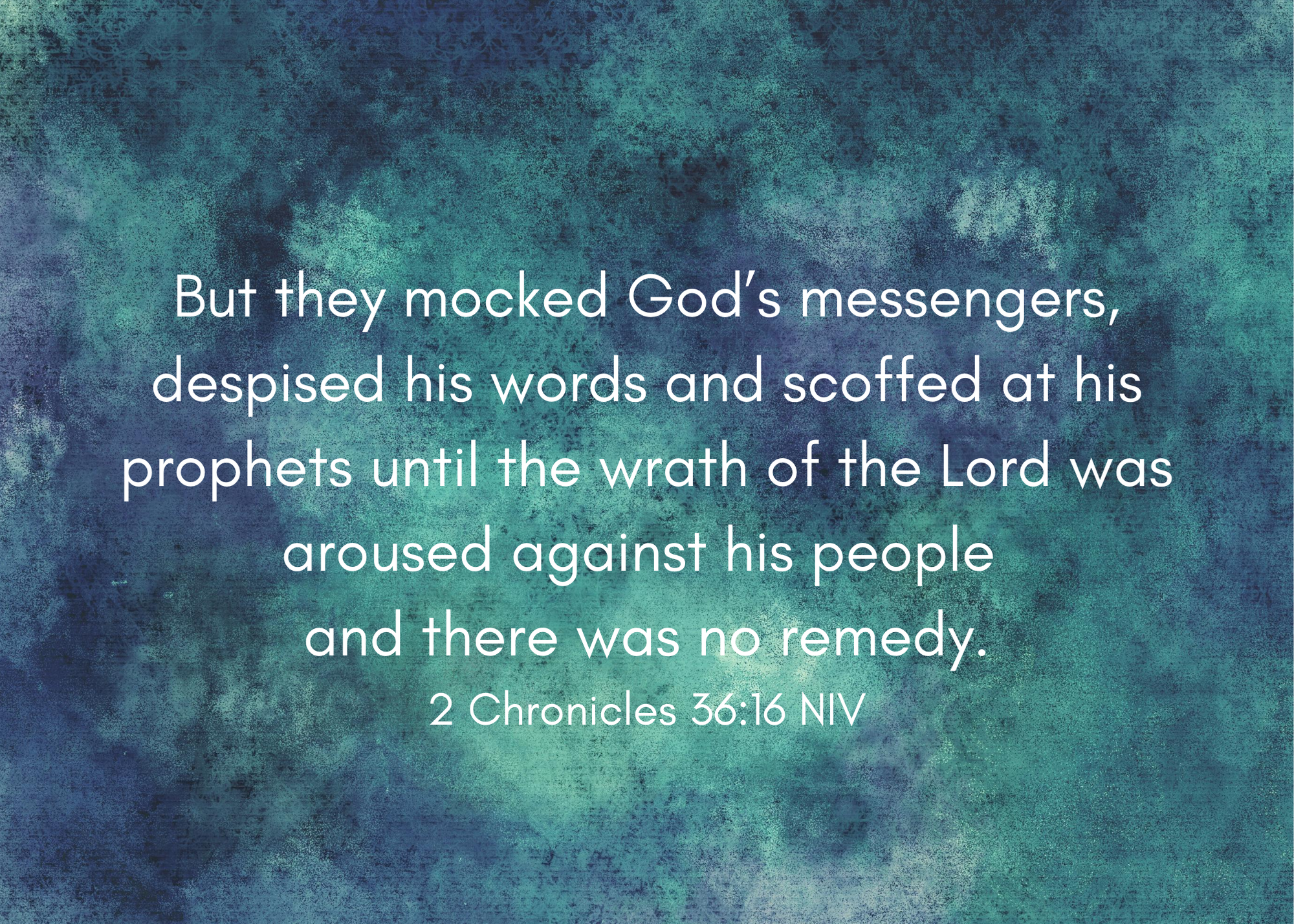
But they mocked God’s messengers, despised his words and scoffed at his prophets until the wrath of the Lord was aroused against his people and there was no remedy. 2 Chronicles 36_16 NIV

Well, if yesterday’s reading was one of the most depressing passages, I guess it applies doubly today, since we read two more accounts of the Babylonian conquest of God’s holy city Jerusalem and the nation of Judah.  Bad kings, poor decisions, temple treasures plundered, men and women forced into exile, rebellion, siege ramps around Jerusalem, starvation, fleeing king captured and tortured, temple and city set on fire, officers executed, more and more exiles, governor assassinated, fleeing for safety.  God’s anger.

It’s not a pretty story.  But it is a story well worth our time to know and remember and understand.  It is such an important part of God’s story and His character.  This is the same God of today and the same God who centuries before this had saved His people out of Egypt and revealed himself to Moses as, “The Lord, the Lord, the compassionate and gracious God, slow to anger, abounding in love and faithfulness, maintaining love to thousands, and forgiving wickedness, rebellion and sin. Yet he does not leave the guilty unpunished…” (Exodus 34:6,7).  God had been patient with His people hundreds of years, but there comes a time when their unfaithfulness can no longer be overlooked or excused or explained away.  He had sent many, many prophets to warn the people and if His people would had listened and repented and turned from their wicked ways, they would have been saved from this time of judgment.  But they made their (poor) choices and there was a consequence to pay for it.  

Today, many like to focus solely on the God of compassion.  It is a beautiful picture.  And, it is true – but it is not the whole picture – or the whole truth.  It can be a fatal error to not consider the whole picture when viewing, knowing and loving God.  He is a God of compassion who is slow to anger and abounding in love and faithfulness.  Praise God!  We have benefitted from His love and compassion in many ways and at many times!  He does not always treat us as our sins deserve.  But He is just when He does punish – way back then, and today.

Did you notice that the two accounts we read today don’t end the same?  At the conclusion of the book of 2 Kings we read of the grace extended to Jehoiachin, a king from Judah who was deported to Babylon and held as a prisoner for 37 years.  The new Babylonian king not only releases him, but welcomes him to a place of honor, he eats at the king’s table and his daily needs are provided.  It is indeed a sweet ending for Jehoiachin.

The book of 2nd Chronicles was written at a later time – to remind the surviving Israelites of their history. This author knows that Jehoiachin is not the only one to experience great grace and restoration.  The years of time-out in exile in Babylon would last 70 years, as predicted by Jeremiah – and then the time would come for God to extend grace and restoration to His people, or to the remnant of believers.  The final verses of 2 Chronicles are:

In the first year of Cyrus king of Persia, in order to fulfill the word of the Lord spoken by Jeremiah, the Lord moved the heart of Cyrus king of Persia to make a proclamation throughout his realm and also to put it in writing:

23 “This is what Cyrus king of Persia says:

“‘The Lord, the God of heaven, has given me all the kingdoms of the earth and he has appointed me to build a temple for him at Jerusalem in Judah. Any of his people among you may go up, and may the Lord their God be with them.’” (2 Chronicles 36:22,23 NIV).  


God works in amazing ways towards restoration for the faithful remnant who walk with Him.  The story of God’s people does not end in exile.

Take heart.  Remember God’s character and His story.  He is a God of love and compassion – who in His perfect love, will not leave the guilty unpunished.  Be wise and pay attention to God’s Word – listen to the prophets who speak for Him.  Seek God with your whole heart and don’t follow after false gods.  God’s plan is still in progress.  It includes love and punishment.  And ultimately He is planning a time of restoration where He will dwell with the faithful remnant in His Kingdom on earth.  How will you prepare for that today?

Marcia Railton


Today’s Bible reading can be read or listened to here – 2 Kings 24-25 and 2 Chronicles 36

Tomorrow’s reading will be the three short chapters that make up the book of Habakkuk as we continue on our 2020 Chronological Bible Reading Plan