Good Fruit, Bad Fruit

Old Testament: Genesis 29 & 30

Poetry: Psalm 12

New Testament: Matthew 12

Have you ever eaten a fresh orange straight from a tree? Or maybe an apple from an orchard? Fresh fruit is SO good. I know that some of you are currently in the thick of a snowy, cold winter. For those of us in the Southwest section of the U.S. it’s actually one of our growing seasons, believe it or not! Orange trees are fully loaded with fruit, here in Phoenix, Arizona. Well…most of them….

I have a small little tree right in the middle of my backyard. I did not plant this tree. Whoever planted it didn’t leave any information about what kind of tree it was. I’m a midwest girl and I could not tell you what kind of leaves each fruit tree has. This little dude is small enough that it isn’t growing any fruit yet (although maybe that’s more on us than this tree!). Since I can’t see its fruit, it is hard to tell what kind of tree it is. (For the record, I did google it and I think it is an orange tree.)

In Matthew 12:33, Jesus confronts the Pharisees by using trees as a metaphor for their speech and hearts. He says “Either make the tree good and its fruit good, or make the tree bad and its fruit bad, for the tree is known by its fruit.” He’s calling them out because they were attempting to “speak good” things while their hearts were “evil”. Woah. Now, Jesus was speaking to this group of people, however, I think we can take something away from his instruction. 

The Bible talks A LOT about our tongue (the words we say), and our actions. In fact, our reading in Psalms today mentions this as well! Verses 3-4 talks about those who boast with their tongue. In Ephesians 2, we see that God’s grace is what saves us so that we cannot boast about our own abilities and actions. (Kinda like the Pharisees were trying to do in Matthew 12). It is by His mercy that we can have a relationship with Him. Because of this, our “tree” can be rooted in Him – the ultimate source of life. He is the reason that we must not be conformed to the world but instead, be transformed by the renewal of our minds (Romans 12). THIS is where the good fruit comes from!

Jesus says in Matthew 12:34 that out of the abundance of our hearts, the mouth speaks. Our words are the outward reflection of our hearts. Proverbs 18:21 says that death and life are in the power of the tongue. What we say has an influence on people. I’m sure all of us can attest to this in our personal lives. 

I want to encourage and prompt you with this: we are called to be the salt and light of the world. How do we do those things? By our words and our actions. God has given us a calling to bring His light, love, and goodness to those around us. I pray that our hearts and minds may continually be transformed to be more and more like Jesus. Because of this, we will bear good fruit so that others can see God’s goodness and love.

-Katelyn Salyers

Reflection Questions

  1. How is your fruit looking and tasting? What do others see coming from your life? What does Jesus see? 
  2. What fruit have you produced that you want to create more of? What fruit from your life would you call bad fruit? How can you alter production to produce more of the good fruit and less of the bad fruit?
  3. Jesus goes on to say, “For by your words you will be acquitted, and by your words you will be condemned.” (Matthew 12:37) Do we often forget the power and consequences of our words? Will your words spoken last week acquit or condemn you? How can you better control the words you say?

The Fruitless Fig Tree

Mark 11

Mark 11 22

In Mark 11:12-14 we see Jesus appear to get upset and curse a fig tree because he was hungry and there was no fruit on it.

“On the next day, when they had left Bethany, He became hungry. Seeing at a distance a fig tree in leaf, He went to see if perhaps He would find anything on it; and when He came to it, He found nothing but leaves, for it was not the season for figs. He said to it, “May no one ever eat fruit from you again!” And His disciples were listening.” Mark 11:12-14

About a month ago, when our family was reading together, we came across this passage. My kids thought it was funny that Jesus was hungry and looking for food. It tickled them that he got “hangry” and cursed the fig tree because there wasn’t any food to be had. But this is a misunderstanding. Notice that the Scripture says there were leaves. Usually when a fig tree has leaves, it also has fruit.  Jesus saw the fig tree from a distance and it looked like it was flourishing. It looked as though it should have fruit. Upon closer inspection, it did not. Jesus found this situation worthy of cursing.

Later, in 11:20-21 Peter mentions to Jesus that the fig tree he cursed is withered (dead). Jesus’ response is interesting. He says, “Have faith in God.” He tells him that if you believe God can do amazing things through you, without doubting, He will! There will be good fruit. And what does this mean for us? We need to be careful about how we are presenting ourselves. Do I look promising? Do I look like a tree that’s healthy with lots of foliage, but in reality I’m not bearing any fruit? If so, I need to understand that this won’t be enough. Jesus finds this worthy of cursing and death. May we all be faithful, flourishing, and bearing fruit for our Father.

-Melissa New

What are You Producing?

Matthew 21

matthew 21 19

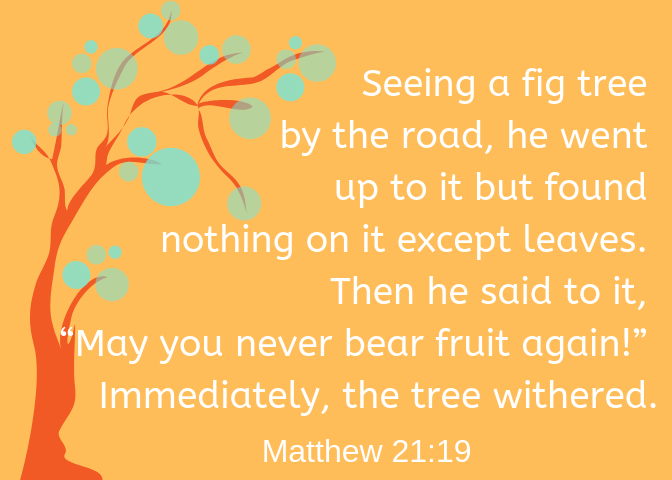
After Jesus had cleared the Temple of the merchants who were selling things in his Father’s house, Jesus approached a fig tree because he was hungry. Unfortunately for Jesus, the fig tree didn’t have any figs on it. At that moment, Jesus spoke to the tree and it completely withered up. His disciples were amazed by this, and were confused why this had happened. I understand the disciples’ confusion because it took me a long time to figure out why this story was in the Bible. What in the world is this talking about? Why would Jesus choose to wither a tree?


After much study, I found that this was a parable of Jesus, although one that was lived out. God’s people that were doing terrible things in God’s Temple were the same as this fig tree; they were not producing any fruit. Because the tree didn’t produce any fruit, Jesus rejected it and allowed it to crumble. The message could not be more clear: if God’s people aren’t producing good fruit, they will crumble and wither.


Jesus talked about “bearing good fruit” many different times, but I want to discuss just two. In John 15, Jesus said that we cannot bear fruit without living in communion with him. You cannot produce anything of substance if Jesus isn’t part of your daily life. Just as a branch cannot produce fruit without being attached to the trunk, we cannot produce anything if we are not constantly attached to Jesus.


In Matthew 7:15-20, Jesus says that we will know people by the fruit that they produce, whether good or bad. If we see an apple on a tree, we know that it is an apple tree; if we see a pear, we know that it is a pear tree. In the same way, if we see good fruit being produced, we know that person comes from Jesus. On the other hand, if bad fruit is being produced, we know that that person is from somewhere else.


So the question for you today is this: “What are you producing?”

Are you producing the fruit of the Spirit (Galatians 5:22-23), or are you producing the same thing as all the sinners in this world? If you aren’t producing good fruit, it is time to reconnect with the Lord of your life, Jesus Christ. We cannot do it without him.


-Talon Paul