Joseph: Prosperous Slave & Successful Prisoner…And God Was With Him

Gen 39 20b-21a

In the beginning of Genesis 39, Joseph has just been sold to a new master named Potiphar.  During the course of the chapter, Joseph is falsely accused and thrown into prison.  The chapter ends as Joseph goes from being a slave to being a prisoner.  Sounds pretty bad, right?  Strangely enough, the chapter starts out by saying of Joseph the slave, “The Lord was with Joseph so that he prospered, and he lived in the house of his Egyptian master.”  The chapter ends by saying of Joseph the prisoner, “The warden paid no attention to anything under Joseph’s care, because the Lord was with Joseph and gave him success in whatever he did.”  So God was with Joseph and gave him success and prosperity even as a slave and a prisoner.  Sounds very strange to me.  It would seem to me that success would be not being a slave and not being a prisoner.  But Joseph understood some things that many of us never understand.


We can learn a lot of good things from Joseph.  Whatever happened in his life, he kept on trying to live for God.  He continued to have a good attitude and he continued to work hard.  He didn’t pout, become discouraged, depressed or cry out, “Why me?”


How about you?  When you go through tough times, do you continue to seek God and discover His will?  Do you try to keep a positive attitude?  Would you keep working hard if you were in Joseph’s shoes?  We will soon see how God’s plan unfolded in Joseph’s life.  Feel free to read ahead in the Bible on this story of Joseph.  It is way more interesting than a TV show.


-Jason Turner

Joseph: Trouble Comes…for a Time

John 16 33

One day Joseph’s brothers were out watching the flocks in the fields (and in the sun), and Joseph was kept at home to relax.  Later on, their dad sent Joseph out to check on the brothers.  When the brothers saw Joseph coming from a distance, they hated him so much that they talked about killing him. After some discussion, they decided to beat him up and threw him into a large, dried out, underground water storage container.  Later, they pulled him back out.  Joseph thought his ordeal was over, but instead his brothers sold him to a caravan of traveling merchants.  Joseph pleaded with them for mercy, but his brothers just smiled and waved goodbye.  You can read about this in Genesis 37 and some of the following chapters also reveal some of the details.  Joseph had basically done nothing wrong, but he found himself betrayed by his own brothers and sold into slavery.

Sometimes people think that if they do everything right, then no bad things will ever happen to them.  Sometimes people are very cautious in order to avoid problems or troubles.  Some people think that if they serve God without making any mistakes, they will then have a nearly perfect life.  But life doesn’t work in these ways.  Joseph did nothing wrong, but he was sold into slavery.  In John 16:33, Jesus said, “In this world you will have trouble.”  The Bible never promises us an easy, trouble free life.  In fact, we are promised we will have trouble.

Joseph was taken to Egypt as a slave, but during his time there, he would see God’s plan unfold for his life.  A much greater good would occur because of his time as a slave.  Perhaps some day you will face tough times when God is trying to bring about long term good.  It will be hard to face at the time, but in the long term, you will see God’s hand at work in your life.

-Jason Turner

Joseph: Loved…and Hated

Genesis 37 3a

One person in the Bible who I find very interesting is Joseph.  During the course of his life, he lived through many troubles and many incredible successes.  Much of the trouble that Joseph faced came from his very difficult family life.  His father, Jacob, had four wives.  Jacob loved Joseph’s mother more than the other three wives.  And then Jacob loved Joseph more than any of the other children.  Genesis 37:4 says “When Joseph’s brothers saw that their father loved him more than any of them, they hated him and could not speak a kind word to him.”  This would lead to big problems for Joseph (more on this later).

Perhaps you have experienced some of this in your own life, in your own family.  Often it is a bad behavior that is passed down from one generation to another.  It creates a lot of resentment within a family.  Imagine how Joseph’s brothers felt knowing their father loved their brother more than them.  Favoritism: don’t pass it on.

-Jason Turner

The OG Avenger

Romans 12 18

My husband and I are making our way through the netflix vigilante, superhero movies and shows. Some of our favorites are the Avenger movies, Daredevil, Iron Fist, Arrow, Flash and so on. Every superhero show needs a villain. Usually these villains have a vendetta on the world because they were wronged at some point by someone.


The Villain in that last show we watched brought his wrath down on Harlem because someone murdered his mom. He decided to repay evil with more evil in an attempt to right the wrong done to him. He let anger, rage and bitterness control his actions.


This reminds me of the passage in Romans 12:

17 Do not repay anyone evil for evil. Be careful to do what is right in the eyes of everyone. 18 If it is possible, as far as it depends on you, live at peace with everyone. 19 Do not take revenge, my dear friends, but leave room for God’s wrath, for it is written: “It is mine to avenge; I will repay,” says the Lord.


When we are wronged we tend to feel the need to right that wrong, to get even, to get revenge. The Bible makes it clear that it is God’s job to repay those wrongs. He even goes further to say:


20 On the contrary:

“If your enemy is hungry, feed him;

   if he is thirsty, give him something to drink.

In doing this, you will heap burning coals on his head.”[e]

21 Do not be overcome by evil, but overcome evil with good.

So unless you want to be the next Thanos, Wilson Fisk or netflix villain I suggest you allow God to be the only avenger and practice overcoming those who wrong you by showing them goodness.


-Elleigh


Bee a Good Worker Bee!

James 1 12

An individual honey bee cannot live on its own much like a true Christian cannot live without the body of Christ to sustain it.  A honey bee colony is referred to as a “super organism.” While each individual honey bee is itself an organism, together as a hive of thousands of bees they become something much more extraordinary!  Every bee has a job to do that changes as they get older. They start by staying in the hive doing jobs like undertaker, food storage, cleaning, nurse and taking care of the queen. Then as they grow they take a test flight outside the safety of the hive.  Then one day they are ready for foraging for food. Foraging is a dangerous yet necessary part of the super organism’s function. Without this foraging the bees would have no nectar to feed upon and no pollen for protein.

Luke 13:6-9 NIV  – Then he told this parable: “A man had a fig tree growing in his vineyard, and he went to look for fruit on it but did not find any.  So he said to the man who took care of the vineyard, ‘For three years now I’ve been coming to look for fruit on this fig tree and haven’t found any. Cut it down! Why should it use up the soil?’ “‘Sir,’ the man replied, ‘leave it alone for one more year, and I’ll dig around it and fertilize it.  If it bears fruit next year, fine! If not, then cut it down.’”

It is essential as a Christian to bear good fruit and to be a good tree that will not be removed from the earth – to be like a good worker bee who helps to feed the hive and sustain the Super organism that is the body of Christ.  When bees leave the hive they leave security; they do not have a protector in heaven just the cruel world crouching at the entrance of the hive.  Some of the trials bees face when they leave the hive are birds, dragonflies, cars, flying up to two miles away and navigating back to the correct hive.  Regardless of what they face bees will move forward even to the point of death against overwhelming odds. As Christians we need to work to put fertilizer around our roots so that we can grow to the point of bearing fruit.  Like bees who take test flights Christians need to be willing to do things that are not in their comfort zone.

James 1:12 NIV Blessed is the one who perseveres under trial because, having stood the test, that person will receive the crown of life that the Lord has promised to those who love him.

Sometimes our venture away from the security of Church camps or the fellowship with our brothers and sisters does not go well.  Stepping out of our comfort zone can leave us feeling anxious or scared. If the bees retreated and refused to persevere through all the dangers they face the hive would have no choice but to begin eating their honey that is stored up.  If there is still no nectar coming in they begin to cannibalize the young pupae who require food. Let’s hope our churches never get to that point! If there is still no nectar coming in and they have gone through their stores they will either abscond or starve.  As Christians we cannot simply hangout in our comfortable zone.  Eventually it’s time to feel uncomfortable and to face trials. It builds our endurance when we face trials and overcome them, allowing us to move past a test flight and become a forager and bear good fruit.    

When bees find a good foraging location they do a dance to point others in the right direction.  To spread the good news they wiggle and wag and somehow that translates to a distance and a direction.  I cannot communicate to you where the fruit is that you need to forage for the Lord through a dance like honey bees but I can encourage you to step out of your comfort zone.  Take a flight away for your warm, safe hive and you will begin to produce more fruit. It could be increasing something you are doing now, doing something you haven’t done before, working on the fundamentals, doing good works, or it could be you try and fail and have to redirect your energy.  You have a wonderful Protector in heaven who loves you. It’s time to show him the same love he shows us.

-Elleigh Dylewski

What Do You Hate in Life?

Proverbs 6 17-19

I was reading in Proverbs about the things that God hates, this got me thinking about the things I hate. Towards the top of the list were things like people chewing with their mouth open, people who leave the toilet seat up and running out of TV shows to watch on netflix, just to name a few.

Let’s take a look at God’s list.


There are six things the Lord hates,

   seven that are detestable to him:

17         haughty eyes,

       a lying tongue,

       hands that shed innocent blood,

18         a heart that devises wicked schemes,

       feet that are quick to rush into evil,

19         a false witness who pours out lies

       and a person who stirs up conflict in the community.

Proverbs 6:16-19

Wow, my list suddenly seems very trivial. After reading this it got me thinking about my husband. In a relationship we communicate the things we love and the things we hate and out of respect and love for that person we do our best to please them. I appreciate my husband for caring about what I love but also for not doing the things I hate, like chewing with his mouth open.


In the same way, I appreciate that God clearly communicates to me the things He hates. Because of this I can do my best to please Him by loving the things He loves and hating the things He hates.


-Elleigh Dylewski (with help from Zack)

Our Life is a Letter

2 Corinthians 3 2 (1)

1Are we beginning to commend ourselves again? Or do we need, like some people, letters of recommendation to you or from you? 2You yourselves are our letter, written on our hearts, known and read by everyone. 3 You show that you are a letter from Christ, the result of our ministry, written not with ink but with the Spirit of the living God, not on tablets of stone but on tablets of human hearts.”

2 Corinthians 3:1-3


Have you ever had to write a letter of recommendation for someone or had one written for you?


In this passage the Corinthians are requesting a letter of recommendation from higher up disciples to prove that Paul is doing the work of the Lord. Paul explains to the Corinthians that their life should be his recommendation letter, a confirmation of his teaching.

Imagine if your life was a letter, open to anyone to read, and when they read it they would know exactly who you are, what you stand for, your convictions, your beliefs, your faith or the lack of. Paul is saying our life is a letter written on our hearts through the Holy Spirit. How we live confirms the message of the gospel. It’s a way for others to see and understand why we dedicate our time, money, and energy into church, ministry, mission work, church camps and much more. When we face the king on judgment day we will not be getting a letter of recommendation from our pastors or parents saying why we should be in the kingdom. Instead Jesus will read the letter of our hearts and our life.

If our life is a letter open to the world to read what do you want people to read? What kind of letter are you going to allow the spirit to write upon your hearts? And will you choose to follow it?


-Elleigh

Forgiveness

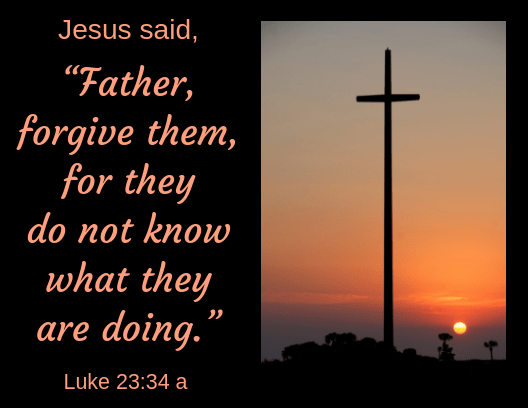
luke 23 34 a

Society is filled with people who have no forgiveness.  We judge, ridicule and try to come up with the next sarcastic zinger to roast someone.  Escalation of situations that could have been resolved in their infancy are full blown Hatfield and McCoy level feuds because people did not possess the unceasing ability of Jesus to forgive.  Jesus was able to forgive even in the midst of extreme situations like being on the cross:

Luke 23:34 NIV Jesus said, “Father, forgive them, for they do not know what they are doing.” And they divided up his clothes by casting lots.

Jesus found the strength to forgive even though he had been mercilessly mocked, beaten and ultimately murdered!  Meanwhile we struggle to forgive people for minor infractions like not liking our outfit, or denying the fact that we are the greatest spike ball player on the planet.  Seeing how Jesus was able to forgive his persecutors who had done much more to him than anyone else has experienced convicts us as Christians to be able to forgive others who have wronged us regardless of our situations because Jesus was able to forgive in situations worse than us.

-Zack Dylewski

My Friend Grace

Ephesians 2_8

Do you have a friend that is there for you? A friend that continues to text you even though you don’t text back till like three days later? Do you have that friend in your life that loves you even though you’re not always the best friend back?

I do, her name is Grace. She is the very best friend I could ask for. Grace is the kind of friend that is intentional, loving and always there for you. She is the type of friend that continues to reach out to you and loves you no matter what. She has taught me so much about what it means to be a friend.

When I think about Grace’s friendship I’m reminded of God’s Grace in our life. God is very intentional about his relationship with us. He loves us unconditionally even though we don’t deserve it. God gives us this wonderful gift of salvation and forgiveness despite our flaws and downfalls. This gift of grace allows us to realize our human weaknesses and failures but know that God still loves us and desires us to have a relationship with him.

I’m so grateful for my friend Grace’s continued, intentional friendship despite my flaws. In the same way I’m so thankful for God’s Grace in my life.  

Ephesians 2:8

8 For it is by grace you have been saved, through faith—and this is not from yourselves, it is the gift of God


-Elleigh Dylewski

Teddy Bears and Corn Snakes

Joshua 1_9

Do you consider yourself to be courageous?

Do you see courage as being something only heros have? Do you have to be like David taking down Goliath or Daniel surviving a lions den or the Avengers fighting against Thanos? Or can you be courageous in your everyday life?

According to Dr. Yadin Dubai, from the Weizmann Institute of Science Rehovot, Israel courage is something that can be practiced. He came to this finding by splitting a group of volunteers into those that were afraid of snakes and those that weren’t. The volunteers were instructed to choose whether to move a teddy bear or corn snake closer or further away. While the participants were making their choice there was a functional magnetic imaging scan done of there head. This scan picked up on activity in the part of the brain called the subgenual anterior cingulate cortex (sgACC). When the participants who feared snakes chose to overcome fear and move the snake closer the sgACC increased, versus those that gave into fear and moved the snake further.

This research found that our brain can learn courage. We can activate and increase the sgACC or part of brain that houses courage by taking conscious, deliberate steps to overcome fear.

Many of us won’t find ourselves facing a literal giant, surviving a lions den or even battling an intergalactic space villain (although that would be sick!). We do however find ourselves facing fears each day. Sometimes those fears are simply getting up out of bed and starting a new day, maybe it’s forgiving someone that you thought you never could, or maybe it’s flying across the county to do mission work or start a new ministry. Whatever your fear in life may be, know that you can overcome it with a little practice and a little patience.

Joshua 1: 9 “Have I not commanded you? Be strong and courageous. Do not be afraid; do not be discouraged, for the Lord your God will be with you wherever you go.”

-Elleigh Dylewski