
Guard Your Mouth

Vs. 23. Whoever guards his mouth and his tongue keeps himself out of trouble.

OLD TESTAMENT: 1 KINGS 21

POETRY: PROVERBS 21

NEW TESTAMENT: LUKE 5

Vs. 23. Whoever guards his mouth and his tongue keeps himself out of trouble.

At the beginning of the movie, Blindside, the narrator explains the role of the offensive line and one position in particular, the left guard.  Her explanation goes something like this: “When a woman is paying the household bills, the first check she writes is to pay the mortgage, the second check is to pay the insurance.”  The meaning: you want to ensure you have your greatest financial asset, your house so you pay the mortgage, and you want to make sure that your asset is protected, so you make sure your insurance premium is up to date.  That all makes logical sense.  As it is applied to football, you first make sure that you have a great quarterback to run the offense, and second, you want to make sure that your quarterback is well-protected, so you invest in a very good left guard to watch and guard the quarterback’s blindside.

Solomon, of course, knows nothing of football.  In his world, as king of Israel most of the work that he accomplishes is with his mouth.  When he as King utters a decree, it becomes law.  As King, his words matter.  The King’s words have the power of life and death.  In some ways, the King’s authority is exercised by his words, they are powerful and effective.  In some ways, they are very similar to God’s Word, which the Bible also says is powerful and effective.  In Genesis 1 God speaks His word and the heavens and earth are formed.

So Solomon understands the power of our words.  In Proverbs, he emphasizes the importance of protecting the source of our words, our tongue. “Whoever guards his mouth and his tongue keeps himself out of trouble.” (Proverbs 21:23).  If your tongue is the quarterback, you need to invest in good protection, a good guard.  That is putting knowledge into practice, that is wisdom.

Practically speaking, think of all the ways that an unguarded tongue can get a person into trouble: lying, gossip, slander, and cursing are just a few examples of trouble that comes courtesy of an unwisely guarded tongue.  Lying can get you in trouble with your parents, with your husband or wife if married, with your boss, with your friends and with God.  That’s a lot of trouble.  People usually tell lies to try to keep out of trouble, but often it backfires and they get into more trouble.  Lie to a police officer and you won’t only get into trouble for whatever you did, but then you’ll have extra trouble for lying about it.  There’s a reason that when arrested they say “You have the right to remain silent, anything you say will be used against you.”   What that means is, you’re better off just keeping your mouth shut then to tell a lie to try to cover up.  Even if you are innocent of the charge, you can still get yourself into trouble by what you say.  Please not, I’m not advocating for you to commit crimes and tell you how to avoid jail, but simply showing the wisdom of guarding your tongue.  Think before you speak.

In this age of social media, guarding your tongue takes on greater meaning.  With social media, our words can go farther faster and last longer.  I have heard of incidents of people not being hired for a job they were otherwise qualified for because the prospective employer looked at their social media feed and saw objectionable content from years earlier.  I’ve heard of people losing jobs because of their words.  Unguarded words can be very costly.  They can cost not only jobs; they can cost relationships.  

Solomon wisely counsels that in many situations it is far wiser to say nothing at all.  Proverbs 17:28 says: “Even a fool who keeps silent is considered wise; when he closes his lips, he is deemed intelligent.”  An old adage attributed to Mark Twain or Abraham Lincoln (but probably someone different) says “It is better to be silent and be thought a fool than to open your mouth and remove all doubt.”

Words have heavy spiritual consequences as well.   Ecclesiastes 5:2 says: “Do not be quick with your mouth, do not be hasty in your heart to utter anything before God. God is in heaven and you are on earth, so let your words be few.”   Think about the promises that you make to other people, and think harder about the promises you make to God.  For instance, when you are baptized, you promise to make Jesus Christ your Lord and Savior be faithful to him and follow him.  That’s a very strong promise.  A disturbingly large number of people who used to go to church faithfully are dropping out of the church, and many no longer identify as Christian, they are joining the swelling ranks of so-called “nones” or people with no religious affiliation.  That’s a lot of people who made promises to God who are no longer keeping those promises.  But good news: God is very forgiving and welcoming to those who repent, turn back to Him.   Still, think about any promises you make with your mouth before God.  Whether it’s to faithfully follow Jesus Christ, be faithful to a wife or husband, commit to serve in a ministry, don’t be quick to make a promise that you don’t really intend to keep.

In short, your words really do matter, so a spiritually wise person needs to “think before you speak.” So be sure to guard your tongue the way a left guard protects his quarterback.  That’s a key to spiritual victory in life, that is a way towards true flourishing.

~ Jeff Fletcher

QUESTIONS:

  1. What power do words have? Have you ever been greatly hurt by words? What about greatly encouraged?
  2. Why is it always better to tell the truth rather than lies?
  3. How can you cultivate your ‘word filter’? How can you practice thinking before you speak?
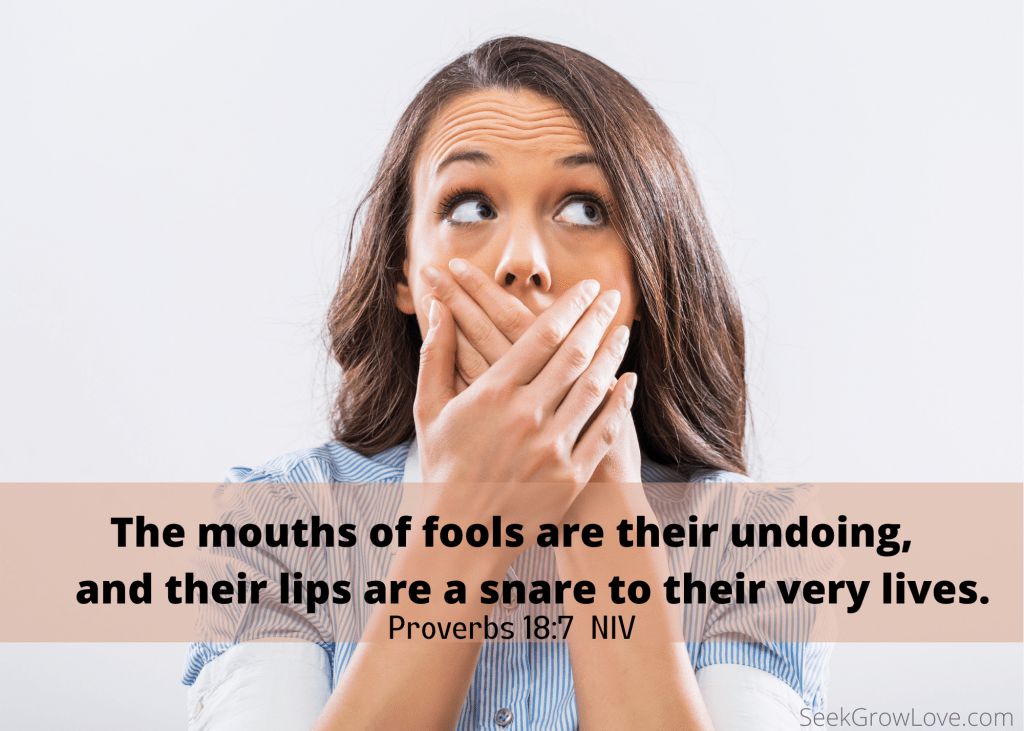
The mouth speaks out of that which fills the heart

Proverbs 17-18

The book of wisdom says, “Death and life are in the power of the tongue, and those who love it will eat its fruit.” (Proverbs 18:21). I understand this scripture to mean that we have the power to speak words to others unto life or words unto death, so we should choose our words carefully. If we love to talk, we better make sure our speech represents who we are because we become what we speak (eat your words). Our words are death and life to our own bodies.

I keep coming back to the issue of the heart. I know we need to have a heart for God if we desire to be with him and his son in the Kingdom of God. But how do we really know if we have a heart for God? The heart can be seen in the things we do that correspond with Jesus’ commandments (love) that we must do to enter in. Works are fruit but works can be deceiving if the heart behind the works is not motivated by love. Mathew 7:15 – 23 says:

15 “Beware of the false prophets, who come to you in sheep’s clothing, but inwardly are ravenous wolves. 16 You will know them by their fruits. Grapes are not gathered from thorn bushes nor figs from thistles, are they? 17 So every good tree bears good fruit, but the bad tree bears bad fruit. 18 A good tree cannot produce bad fruit, nor can a bad tree produce good fruit. 19 Every tree that does not bear good fruit is cut down and thrown into the fire. 20 So then, you will know them by their fruits.

21 “Not everyone who says to Me, ‘Lord, Lord,’ will enter the kingdom of heaven, but he who does the will of My Father who is in heaven will enter22 Many will say to Me on that day, ‘Lord, Lord, did we not prophesy in Your name, and in Your name cast out demons, and in Your name perform many miracles?’ 23 And then I will declare to them, ‘I never knew you; depart from Me, you who practice lawlessness.’

The people speaking to Jesus in this passage are shocked that Jesus doesn’t know them. The works mentioned in this passage do outwardly appear to be good fruit. Fruit can look good on the outside but can be rotten on the inside.

It can be difficult to identify bad fruit sometimes. If you really want to know if you’re producing good fruit or not, there is one particular fruit that’s pretty transparent, at least to the people we’re around the most. Our words are a good indication of what’s in our hearts.

Here’s a similar passage from Luke’s perspective in Luke 6:43-47:

43 For there is no good tree which produces bad fruit, nor, on the other hand, a bad tree which produces good fruit. 44 For each tree is known by its own fruit. For men do not gather figs from thorns, nor do they pick grapes from a briar bush. 45 The good man out of the good treasure of his heart brings forth what is good; and the evil man out of the evil treasure brings forth what is evil; for his mouth speaks from that which fills his heart.

46 “Why do you call Me, ‘Lord, Lord,’ and do not do what I say? 47 Everyone who comes to Me and hears My words and acts on them, I will show you whom he is like: 

Jesus has a little more to say about the mouth in Mathew 12:30-37:

  30“He who is not with Me is against Me; and he who does not gather with Me scatters.

      31“Therefore I say to you, any sin and blasphemy shall be forgiven people, but blasphemy against the Spirit shall not be forgiven. 32“Whoever speaks a word against the Son of Man, it shall be forgiven him; but whoever speaks against the Holy Spirit, it shall not be forgiven him, either in this age or in the age to come.

      33“Either make the tree good and its fruit good, or make the tree bad and its fruit bad; for the tree is known by its fruit. 34“You brood of vipers, how can you, being evil, speak what is good? For the mouth speaks out of that which fills the heart35“The good man brings out of his good treasure what is good; and the evil man brings out of his evil treasure what is evil. 36“But I tell you that every careless word that people speak, they shall give an accounting for it in the day of judgment. 37For by your words you will be justified, and by your words you will be condemned.”

James gives us even more clarity about the power of our speech in chapter 3:5-12:

So also the tongue is a small part of the body, and yet it boasts of great things. See how great a forest is set aflame by such a small fire! And the tongue is a fire, the very world of unrighteousness; the tongue is set among our body’s parts as that which defiles the whole body and sets on fire the course of our life, and is set on fire by hell. For every species of beasts and birds, of reptiles and creatures of the sea, is tamed and has been tamed by the human race. But no one among mankind can tame the tongue; it is a restless evil, full of deadly poison. With it we bless our Lord and Father, and with it we curse people, who have been made in the likeness of God; 10 from the same mouth come both blessing and cursing. My brothers and sisters, these things should not be this way. 11 Does a spring send out from the same opening both fresh and bitter water12 Can a fig tree, my brothers and sisters, bear olives, or a vine bear figs? Nor can salt water produce fresh.

Are you noticing as I am that some of the scariest, most convicting verses in the bible for a supposed Christian regard our speech? We must tame our tongue. To tame the tongue we must change our hearts.

By examining our own words, we can tell if we have a heart for God or not. I think it’s a really good indication about our destiny too. If you really want to know if you are producing good fruity speech, ask those who are closest to you how they perceive your speech towards them. If they aren’t on the receiving end of your good fruity speech, that’s not good. Be prepared with your response. If you don’t like what you hear, how will you respond? Choose your words wisely.

If you know you will have trouble responding with good fruit, prune your speech! You might find it helpful to practice not saying anything at all. Proverbs is chock-full of verses that tell us that there is wisdom in keeping our mouths closed. Even a silent fool is considered wise if he keeps his mouth shut. We can use that silent time to pray for wisdom and words of life and in the meantime, practice our sacrifice of praise to God, which is the fruit of our lips that give thanks to his name.

-Juliet Taylor

Today’s Bible reading passages can be read or listened to at BibleGateway here – 1 Chronicles 3-4 and Proverbs 18