The Peaceful Tongue

Job 22-24

Psalm 98

James 3

-Devotion by Makenna Landry, née Cisler, a 2021 ABC graduate. Makenna is a licensed pastor of the Church of God General Conference working to service God by teaching His word and supporting His people through all aspects of life. She has two children, a passion for helping people, and loves Disney. She spends her time writing and enjoys playing board games with friends and family. 

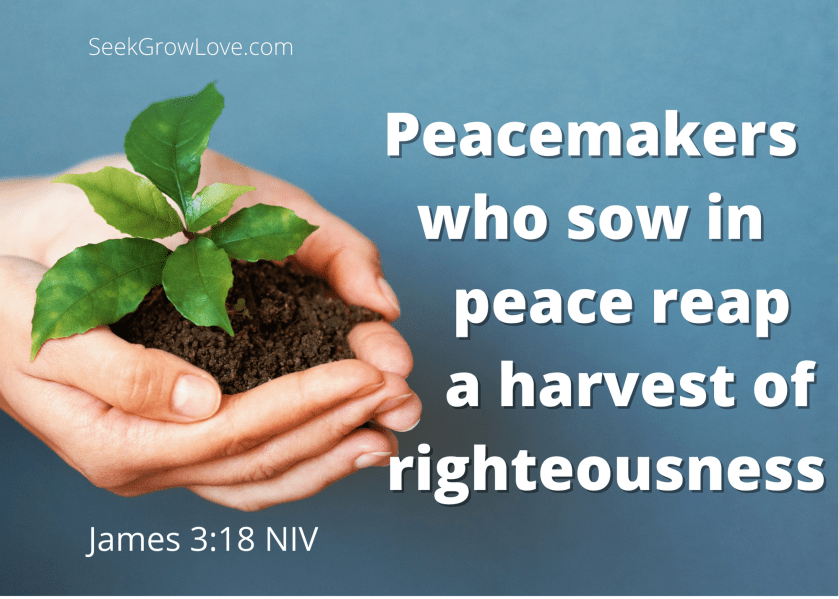
Key passage: “But the wisdom from above is first pure, then peaceable, gentle, open to reason, full of mercy and good fruits, impartial and sincere. And a harvest of righteousness is sown in peace by those who make peace.” James 3:17-18 (ESV) 

James 3 starts off by making the claim that not everyone can be a teacher. This is similar to the lesson I wrote on 1 Timothy that not everyone has the right to understand or focus not on scripture but on other things that tickle the ears of the listeners. This warning from James ties into the passage of Job. Job’s friends are trying their best to help Job and Job refutes them at every turn. At the end of Job, we see neither party was in the right. Job and his friends hold an example to us to be careful what we say to others. 

This is why the entire chapter of James 3 is so important. It teaches and guides us on how we can speak to others and what wisdom we should pass along to others. 

Let’s break down the chapter. 

James 3:5 (ESV) says, “So also the tongue is a small member, yet it boasts of great things. How great a forest is set ablaze by such a small fire!”

James is not telling his readers that people should have low self esteem and a bad view of themselves. He warns against pridefully honoring yourself over others. This can be seen more as bragging about your accomplishments instead of humbly celebrating victories. 

James 3:8 (ESV) but no human being can tame the tongue. It is a restless evil, full of deadly poison.

This verse is pretty doom and gloom! It feels helpless and like we are in an endless maze. So the question arises what does that mean? What does it mean that the tongue is a restless evil that cannot be tamed?

You know how sometimes when you stub your toe really hard you cry out in pain. Some people swear others have swear alternatives like “gosh darn it”, “holy cow”, or “great googly moogly” (can you imagine someone actually saying that besides Major Monogram from Phineas and Ferb ha!). All these phrases and words, a lot of us have used in place of curse words. But does that make it good to say it? When I was young and really into the phase of finding alternative expressions from curse words, my mom shared a piece of advice that still shapes how I speak and talk to this day: any word used poorly becomes a curse word. When our intention is to express anger and pain towards an individual or object our words are no longer from God but from the evil that plagues this world. 

No matter how hard one might try not to use the socially deemed words with bad meetings, our heart behind anything we say reflects whether or not the words are bringing glory to God. This might not even be the words we say but the tone we say it in! Our language abounds in ways that we can be rude to others. But, that doesn’t mean we can’t try. We will mess up and we won’t ever be perfect, yet we can be reminded by James to try our best to tame our tongue. 

What are some ways you might be cursing in your life? Do you use curse words, do you use alternative curses, or does your tone reflect one of judgment and anger? What are ways you can work towards taming your tongue?

When we consider shaping the things we say to God, we have to consider what would bring Him glory. That’s why I started the lesson with James 3:17-18. It brings into the view the focus of our hearts and words. Wisdom is not just something we impart to others but something that should be imbued in our very being. Our thoughts, words, and deeds should be done in wisdom. 

From James 3:17-18, what does it look like to have wisdom in the way that we speak?

Psalm 98 is a great reminder of the heart behind our words to God. James is specifically focusing on our words to others, but Psalm 98 can be an example of the heart behind the words we say. 

Have you ever heard someone say, “I can’t sing so I make a joyful noise”? I know many individuals who have said it to me and they are some of the most joyful worshipers I have ever seen. To give them credit they also can sing a lot better than they think.  But worship isn’t about perfection. It’s not about a big band, special lighting, perfect pitch and harmony. 

When we worship God with Him as the focus, we are taming our tongue. The more we align ourselves with God’s goodness, faithfulness, and lovingkindness the more our words are shaped to reflect Him. Singing praise to God fills us with holy thoughts and focuses our attention on the one we should be following. 

Further QUESTIONS TO PONDER:

How can worship help you tame the tongue?

What are ways you can bring glory to God through your words?

How did you relate to the individuals in the book of Job in today’s reading?

PRAY:

Father in heaven may glory be brought to You in my words and deeds. Help me tame my tongue and speak gently to those around me. You have made all things and Your love endures forever. Be gracious to me and show me how to be gracious to those around me. In the name of Jesus Christ, my savior and mediator, amen. 

Perfect in God’s Eyes

Exodus 40

February 15

Who here is perfect? No one? Being perfect in society is hard and being a Christian in society is probably even harder. Society has built a whole view of a perfect person. In school you’re perfect if you have a 4.0 gpa, are a scholar athlete, and are participating in 20 billion extracurricular activities. Being a perfect person at work is doing your job to the “T”, having perfect attendance, being dependable, and maybe even being 20 different people at one time. Life is
hard.

As Christians our job is to set an example and show God’s work. Easy, right?

Exodus 40. Building the perfect tabernacle. Building a place fit for God.

Imagine being Moses for a second. This man not only was the one who got to come down from a mountain with God’s commands, but he also got to make this tabernacle a perfect place for God.

Now we can’t be Moses, because God has created us on our own path. But we can work at making our bodies perfect.

James 3:2 “We all stumble in many ways. Anyone who is never at fault in what they say is perfect, able to keep their whole body in check.” James 3 is about taming your tongue and your body. I relate these two together. Though I’m not creating a tabernacle, I can create a holy body.

-Genesis Dylewski

Questions for Reflection and Discussion

  1. Many of the chapters in Exodus that we didn’t specifically read this week were giving detailed directions for how to make the tabernacle according to God’s plan. Go back and read Exodus 25:1-9. What was the purpose of the tabernacle? How did Moses get the supplies needed? Why so many directions throughout the rest of Exodus?
  2. In Exodus 40 how many times do we read Moses did, “as the LORD commanded him”? Why is that important?
  3. What directions are given to us throughout God’s Word for creating ourselves to be a perfect place for God?

The mouth speaks out of that which fills the heart

Proverbs 17-18

The book of wisdom says, “Death and life are in the power of the tongue, and those who love it will eat its fruit.” (Proverbs 18:21). I understand this scripture to mean that we have the power to speak words to others unto life or words unto death, so we should choose our words carefully. If we love to talk, we better make sure our speech represents who we are because we become what we speak (eat your words). Our words are death and life to our own bodies.

I keep coming back to the issue of the heart. I know we need to have a heart for God if we desire to be with him and his son in the Kingdom of God. But how do we really know if we have a heart for God? The heart can be seen in the things we do that correspond with Jesus’ commandments (love) that we must do to enter in. Works are fruit but works can be deceiving if the heart behind the works is not motivated by love. Mathew 7:15 – 23 says:

15 “Beware of the false prophets, who come to you in sheep’s clothing, but inwardly are ravenous wolves. 16 You will know them by their fruits. Grapes are not gathered from thorn bushes nor figs from thistles, are they? 17 So every good tree bears good fruit, but the bad tree bears bad fruit. 18 A good tree cannot produce bad fruit, nor can a bad tree produce good fruit. 19 Every tree that does not bear good fruit is cut down and thrown into the fire. 20 So then, you will know them by their fruits.

21 “Not everyone who says to Me, ‘Lord, Lord,’ will enter the kingdom of heaven, but he who does the will of My Father who is in heaven will enter22 Many will say to Me on that day, ‘Lord, Lord, did we not prophesy in Your name, and in Your name cast out demons, and in Your name perform many miracles?’ 23 And then I will declare to them, ‘I never knew you; depart from Me, you who practice lawlessness.’

The people speaking to Jesus in this passage are shocked that Jesus doesn’t know them. The works mentioned in this passage do outwardly appear to be good fruit. Fruit can look good on the outside but can be rotten on the inside.

It can be difficult to identify bad fruit sometimes. If you really want to know if you’re producing good fruit or not, there is one particular fruit that’s pretty transparent, at least to the people we’re around the most. Our words are a good indication of what’s in our hearts.

Here’s a similar passage from Luke’s perspective in Luke 6:43-47:

43 For there is no good tree which produces bad fruit, nor, on the other hand, a bad tree which produces good fruit. 44 For each tree is known by its own fruit. For men do not gather figs from thorns, nor do they pick grapes from a briar bush. 45 The good man out of the good treasure of his heart brings forth what is good; and the evil man out of the evil treasure brings forth what is evil; for his mouth speaks from that which fills his heart.

46 “Why do you call Me, ‘Lord, Lord,’ and do not do what I say? 47 Everyone who comes to Me and hears My words and acts on them, I will show you whom he is like: 

Jesus has a little more to say about the mouth in Mathew 12:30-37:

  30“He who is not with Me is against Me; and he who does not gather with Me scatters.

      31“Therefore I say to you, any sin and blasphemy shall be forgiven people, but blasphemy against the Spirit shall not be forgiven. 32“Whoever speaks a word against the Son of Man, it shall be forgiven him; but whoever speaks against the Holy Spirit, it shall not be forgiven him, either in this age or in the age to come.

      33“Either make the tree good and its fruit good, or make the tree bad and its fruit bad; for the tree is known by its fruit. 34“You brood of vipers, how can you, being evil, speak what is good? For the mouth speaks out of that which fills the heart35“The good man brings out of his good treasure what is good; and the evil man brings out of his evil treasure what is evil. 36“But I tell you that every careless word that people speak, they shall give an accounting for it in the day of judgment. 37For by your words you will be justified, and by your words you will be condemned.”

James gives us even more clarity about the power of our speech in chapter 3:5-12:

So also the tongue is a small part of the body, and yet it boasts of great things. See how great a forest is set aflame by such a small fire! And the tongue is a fire, the very world of unrighteousness; the tongue is set among our body’s parts as that which defiles the whole body and sets on fire the course of our life, and is set on fire by hell. For every species of beasts and birds, of reptiles and creatures of the sea, is tamed and has been tamed by the human race. But no one among mankind can tame the tongue; it is a restless evil, full of deadly poison. With it we bless our Lord and Father, and with it we curse people, who have been made in the likeness of God; 10 from the same mouth come both blessing and cursing. My brothers and sisters, these things should not be this way. 11 Does a spring send out from the same opening both fresh and bitter water12 Can a fig tree, my brothers and sisters, bear olives, or a vine bear figs? Nor can salt water produce fresh.

Are you noticing as I am that some of the scariest, most convicting verses in the bible for a supposed Christian regard our speech? We must tame our tongue. To tame the tongue we must change our hearts.

By examining our own words, we can tell if we have a heart for God or not. I think it’s a really good indication about our destiny too. If you really want to know if you are producing good fruity speech, ask those who are closest to you how they perceive your speech towards them. If they aren’t on the receiving end of your good fruity speech, that’s not good. Be prepared with your response. If you don’t like what you hear, how will you respond? Choose your words wisely.

If you know you will have trouble responding with good fruit, prune your speech! You might find it helpful to practice not saying anything at all. Proverbs is chock-full of verses that tell us that there is wisdom in keeping our mouths closed. Even a silent fool is considered wise if he keeps his mouth shut. We can use that silent time to pray for wisdom and words of life and in the meantime, practice our sacrifice of praise to God, which is the fruit of our lips that give thanks to his name.

-Juliet Taylor

Today’s Bible reading passages can be read or listened to at BibleGateway here – 1 Chronicles 3-4 and Proverbs 18

Worship God with your Speech

1 Thess 5 18

Free theme week: Worship
Chapter reading for the day: I Thessalonians 5

The most obvious way people communicate is through speech. Much like thinking,
because we talk so much, and it is such an integral part of our life experience we often
don’t think about what we say. We live in an age where being heard is more important
than the quality and validity of what is being said. When it comes to speech and talking
do you worship God? Is your tongue obedient to Jesus? Jesus often only presents two
options when it comes to examining your life. You’re either on the broad road that leads
to death or you’re on the narrow road that leads to life. You’re either a good tree that
produces good fruit or you’re an evil tree that produces evil fruit. You either serve God
or wealth. You either hear the words of Jesus and don’t act on them or you hear the
words of Jesus and act on them. Ask yourself,  “Do the words I speak honor God and
Jesus or do they not?”
God and Jesus care about what comes out of your mouth. What you say has power and
consequences. Because of this truth the Bible has a lot to say about words and speech
conduct:
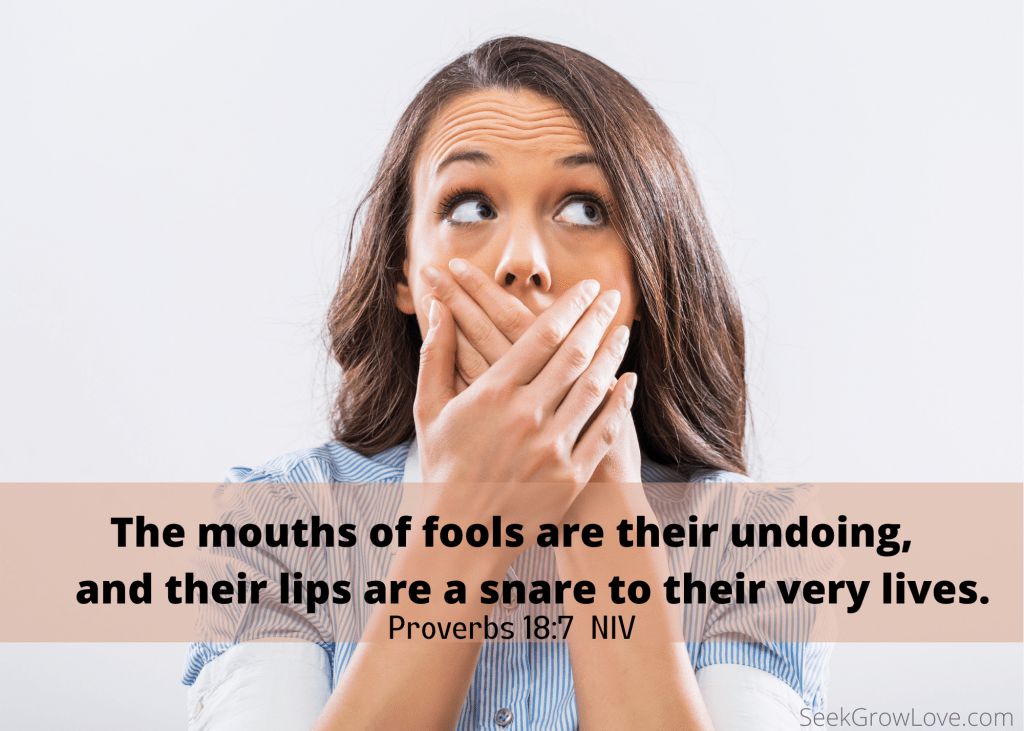
“An evil man is ensnared by the transgression of his lips, but the righteous will escape
from trouble” – Proverbs 12.13
“The one who guards his mouth preserves his life; the one who opens wide his lips
comes to ruin” – Proverbs 13.2
“Death and life are in the power of the tongue, and those who love it will eat its fruit” –
Proverbs 18.21
“You brood of vipers, how can you being evil, speak what is good? For the mouth
speaks out of that which fills the heart…But I tell you that every careless word that
people speak, they shall give an accounting for it in the day of judgement. For by your
words you will be justified, and by your words you will be condemned” – Matthew
12.34,35,36
“Let no unwholesome word proceed from your mouth, but only such a word as is good
for edification according to the need of the moment…” – Ephesians 4.29
“There must be no filthiness and silly talk or coarse jesting, which are not fitting, but
rather giving of thanks.” – Ephesians 5.4
“In everything give thanks; for this is the will of God for you in Christ Jesus” – I
Thessalonians 5.18
“No one can tame the tongue; it is a restless evil and full of deadly poison. With it we
bless the Lord and Father and with it we curse men…from the same mouth come
blessing and cursing, my brethren, these thing ought not to be this way” – James 3.8-9
We can see that the Bible teaches about speech in different ways. Sometimes the
Bible teaches using wisdom and starts with the point that the tongue is powerful and
wisdom should be used when speaking. Jesus teaches us that what we say we will beheld accountable to. And the Bible teaches about positive and negative speech. We
should abstain from “unwholesome” words that don’t edify or encourage others. This
could be constant negative speaking, sarcasm, curse words, unnecessary criticism, etc.
Whereas we are urged to be grateful in our speech and speak life and uplift others.
Jesus says that out of the heart the mouth speaks. What does your speech say about your
heart condition? Do your words worship God or do your words sound like the world?
God wants all of you including your speech. Glorify God with your words. Speak life and
not death.
-Jacob Rohrer